Nikola Tesla: Inventor, Humanist and the Price of Principle
Tesla is extraordinary enough without myth: polyphase AC, the induction motor, remote control and wireless experiments are documented. But Wardenclyffe, royalties, radio, “free energy” and his humanist image require a more exacting look.
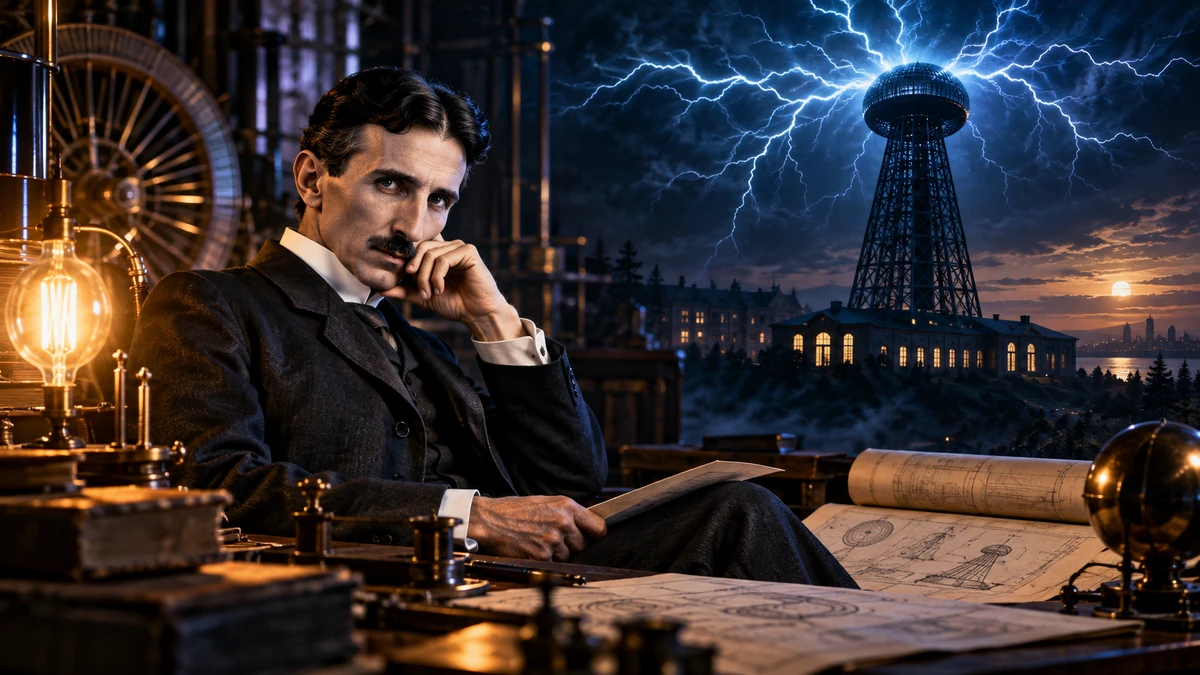
Nikola Tesla became more than a historical inventor. In popular culture he is simultaneously a symbol of genius, an overlooked visionary, an opponent of corporate power, and an almost mythical figure who supposedly already possessed solutions for free energy, radio, robotics and a world without war. Part of that image has a solid historical core. Part is later legend, and the legend makes Tesla less interesting rather than more.
The documented Tesla is extraordinary enough without additions. His work on polyphase alternating-current systems and the induction motor helped transform electricity from a local service into infrastructure that could transmit power over long distances and turn it efficiently into mechanical work. He experimented with high frequencies, wireless transmission, remote control and the idea of a global communications system decades before such technologies became ordinary.
But Tesla did not create in a vacuum. His motors needed Westinghouse engineers, transformers, generators, capital, standardization and power stations. Wardenclyffe was not a finished technology that someone simply switched off; it was a high-risk development project that failed to reach either its technical or business goal. Even the famous story that Tesla, in a moment of pure selflessness, tore up a contract and surrendered unimaginable millions is historically less simple than it is usually told.
This article therefore neither diminishes nor canonizes Tesla. It examines the difference between a patent, a working system, a vision, a business failure and a later myth — and asks what it means to call someone a humanist when his efforts for welfare and peace stand beside ideas that we now rightly recognize as coercive and inhumane.
From Smiljan to the rotating magnetic field
Tesla was born in 1856 in Smiljan, then in the Austrian Empire and now in Croatia, into a Serbian Orthodox family. He studied at the Graz Polytechnic but did not complete a degree. He worked in Budapest and later for the Continental Edison Company in Europe, then moved to New York in 1884 and briefly worked at Edison Machine Works. Later biographies often frame his relationship with Edison as a personal duel between two geniuses, but the actual 'war of currents' was primarily an industrial contest over networks, patents, safety, capital and companies.
Tesla's central technical breakthrough was a polyphase alternating-current system using a rotating magnetic field. U.S. patents granted in 1888, including Nos. 381,969 and 382,280, described motors and transmission systems in which phase-shifted currents produced a moving magnetic field. This enabled robust motors without a mechanical commutator and supplied an important missing element in the wider development of practical AC systems.
The word wider matters. Tesla did not 'invent alternating current.' Transformers, alternators and AC distribution were already being developed by several European and American researchers and companies. Tesla's original contribution lay chiefly in the polyphase system and motor that extended AC from efficient transmission and lighting into efficient industrial motive power.
Westinghouse: when an invention becomes infrastructure
In July 1888 Tesla's business partners Charles Peck and Alfred Brown reached an agreement with Westinghouse for key Tesla patents. Historical records summarized in W. Bernard Carlson's research give terms of $25,000 in cash, $50,000 in notes, and a royalty of $2.50 per horsepower on motors sold. Tesla then spent roughly a year consulting for Westinghouse as the system was adapted for commercial use.
This exposes something that biographies of the solitary genius often hide. Between a patent and an electric grid lies an enormous amount of engineering. Westinghouse was already developing transformers and AC networks; William Stanley and other engineers were solving voltage conversion, generators, metering, standards and reliability. Tesla's patents were essential, but they became historically consequential as part of a system of people, capital and infrastructure.
That does not reduce Tesla's contribution. It clarifies why he mattered. An inventor is not important because he does everything alone, but because at the right moment he creates a solution that lets others build something larger. In Tesla's case, the rotating magnetic field and polyphase motor fit the emerging AC network.
Chicago and Niagara: where myth gives way to measurable success
Westinghouse supplied electric lighting for the 1893 World's Columbian Exposition in Chicago. The fair became a major public demonstration of alternating current and strengthened confidence in a system that only a few years earlier had been portrayed as too dangerous for broad use. Tesla also staged spectacular high-frequency demonstrations there, but the historical importance was not just theatrical: AC was demonstrating that it could become an industrial standard.
An even larger test came at Niagara Falls. The project had to convert hydroelectric power into electricity and deliver it to users who were not beside the generating station. Westinghouse generators and the polyphase system rooted in Tesla's work began operating in the mid-1890s; by 1896 power was transmitted to Buffalo. Large-scale AC distribution had been demonstrated in practice.
This is the strongest answer to the question of how much of Tesla's legacy is real. There is no need to rely on rumors about secret devices. Motors, patents, power stations and networks existed and worked. Tesla was one of the central figures in a technological transition that turned electric power into scalable infrastructure.
High frequency, remote control and radio without a single father
After his early success in power engineering, Tesla increasingly focused on high-frequency and high-voltage phenomena. Patents from 1891 describe electrical conversion and distribution at high frequencies; devices now associated with the Tesla coil enabled very high voltages, resonant effects and spectacular discharges. This work influenced radio engineering, lighting and experimental electrical technology, although not every Tesla prediction became a practical technology.
In 1898 he publicly demonstrated a radio-controlled boat and patented a system for controlling a moving vessel at a distance. This was one of his most directly futuristic achievements: not merely a wireless signal, but a signal that commanded a machine. Tesla was already thinking about automata and devices operating without a person aboard — an early point in the history of remote control and robotics.
Radio requires similar precision. Tesla patented resonant wireless systems and made important contributions to the prehistory of radio communication, but the U.S. Supreme Court in 1943 did not simply proclaim Tesla the 'true inventor of radio.' In Marconi Wireless v. United States it evaluated specific later Marconi patent claims and found that certain elements had already been shown by Stone, Lodge and Tesla. Marconi's historical role in successful radiotelegraphy was not erased, while Tesla's prior work remained significant.

Wardenclyffe: a large vision, an unfinished proof
At the turn of the century Tesla wanted to scale his wireless experiments to a planetary system. J. P. Morgan contributed roughly $150,000 to the Wardenclyffe project on Long Island. Stanford White designed the laboratory building, and beside it rose a wooden tower about 187 feet high. Tesla described a global system carrying messages, voice, images and eventually electric power without wires.
The project faltered at exactly the point where vision has to become an engineering and business system. Costs increased, Tesla expanded the original ambition, Marconi demonstrated a transatlantic radio signal in 1901 using a much simpler arrangement, and Morgan did not provide the additional financing Tesla wanted. Wardenclyffe never reached planned commercial operation; Tesla lost the heavily mortgaged property in 1915, and the tower was dismantled in 1917 to satisfy debts.
None of this means every Tesla idea was wrong. Modern short-range wireless power transfer is entirely real. But Wardenclyffe is not evidence that a functioning system for near-lossless global transfer of large amounts of power had already been completed. Nor does 'wireless energy' mean 'free energy': Tesla's own patents contain a transmitter, an electrical source, resonant components and a receiver. The network was intended to remove wires, not the conservation of energy.
Money and the legend of the torn contract
One of the most popular Tesla stories says that George Westinghouse asked the inventor to surrender his royalties because the company would otherwise collapse, and Tesla, out of friendship, tore up the contract and discarded a fortune worth millions. The core of the story is real: Westinghouse came under severe financial pressure in the early 1890s, and the original royalty arrangement was ended. The dramatic version involving a single sheet of paper and already assured millions is much less securely documented.
The IEEE biography cautiously calls the contract-tearing story supposed, while popular biographies, PBS and Smithsonian presentations often tell it more directly. Carlson's reconstruction of business records notes that in 1891 Tesla's motors had not yet been commercialized on a mass scale and the imagined future millions in royalties were not then a guaranteed cost. A more plausible interpretation is that financiers restructuring Westinghouse wanted to remove long-term patent obligations, and Tesla agreed because he needed the company that could actually develop his system.
Tesla's later financial difficulties should therefore not be reduced to a single noble sacrifice. They reflected expiring early patents, the 1895 laboratory fire, costly experiments, dependence on individual patrons, the failure of Wardenclyffe, changing markets, and Tesla's own tendency to open a new technical horizon rather than turn the previous one into a stable business.
A humanist by intention — but not without a dark boundary
Tesla's own writings contain a strong humanitarian tone. In his 1919 autobiography he described the ultimate purpose of invention as harnessing the forces of nature to human needs. In The Problem of Increasing Human Energy from 1900 he discussed health, food, water, solar and hydro power, and ways to reduce forces that impede human development. His global wireless system was also imagined as a way to shrink distance between people and make knowledge more rapidly accessible.
Tesla also repeatedly spoke against war. Late in life he presented his proposed 'teleforce' as a defensive system that would make attack futile. He never demonstrated it as an operational weapon, so it belongs in the category of proposal and technical claim rather than lost completed technology. But the goal he stated was deterrence: to give nations a defense that would remove the logic of attack.
The word humanist, however, cannot become absolution. In a 1935 Liberty interview Tesla also endorsed coercive eugenics, sterilization of people he deemed 'unfit', and stricter controls on reproduction. Such ideas were widespread among influential scientists and institutions in the first half of the twentieth century, but historical context explains their presence rather than making them ethically acceptable. Tesla could sincerely seek human welfare while also supporting policies that violate individual dignity and bodily autonomy.
The price of principle and a legacy without a cult
Tesla's life is tempting to compress into a morality tale: pure genius against a greedy system, visionary against bankers, goodness against Edison, free energy against corporations. The story is emotionally effective but hides what is most instructive. Innovation is a meeting of ideas, measurement, patents, people, money, infrastructure and timing. Tesla won some of those meetings spectacularly; in others he overestimated the maturity of an idea or underestimated the institutions needed to scale it.
If we speak of a 'price of principle,' it is more accurate to say that Tesla repeatedly chose his vision of the future over a safer business path. That enabled experiments a more conservative engineer might never have attempted, while also exposing him to financial collapse. Some principles were admirable, some beliefs were wrong, some technical intuitions were extraordinary, and some late claims remained unverified. Once history traps a person inside a single label, the person becomes a symbol rather than a human being.
Tesla's real legacy is therefore stronger than the cult around him. The polyphase AC system, induction motor, high-frequency experimentation, remote control and important wireless patents are verifiable achievements. Wardenclyffe is a verifiable failure of great ambition. His writings about the future contain both striking foresight and serious error. The most fitting tribute to Tesla is not to believe every story about him, but to apply the discipline that good science requires: separate the demonstrated from the possible, the possible from the desired, and the person from the myth.
Sources and further reading
- U.S. Patent 381,969 (Nikola Tesla, 1888) — Electro-Magnetic Motor: rotating magnetic field and polyphase motor principle.
- U.S. Patent 382,280 (Nikola Tesla, 1888) — Electrical Transmission of Power: polyphase power-transmission system.
- U.S. Patent 390,413 (Nikola Tesla, 1888) — System of Electrical Distribution.
- Engineering and Technology History Wiki (IEEE) — Tesla’s Electro-magnetic motor: 1888 patent, AIEE presentation and Westinghouse acquisition.
- Engineering and Technology History Wiki (IEEE) — Nikola Tesla biography: education, Edison, Westinghouse, AC work, later career and Edison Medal.
- IEEE Milestones Wiki — Tesla 1899 proposal, citing W. Bernard Carlson on the July 1888 Westinghouse agreement and royalty terms.
- U.S. National Park Service — The Origins of Hydroelectric Power: Tesla/Westinghouse AC system and Niagara-to-Buffalo transmission.
- U.S. National Park Service — Wardenclyffe Laboratory: Tesla’s work, World Wireless System, financial failure and loss of the property.
- Tesla Science Center at Wardenclyffe — History of Wardenclyffe: construction, global communications/power vision and historical site context.
- Tesla Science Center at Wardenclyffe — Tesla’s Wireless Power: Colorado Springs experiments, Wardenclyffe design and stated wireless-power goal.
- U.S. Patent 462,418 (Nikola Tesla, 1891) — Method of and Apparatus for Electrical Conversion and Distribution: high-frequency electrical work.
- U.S. Patent 454,622 (Nikola Tesla, 1891) — System of Electric Lighting: high-frequency/high-potential currents for lighting effects.
- U.S. Patent 613,809 (Nikola Tesla, 1898) — Method of and Apparatus for Controlling Mechanism of Moving Vessels or Vehicles: radio remote control.
- U.S. Patent 645,576 (Nikola Tesla, 1900) — System of Transmission of Electrical Energy.
- U.S. Patent 649,621 (Nikola Tesla, 1900) — Apparatus for Transmission of Electrical Energy.
- Cornell Legal Information Institute — Marconi Wireless Telegraph Co. v. United States, 320 U.S. 1 (1943): patent ruling involving prior work by Stone, Lodge and Tesla.
- Project Gutenberg — Thomas Commerford Martin, The Inventions, Researches and Writings of Nikola Tesla (1894): contemporary compilation of Tesla lectures and technical work.
- Wikisource — Nikola Tesla, My Inventions (1919): Tesla’s autobiographical account and philosophy of invention.
- Tesla Collection — Nikola Tesla, The Problem of Increasing Human Energy, Century Magazine (June 1900): primary historical article.
- IEEE Xplore — Wireless Power Transfer: Survey and Roadmap (2015): modern inductive, resonant and radiative wireless-power technologies and their distance/efficiency constraints.
- Tesla Universe — A Machine to End War, Liberty (9 February 1935): historical transcription of Tesla’s late interview on peace, technology, future society and eugenics.
- Smithsonian Magazine — Tesla at the Smithsonian: engineering legacy, Westinghouse relationship, later claims and eugenics discussion.
- Smithsonian Magazine — Nikola Tesla the Eugenicist: historical discussion of the 1935 Liberty interview and coercive eugenic views.
- Smithsonian Magazine — Nikola Tesla and the Tower That Became His “Million Dollar Folly”: Wardenclyffe, late-career claims and financial decline.
- PBS American Experience — Tesla: documentary transcript covering Westinghouse, AC commercialization, royalties and Tesla’s later wireless research.