Energy: From Consumer to Energy Cooperation
This article shows how local generation, energy sharing, storage, flexible demand and community governance can increase resilience without the illusion of complete energy self-sufficiency.
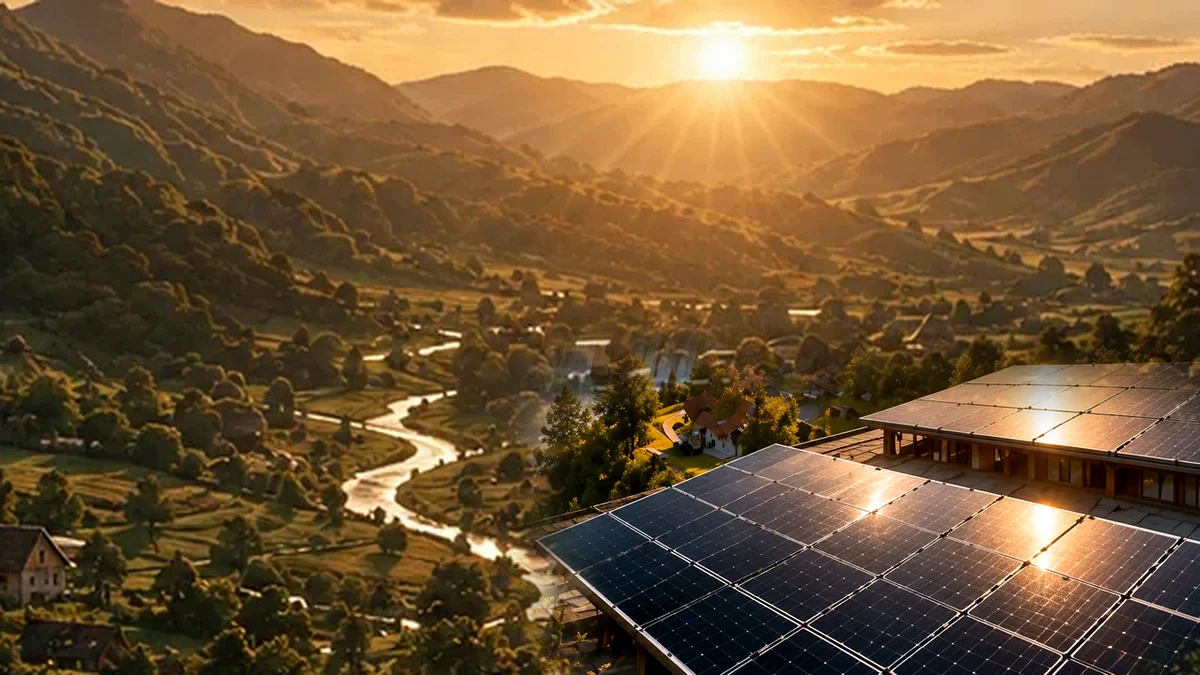
Electricity is often experienced as something that simply comes out of a socket. We pay a bill, a supplier provides energy, the grid carries it, and the user remains at the end of the chain. That model is convenient, but it can teach people to think of energy only as a service delivered by somebody else. this article reverses the perspective: a community does not have to remain only a consumer. It can also become a producer, an owner of part of the infrastructure, a manager of demand, a participant in storage and a partner of the grid.
“Local Sovereignty: How to Build Resilience Without Isolation” already showed that local sovereignty is not the same as isolation. “Who Takes Care of the Commons?” opened the question of governing shared resources, “How Do We Finance Shared Functions Without Automatic Centralization?” the financing of common functions, and “Local Economy Without Autarky” the boundary between local capability and autarky. Energy brings all four questions together: generation can be local, infrastructure can be shared, financing is long-term, and physical balance has to be maintained in real time.
The real question is not “How do we disconnect from the grid?” but: how much generation, flexibility, reserve capacity and decision-making can be brought closer to users without losing the benefits of a wider electricity system?
Energy resilience is not the same as energy self-sufficiency
Energy self-sufficiency sounds attractive, but it can be a misleading target. Solar generates when the sun shines, while demand may rise in the evening, in winter or during several days of poor weather. Wind has a different profile, hydropower depends on flows, batteries have finite capacity, and every source has maintenance needs, failure modes and physical limits. Resilience therefore does not mean needing nothing from anyone else. It means having several real pathways when one fails.
For a community, it is more useful to know which services are critical, which resources are available, how much demand can be reduced or shifted and how long essential functions can continue during disruption. A school, clinic, pumping station, cold store, communications system and household do not have identical requirements. An energy plan that looks only at annual kilowatt-hours can miss the exact moment when energy matters most.
This distinction also matters for material independence. Local generation can reduce exposure to a single supplier or price shock. It does not remove the need for reserves, maintenance, networks, alternative sources or rules for sharing costs. Autonomy is better measured by the capacity to act than by the myth of complete separation.
From passive consumer to active participant
Electricity systems were long built mainly as one-way chains: large generation units, transmission, distribution and finally the customer. The picture is now more diverse. A household can generate on its roof, a business can shift demand, a battery can store electricity, several users can share generation, and an association or cooperative can invest jointly in generation and services.
EU law therefore recognises more than the conventional customer: it includes active customers, self-consumption, energy sharing, citizen energy communities and renewable energy communities. These terms are not perfect synonyms and their practical implementation depends on national rules, but the direction is clear: users can become active parts of the system without losing their rights as final customers.
Community energy is also more than a group purchase of solar panels. It can include shared generation, energy sharing, batteries, managed vehicle charging, demand response, building renovation, local heat solutions or a combination of several measures. The transition from consumption to cooperation begins when a group stops buying energy only as a finished product and starts deliberately managing part of its energy needs, risks and assets.
Local generation is a capability, not the whole system
Local generation has several genuine advantages. Some energy is produced closer to demand, local users can become co-owners of a productive asset, part of the financial flow can remain in the community, and new installations diversify supply. In Slovenia, installed solar capacity reached 1,571 MW by the end of 2025, while the government also reported more than 500 community self-supply solar installations with a combined capacity of 36 MW. Group models are therefore no longer only theoretical.
But annual generation does not tell us how much electricity is useful at a particular moment. Ten homes with solar panels can all export at midday and all need outside power in the evening. If everyone has the same generation profile, adding more identical units does not automatically create much temporal diversity. A good project therefore has to look at load profiles, seasonality, local grid constraints and flexibility options, not only installed capacity.
Locality is best understood as an additional capability: more knowledge, more locally owned assets, more options for cooperation and potentially less exposure to one external point of failure. Once local generation becomes a demand for complete self-sufficiency, communities can end up building expensive reserves for events that wider networks can often handle more effectively. “When is larger scale genuinely necessary?” will later examine when wider scale becomes necessary; this article keeps a simpler rule: a local resource should increase options, not reduce the number of connections.
The grid is not the opposite of local sovereignty
The electricity grid is often portrayed as a symbol of central dependence. Physically, however, it also performs another role: it connects places with different generation and consumption profiles, allowing a surplus in one location to become usable energy elsewhere. When a local generator is insufficient, the connection provides access to other sources; when it produces too much, the grid enables export or sharing.
As solar, wind, batteries, electric vehicles and heat pumps expand, grids are becoming more important, not less. The IEA warns that grid capacity has already become a bottleneck for connecting new generation, demand and storage in many regions. Distributed generation therefore does not remove the need for shared planning of connections, protection, voltage, flows and reserves.
For local sovereignty, a more useful question is: do we depend on one point, or do we belong to a network of reciprocal options? A good system can combine local generation, local flexibility and wider interconnection. In that model the grid is not a master over the community but shared infrastructure whose rules, costs and access should be understandable, reviewable and proportionate.
Storage is not a magic battery for every problem
When generation and demand do not line up in time, the quick answer is often: add a battery. Batteries are extremely useful, but they solve a particular class of problems. The IEA describes battery storage as especially valuable for short-duration flexibility, often around one to eight hours of continuous discharge. That can shift solar output from midday into the evening, reduce peaks, stabilise the system or provide short backup, but it is not the same thing as multi-day or seasonal energy reserves.
Flexibility therefore has several forms. Some demand can move in time: a water heater can run earlier, cold storage can use thermal inertia, an electric vehicle can charge when there is a surplus, and some commercial or industrial loads can be scheduled differently. IEA work in 2025 and 2026 highlights the growing importance of demand response as a flexibility resource that can reduce peaks and make better use of existing generation and networks.
Storage also includes thermal storage, pumped hydropower and other technologies, each suited to different scales and time horizons. A mature energy community therefore asks not only “How much battery do we need?” but “Which flexibility problem are we actually solving, and is it better to shift demand, store energy, strengthen the connection or combine several options?”
Resilience during outages requires designed islanding
One of the most common misconceptions is that rooftop solar automatically keeps the power on during a grid outage. Ordinary grid-connected systems generally shut down during a major outage for safety reasons. For local generation to power a home or group of buildings without the main grid, the installation must be designed for it, with suitable inverters, storage or another source, protection systems and a safe way to separate from the wider network.
A microgrid goes a step further. It is a group of connected loads and local energy resources that can, when properly designed, act as one controllable unit and disconnect from the larger grid when needed. Such systems are especially relevant where continuity matters: critical public services, communications, pumping, shelters or local health infrastructure.
Resilience does not necessarily mean powering everything during an outage. It is often more practical to identify critical loads first: what must operate for the first hours, what has to remain available for a day, and what can temporarily stop. That makes backup systems smaller, cheaper and more purposeful. Energy resilience starts by ranking needs, not by purchasing technology.
Community energy is also about ownership and rules
Technology alone does not tell us who has power. A solar installation can be owned by households, a municipality, a cooperative, a company, an investment fund or a mixture of stakeholders. Two technically identical projects can therefore create very different relationships: in one, users participate in decisions and benefits; in another, they are only tenants of roof space or customers of a service.
The EU framework for renewable energy communities emphasises open and voluntary participation, autonomy and environmental, economic or social community benefits rather than financial profit as the primary purpose. That does not guarantee that every project will be fair, but it provides a useful institutional test. A community should know who may join, who votes, who carries risk, how benefits are distributed, how a member can leave and what happens if the project underperforms.
Access matters as well. If participation requires high upfront capital, projects can unintentionally favour people who already have roofs, savings and stable incomes. More inclusive models can use collective ownership, different share sizes, municipal or cooperative finance, targeted participation of tenants and vulnerable households, and clear rules for distributing savings. Energy democracy is not the number of panels. It is the relationship between ownership, information, risk and the right to decide.
A practical community energy audit
This article can be turned into a practical map. For a town, neighbourhood, community or apartment building, try to answer the following questions:
- Which energy services are critical? Heating, cooling, water pumping, communications, cold chains, lighting, mobility or medical equipment?
- What is our demand profile? Not only how much energy is used in a year, but when daily and seasonal peaks occur?
- Which local resources do we realistically have? Solar, wind, biomass, waste heat, geothermal energy or another source — and what are their actual limits?
- Who can generate and who currently cannot? Do tenants, apartment residents and small businesses have a route to participate?
- What demand can move in time? Vehicle charging, water heating, cooling, selected business processes or other flexible loads?
- Which problem would storage solve? An evening peak, a short outage, a grid constraint or something else — and how many hours of support are actually needed?
- What happens when the grid fails? Can local generation genuinely operate, which loads would be supplied and who manages the transition?
- Who owns the assets and who decides? What are the rules for entry, voting, finance, benefit sharing, exit and responsibility for debt?
- Where do we need the wider grid? Seasonal balancing, backup sources, exporting surpluses, mutual aid during failure or specialised system services?
- What is the lowest-risk first step? Metering, an energy audit, joint procurement, demand shifting, a small shared project or a feasibility study?
Such an audit prevents a community from starting with the most visible technology and only later searching for a problem that it might solve. Needs first, then data, then rules, and only then technology.
From consumer to a cooperative energy system
Energy freedom is not the moment when the last cable to the wider grid is cut. A more useful form of freedom is the ability to understand our own demand, keep part of generation or flexibility under closer control, know our critical dependencies and negotiate with others from a more informed position.
A community that produces part of its energy, can shift some demand, has a deliberate reserve strategy, understands its grid constraints and governs a shared investment transparently is less passive even while remaining connected to a large system. That connection can itself be part of resilience: local capability helps during wider disruption, while the wider network helps when local generation is temporarily weak or fails.
The goal is therefore not an energy island but a polycentric system: many active users and communities, enough local capability for genuine choice, and enough wider coordination to keep electricity reliable when sunlight, wind, demand or a particular device does not follow our plan.
Sources and further reading
- European Commission. Energy communities — current EU overview of citizen-driven energy action and the scale of energy communities in the EU. Source
- European Commission (2026). Citizens Energy Package — guidance on empowering energy communities, self-consumption and citizen participation. Source
- European Union. Directive (EU) 2018/2001, consolidated text — renewable self-consumers and renewable energy communities, including Article 22. Source
- European Union. Directive (EU) 2019/944, consolidated text — active customers, citizen energy communities and the right to energy sharing. Source
- European Union. Directive (EU) 2024/1711 — electricity market design reform and energy-sharing provisions. Source
- International Energy Agency (2026). Electricity 2026 — grids and flexibility in rapidly changing power systems. Source
- International Energy Agency (2026). Flexibility, Electricity 2026 — battery storage and demand-side flexibility. Source
- International Energy Agency (2026). Scaling Up Demand Flexibility — demand response, reliability and network efficiency. Source
- International Energy Agency (2023). Electricity Grids and Secure Energy Transitions — the continuing role of stronger, smarter grids alongside distributed resources. Source
- International Energy Agency (2024). Batteries and Secure Energy Transitions — battery storage as a short-duration flexibility and resilience resource. Source
- U.S. Department of Energy. Solar and Resilience Basics — why ordinary grid-tied solar does not automatically provide power during outages and how solar-plus-storage can support resilience. Source
- U.S. Department of Energy. Distributed Energy Resources and Microgrids Basics — grid-connected and islanded microgrid operation. Source
- Government of the Republic of Slovenia (2026). Slovenija več kot potrojila sončne kapacitete v štirih letih — installed solar capacity and community self-supply figures for end-2025. Source
- Energy Agency of the Republic of Slovenia. Samooskrba — conceptual distinction between self-generation and full electricity self-sufficiency and the role of the grid. Source
- European Commission. Protecting and empowering energy consumers — current EU electricity-market rules on consumer participation and energy sharing. Source