Local Economy Without Autarky
This article shows how to build local capabilities, value circulation and fallback supply routes without confusing resilience with economic isolation.
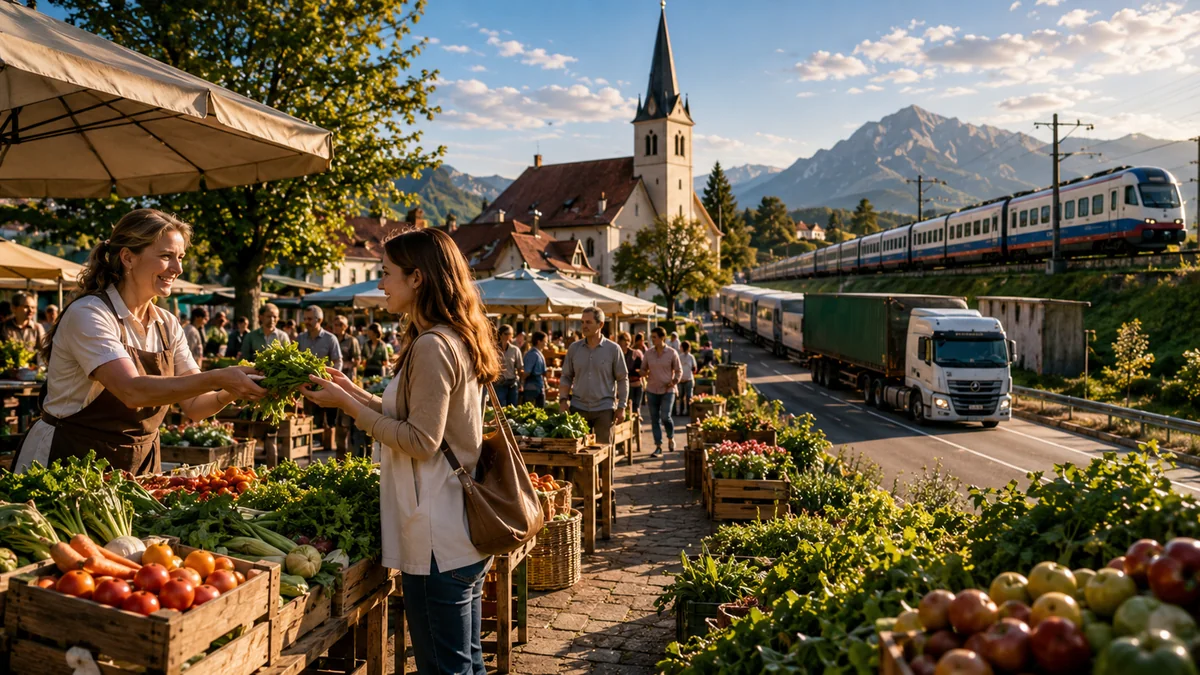
A local economy sounds simple: buy local, produce local, keep money circulating in the community. Push that idea to an extreme, however, and it becomes autarky — an economy trying to satisfy as many needs as possible by itself while cutting itself off from wider specialisation, knowledge and trade. Resilience is not the same as closure.
The source manuscript Prebujenje v Naravni zakon emphasises local food, water, energy, community and material independence as foundations of freer life. This article keeps that sharp concern: critical dependence on a distant monopoly or a single supply route is a real vulnerability. But it explicitly rejects the conclusion that everything should be produced domestically or within the same municipality.
A better question is: which capabilities are worth keeping close, which flows should be diversified, and where does wider exchange increase freedom by giving us more suppliers, knowledge, competition and fallback routes? A local economy without autarky is a network with strong local roots and several external links — not a wall.
Locality, autarky, and real resilience
Local is a scale, not a moral label A product is not automatically fairer, better or more sustainable because it was made ten kilometres away. Locality is valuable when it reduces critical dependence, shortens response time, preserves skills, enables repair, improves visibility or creates real competition. The test is not distance itself but function, risk and consequence.
Autarky trades one vulnerability for others Complete self-sufficiency asks a small community to produce things for which it lacks materials, know-how, capital or sufficient market size. OECD modelling of broad supply-chain relocalisation finds large economic costs without a guaranteed gain in stability. If closure removes supplier diversity and specialisation, it can make a system less, not more resilient.
Dependence is most dangerous when it is concentrated The problem with wider trade is not simply that something comes from far away. Vulnerability rises when a critical input depends on one supplier, one country, one route or one technological choke point. OECD evidence finds larger shock effects when supplier concentration is high, while diversification offers more protection than simple onshoring.
Resilience has several tools Local fallback production is only one tool. Others include multiple suppliers, substitutable materials, inventories, repairability, standard parts, alternative transport routes, shared reserves and the ability to switch quickly. For each critical good, a portfolio of fallbacks is more robust than a single ideological answer.
What should stay close and what should remain open?
What is worth building closer? Capabilities deserve local or regional backup when interruption carries a rapid and serious cost: basic food, some maintenance, repair, emergency transport, parts of health and social support, local water knowledge and backup energy functions. This does not mean all supply must be local; it means the community is not helpless when an external flow stops for days or weeks.
What often makes sense at wider scale? Complex medical equipment, advanced chips, specialised machinery, rare medicines and research infrastructure can require very high fixed costs and broad knowledge networks. Trying to duplicate everything locally can consume resources that would create more security elsewhere. The smallest competent scale applies to economics too.
Openness can itself increase resilience Wider exchange makes it possible to source from elsewhere when a local producer fails. OECD therefore emphasises that open markets and diversified trade links can strengthen resilience when they are not concentrated in one source. Trade is not the opposite of local sovereignty; it can be one of its fallback channels.
Slovenia illustrates both sides Slovenia is a small, highly open economy deeply integrated into European value chains. The OECD’s 2026 survey notes vulnerabilities from foreign inputs in some industries, while also finding that strong EU trade links helped cushion recent shocks. The lesson is not “close the economy”; it is diversify and understand critical dependencies.
Local capabilities, small firms, and the danger of nepotism
A local economy needs capabilities, not only shops If a locality merely resells goods bought elsewhere, it has nearby retail but not necessarily local economic capability. Resilience grows when a place retains or develops skills, tools, services, production steps, logistics, storage and people who know how to repair things.
Small firms are part of resilience infrastructure Small and medium-sized enterprises often operate close to customers and employ locally, yet oversized tenders, complex procedures and disproportionate requirements can exclude them from markets. OECD public-procurement work therefore recommends proportionate requirements, lotting larger contracts and reducing unnecessary administrative burdens while retaining open competition and equal treatment.
“Buy local” must not become cronyism If local procurement means the contract always goes to the mayor’s friend, a relative or the correct in-group, we have not built resilience but a local cartel. Local value should be tied to transparent criteria: quality, total cost, serviceability, lifetime, supply risk and verifiable local effects — not personal connections.
Circularity, local value, and total cost
Circularity reduces dependence on new inputs Repair, reuse, exchanges of by-products between firms and secondary materials can reduce the need for new distant inputs. European circular-city and regional initiatives therefore begin by mapping material flows and value chains. This is practical resilience economics: less waste can also mean fewer new imports.
Zasavje shows that local does not mean isolated A 2026 European case on Slovenia’s Zasavje region links support for local firms, skills, innovation infrastructure and circular practices with entry into wider low-carbon value chains. That is a useful picture: the aim of local policy is not to make firms sell only to neighbours, but to build capability, know-how and bargaining power at home while remaining connected outward.
Keeping value local is useful when real value is created It makes sense to reduce unnecessary leakage — for example importing a service that a competent local supplier could provide. But “money must stay local at any cost” is a poor rule. If a local monopoly offers worse service at a much higher price, forced local purchasing can simply transfer rent to a local monopolist.
Price is not the only metric, but cost is real The lowest purchase price can hide downtime, transport, waste, short product life or lack of repair. The local label can hide inefficiency in the other direction. A better approach uses whole-life cost and risk, not only the invoice price or the producer’s distance.
Finance, local currencies, and networks of communities
Finance is part of local capability the articles from “Mutual Aid, Insurance, and Social Security from the Bottom Up” through “How Do We Finance Shared Functions Without Automatic Centralization?” covered pooled funds, ownership, credit and financing shared functions. A local economy also needs routes to capital: savings, membership finance, cooperative capital, mutual funds, banks, credit unions and wider capital where appropriate. The goal is not to seal financial flows but to have more than one door to finance.
A local currency is not a magic solution A complementary currency or mutual-credit system can connect underused local capacity, but it cannot create fuel, medicines or machinery that do not exist locally. If it is illiquid, opaque or hard to exchange, it can trap users in a small circle. Monetary design must follow real productive and service capability.
Networks of communities are stronger than islands Several local economies can pool procurement, reserves, logistics, expertise and production, reaching a scale that no single community has. This is the polycentric alternative: local units keep meaningful decision capacity while cooperating where connection reduces risk or cost.
Redundancy, knowledge, anchor buyers, and measuring resilience
Redundancy costs money — and that can be a sensible premium The cheapest supply chain is often the one with the fewest reserves. A second supplier, some inventory or local fallback capacity can look inefficient in normal times. In practice they may function like insurance. The goal is not maximum redundancy but deliberate backup where failure would cause disproportionate harm.
Knowledge is local capital that balance sheets often miss If the last repair technician, miller, electrician, mechanic or system operator disappears, a community loses capability even if it still has money. A local economy therefore includes apprenticeships, knowledge transfer, documented procedures and more than one person able to perform critical work. A backup supplier without backup knowledge can be only an illusion.
Large local buyers can open a market — or close it A municipality, school, hospital, large company or cooperative can create enough demand for a local supplier to emerge. But a guaranteed long-term contract without competition can create a protected dependent. It is better to remove needless barriers for smaller firms, split contracts where appropriate and use transparent criteria than to disguise protectionism as “localism”.
Measure resilience, not only the local-spend share More useful indicators include the number of independent suppliers, the share of critical inputs with a single source, replacement time, inventory days, local repairability, available fallback capacity and the share of spending for which a genuinely competitive local alternative exists. This avoids false precision from one “local multiplier” and measures what the system actually needs to improve.
Failure mode and power check
Failure mode: local protectionism A local economy can fail like any other system: higher prices without quality, barriers to new entrants, political favouritism, overuse of local ecosystems or social pressure to buy only from “our own”. When locality becomes an identity duty, voluntary cooperation can turn into a new form of coercion.
Power check: who controls the choke points? Look at warehouses, land, payment infrastructure, credit, digital platforms, logistics hubs, energy and permits. If one person or a small group controls access to most of these gates, the economy can be geographically local and still highly centralised.
A practical map of the local economy
Start today: local economy map v0.1 Choose twenty categories that households and local organisations buy regularly. For each, record supplier count, how many are local, where the critical input comes from, how long you could operate during disruption, whether substitutes exist and which capability would be worth developing closer to home. Measure options, not patriotism.
Second step: find three real gaps Instead of writing a grand plan, select three gaps with actual demand and feasible capability — for example repair, storage, food processing, shared equipment, transport or maintenance. Connect people, capital and know-how, then test whether the project can survive without permanent subsidy or a captive buyer.
Minimum compact for a local economy Rules should include open entry for new suppliers, transparent criteria for shared procurement, conflict-of-interest disclosure, no coercive “buy local” requirement, monitoring of critical dependencies, backup-supplier plans and freedom to connect with outside partners. A local economy should increase choice, not reduce it.
Local roots, open connections
This article therefore proposes no economic island. It proposes an economy that can make, repair and organise more close to people while avoiding dependence on a single geographic scale. A freer economy is not one that needs nothing from others; it is one that can cooperate with others without becoming helpless if one supplier, financier or centre fails.
Sources and further reading
- OECD. Supply Chain Resilience Review: Navigating Risks (2025) — relocalisation costs, import concentration, diversification and resilient supply-chain principles. Source
- OECD. Policies to strengthen the resilience of global value chains — supplier concentration, diversification and limits of partial onshoring. Source
- OECD. Global trade and open markets — benefits of openness, diversification and resilient supply chains, with distributional caveats. Source
- OECD. Strengthening regional policy for resilient places (2025) — place-based development, local assets, governance capacity and regional resilience. Source
- OECD. Economic Surveys: Slovenia 2026 — Slovenia’s open economy, foreign-input dependencies, EU trade links and resilience to external shocks. Source
- OECD. Implementing the OECD Recommendation on Public Procurement — current practices for SME access, lotting, capacity building and simplified procedures. Source
- OECD. SMEs in Public Procurement — barriers to SME participation, equal treatment, open access and proportionate procurement design. Source
- European Commission. Proximity and social economy transition pathway — local green partnerships, local value chains, social-economy entities and small businesses. Source
- European Commission / CCRI. Zasavje: Systemic Transition Supporting Local Businesses (2026) — Slovenian regional diversification, circular practices, skills and new value chains. Source
- European Commission / CCRI. Practical methodology for implementing circular solutions (2025) — map, design and implement circular systems at local and regional scale. Source
- EIB Circular City Centre / CCRI. Circular public procurement in cities (2026 update) — lifecycle costing, repair/reuse and procurement as a lever for circular local markets. Source
- International Labour Organization. Cooperatives for a Peaceful World (2026) — cooperatives, decent work, democratic participation and resilient local communities. Source