Food: How Much Locality Increases Resilience?
This article shows why food resilience is not the same as self-sufficiency: seed, fertiliser, energy, processing, storage, logistics, trade and access all matter.
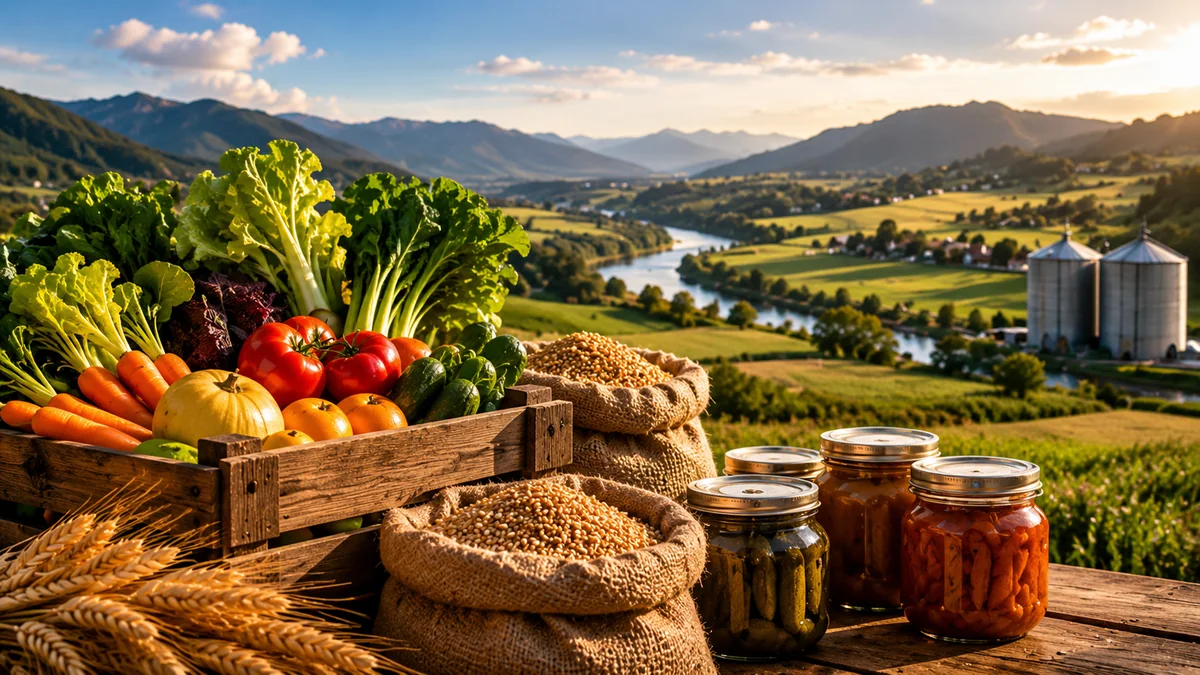
When food security is discussed, the first question is often: “How much food do we produce ourselves?” That is useful, but incomplete. Self-sufficiency measures domestic production relative to consumption; resilience measures how many workable routes remain when something fails.
The source manuscript Prebujenje v Naravni zakon stresses that control over food, water and energy can strongly shape people’s material independence. “Local Sovereignty: How to Build Resilience Without Isolation” and “Local Economy Without Autarky” already transformed that concern: the aim is not isolation but enough local capability and enough wider connections that one failure or decision cannot become leverage over basic life.
This article therefore treats food not as a crop in a field but as a whole system: seed, feed, fertiliser, water, energy, labour, machinery, production, processing, cooling, storage, transport, retail, purchasing power and nutritional quality. The real question is not merely “How local is it?” but: where are the critical dependencies, how quickly can they be replaced, and which local capabilities would most increase genuine choice?
Self-sufficiency, hidden inputs, and the limits of locality
Self-sufficiency is an indicator, not the final objective SURS defines self-sufficiency as domestic production relative to domestic use. The percentage tells us a great deal about the production base, but not whether the crop depends on imported seed, feed, fertiliser, fuel or spare parts, nor whether processing, storage and logistics exist. A high percentage can help, but resilience requires a map of the whole chain.
Food begins before the farm FAO describes agricultural supply chains from inputs to consumers: seed and fertiliser, production, processing, packaging, distribution, retail and storage. If a critical input is missing before planting, domestic land alone does not guarantee a harvest. Food autonomy therefore has to examine the ability to obtain or substitute key inputs as well.
A hidden input can be a bigger vulnerability than imported food A farm can count as domestic production while depending heavily on imported fertiliser, feed, diesel, electricity, crop-protection inputs or machinery. During 2026 disruptions around the Strait of Hormuz, FAO stressed how deeply energy, seeds, fertiliser and other agricultural inputs are connected, and how fertiliser shortages affect later harvests. Resilience looks one season ahead, not only at today’s shelves.
Local production is a fallback route, not a magic shield Local and regional production can shorten some routes, preserve skills, connect producers to consumers and provide an additional supply channel during external disruption. FAO treats urban and peri-urban agriculture as one strategy for strengthening city food-supply resilience. But a local field is exposed to the same drought, flood, hail or disease affecting its surrounding region.
Diversification, reserves, and storage
Geographic diversification can act like insurance When a domestic harvest fails, imports from another climate zone can buffer the shock. FAO therefore emphasises diversified food sourcing through international trade as part of national agrifood resilience. Trade is not the opposite of food resilience; it becomes dangerous mainly when it is concentrated and lacks fallback options.
Trade also needs diversification One foreign supplier is not a real reserve. The number of suppliers, geographic spread, alternative transport routes and switching speed all matter. Broader OECD supply-chain work similarly finds that complete relocalisation does not guarantee stability; a more robust mix combines domestic capability with diversified external links.
Stocks buy time Stocks do not replace production, but they create response time. For grains, pulses, oils, feed, seed and other stable goods, well-managed reserves can bridge short disruptions. The EU’s EFSCM food-security mechanism has explicitly examined stockpiling and stress testing in 2025–2026. A reserve without rotation rules can simply become expensive waste.
Storage is infrastructure, not a detail A harvest without suitable storage is only temporary abundance. Silos, warehouses, cold rooms, packaging, temperature control and pest protection determine how much food actually survives until consumption. FAO notes that cold-chain investment can be cost-effective compared with continually increasing production when it prevents losses of perishable food.
Processing, energy, knowledge, and diversity
Processing is often the bottleneck Milk needs cooling and processing. Grain needs milling. Fruit may need drying, canning or cold storage. A region can have many farms yet depend on one large processing plant, leaving apparently local production exposed to one failure point. Food resilience therefore includes mills, slaughterhouses, packhouses, kitchens and other transformation steps.
Electricity, fuel and water are part of the food chain Irrigation, milking, cooling, drying, water pumping, transport and retail all use energy. Food resilience therefore links directly to “Water and Sanitation: Local Source, Shared Watershed” and “Energy: From Consumer to Energy Cooperation”: water or power failures can halt food even when the field is local. Better planning checks backup power, alternative water and fuel dependence at critical steps.
Knowledge and labour are inputs too A tractor without a mechanic, an orchard without people who know pruning, or a seed bank without people who can reproduce seed are not complete capabilities. Local resilience therefore includes skill transfer, seasonal labour, apprenticeships and documented procedures. A capability that exists in only one person’s head is fragile.
Production diversity reduces one class of risk If local supply depends on only a few crops, one disease or weather event can cause a major loss. Diverse crops, varieties and production systems can spread some biological and climate risk. Yet there is no automatic rule here either: regions have real comparative advantages, and it is not rational for every place to grow everything.
Calories, affordability, and selective local production
Calorie self-sufficiency is not the same as a healthy diet A system can be nearly self-sufficient in one calorie-dense crop while relying heavily on imported fruit, vegetables, proteins or other nutritionally important groups. FAO stresses supply diversity for healthy diets as well. Resilience should therefore measure access to diverse food, not only tonnes and calories.
Food must be affordable as well as physically present Full warehouses do not mean food security if part of the population cannot afford the food. Resilience therefore has at least two sides: physical availability and economic access. “Mutual Aid, Insurance, and Social Security from the Bottom Up” and “How Do We Finance Shared Functions Without Automatic Centralization?” already showed how mutual funds, insurance, kitchens or other support mechanisms can help during temporary vulnerability without requiring one single central model for every form of assistance.
Slovenia shows why one percentage is not enough According to provisional SURS data for 2025, Slovenia’s self-sufficiency was about 74% for cereals, 34% for potatoes, 32% for vegetables, 21% for fruit, 85% for meat and 81% for eggs. These differences matter. But even 100% would not mean complete resilience if domestic output depended critically on one input, one mill or one transport route.
Local production can be selective A city does not need to grow all of its own food. Urban and peri-urban gardens, greenhouses, orchards, community plots and nearby farms are most useful where freshness, rapid access, skills and short routes add real value. FAO’s city-region approach therefore connects cities with peri-urban and rural hinterlands rather than separating them.
Shorter chains and public procurement
A shorter chain is not always more resilient — but it can be more visible Direct sales and short chains can reduce intermediaries and allow quicker communication between farmer and buyer. Yet a single local supplier can still fail. A stronger strategy is several short routes plus some wider routes, not one ideal supply-chain length.
Public procurement can build capacity if it stays open Schools, childcare centres, hospitals and other large kitchens create steady demand that can help local producers and processors build capacity. Procurement must not become a hidden monopoly for politically connected suppliers. Criteria should remain transparent: quality, safety, price, seasonality, reliability and real supply resilience.
Stress testing and power check
A food system needs a stress test Instead of arguing “local versus global”, choose a scenario: a week without the main transport route; a month without a particular fertiliser; a regional drought; a power outage at cold storage; closure of the only processor. Then ask which foods disappear, after how many days and what fallback route exists. Resilience is the ability to maintain function under disruption, not the feeling of self-sufficiency.
Power check: who controls the gates to food? Look at seed, land, water, fertiliser, credit, processing, storage, major retail channels and digital platforms. If several critical gates are controlled by the same actor or narrow group, the system can remain vulnerable even with high domestic production. The critique from Prebujenje is strongest when translated into a concrete question of concentrated access, rather than an unproven claim about one hidden plan.
A practical map of food resilience
Start today: food resilience map v0.1 For 15–20 basic food groups, record consumption, nearby production, critical input dependencies, number of independent suppliers, processing location, inventory days and realistic alternatives during disruption. The goal is not perfect locality but the weakest link with the largest consequence.
Start with one capability, not a master plan Once a gap is found, choose one feasible improvement: shared storage, cold room, dryer, seed exchange, local processing, a second supplier, a contract between farms and a communal kitchen, preservation skills or a surplus map. A small functioning reserve is more valuable than a manifesto for complete self-sufficiency.
Minimum compact for food resilience A community food project should define food-safety rules, traceability, open supplier entry, conflicts of interest, a backup plan for critical suppliers, stock rotation, protection of seed and other material, affordability for vulnerable people and periodic checks that the local measure actually reduces risk rather than creating a new rent.
A freer food system has more pathways
This article does not propose a food island. It proposes a system in which nearby production and knowledge form one fallback, regional links another, diversified trade a third, stocks a fourth and adaptable processing a fifth. Food freedom is not a state in which we need nobody; it is a state in which one failure or control point has difficulty leaving us without basic food.
Sources and further reading
- FAO. The State of Agricultural Commodity Markets 2026 / July 2026 launch — interconnected food markets, shocks and trade-policy resilience. Source
- FAO. International trade and the resilience of national agrifood systems — diversified sourcing through trade as a resilience strategy. Source
- FAO. Increasing the resilience of agricultural supply chains — production, inputs, processing, distribution, retail and storage as one connected chain. Source
- FAO. Strait of Hormuz crisis: fertilizer scarcity will affect next harvests and food supplies (2026) — fertiliser and input dependence as a delayed food-security risk. Source
- FAO. Urban and peri-urban agriculture — nearby production as one strategy for resilient city food supply. Source
- FAO. City-region food systems — urban-rural linkages, food loss/waste, local production and resilient territorial food systems. Source
- FAO. Cold storage / food loss and waste — cold-chain infrastructure and its role in preventing losses of perishable foods. Source
- European Commission. Ensuring global food supply and food security / EFSCM — diversity of supply, stockpiling, crisis preparedness and food-system stress testing. Source
- OECD. Towards resilient food systems — trade as risk pooling and the need for a system-wide view of food resilience. Source
- OECD. Practical approaches to develop resilience strategies for food systems (2025) — recurring risk assessment, responsibilities and action plans. Source
- Statistical Office of the Republic of Slovenia (SURS). Supply balance sheets of agricultural products, 2025 — provisional self-sufficiency rates by product group. Source
- SURS. Self-sufficiency rate methodology — production as a share of domestic use; indicator definition and annual series. Source