The Monroe Institute: Hemi-Sync, Gateway Experience and the Exploration of Consciousness
What does the Monroe Institute actually do? Robert Monroe’s history, Hemi-Sync, Gateway Experience, Focus levels, programs, subjective experiences, military documents and the research that can be checked.
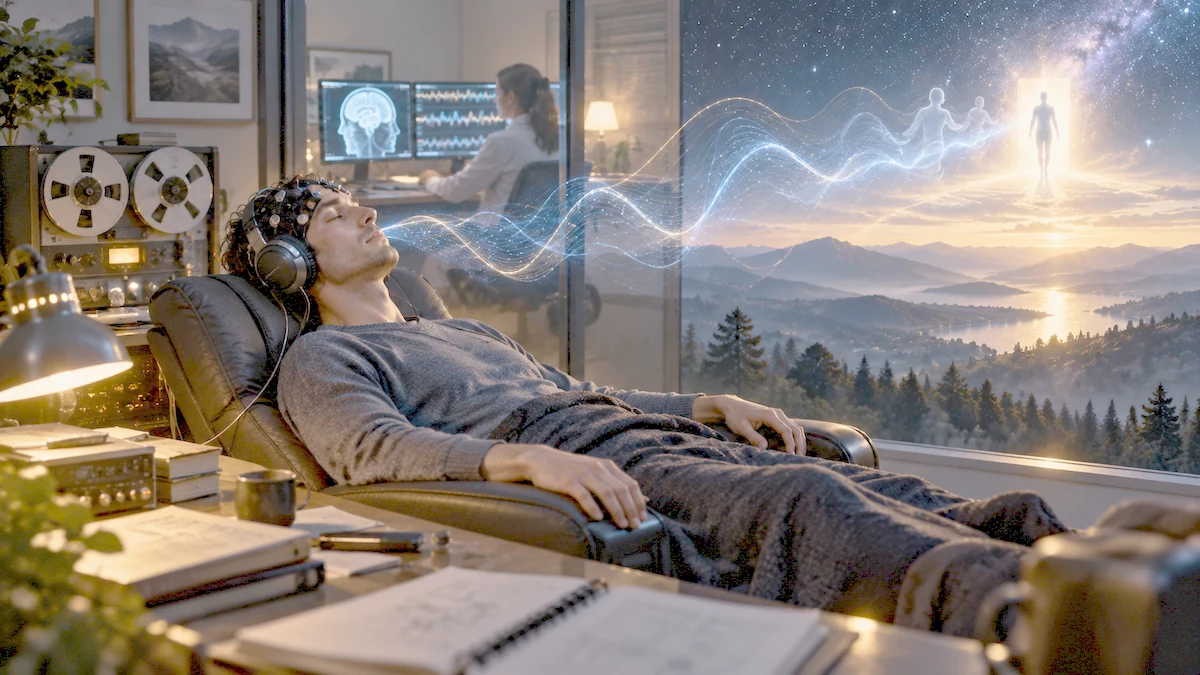
The Monroe Institute is a research and educational organization that has spent decades developing structured methods for exploring meditative and altered states of consciousness. Its best-known legacy is the combination of Robert Monroe, Hemi-Sync audio technology and the Gateway program.
A large mythology has grown around those names, especially because of declassified U.S. military documents. Yet the verifiable history is unusual enough on its own: a radio producer begins experimenting with sound and sleep, reports spontaneous out-of-body experiences, develops an audio-guidance system, and turns laboratory exploration into an institute devoted to consciousness.
This article therefore does two things at once. It first explains the system so that a reader understands what a participant actually listens to and does. It then separates personal experience, EEG measurement, clinical findings, internal research claims and the much larger ontological interpretations about consciousness beyond the body.
What is the Monroe Institute — in two minutes
The story begins in the research and development division of Monroe Industries in the 1950s. Robert A. Monroe initially investigated how sound patterns and environmental changes might affect learning and sleep. According to his own accounts, spontaneous experiences later described as out-of-body experiences began in 1958. He published Journeys Out of the Body in 1971, the same year the organization that became today’s Monroe Institute was created.
The present institute does not present itself as a religion and does not require one mandatory metaphysical doctrine. Its practical model is experiential: participants receive audio guidance, breathing and attention techniques, a sequence of exercises and a map of so-called Focus levels. The aim is to observe changes in perception, body sense, imagery, sleep and the felt boundaries of identity.
It is also important to distinguish today’s Monroe Institute from the Hemi-Sync company. Hemi-Sync is the historic technology and brand that was later separated organizationally; the institute now develops its continuing sound technology under the name Monroe Sound Science.
Robert Monroe: from radio and sleep research to out-of-body consciousness
Monroe did not begin as a mystic. He worked in radio and production, so sound first reached him as a technical medium. His experiments asked whether controlled audio patterns could influence wakefulness, relaxation and sleep. One result of that development path was a 1975 U.S. patent for using sound modulated with EEG-like patterns to induce and maintain different stages of sleep.
His reports of out-of-body experiences widened the project. Instead of asking only “can sound help with sleep?”, he began asking how much conscious experience could be maintained while the body became deeply relaxed or slept. That shift became the foundation of the later Gateway system.
This is the first evidentiary boundary: that Monroe reported OBE experiences is a historical fact about his testimony. Whether consciousness literally separated from the brain during those experiences is a much larger scientific and philosophical claim that the testimony alone cannot establish.
Hemi-Sync and Monroe Sound Science: what is actually happening in the audio
Classic Hemi-Sync uses layered audio signals, the best known of which are binaural beats: each ear receives a slightly different frequency and the auditory system perceives a rhythmic difference between them. Monroe combined such signals with spoken guidance, music and ambient sound.
Today’s Monroe Sound Science is broader than binaural beats alone. The institute lists monaural and isochronic tones, frequency, amplitude and phase modulation and other techniques. The effect of a complete exercise therefore cannot fairly be reduced to one “magic frequency”: sound, instructions, expectation, relaxation, breathing, setting, repetition and individual differences can all contribute.
The binaural percept itself is experimentally real, but the broader literature on complete hemispheric synchronization and reliable switching of the whole brain into a selected state remains inconsistent. That does not mean a listener experiences nothing; it means subjective effect and a precise neurophysiological model are different claims.
Gateway Experience, Gateway Voyage and Focus levels: a map of the practice
Gateway Experience is the progressive home-training series now sold by Hemi-Sync. It starts with Wave I — Discovery and continues through eight Waves. Gateway Voyage is Monroe’s guided program or retreat, now also offered online. The names are related, but they are not the same product or format.
The basic map consists of Focus levels. In Monroe terminology, Focus 10 is “mind awake, body asleep”; Focus 12 is expanded awareness; Focus 15 is described as a state without the ordinary sense of linear time; Focus 21 is treated as a threshold between ordinary physical experience and what the system describes as a nonphysical domain.
These labels are useful as operational navigation language, not as an official neurological classification. Two people can have very different experiences under the same label. Exercises combine deep relaxation, directed attention, imagery, changes in body sense, internal questions and periods of open exploration.
Current programs range further, including lucid dreaming, OBE exploration, remote viewing, meditation and the EEG-monitored Discovery program. The inclusion of a practice in a program, however, is not the same as independent scientific validation of every interpretation a participant may attach to the experience.
What people experience — and an author’s first-person note
Participant reports often include deep relaxation with preserved awareness, vibration or wave sensations, altered body size and position, hypnagogic imagery, lucid dreaming, vivid internal scenes, sensed presences and episodes interpreted as leaving the body. Such reports matter as phenomenological data: they tell us what a person experienced, not automatically what external cause produced it.
Author’s experience: I have also tried their audio products, and my short conclusion is that they work for me. By “work” I primarily mean that they can noticeably change my level of relaxation, body sensation, attention and the quality of inner experience. I do not use that personal result as evidence that everyone will respond the same way or that it already proves a particular metaphysical interpretation.
That is why Monroe’s approach can also be interesting to a skeptical investigator. One does not have to accept a nonphysical model of consciousness in advance to test whether a structured audio exercise reproducibly changes subjective state. The next question — what such a state means ontologically — can remain open.
What research has actually shown: from surgical analgesia to stress
Controlled peer-reviewed studies do exist for some applications. A 1999 double-blind randomized study of 76 surgical patients reported lower fentanyl requirements in the Hemi-Sync group during anesthesia compared with classical music and blank-tape controls. That is a concrete physiological-clinical result, but one study is not universal proof.
A 2004 trial complicated the picture in a useful way. In bariatric surgery the Hemi-Sync group required about one-third less fentanyl, while the lumbar-surgery subgroup did not show a significant difference. This matters precisely because it shows that an effect need not be identical across contexts.
In 2017, a double-blind randomized study of 74 U.S. service members with postdeployment stress compared music containing binaural-beat technology with the same music without it. The binaural group showed more favorable changes in some heart-rate-variability measures and reported less stress. This supports measurable effects in some protocols; it does not establish OBE, remote viewing or consciousness independent of the brain.
The broader binaural-beat literature, reviewed separately on this site, remains mixed: positive outcomes exist for anxiety, pain, attention and other measures, while EEG evidence for a simple global entrainment model is inconsistent. The fairest conclusion is that some effects are measurable while mechanism and magnitude depend on the protocol.
The military, the Gateway report and the myth of “CIA confirmation”
The best-known document is Analysis and Assessment of Gateway Process, dated 9 June 1983. It was written by Lt. Col. Wayne M. McDonnell of U.S. Army Intelligence and Security Command after he was tasked to assess the mechanics and practicality of the Gateway Experience. The document later became publicly accessible through the CIA FOIA collection, which is why it is often shortened online into the claim that “the CIA proved Gateway.”
That is not accurate. The report is a genuine U.S. Army document and it establishes that Gateway received serious government interest and evaluation. It is not a randomized clinical trial, and its discussions of a holographic universe, quantum mechanics, Bentov’s models and “the Absolute” are the author’s theoretical synthesis rather than a consensus statement from physics or neuroscience.
Another declassified Army record about Hemi-Sync presentations is even more instructive. Evaluators wrote that exposure to a sleep recording appeared to aid sleep induction and stress reduction, while wakefulness effects were not convincingly demonstrated; broader claims were left for further evaluation. That is a more informative picture than either “confirmed” or “debunked”: the institution observed some effects, failed to confirm others and wanted more data.

What can be said today: technology, experience and open questions
With high confidence we can say that the Monroe Institute is a long-running organization devoted to experiential consciousness exploration; that Robert Monroe developed and patented several audio methods; that Gateway uses a structured sequence of exercises and a Focus map; that the U.S. military genuinely evaluated the system; and that some audio applications have produced measurable stress or analgesic outcomes in controlled studies.
With moderate confidence, the combination of audio, relaxation and guidance can be said to help at least some people enter unusual, deep or meditative states. The specific contribution of binaural beats within the complete package is not always separable from music, suggestion, expectation and training.
The largest questions remain open: whether OBE represents genuine perception from a point outside the body, whether remote viewing is reliably reproducible under stringent conditions, whether consciousness can exist independently of the brain, and how the most unusual participant reports should be explained. The Monroe Institute explores these possibilities; the public evidence does not yet justify presenting them as settled scientific facts.
Perhaps that openness is the most useful stance toward Monroe’s work: do not dismiss an experience merely because it is unusual, and do not confuse a powerful personal experience with proof of an explanation. Test, record, compare, and keep “what did I experience?” separate from “what does it prove?”
Sources and further reading
- The Monroe Institute — Early History and Development of the Monroe Institute (Robert A. Monroe, originally 1987)
- The Monroe Institute — The History of Sound at the Monroe Institute
- The Monroe Institute — Monroe Sound Science
- The Monroe Institute — Gateway Voyage Online: Focus 10, 12, 15 and 21 structure and safety notes
- Hemi-Sync — Gateway Experience Wave I: Discovery and progressive in-home training series
- U.S. Patent US3884218A — Robert A. Monroe, Method of inducing and maintaining various stages of sleep in the human being, 1975
- U.S. Patent US5356368A — Robert A. Monroe, Method of and apparatus for inducing desired states of consciousness, 1994
- U.S. Department of the Army — Analysis and Assessment of Gateway Process, 1983, GovInfo record
- CIA FOIA / U.S. Army — HEMI-SYNC presentation and military applications evaluation, 1983
- Kliempt, P. et al. — Hemispheric-synchronisation during anaesthesia: a double-blind randomised trial, Anaesthesia, 1999
- Lewis, A. K., Osborn, I. P. & Roth, R. — The effect of hemispheric synchronization on intraoperative analgesia, Anesthesia & Analgesia, 2004
- Gantt, M. A. et al. — The Effect of Binaural Beat Technology on the Cardiovascular Stress Response in Military Service Members With Postdeployment Stress, 2017
- Ingendoh, R. M. et al. — Auditory Beat Stimulation and its Effects on Cognition and Mood States, EEG evidence review, 2023
- Orozco Perez, H. D. et al. — Binaural Beats through the Auditory Pathway: From Brainstem to Connectivity Patterns, 2020
- The Monroe Institute — Research Overview: current and upcoming consciousness studies
- The Monroe Institute — Discovery: experiential program with real-time EEG monitoring
- The Monroe Institute — Our Programs: current program catalogue
- Wikimedia Commons — Analysis and Assessment of Gateway Process PDF, U.S. government public-domain copy