Joe Biden — Withdrawal from Afghanistan and a New War from Afar
When Joe Biden became president of the United States in January 2021, he did not inherit a country still deciding whether to begin a war in Afghanistan.
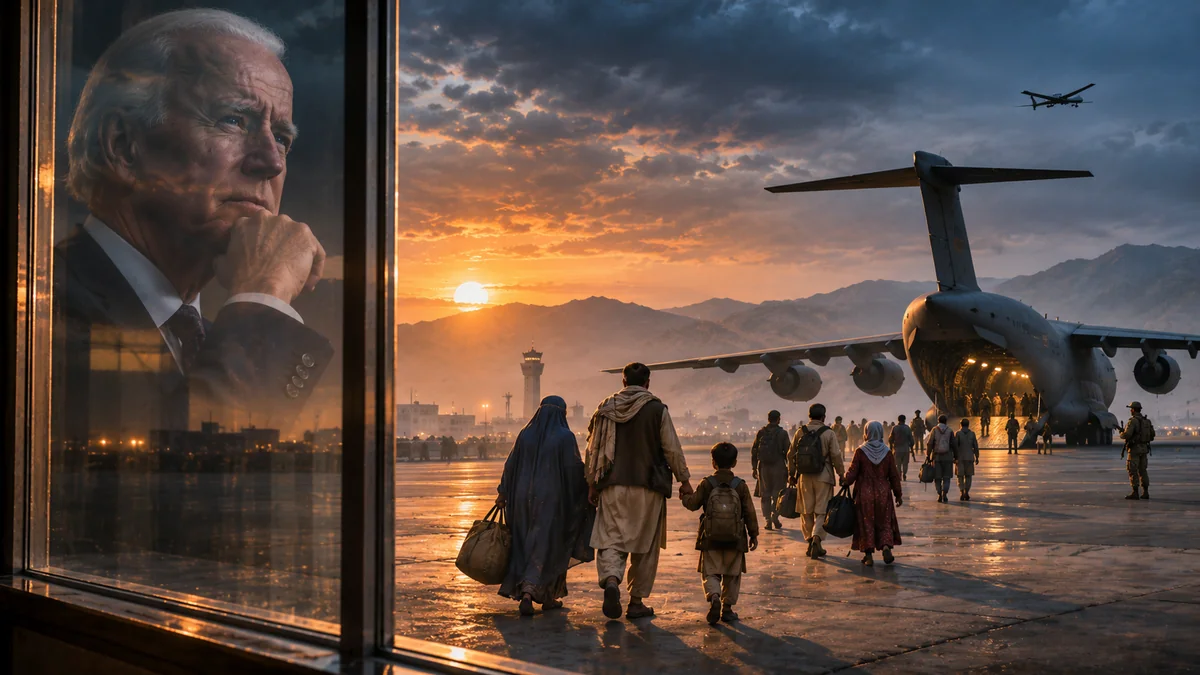
Editorial illustration.
When Joe Biden became president of the United States in January 2021, he did not inherit a country still deciding whether to begin a war in Afghanistan. He inherited a war that had lasted nearly twenty years, counterterrorism operations across several countries, and a military presence whose political and legal foundations reached back to earlier administrations. Seven months later, American troops left Kabul. That did not mark the end of US military force on foreign soil. During his presidency, through January 2025, Biden personally ordered several strikes in Syria and Iraq, authorized particular counterterrorism operations, and directed major US–British strikes against Houthi targets in Yemen.
The question of his responsibility therefore cannot be reduced to how many people died in every place where the United States was militarily active at the time. Some deaths directly resulted from American strikes. Others were caused by ISIS-K, the Taliban, armed militias, or the Houthis. In still other cases, the president's decision to deploy forces can be established, but not a personal order to strike a specific lethal target. We distinguish a direct presidential decision (P1), the wider policy and operational framework (P2), and the execution of a particular operation (P3). This is not a scale of moral innocence or guilt; it is a way to ground political judgment in the actual chain of decision-making.
Afghanistan: the decision to withdraw and the collapse of the state
At the beginning of Biden's term, approximately 2,500 US troops remained in Afghanistan. Earlier, on February 29, 2020, the Trump administration had signed an agreement with the Taliban providing for a phased withdrawal of foreign forces and, subject to certain commitments, their complete departure. The Afghan government was not a signatory to the US–Taliban agreement itself. Alongside its military provisions, the deal envisaged a process for releasing up to 5,000 Taliban prisoners and up to 1,000 prisoners held by the other side; this did not mean that the US government directly held all those prisoners. Biden inherited an ongoing withdrawal process, but not its final execution. [1] [2]
It was the final execution that became his decision. On April 14, 2021, he announced a complete withdrawal, choosing to begin its final phase on May 1 and to remove US forces before the twentieth anniversary of the September 11 attacks. In July he set August 31 as the end of the military mission. This was a clear presidential strategic decision—P1—even though it was not a decision to begin the Afghan war. That distinction does not diminish its historical significance: the president assumed responsibility for the timetable and the political consequences of the final American departure. [3] [4]
In the summer of 2021 the Taliban advanced rapidly and took Kabul on August 15. The sequence invites a simple equation in which one president, by making one decision, supposedly caused everything that followed. Yet a later inquiry by the US Special Inspector General for Afghanistan Reconstruction (SIGAR) identified six interconnected factors in the collapse of the Afghan government and security forces. They included the government's political weakening during negotiations from which it had been excluded and its lack of preparation for the actual departure of US support. Withdrawal was an important causal factor, not evidence that American forces directly caused every death associated with the Taliban takeover. [5]
An emergency evacuation from Kabul airport followed. American and partner forces helped evacuate approximately 124,000 people; depending on the time and method of counting, final reports also give a figure of a little over 123,000. Evacuee figures describe the scale of the operation, not the number of people killed. The last US military aircraft departed on August 30, 2021, at 11:59 p.m. Kabul time: the operational end of the military presence was a P3 execution of the president's earlier P1 decision. [6]

Abbey Gate and Kabul: two events, two very different responsibilities
During the evacuation, on August 26, an ISIS-K suicide bomber detonated explosives at the airport's Abbey Gate entrance. 13 US service members and approximately 170 Afghan civilians were killed. A Pentagon investigation and a supplementary review in 2024 attributed the attack to a single ISIS-K suicide bomber. Investigators subsequently identified him as Abdul Rahman al-Logari, who, according to US reporting, had been released when the Taliban took over prisons. Investigators also noted that the group had other potential attackers. The circumstances therefore cannot be compressed into the claim that the attack would certainly have been prevented had one man remained in custody. [7] [8]
It also matters what investigators found about reports that American troops fired into the crowd after the explosion. Warning shots and other gunfire were examined, but the official investigation found no conclusive evidence that anyone was killed or injured by American or Afghan gunfire. That is a limit of the evidence, not a prohibition on further critical investigation. For purposes of identifying the direct perpetrator, the deaths at Abbey Gate are therefore attributed to ISIS-K, not to an American strike. Biden's decisions concerning the evacuation remain a political question, but they do not in themselves change who caused the explosion. [8]
After the tragedy, Biden directed the preparation of plans to strike ISIS-K assets and leadership. This was a documented presidential direction for retaliatory action at the P2 level, not proof that he personally selected every subsequent target. The Pentagon described a US strike in Nangarhar on August 27 as having killed two ISIS-K members and wounded a third, with no civilian casualties known at that time. That is an official US operational assessment of a P3 direct US strike, not an independently verified and exhaustive list of those killed. [9] [10]
A markedly different case occurred on August 29. An American drone in Kabul tracked a vehicle driven by humanitarian aid worker Zemari Ahmadi. Analysts and the operational team interpreted the vehicle as a possible means of posing an imminent threat to the airport. A Hellfire missile was launched, and the US military initially described the attack publicly as a strike against a suspected ISIS-K threat. Later evidence overturned that account. On September 17, CENTCOM commander Kenneth McKenzie acknowledged that the decision had been a tragic mistake, that the vehicle was probably not connected to ISIS-K, and that those killed in or near it had posed no imminent threat to American forces. Ten civilians died, seven of them children. [11]
Here the direct responsibility of American weaponry is established: P3, DIRECT-US. Publicly available evidence does not, however, show that Biden personally selected Ahmadi's vehicle or signed an order to strike that specific target. An internal military review identified serious execution and communication failures, as well as confirmation bias, but did not find a violation of the law of war. The conclusion of an internal inquiry is not the same as an independent judicial ruling. Nor does the moral question end with the finding that the commander in chief did not personally select the vehicle. Presidential and command responsibility also encompass the precautions a military requires, how it investigates mistakes, and how it treats the families of those killed. [11] [12]
Iraq and Syria: the president’s orders for retaliatory strikes
In Iraq and Syria, Biden inherited Operation Inherent Resolve, the campaign against ISIS that had begun before his presidency. At the start of 2021, roughly 2,500 US troops were in Iraq and 900 in Syria. Unlike the general framework of that inherited mission, however, many of Biden's new attacks on facilities associated with Iran-backed militias are directly documented as having been ordered by him. [13]
In February 2021, rockets near Erbil killed a Filipino contractor and injured others. On February 25, Biden ordered a strike against facilities in eastern Syria associated with Kata'ib Hezbollah and Kata'ib Sayyid al-Shuhada. In his letter to Congress, he explicitly stated that the operation had been carried out at his direction. That is P1 use of American force. Citing militia sources, the Associated Press reported one fighter killed, but the publicly available official US record does not supply an equally definitive figure. The contractor was killed in the attack on Erbil by the opposing side; his death was not a casualty of the American response. [14] [15]
A similar pattern recurred on June 27, 2021, when Biden ordered strikes on facilities near the Iraq–Syria border. This too was P1. Reports of four dead militia members originated in militia claims, not independently confirmed US statistics. In August 2022 the president again ordered a strike on a facility in eastern Syria; the following day American forces carried out tactical counterstrikes after attacks on their bases. CENTCOM reported four enemy fighters killed in the broader response. Those four cannot be attributed to the first, separately presidentially authorized strike: it was a different action within the same chain of escalation. [16] [17] [18] [19]
In March 2023, an attack drone struck a coalition base in Syria, killing US contractor Scott P. Dubis and injuring several American service members and contractors. Biden then ordered retaliatory strikes on facilities linked to Iran's Revolutionary Guard. The Pentagon later assessed that the US strikes had killed eight fighters. The contractor's death belongs to the initial attack by an opposing actor; the eight fighters killed belong to the subsequent American response. Combining the two incidents in one death toll would obscure the direction in which force was used. [20] [21]
After October 2023 the cycle became almost continuous. Militias attacked US bases with rockets and drones, while Washington responded with a combination of tactical self-defense and presidentially authorized strikes against storage, command, and logistics facilities. In individual rounds in November, December, and January, Biden's personal direction is documented; for immediate defensive fire ordered by commanders it often is not. There is therefore no single correct P1 label for every American bomb used in the region. Nor is there one reliable aggregate death toll for the entire sequence. [22] [23] [24] [25]
On January 28, 2024, a drone struck the US base known as Tower 22 in Jordan. Three American soldiers were killed and more than forty people wounded. The US administration attributed responsibility to the Islamic Resistance in Iraq network, associated with Iran-backed militias. That does not, by itself, prove that Iran's leadership personally ordered this particular attack. Nor were the three American deaths casualties of the subsequent US retaliatory strikes: they resulted from the actions of the opposing side. [26] [27]
According to the US military, Biden's response on February 2, 2024, struck more than 85 targets across seven military facilities or locations in Iraq and Syria, using more than 125 precision munitions. These figures demonstrate the scale of force; they are not numbers of people killed, 85 separate military bases, or 125 separate attacks. Biden explicitly informed Congress that he had ordered the strikes himself. Iraqi official sources reported 16 people killed, reportedly including civilians, while a Syrian source cited in media reports reported 23 dead. Because the counting criteria and identities do not align, the figures cannot fairly be presented as a single confirmed total of people directly killed by US forces. [28] [29] [30]
The legal assessment cannot be reduced to one sentence either. For February 2024, Biden invoked constitutional presidential authority, the 2001 and 2002 Authorizations for Use of Military Force (AUMFs), and the right of self-defense under Article 51 of the UN Charter. The Iraqi and Syrian authorities objected that the strikes violated their countries' sovereignty. This is not the same legal documentation as for his first strikes in 2021, when the AUMFs were not invoked in the same way in the particular letters to Congress. The public should see both the US justification and the objections of the affected states, rather than a fabricated definitive judgment absent from the available record. [29] [31]
Somalia and Yemen: a military presence is not an order for every strike
Near the end of its first term, the Trump administration relocated most American personnel out of Somalia. That did not end all US counterterrorism operations. In July 2021 AFRICOM carried out a strike against al-Shabaab in support of Somali forces; the Pentagon explained that the commander had acted under existing authority and did not need a new presidential order for the specific strike. This was a direct US P3 action, not a P1 decision merely because Biden was commander in chief. [32]
In May 2022 Biden changed the broader posture: he authorized a small, more persistent US military presence in Somalia in place of intermittent deployments. That was P1, but it was a decision about deployment and support for Somali partners, not in itself an incident in which anyone was killed. Subsequent officially acknowledged American strikes must be assessed individually. Near Jilib in October 2022, for example, AFRICOM assessed that an al-Shabaab commander and one other person had been killed, while independent reporting disputed the civilian status of the second person. At Galcad in January 2023, the command spoke of approximately 30 al-Shabaab fighters killed, but as the combined result of Somali forces and an American strike. That estimate must not be recast as 30 deaths caused exclusively by US forces. [33] [34] [35]
In Yemen, Biden announced in February 2021 that the United States would end its support for offensive operations by the Saudi-led coalition. The same official policy framework, however, expressly excluded US counterterrorism missions against AQAP and ISIS from that change. It would be wrong to say that the United States simply stopped all military activity in Yemen under Biden. It would be equally wrong to attribute every subsequent Saudi strike directly to the US armed forces. [36] [37]
The question of US strikes against AQAP is more uncertain still. Local reports in 2021–2023 attributed certain drone attacks to the United States, including incidents near Marib. Independent assessments by New America note that public US confirmation of those particular attacks was unavailable and that CENTCOM even denied involvement in some similar incidents. The absence of a public acknowledgment does not prove the absence of a covert operation; it does prevent those deaths from fairly being declared a confirmed total of people directly killed by the United States. At the same time, the Biden administration updated its broader framework for direct counterterrorism action in 2022, which was not in itself an incident involving deaths. [38] [39] [40]
From Atmeh to Kabul: ordering an operation does not mean US weapons caused every death
In February 2022, US special operations forces conducted a nighttime raid in Atmeh, northwestern Syria, against ISIS leader Abu Ibrahim al-Hashimi al-Qurayshi. Biden publicly stated that the operation had been carried out on his orders. The US side said it had chosen a ground operation rather than direct bombardment because of the danger to civilians. According to the Pentagon's initial account, the principal target detonated explosives himself, killing several people, including civilians. American troops also killed other people in clashes during the operation: an official spokesperson separately described fighting inside the building and a later engagement with a group approaching the site. The official explanation at the time left questions open about the death of a child on the second floor. The operation was presidentially ordered (P1), but not every death can be attributed to the same direct perpetrator. This does not erase questions about planning and responsibility; it prevents an invented definitive total. [41] [42]
Biden's approval of the strike against Ayman al-Zawahiri in Kabul on July 31, 2022, was more direct still. According to the official US account, Biden personally approved the target, and, after the withdrawal of regular troops from Afghanistan, the United States used its over-the-horizon strike capability. According to the Pentagon, two Hellfire missiles killed al-Zawahiri; the US report did not confirm any additional deaths or civilian casualties. In this record, the link between P1 and one death caused by American weaponry is relatively clear. A separate question is the debate under international law over an attack on Afghan territory without the consent of the Taliban authorities, who condemned it as a violation of sovereignty. [43] [44]
In January 2023 Biden also ordered an operation in northern Somalia against Bilal al-Sudani, an important ISIS member and financial facilitator. According to the American account, the initial objective was to capture him, but the targeted group resisted and US forces killed approximately eleven ISIS members, including al-Sudani. The official US assessment listed no civilian casualties. The word approximately matters: this was not a name-by-name verified list of exactly eleven people killed. Biden's order for the operation is documented, while the domestic legal justification relied on the inherited 2001 AUMF. [45] [46]
The Red Sea: from protecting vessels to US–British strikes
After the war in Gaza began in October 2023, the Houthis in Yemen increasingly attacked or threatened ships in the Red Sea and Gulf of Aden. The Houthis justified their actions by reference to the plight of Palestinians, while Western governments emphasized threats to merchant shipping, crews, and their own forces. In December, the multinational maritime initiative Operation Prosperity Guardian was established. That defensive initiative was not the same as the air and missile strikes that the United States and United Kingdom subsequently began conducting against Houthi facilities on land. CENTCOM itself expressly distinguished the two. [47] [48]
During the night of January 11–12, 2024, American and British forces struck radars, air-defense assets, storage facilities, and launch sites. Biden informed Congress that the strikes were carried out at his direction—P1. The same is documented for three further major joint rounds on January 22, February 3, and February 24. Meanwhile, US forces carried out almost daily unilateral defensive strikes against drones, missiles, and other assets assessed to pose imminent threats to vessels. Those tactical actions remain P3 within a broader presidentially authorized campaign unless a separate presidential order for a particular target is demonstrated. [49] [50] [51] [52]
The number of targets hit does not establish how many people died. In April 2024, Houthi leaders claimed that hundreds of US and British strikes had killed 37 people and wounded 30; this is not an independently verified, US-specific figure. Following joint strikes on May 30, Houthi sources initially reported 14 dead and later 16, with dozens injured, allegedly including civilians. Published reports also disagree about the exact number of wounded. CENTCOM reported the targets struck but did not provide an equivalent definitive death toll. These reports must therefore remain incident-specific and attributed to their sources, not converted into an ostensibly precise “Biden total.” [53] [54] [55]
Within the wider conflict, but during a separate maritime weapons-interdiction operation, two US Navy SEALs went missing while boarding a vessel in January 2024 and were later declared dead. Their deaths were American operational losses, but on the publicly documented circumstances they were not caused by Houthi fire, nor were they casualties of US bombing. By contrast, merchant sailors killed by Houthi fire were victims of lethal acts committed by another actor. This distinction is not bureaucratic trivia: without it, deaths across the Red Sea are attributed to the wrong parties. [56] [57] [58]
American strikes continued into the autumn of 2024, including B-2 bomber attacks on hardened weapons-storage facilities. It cannot simply be assumed that Biden personally approved every specific target in those later strike packages. We must retain the distinction between a politically authorized campaign and its operational execution. The legal basis also differed from that invoked for the Iraq and Syria strikes: Biden's reports to Congress concerning the Houthis cited presidential constitutional powers and self-defense under international law, but not the same express reliance on the 2001 and 2002 AUMFs as in the February response in Iraq and Syria. The Congressional Research Service noted debate over the limits of unilateral presidential military action. A UN resolution condemning attacks on shipping was not, by itself, a straightforward authorization to bomb Yemen. [59] [60]
What can be attributed to the president — and what remains unresolved
Biden demonstrably decided to complete the withdrawal from Afghanistan, personally ordered several retaliatory strikes in Iraq and Syria, approved a return to a more persistent US presence in Somalia, and directed certain specified counterterrorism operations as well as major US–British strikes against the Houthis. Such decisions carry political and moral responsibility whether publicly described as withdrawal, protection of troops, counterterrorism, or defense of shipping.
Yet a documented decision to use force does not mean that every person killed nearby had the same killer. The ten civilians killed in the erroneous US strike in Kabul are a matter of direct American responsibility even though the president is not shown to have selected the target. The thirteen American service members and approximately 170 Afghan civilians at Abbey Gate were killed by an ISIS-K attacker. At Atmeh, the principal target reportedly blew himself up; in al-Zawahiri's case, one death was directly attributed to the American strike. For the Houthi campaign, official target counts, local death reports, and contemporaneous deaths among ship crews cannot all be merged into a single category. These are not exceptions but fundamental requirements of sound historical reasoning.
If the public wishes to judge presidential power seriously, it must ask at the same time who decided to use force, who carried out the operation, who actually caused the deaths, and how civilian harm was investigated. Precision does not weaken the moral question. On the contrary, only when we give up the comfort of an imaginary single number can we demand that those in power answer for specific decisions and for the people affected by them.
Sources and further reading
- US–Taliban Agreement (February 29, 2020). Source
- Christopher Miller, US Department of Defense statement on force levels in Afghanistan (January 15, 2021). Source
- Joe Biden, remarks on the way forward in Afghanistan (April 14, 2021; archived Portuguese translation). Source
- Joe Biden, remarks on the drawdown of US forces in Afghanistan (July 2021; archived Portuguese translation). Source
- Special Inspector General for Afghanistan Reconstruction (SIGAR), evaluation of the collapse of Afghanistan's government and security forces. Source
- CENTCOM and Department of Defense, briefing on the end of the Afghanistan evacuation (August 30, 2021). Source
- US Department of Defense, supplementary review of the Abbey Gate attack (April 15, 2024). Source
- CENTCOM and Department of Defense, briefing on the Abbey Gate investigation (February 4, 2022). Source
- Joe Biden, public remarks after the Abbey Gate attack (August 26, 2021; GovInfo). Source
- US Department of Defense, briefing on strikes and evacuation in Afghanistan (August 28, 2021). Source
- CENTCOM and Department of Defense, acknowledgment of the fatal Kabul strike error (September 17, 2021). Source
- US Department of Defense, briefing on the independent military review of the August 29, 2021 strike (November 3, 2021). Source
- Lead Inspector General, Operation Inherent Resolve quarterly report (January–March 2021). Source
- Joe Biden, letter to Congress concerning the US strike in Syria (February 27, 2021). Source
- Associated Press/PBS, report on the Syria militia strike and one reported death (February 26, 2021). Source
- Joe Biden, letter to Congress concerning strikes in Iraq and Syria (June 29, 2021). Source
- Reuters, report on US strikes on militias near the Iraq–Syria border (June 28, 2021). Source
- Joe Biden, letter to Congress concerning US military action in Syria (August 25, 2022). Source
- CENTCOM, report on engagements with armed fighters in northeastern Syria (August 25, 2022). Source
- Joe Biden, letter to Congress concerning US strikes in Syria (March 25, 2023). Source
- US Department of Defense, Pat Ryder briefing on Syria strikes (March 30, 2023). Source
- Lead Inspector General, Operation Inherent Resolve quarterly report (October–December 2023). Source
- Joe Biden, congressional report on the use of US military force (November 22, 2023). Source
- Lloyd J. Austin III, statement on US strikes in Iraq (December 25, 2023). Source
- CENTCOM, statement on strikes against Kata'ib Hezbollah facilities in Iraq (January 23, 2024). Source
- US Department of Defense, report on the drone attack at Tower 22 in Jordan (January 29, 2024). Source
- Associated Press, report on US attribution of the Tower 22 attack (January 31, 2024). Source
- CENTCOM, official statement on strikes in Iraq and Syria (February 2, 2024). Source
- Joe Biden, letter to Congress on strikes in Iraq and Syria and their legal basis (February 4, 2024). Source
- Reuters, reports on deaths following US strikes in Iraq and Syria (February 3, 2024). Source
- UN Security Council, public account of debate on the Iraq and Syria strikes (February 5, 2024). Source
- US Department of Defense, briefing on the Somalia strike (July 21, 2021). Source
- US Department of Defense, announcement of a renewed persistent military presence in Somalia (May 16, 2022). Source
- Airwars, civilian casualty incident file USSOM353-C, Somalia (October 1, 2022). Source
- AFRICOM, report on the operation alongside Somali forces near Galcad (January 20, 2023). Source
- US Department of State, briefing on policy toward Yemen (February 5, 2021). Source
- US Department of State, follow-up briefing on policy toward Yemen (February 8, 2021). Source
- New America, The State of America's Drone Wars in 2022. Source
- New America, call for a detailed accounting of US operations in Yemen (2023). Source
- Joe Biden, congressional report on the legal and policy framework for use of military force (November 15, 2022). Source
- Joe Biden, statement on the operation against an ISIS leader in Syria (February 3, 2022). Source
- US Department of Defense, John Kirby briefing on the Atmeh operation (February 3, 2022). Source
- Joe Biden, statement on the strike against Ayman al-Zawahiri (August 1, 2022). Source
- US Department of Defense, report on the killing of al-Qaeda's leader in Kabul (2022). Source
- Lloyd J. Austin III, statement on the operation against Bilal al-Sudani in Somalia (January 26, 2023). Source
- Joe Biden, regular congressional report on the use of military force (June 2023). Source
- Congressional Research Service, Yemen: Conflict, Maritime Attacks, and U.S. Policy. Source
- CENTCOM, official statement on joint strikes in Yemen (January 11–12, 2024). Source
- Joe Biden, letter to Congress on strikes in Yemen (January 12, 2024). Source
- Joe Biden, letter to Congress on strikes in Yemen (January 24, 2024). Source
- US Congress, Document 118-104 concerning strikes in Yemen (February 5, 2024). Source
- Joe Biden, congressional report on strikes in Yemen (February 26, 2024). Source
- Reuters, Houthi claims concerning deaths and injuries in US–UK strikes (April 4, 2024). Source
- CENTCOM, report on strikes and targets destroyed in Yemen (May 30, 2024). Source
- Reuters, Houthi statements concerning strikes and casualties (May 31, 2024). Source
- CENTCOM, interdiction of weapons allegedly bound for the Houthis (January 2024). Source
- CENTCOM, status of the missing Navy SEAL personnel (January 21, 2024). Source
- Reuters, report on the attack on the merchant vessel True Confidence (March 6, 2024). Source
- CENTCOM, report on B-2 bomber strikes against Houthi underground weapons depots (October 16, 2024). Source
- Congressional Research Service Legal Sidebar, legal questions on US operations and the War Powers Resolution (2024). Source