Donald Trump II — The Use of Force, 2025–2026
When Donald Trump returned to the White House on January 20, 2025, he did not inherit a blank map.
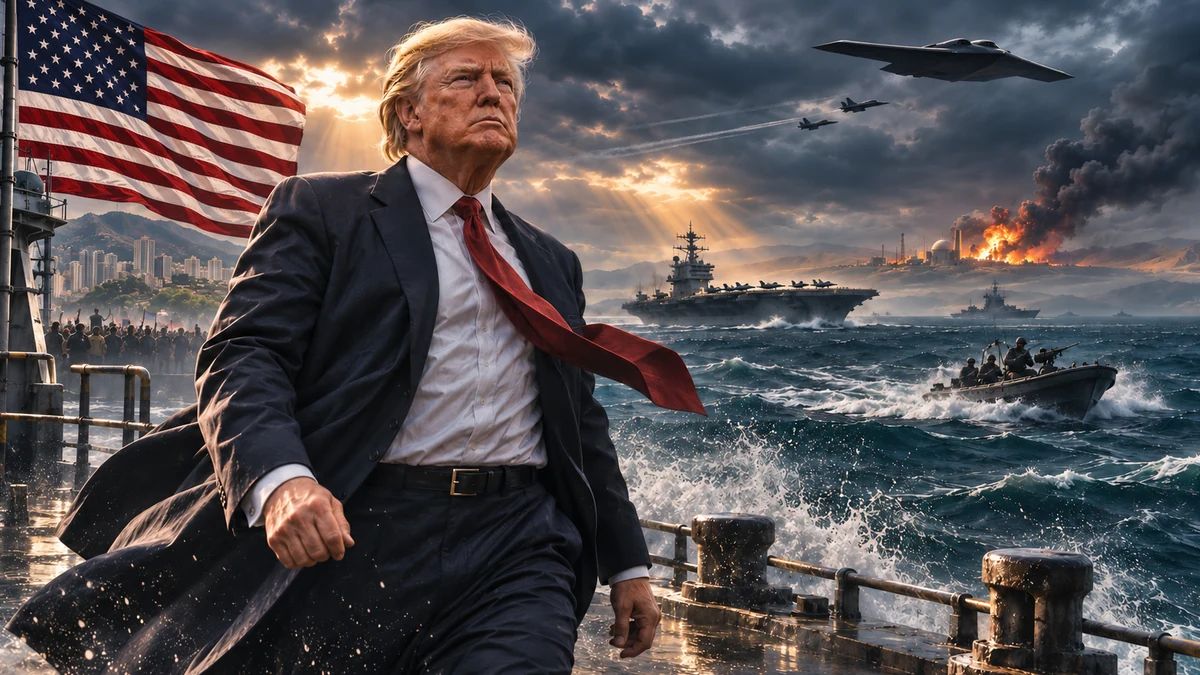
Editorial illustration.
When Donald Trump returned to the White House on January 20, 2025, he did not inherit a blank map. U.S. forces were already operating in Somalia, Iraq, and Syria; tensions in the Red Sea predated his return; and American military deployments in various regions rested on authorities that had outlasted several presidents. Yet his second term was not merely a matter of managing inherited operations. Over the next twenty months, the documentary record came to include new presidential orders for strikes, campaigns against armed groups, an intervention in Venezuela, attacks on Iranian nuclear facilities, and ultimately a large-scale war against Iran.
This article covers events and evidence through September 25, 2026. Some operations had not ended by that date. The death tolls and operational figures presented here are therefore time-specific records, not a final tally established later; they can be revised only in light of further evidence. The central question is not how to attribute the largest or smallest possible number of deaths to Trump. It is where evidence exists of his direct order, what the military carried out at subordinate levels, and who actually caused deaths in each case.
When the President Says He Ordered the Strike
As early as February 1, 2025, Trump publicly said that he had ordered strikes against members of the Islamic State (ISIS) in Somalia. Defense Secretary Pete Hegseth confirmed that U.S. forces had acted at the president's direction and in coordination with the Somali government. This was not merely political endorsement of a longstanding campaign: the presidential decision initiating this specific operation is documented. Under our methodology, this is P1 — a direct order or decision that can be traced in the public record. [1] [2]
AFRICOM subsequently estimated that strikes around cave complexes southeast of Bosaso had killed approximately 14 members of ISIS-Somalia and stated that, in its assessment, no civilians had been killed or injured. This information matters, but it must be described precisely: it is an official military assessment of the strike's results, not an independently verified list naming everyone killed. Nor does the absence of civilian casualties in the official assessment establish with absolute certainty that every possible effect of the strike was ruled out. [3]
Somalia also reveals the limits of that evidence. A presidential order for one operation does not mean Trump personally ordered every subsequent AFRICOM strike in 2025 and 2026. Continuing counterterrorism operations may proceed under existing authorizations, with commanders making decisions at the operational level. This is the distinction between P1, the political framework P2, and operational execution P3 — not a hierarchy of moral seriousness, but a way to remain faithful to the documented chain of decision-making.
A much larger campaign began in Yemen on March 15, 2025. Trump publicly announced a major military operation against the Houthis, and his subsequent letter to Congress expressly stated that U.S. forces had begun the strikes at his direction. Operation Rough Rider followed earlier Red Sea hostilities under the Biden administration, but it represented a new Trump decision, both politically and operationally. The initial decision is P1; the wider campaign constitutes the P2 framework; each subsequent tactical strike is not automatically a new P1 order. [4]
By April 27, CENTCOM had reported striking more than 800 targets, while Reuters referred to more than a thousand airstrikes over nearly two months as the campaign ended. The figures do not necessarily contradict one another because they measure different things. A target is not the same as a strike, a strike is not the same as a bomb dropped, and none of those measures by itself tells us how many people died. Following Omani mediation, the United States and the Houthi movement agreed on May 6 to halt their attacks against one another. That marked the end of a particular phase of the campaign, not the end of every war in Yemen. [5] [6]
When assessing civilian harm, caution with numbers matters even more. Airwars documented at least 224 alleged civilian deaths during the eight-week campaign, including dozens of casualties at Ras Isa and at a detention center in Saada. These findings constitute independent documentation of reported or assessed casualties; they are not identical to an official U.S. total. Some later official acknowledgments concern the same incidents and therefore must not be added to the Airwars estimate. The phrase “alleged civilian death” does not diminish the human significance of a death here: it identifies the level of evidentiary confirmation and the potential for overlapping records. [7] [8]
Iran in 2025 and a New Legal Boundary at Sea
In June 2025, the president ordered strikes against three Iranian nuclear facilities — Fordow, Natanz, and Isfahan. His message to Congress used language documenting a direct presidential decision. The Pentagon named the operation Midnight Hammer. According to its account, seven B-2 bombers dropped fourteen GBU-57 bombs, while Tomahawk missiles were also launched at targets; approximately 125 U.S. aircraft took part in the operation overall. Those are figures describing the use of force. As for possible deaths caused by the strikes themselves, the public sources reviewed by the research cutoff provided no stable, verified, final list. The responsible wording is therefore not “zero deaths” but “the confirmed death toll has not been established.” [9] [10] [11]
The administration justified the strikes by invoking the protection of U.S. interests and Israel's collective self-defense. But the administration's stated legal justification, an assessment of the necessity of the attack, and an evaluation of its actual effect on Iran's nuclear program are separate questions. Early satellite analyses showed extensive physical damage alongside considerable uncertainty about the impact on deep underground facilities. Questions of legality, military effectiveness, and human consequences cannot therefore be settled by a single political declaration of “complete destruction.” [12]
Only a few months later, American military force was being used in a different setting: against vessels in the Caribbean Sea and eastern Pacific that Washington associated with drug trafficking. In his letter to Congress concerning the September 2, 2025 strike, Trump explicitly stated that U.S. forces had acted at his direction. The U.S. side reported eleven people killed in the first strike. This is evidence of deaths directly caused by a U.S. military attack; it is not, however, independent verification of the identity, conduct, and legal status of each person killed. [13]
The campaign developed into Operation Southern Spear. In mid-August 2026, Reuters cited a U.S. acknowledgment that 67 vessels had been destroyed and more than 220 people killed; after the September strikes, the Associated Press reported at least 231 dead across 69 strikes. These are dated snapshots of a rapidly changing situation, not two figures to be added together. Even the basic legal classification is disputed: are those aboard the vessels lawful military targets in an armed conflict, or suspected offenders entitled to safeguards under the law-enforcement framework? The administration invoked self-defense and the president's constitutional powers; critics invoked the prohibition on arbitrary or extrajudicial killings. The debate cannot be resolved fairly by accepting a designation of a target simply because the government used it. [14] [15]
Nigeria, Syria, and Venezuela: Similar Military Means, Different Authorities
Christmas Day 2025 brought a new U.S. operation in Nigeria. AFRICOM stated that strikes on ISIS targets had been carried out at the direction of the U.S. president and the secretary of defense. The White House's annual report cited the 2001 Authorization for Use of Military Force and the Nigerian government's consent as the legal framework. That is not the same rationale used for strikes against alleged smuggling vessels. In its initial assessment, AFRICOM referred to several ISIS members killed but supplied no exact publicly confirmed number. That gap cannot legitimately be filled by guesswork. [16] [17]
In Syria, an ISIS attack in Palmyra on December 13, 2025 killed two American soldiers and a U.S. civilian interpreter. Six days later, U.S. and Jordanian forces launched Operation Hawkeye Strike. CENTCOM explicitly stated that the campaign had begun at Trump's direction. According to official figures, the initial wave struck more than 70 targets using more than 100 precision munitions. Subsequent partner missions, the command said, killed at least seven ISIS members and captured others. The first three American deaths resulted from an attack by another actor; they were not deaths caused by U.S. retaliation. Nor should later joint-operation results be converted into an exclusively American death toll. [18] [19]
On January 3, 2026, the U.S. military carried out strikes inside Venezuela in support of the apprehension of Nicolás Maduro and Cilia Flores and their transfer to the United States. The president's January 5 letter to Congress directly confirms his order. The administration characterized Operation Absolute Resolve as support for American law enforcement, based on the president's constitutional authority. A memorandum from the U.S. Office of Legal Counsel set out a domestic-law theory under which such a limited operation does not necessarily reach the constitutional threshold of war. The existence of that theory, however, does not by itself resolve questions of international law, Venezuelan sovereignty, or the scope of Congress's authority. [20] [21]
The reported death toll was also inconsistent. Venezuelan authorities reported at least 24 security personnel killed; Cuba reported 32 Cuban personnel killed; and, according to The Washington Post, U.S. officials estimated around 75 deaths overall, including security personnel and civilians. Different reports may partly describe the same people and partly refer to different groups. It would therefore be wrong to add the reported 24 Venezuelan and 32 Cuban security personnel to the estimate of about 75 deaths overall, which U.S. officials said already included security forces and civilians, or to exclude civilians from that estimate when their share has not been established. For political and moral assessment, the fact that a presidentially ordered intervention had fatal consequences is already significant. A precise statistical conclusion, however, requires a better list and verified attribution. [22] [23]
Epic Fury: A Presidential Order and a War That Cannot Be Attributed to One Weapon
The second term's greatest escalation began on February 28, 2026, with Operation Epic Fury against Iran. CENTCOM and presidential reporting connect the start of the campaign to a direct order from Trump. This is a documented P1 decision at the level of initiating military action. After 38 days of major operations, CENTCOM cited more than 10,200 sorties and more than 13,500 strikes. These are different categories of measurement; neither is a count of people killed. [24] [25] [26]
The war was not confined to one country, one attacking party, or one category of casualties. U.S. and Israeli forces struck Iran, Iran responded across the region, and the wider fighting also affected other populations and territories. In successive reports, Reuters summarized varying, time-sensitive figures: an earlier overview by the International Federation of Red Cross and Red Crescent Societies cited at least 1,900 people dead in Iran, while the group HRANA reported 3,636 deaths as of April 7, including 1,701 civilians. These are not the lower and upper bounds of the same measurement, but separate reporting snapshots based on different sources. They are broad, multilateral war estimates, not a direct count of people killed by U.S. forces — much less a count of individuals whom Trump personally ordered killed. Where a total does not identify which force carried out which attack, converting it into a measure of the president's personal responsibility for causing deaths is unsound. [27]
That is why the incident at Minab is especially important. The Shajara Tayyiba primary school was struck on February 28. In the research version used through September 25, 2026, Airwars reported between 157 and 168 deaths; among 157 people recorded by name, it identified 123 children. On the available evidence, Airwars attributed the strike to probable U.S. action, without this independent assessment constituting a public acknowledgment by the Pentagon. The Associated Press further reconstructed the incident, while the public U.S. investigation's conclusion had not been completed or disclosed in the canonical record at that time. The connection to a U.S. strike is stronger here at the incident level than for an overall Iranian war death toll. Still, independent evidentiary attribution and official acknowledgment are not the same thing. Caution in research must not become a way of erasing dead children; neither can the emotional gravity of the incident replace the need to correctly identify the military force responsible. [28]
AP photo report: the aftermath of the Minab school strike (September 2026)
The war also claimed American service members' lives, but those deaths must be examined in separate categories. Reuters reported in April that thirteen U.S. troops had died by the time of the ceasefire. Deaths caused by hostile attacks are not the same as deaths of an aircrew in an operational aviation accident, and neither belongs in a count of civilians killed by U.S. strikes. In September, reports also emerged of discrepancies in public U.S. totals, which the Pentagon disputed. It would therefore be misleading to present a single undifferentiated figure for American military deaths as a definitive account of how those deaths occurred. [29] [30]
After the Ceasefire: New Decisions, Not Automatically a New War for Every Action
In May 2026, a new presidential directive was also publicly reported in Nigeria. Trump and AFRICOM described a joint U.S.–Nigerian operation against ISIS in which Abu-Bilal al-Minuki was, according to their assessment, killed along with other members of the group. The official account gives no reliable, precise overall death toll. Subsequent strikes on May 17 do not automatically establish a new personal presidential order for every target. Nor should the legal rationale documented for the previous year's Christmas operation be uncritically applied to a later incident when the specific announcement does not state its legal basis. [31]
The April ceasefire did not definitively close the conflict with Iran. Presidential letters to Congress document new orders to use force on June 9, then on June 26 and 28, and on July 7, 2026, as the United States reported responding to new attacks against U.S. assets or civilian maritime traffic. These events matter methodologically because they are more than a vague assertion that “the war continued.” Specific new presidential statements about orders exist, so the decisions can be classified as P1. Yet within each subsequent operational wave, the political order, selection of individual targets, and actual results of strikes must still be distinguished. [32] [33] [34]
In June, according to Reuters, Trump said U.S. forces had carried out a targeted strike on his orders that killed Héctor Rusthenford Guerrero Flores, known as Niño Guerrero, the leader of the criminal group Tren de Aragua. Hegseth and Venezuelan authorities reported his death. Those are statements by authorities involved in the events, not an independently reconstructed account of the strike here. Evidence that the president made a public statement therefore does not settle the separate legal question of whether military force may be used against an alleged criminal leader outside a conventional battlefield, and under what conditions. Nor should the reported death automatically be added to the Southern Spear maritime tally, which covers other incidents. [35]
In July 2026, U.S. and Saudi forces carried out coordinated strikes against Iran-backed armed groups in Iraq. According to Reuters, Iraq's Popular Mobilization Forces claimed that at least 20 people were killed and 32 wounded in the coordinated attacks. That is a statement by an affected party, not an independently verified breakdown of casualties by the force responsible. In such a case, U.S. participation may be documented, but this does not establish which country caused each death. Without clearer national attribution, the accurate description is a joint U.S.–Saudi operation with reported casualties, not a claim that Americans alone killed all twenty people. Nor is there public evidence that Trump personally selected each target of that operation. [36]
What Can We Say as of September 25, 2026?
By the research cutoff, Trump's second term offered several instances in which public documents directly linked the president to the use of military force: Somalia, the new Yemen campaign, the strike against Iranian nuclear facilities, the first attack on a Caribbean vessel, the intervention in Venezuela, the launch of Epic Fury, and later separately documented rounds of retaliatory strikes. Elsewhere, the evidence establishes a broader political framework or the execution of particular operations without a new personal order. Different legal rationales — from the 2001 AUMF and a state's consent to presidential constitutional power and asserted self-defense — do not form one simple category that automatically resolves legality.
The human consequences are documented with equally varying degrees of certainty. For some attacks, there is an official acknowledgment of the use of force and an estimated death toll; for others, victims' names and an independent investigation; for still others, only incomplete battlefield data. The war with Iran also generated broader multilateral totals. Civilian deaths matter no less because they cannot be used to construct a comparative ranking of presidents. Their dignity demands that they not become figures arbitrarily shifted from one column to another. Asking who ordered, who carried out the order, and who bears the consequences is the foundation of accountability, not an obstacle to it.
This article therefore does not end by announcing how many people Trump “killed.” It can reach a more exacting conclusion: direct presidential decisions can often be documented, but the precise deadly consequences attributable to particular forces cannot always be established without double counting, speculation, or misclassification. And as operations continue, every new finding must be dated — not silently inserted into an older, locked account.
Sources and further reading
- U.S. Department of Defense, Hegseth statement on Somalia, February 1, 2025. Source
- AFRICOM, initial report on the Somalia strike, February 1, 2025. Source
- AFRICOM, assessment of the ISIS-Somalia strike, February 11, 2025. Source
- White House, Trump report to Congress on Houthi strikes, March/April 2025. Source
- CENTCOM, public operational figures for Rough Rider, April 27, 2025. Source
- Reuters, Oman mediates U.S.–Houthi ceasefire, May 6, 2025. Source
- Airwars, Operation Rough Rider investigation and subsequent monitoring. Source
- Airwars, overview of U.S.-acknowledged civilian casualties, 2025. Source
- U.S. Congress, House Document 119-64, War Powers report on the June 2025 Iran strikes. Source
- STRATCOM/DoD, official operational account of Midnight Hammer, June 22, 2025. Source
- Associated Press, reconstruction of the strike on Iranian nuclear facilities, 2025. Source
- Reuters, satellite evidence and uncertainties at Fordow, June 22, 2025. Source
- U.S. Congress, House Document 119-92, War Powers letter on the vessel strike, September 8, 2025. Source
- Reuters, Southern Spear and the legal status of targets, August 15, 2026. Source
- Associated Press, September tally for the maritime campaign, September 20, 2026. Source
- AFRICOM, ISIS strike in Nigeria, December 25, 2025. Source
- White House, Use of Military Force and Related National Security Operations, annual report. Source
- CENTCOM, Hawkeye Strike, January 10, 2026. Source
- CENTCOM, follow-on missions after Hawkeye Strike, December 30, 2025. Source
- U.S. Congress, House Document 119-124, War Powers letter concerning Venezuela, January 5, 2026. Source
- DOJ Office of Legal Counsel, memorandum on the constitutional basis of the Venezuela operation, December 23, 2025. Source
- Associated Press, fatalities in the Venezuela operation, January 2026. Source
- The Washington Post, U.S. estimate of deaths in Venezuela, January 6, 2026. Source
- CENTCOM, Operation Epic Fury — operational overview. Source
- U.S. Congress, House Document 119-139, War Powers metadata for Epic Fury, March 2026. Source
- CENTCOM, posture statement containing operational figures for Epic Fury, 2026. Source
- Reuters, comparative estimates of deaths in the Iran war, April 7, 2026. Source
- Airwars, Minab incident and the Associated Press reconstruction, 2026. Source
- Reuters, snapshot of the Iran war and U.S. losses, April 8, 2026. Source
- Reuters, dispute over U.S. military deaths in the Iran war, September 18, 2026. Source
- AFRICOM, Nigeria strike, May 16, 2026. Source
- U.S. Congress, House Document 119-162, Iran strikes of June 9, 2026. Source
- U.S. Congress, House Document 119-167, Iran strikes of June 26 and 28, 2026. Source
- U.S. Congress, House Document 119-169, Iran strikes of July 7, 2026. Source
- Reuters, strike targeting Niño Guerrero, June 13, 2026. Source
- Reuters, U.S.–Saudi strikes in Iraq, July 29, 2026. Source