Ivan Kramberger: People’s Tribune, Political Phenomenon, and a Death Under Scrutiny
Nearly one fifth of the vote without a major party machine, a renewed 1992 campaign and a killing whose final court judgement did not end public doubt. What do election data, forensics and documents actually establish — and where does an unproven political-assassination hypothesis begin?
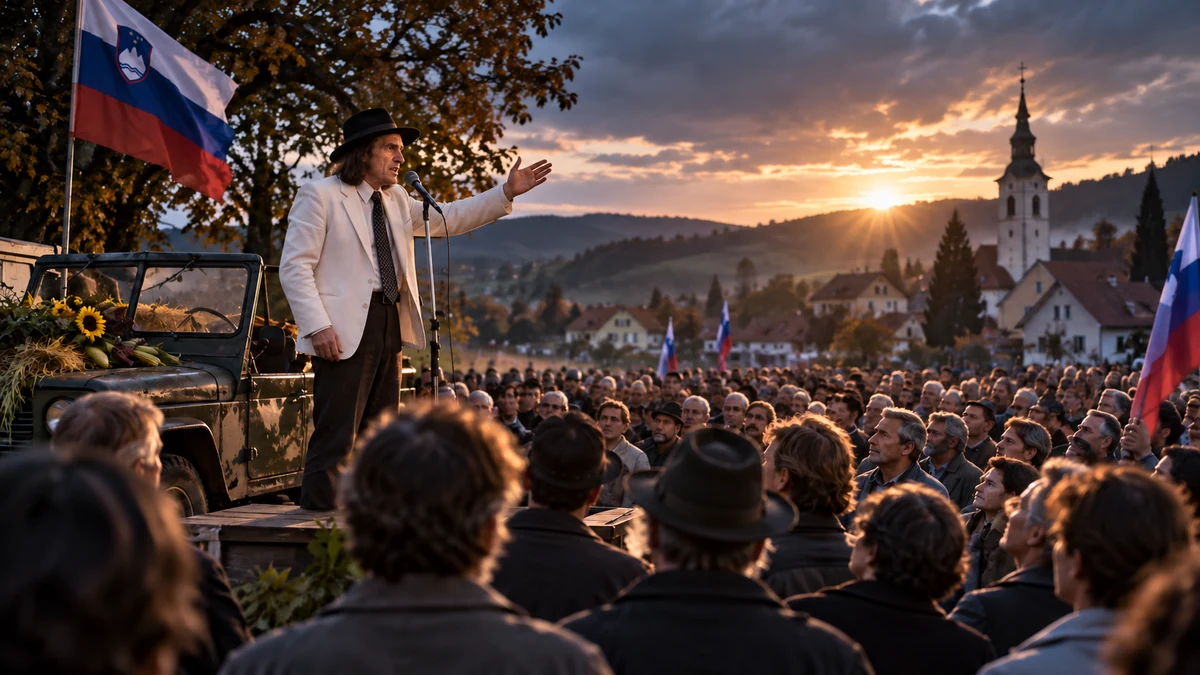
Ivan Kramberger entered Slovenian politics without a major party machine, yet won 18.5 percent of the vote in the first multiparty presidential election in 1990 and finished third. The result was a political surprise: surviving pre-election polls printed at the time generally measured him much lower. That supports describing him as a popular political phenomenon. It does not establish that he would certainly have won a presidential election in 1992.
His death on 7 June 1992 received a final judicial resolution. Peter Rotar was convicted of the killing and, on appeal, sentenced to twelve years in prison. The prosecution and court had material and circumstantial evidence they considered incriminating: Rotar's rifle had been fired, a cartridge case and soot were found in the weapon, and gunshot residue was reported on his hands. Yet the case also left real unresolved questions, which is why the political-assassination hypothesis never disappeared from public debate.
Reasons for doubt include the fact that the fatal bullet was never recovered, no eyewitness saw the shooter, Rotar later withdrew his confession, the motive was never persuasively explained, and conflicting accounts developed around a neighbouring house, the ballistics, the timeline and crime-scene handling. Some of these objections also have documented counter-explanations. It is therefore unsound either to dismiss them or to turn them automatically into proof of a political order.
This article therefore examines three separate questions: how strong Kramberger's measurable political support actually was, what the official criminal case established, and what evidence would be required for a politically ordered assassination hypothesis to move from suspicion to proof. The rule is simple: an anomaly is not proof of conspiracy, while a final judgement is not by itself a reason to stop examining documented anomalies.
First: five claims that must not be collapsed into one
Discussions of Kramberger often combine very different claims in a single sentence: that he was highly popular; that political elites saw him as a threat; that he would have won in 1992; that the killing was politically ordered; and that the state knowingly covered it up. The first claim has strong empirical support. The second has partial support in his confrontational relationship with established politics and in contemporary reactions. The last three require much stronger evidence than popularity or an unusual homicide alone.
A source-critical method therefore uses separate evidentiary thresholds. An election result establishes how many people voted for him in a particular election. A poll measures opinion at a particular time. A criminal judgement establishes the legal resolution based on the record before the court. A forensic anomaly justifies further questions. A politically ordered assassination, however, requires a link among perpetrator, principal, motive, communications, money, logistics or another independent chain of evidence.
From vineyard poverty to benefactor and self-taught public figure
Kramberger's political charisma did not originate in a party machine. He came from poverty, trained as a chimney sweep, moved to Germany and worked in fields that included dialysis technology. Slovenian biographical and press sources credit him with technical improvements and extensive philanthropy, especially the donation of dialysis machines. This biography became an important source of political capital: he presented himself as someone who had risen from poverty by his own effort and then helped others.
In politics he especially addressed people he called 'my people': workers, farmers, pensioners, the sick, disabled people and those in economic hardship. His style was improvised, direct and often theatrical. Danica Fink-Hafner's academic analysis treats him as a populist case in which personal charisma and pre-modern directness gradually sought to become modern party organisation.
1990: a result the polls failed to capture well
In the first democratic election in April 1990, Kramberger ran without the support of a major party. Official and historical sources record that he won 18.5% of the first-round vote, behind Milan Kučan and Jože Pučnik and ahead of Marko Demšar. This is the strongest evidence of his political reach.
| Measure | Kramberger | What it shows |
|---|---|---|
| Field poll, 30–31 March 1990 (N=810) | 11.4% | Shortly before election day, measured support was substantially below the final result. |
| Other pre-election waves reported by Delo | about 2.8–7.3% | Different polls underestimated him or captured unstable support. |
| First round, 8 April 1990 | 18.5% | Actual result: nearly one in five valid votes for president of the presidency. |
The gap matters. It shows that his support was difficult to measure and that he could mobilise voters outside conventional party infrastructure. It does not provide a mathematical basis for concluding that two years later he automatically became the favourite to win more than half the vote.
Was he 'chosen by the people'? What the phrase can and cannot mean
In political memory Kramberger is often described as a candidate 'chosen by the people' because he built his candidacy from below, collected signatures and spoke directly to crowds. In that sociological sense the phrase is understandable: he was not the product of a major party leadership and demonstrably won mass electoral support.
In the strict electoral sense, however, he was not elected president of the presidency in 1990. He received 18.5%, Kučan 44.4% and Pučnik 26.6%, with Kučan and Pučnik advancing to the second round. The article therefore uses 'chosen by the people' only to describe his bottom-up legitimacy and surprising mass support, not as a synonym for an actual electoral victory.
1992: a real campaign, but an unsettled final electoral strategy
By spring 1992 Kramberger was again campaigning around the country. In April, Gorenjski glas reported his election meetings and wrote that he would again run for president while also entering politics with his party. Other later accounts emphasise that he was primarily planning a parliamentary run by his political list. His strategy therefore appears in more than one form in the sources and may itself have changed.
That matters to any counterfactual claim. If even the final form of his candidacy was not fully settled before his death, the statement 'he would certainly have won the 1992 presidential election' becomes still harder to establish. What is clear is that he was politically active, drew crowds and intended to transform personal support into a more durable organisation.
Would he have won in 1992? The evidence cannot establish that
The review did not find a preserved nationwide pre-election poll from before 7 June 1992 showing Kramberger leading the presidential race or approaching a majority. That does not prove he could not have improved on his 1990 result; his earlier performance showed that polls could underestimate him. It does mean that a confident prediction of victory cannot be built from a verifiable data set.
The actual December 1992 presidential result, in which Milan Kučan received about 63.9%, does not answer the counterfactual either because Kramberger was no longer able to run. Nor is the 0.77% received by a parliamentary list carrying Kramberger's name a fair proxy for his personal popularity after his death. The defensible conclusion is that he possessed a proven and unusually large personal political base, while his future reach became unknowable because he was killed.
The day of the killing: 7 June 1992 — one shot and an immediate political shock
On 7 June 1992 Kramberger addressed a rally in Jurovski Dol. At about 18:40–18:45 he was struck by a gunshot. The wound damaged major blood vessels and he died during transport. Police arrested local resident Peter Rotar that evening. An official ministerial reply printed in the parliamentary Poročevalec states that police processed the scene, located Rotar that evening, obtained a confession during the night and then brought him before an investigating judge.
The speed with which the case focused on Rotar became one foundation of later suspicion. Speed alone, however, is not evidence of wrongdoing: police can identify a suspect quickly when concrete traces exist. The relevant question is therefore what evidence was actually present in the case.
What incriminated Rotar
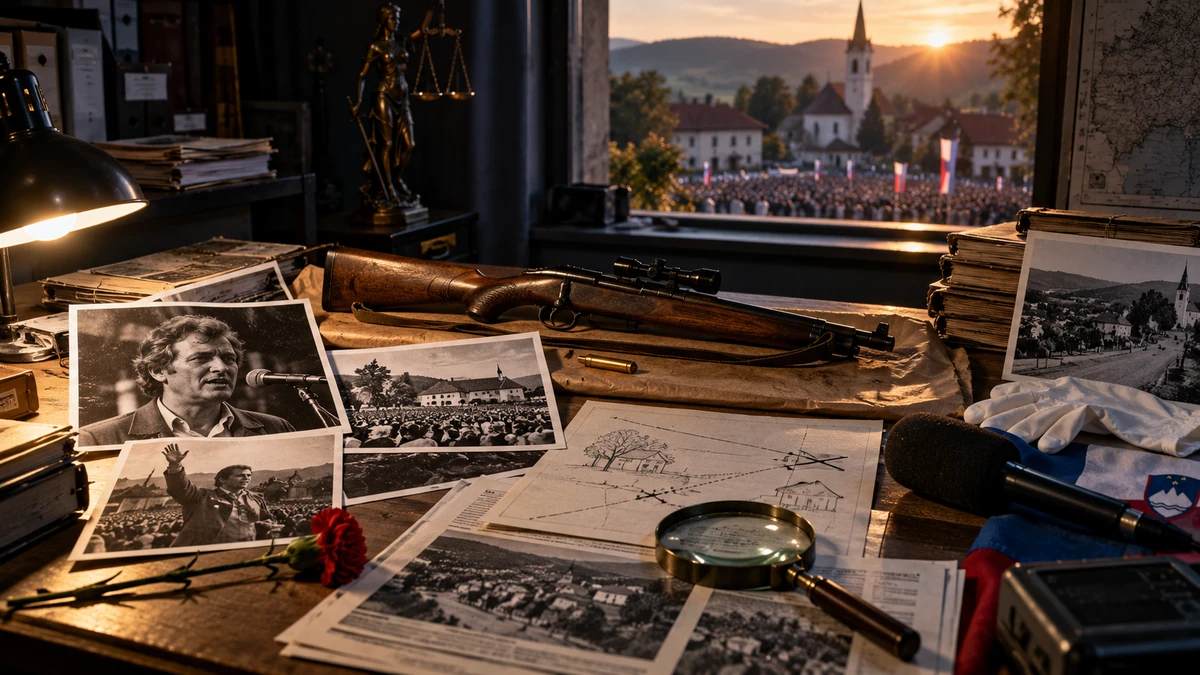
Later accounts summarising the criminal and court record identify several elements against Rotar. His hunting rifle was found by a window; a spent case was in the chamber, soot was present in the barrel, and part of the scope equipment was found near the window. Forensic testing reportedly found gunshot residue on his hands. The official reconstruction placed the firing position in his unfinished house about 63 metres from Kramberger.
Rotar first confessed to police and, according to several reports, also admitted the act before the trial court. The Maribor court sentenced him in August 1992 to nine years in prison; the higher court increased the sentence to twelve years. That is the final legal outcome and the article does not conceal it.
Why doubt persisted: documented anomalies
Public doubt did not arise only from Kramberger's political popularity. The fatal bullet was never recovered. No eyewitness directly saw the shooter. Rotar later withdrew his confession. The motive remained weakly explained. The defence disputed the firing position and pointed to the neighbouring Roškar house. Public discussion also raised questions about two drinking glasses, a shoeprint, a possible second shot and differing ballistic assessments.
Importantly, some anomalies did receive counter-explanations. Investigator Golja later said that the footprint on a chair under a window in the neighbouring house was his, because he stepped onto the chair during the inspection to look through the window. He explained the missing bullet by noting that a soft-point hunting round can expand and fragment after striking bone. Police accounts also emphasised closed or dusty shutters on the neighbouring house.
What is an anomaly, and what would already count as evidence of a cover-up
| Question | Verified state | Evidentiary weight |
|---|---|---|
| The bullet was not recovered | Yes; this is acknowledged even by defenders of the official reconstruction. | An important forensic limitation, not automatic proof of a second shooter. |
| Rotar later denied the confession | Yes; in later interviews he denied the act or expressed uncertainty. | Complicates the simple narrative, but does not erase other evidence or the judgement. |
| He was intoxicated | Yes; public sources report about 2.5‰, while higher figures come from later claims. | Relevant to capacity and responsibility, but it was addressed by expert evidence. |
| Alternative firing position | The defence and later authors proposed one; the official reconstruction rejected it. | A hypothesis requiring independent ballistic or material confirmation. |
| Political principal | No direct documentary chain of an order appears in the reviewed sources. | Unproven; it would require communications, witnesses, financial/logistical traces or other independent evidence. |
| State cover-up | There are allegations of a flawed investigation; the reviewed sources do not establish a coordinated state cover-up. | Open as a claim to investigate, not an established fact. |
This distinction is the core of the article. A flawed investigative decision can exist without a political order. A political order could theoretically exist without a documented cover-up. To combine the two claims, evidence must bridge crime-scene anomalies and specific political actors.

The state's official record: the case was not institutionally erased
An important document is the reply by the Ministry of Justice and Administration together with the Ministry of the Interior, published in the parliamentary Poročevalec in autumn 1992. It describes the timing of the rally, the scene examination, the identification of Rotar, his confession and his appearance before an investigating judge. It also explicitly states that the legality of the procedure and completeness of the findings were matters for the courts through ordinary and extraordinary legal remedies.
This means the case was not simply erased from the institutional record. Police, prosecutorial, court and parliamentary documents existed, followed by decades of public debate. The phrase 'swept under the rug' therefore has to be unpacked: one can argue that some questions never received a publicly satisfying answer; the much stronger claim of a coordinated state operation to conceal a political principal is not established by the reviewed evidence.
Political assassination: why the hypothesis is understandable — and where the chain of proof stops
The political-assassination hypothesis is not irrational. Kramberger was an unusual independent candidate with proven mass support, he sharply attacked both old and new political elites, he was campaigning again in 1992, and he himself spoke of threats and danger before his death. His killing during a political speech was, by definition, an event with an obvious political context, so testing a political motive is legitimate.
But political context is not the same as a political order. In the reviewed corpus we did not find an authentic document, communication, financial trail, witness or other independent chain connecting a specific political structure to an instruction to kill him. The article therefore does not state 'the political structure killed him' as fact. It states something stricter: a legal resolution exists, but the combination of an unexplained motive, a missing bullet, a later repudiated confession and disputes over reconstruction justifies historical testing of a political hypothesis that remains unproven.
Was the case closed too quickly? The speed is factual; its meaning is contested
The trial began in late August 1992 and the first-instance judgement was delivered after only several days of hearings. For such a politically consequential killing, that remained unusually fast in public memory. Speed by itself does not prove political pressure; it may also reflect a confession and an evidentiary picture the court considered straightforward.
Historically, however, it is legitimate to ask whether alternative hypotheses were excluded thoroughly enough. That is a different question from asserting that the judgement was knowingly fabricated. The article therefore uses investigative gaps where a missing item or disputed explanation can be shown, and uses cover-up only where there would be evidence of institutional intent to destroy, conceal or falsify material.
Evidence matrix: what the article can state without making a leap
| Claim | Status | Editorial conclusion |
|---|---|---|
| Kramberger had exceptional popular support for an independent candidate | CONFIRMED | 18.5% in the 1990 first round; the result exceeded several pre-election measurements. |
| He was again building a political campaign in 1992 | CONFIRMED | Contemporary press sources record rallies and electoral plans. |
| He would certainly have won in 1992 | UNVERIFIABLE / UNPROVEN | No nationwide pre-death data set was found that permits such a conclusion. |
| Peter Rotar was finally convicted | CONFIRMED | The initial nine years were increased to twelve; he served about nine years. |
| The bullet was not recovered and the confession was later repudiated | CONFIRMED | These are real limitations or anomalies in the official narrative. |
| Some alleged anomalies have counter-explanations | CONFIRMED | For example, the chair footprint and fragmentation of a soft-point hunting bullet were publicly explained. |
| The killing was ordered by Slovenia's political structure | UNPROVEN | The reviewed sources contain no direct chain from a specific principal to the act. |
| The entire case was swept under the rug | TOO BROAD | The case produced police, judicial and parliamentary records; specific unresolved questions nevertheless remained publicly contested. |
Conclusion: the strongest case is not certainty, but the right to ask precisely
Ivan Kramberger was a genuine political phenomenon. In 1990, without a major machine, he won nearly one fifth of the vote, while several pre-election measurements underestimated his result. His popular legitimacy is therefore not a myth. But that cannot honestly be converted into a certain victory in 1992.
Nor are doubts about the killing merely an internet invention. The missing bullet, the later repudiated confession, the unclear motive and disputes over the firing reconstruction are documented reasons for continuing interest. Against them stand a final conviction, forensic traces connected to Rotar and his rifle, and public counter-explanations for some disputed details.
The strictest conclusion is therefore twofold. It has not been proven that Slovenia's political structure removed Kramberger. Nor is it historically accurate to portray the case as containing no real anomalies and all questions as fantasy. If a new archival, forensic or testimonial chain ever appears, it should be tested by the same standard: provenance, authenticity, independent corroboration and a direct connection to the act.

Sources and further reading
- Ko, Tjaša. Historical overview of Slovenia’s first democratic elections; cites the official election commission and Uradni list for the 1990 presidential race.
- Delo, 9 April 1990, “Po bitki so lahko vsi generali” — contemporary compilation of pre-election polling immediately before the first democratic election.
- Gorenjski glas, April 1990 — contemporary report of first-round election results including Kramberger’s 18.5%.
- Gorenjski glas, 17 April 1992, “Vsi so komunisti in vsi samo stole glodajo!” — contemporary report from Kramberger’s 1992 campaign meetings.
- Fink-Hafner, Danica (2020). Populizem. Faculty of Social Sciences, University of Ljubljana. Contains a comparative analysis of Kramberger’s populism and political institutionalisation.
- Obrazi slovenskih pokrajin. Ivan Kramberger — biographical record and bibliography of his published works.
- Delo. “Dobri človek iz Negove” — retrospective biography of Kramberger, his political organising, reported threats and circumstances of death.
- Delo, 7 June 2022. “Pred 30 leti pod strelom atentatorja umrl Ivan Kramberger” — summary of the killing, trial and later forensic explanations.
- Delo, 6 June 2026. “Strel je 7. junija prekinil glas dobrotnika” — anniversary review of Kramberger’s life, electoral result and unresolved public questions.
- Skupščina Republike Slovenije, Poročevalec, 15 October 1992 — ministerial reply describing the police procedure, identification of Rotar and transfer to the investigating judge.
- Siol / Kartoteka, “Atentat na Ivana Krambergerja” — documentary review presenting both the final conviction and enduring objections to the investigation.
- Svet24/Vestnik, 2022. “Zgodba prvega in edinega atentata v Sloveniji” — detailed chronology of evidence, trial and judgement.
- 24ur.com / STA, 7 June 2022. “Pred 30 leti pod strelom atentatorja umrl Ivan Kramberger” — election context, official case and continuing theories.
- 24ur.com, 2012. “Pok, ki tudi po 20 letih še vedno odmeva” — includes investigator comments on ballistics and the disputed neighbouring-house footprint.
- Dnevnik, 2022. “Ivan Kramberger in teorija drugega strelca” — retrospective discussion of the second-shooter hypothesis, missing bullet and intoxication issue.
- Dnevnik, 29 December 2024. “Se še spominjate edinega atentata na politika pri nas?” — biographical and trial retrospective.
- Reporter, 2022. “Skrivnostni umor Ivana Krambergerja” — presents doubts and also investigator counter-explanations, including the bullet-fragmentation account.
- Slovenske novice, 2012. “Bil sem na smrt pijan, pa naj bi ustrelil Iveka!” — later interview material on Rotar’s repudiation of his confession and defence objections.
- Večer, interview with Ivan Kramberger Jr. — retrospective account of the official case and family’s continuing doubts.
- Arhiv družboslovnih podatkov, Slovensko javno mnenje 1992: Media — contemporaneous survey documentation; used only as context, not as a pre-death presidential voting poll.
- Državna volilna komisija. Poročilo o izidu volitev predsednika Republike Slovenije, 1992.
- Uradni list Republike Slovenije. Poročilo o izidu volitev predsednika republike, December 1992.
- Državna volilna komisija. Volitve v državni zbor 1992 — official national results, including the list carrying Kramberger’s name.
- Statistični urad Republike Slovenije. Statistični letopis 1994 — official statistical chart of the 1992 presidential election.
- Kršinar, Igor. Komu je bil napoti Ivan Kramberger — book description and summary of the author’s political analysis.
- Knjižnica Medvode. Presentation of Igor Kršinar’s work on Kramberger; includes 1990 electoral context and political biography.
- Reporter. Anniversary review “Komu je bil napoti dobrotnik iz Negove” — electoral result and interpretation of Kramberger’s voter base.