Hitler's Death: The Bunker, Forensics, and Open Questions in the Postwar Trail
What can be reconstructed with confidence about Hitler's final days, and what remains open? The article compares bunker testimony, dental identification, Soviet handling of remains, and FBI/CIA postwar leads without treating either escape or the bunker-death reconstruction as beyond further scrutiny.
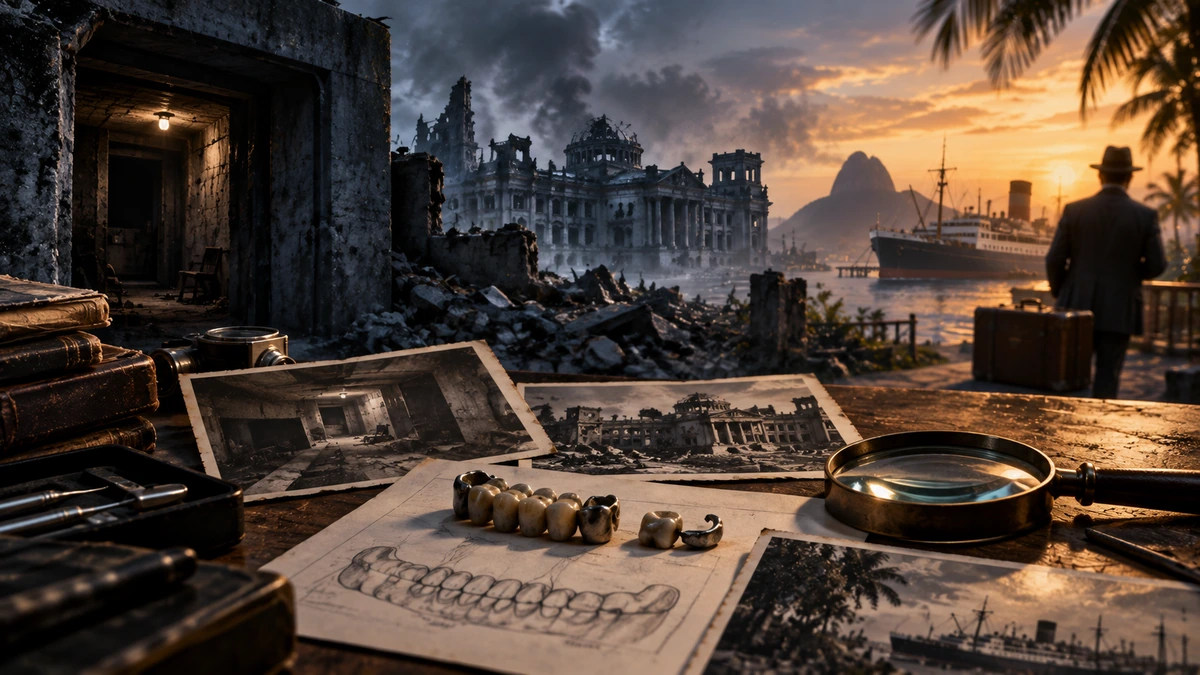
Few historical deaths have produced as many persistent competing narratives as the final days of Adolf Hitler in April 1945. His body was not publicly displayed, the remains were heavily damaged by fire, Soviet authorities issued contradictory postwar messages, and genuine Nazi fugitives later lived under false identities in South America.
The article therefore does not begin by assuming that the official bunker reconstruction must be complete, nor by assuming that Hitler certainly escaped. It examines two competing possibilities and, above all, the quality of their evidentiary chains: witness testimony, dental identification, and X-rays on one side; postwar sightings, intelligence leads, and real escape networks on the other.
The bunker reconstruction is supported today by several overlapping witness accounts and a strong dental record, including ante-mortem X-rays and later direct examination of jaw and dental remains. Yet the historical force of that material is also tied to provenance, handling of the remains, and a Soviet archival chain that was not openly available for independent contemporary scrutiny.
Postwar leads from Argentina, Colombia, and elsewhere are likewise real as archived tips and reports, but their contents have not been verified through a comparable continuous identification chain. this article therefore leaves open the possibility that parts of the official narrative are incomplete or wrong, while also leaving open the possibility that postwar stories were mistaken, exaggerated, or deliberately fabricated. Keeping the question open does not mean all hypotheses carry equal evidentiary weight.
What are we actually testing?
The statement 'Hitler died in the bunker' is not a single claim. It includes that he was still in the Führerbunker on 30 April 1945, that he and Eva Braun withdrew into private rooms, that associates later described them as dead, that remains were carried into the garden and burned, and that Soviet investigators later recovered material connected with Hitler's dental anatomy. Each link has its own sources, provenance, and degree of directness.
An escape hypothesis requires a different chain: positive postwar identification of the same person. That might include verifiable travel or identity records, independently confirmed locations, biometric or forensic matching, financial or communications traces, and witnesses whose information does not derive from one another. At the same time, the official reconstruction should not become immune from scrutiny simply because it became the standard historical account.
The article therefore has two aims: to explain why the bunker reconstruction currently carries greater evidentiary weight, while marking the places where provenance problems, contradictory official statements, or missing data remain. Postwar South American leads are treated as genuine archival leads, but not as verified identification unless their contents can be independently tied to the same person.
Berlin on 30 April 1945: the room for escape closes
By late April 1945 central Berlin was under direct Red Army pressure. MI5's postwar summary of bunker testimony describes nearby shelling, the collapse of planned relief operations, and Hitler's admission to members of his staff that the war was lost. His political and personal testaments and his marriage to Eva Braun were completed during the night of 28–29 April.
That does not by itself prove the later death, but it places the final hours in a verifiable context. Hitler spoke in his last days of not falling into Soviet hands, staff destroyed his personal papers, and preparations for the end intensified inside the bunker. Historical reconstruction therefore begins not with a corpse but with the sequence of decisions and actions before 30 April.
Farewells and the withdrawal into private rooms
Several witnesses described Hitler saying farewell to staff. According to British postwar interrogations, Hitler and Eva Braun withdrew into his private quarters on 30 April while staff and guards remained outside. That time point matters because later testimony comes not from a single source but from several people who observed different parts of the same sequence.
No witness described the instant of a gunshot or poison ingestion inside the room. That is an important limit. The testimony is direct for events before the room was closed and for what witnesses said they observed after it was opened, not for every physiological moment inside. Direct observation, witness inference, and later historical reconstruction therefore need to be kept distinct.
What Linge, Günsche, and others reported
Hitler's valet Heinz Linge and adjutant Otto Günsche described Hitler dead in the room with visible blood around the head; Günsche referred to a gunshot wound at the right temple. Eva Braun did not display a comparable gunshot injury and was associated in several accounts with cyanide. Witnesses differ on details of body position, but their basic chronology overlaps strongly.
Bunker witnesses must be evaluated with the possibility of faulty memory, self-interest, and later cross-influence in mind. Their historical weight does not depend on one witness being infallible, but on the convergence of multiple witnesses on key points: Hitler remained in the bunker, was found dead after withdrawing to the private room, was recognized, and was carried into the garden.
Burning the bodies in the Reich Chancellery garden
Witnesses including Günsche, Linge, and Hitler's driver Erich Kempka described the bodies being carried through the bunker exit into the Reich Chancellery garden, doused with petrol, and burned while Soviet shelling continued. MI5's summary states that the bodies were only partly destroyed by fire and were then hastily buried nearby.
This helps explain two later problems: why there was no intact public corpse and why identification came to depend so heavily on dentistry. Burning sharply reduces the possibility of ordinary morphological identification, while metal dental prostheses and teeth can survive conditions that destroy much soft tissue. Dental evidence therefore became central.
The British investigation: why Hugh Trevor-Roper was sent
When the Soviet Union publicly suggested in June 1945 that Hitler might still be alive, the Western Allies faced a practical intelligence question: was the leader of the defeated regime dead or in flight? British intelligence collected and compared interrogations of people from Hitler's immediate circle, and historian-intelligence officer Hugh Trevor-Roper produced a reconstruction later published as The Last Days of Hitler.
Trevor-Roper's reconstruction was not a forensic identification and is not the final word on every detail. Its value lies in the early collection of multiple separate accounts; its limitation is that it operated in a postwar intelligence environment without full access to Soviet physical material. Later research has mostly refined the bunker chronology rather than producing a verified postwar Hitler biography, but that does not require every element of the early reconstruction to be accepted without further scrutiny.

The Soviet search and contradictory information
Soviet units and SMERSH searched the Reich Chancellery and bunker area in May 1945. Later Soviet records describe the recovery of burned remains and dental material. At the same time Soviet leaders allowed or encouraged the possibility, in statements to Western interlocutors and the public, that Hitler had escaped. MI5 today describes the June Soviet claim that no remains had been found and that Hitler was probably alive as false.
That duality matters in its own right. It shows that the official postwar information picture was neither uniform nor transparent, making later doubt understandable. But contradiction alone cannot establish either escape or a deliberately staged death: concealment, disinformation, institutional confusion, or a mixture of motives are all logically possible. The article therefore treats Soviet opacity as an open question of provenance and intent, not as standalone proof for either hypothesis.
The key question is therefore how much of the bunker reconstruction can also be supported outside the Soviet narrative: bunker witnesses, pre-death dental documentation, later odontological comparisons, and modern researchers' access to preserved material.
The teeth: identification beginning in May 1945
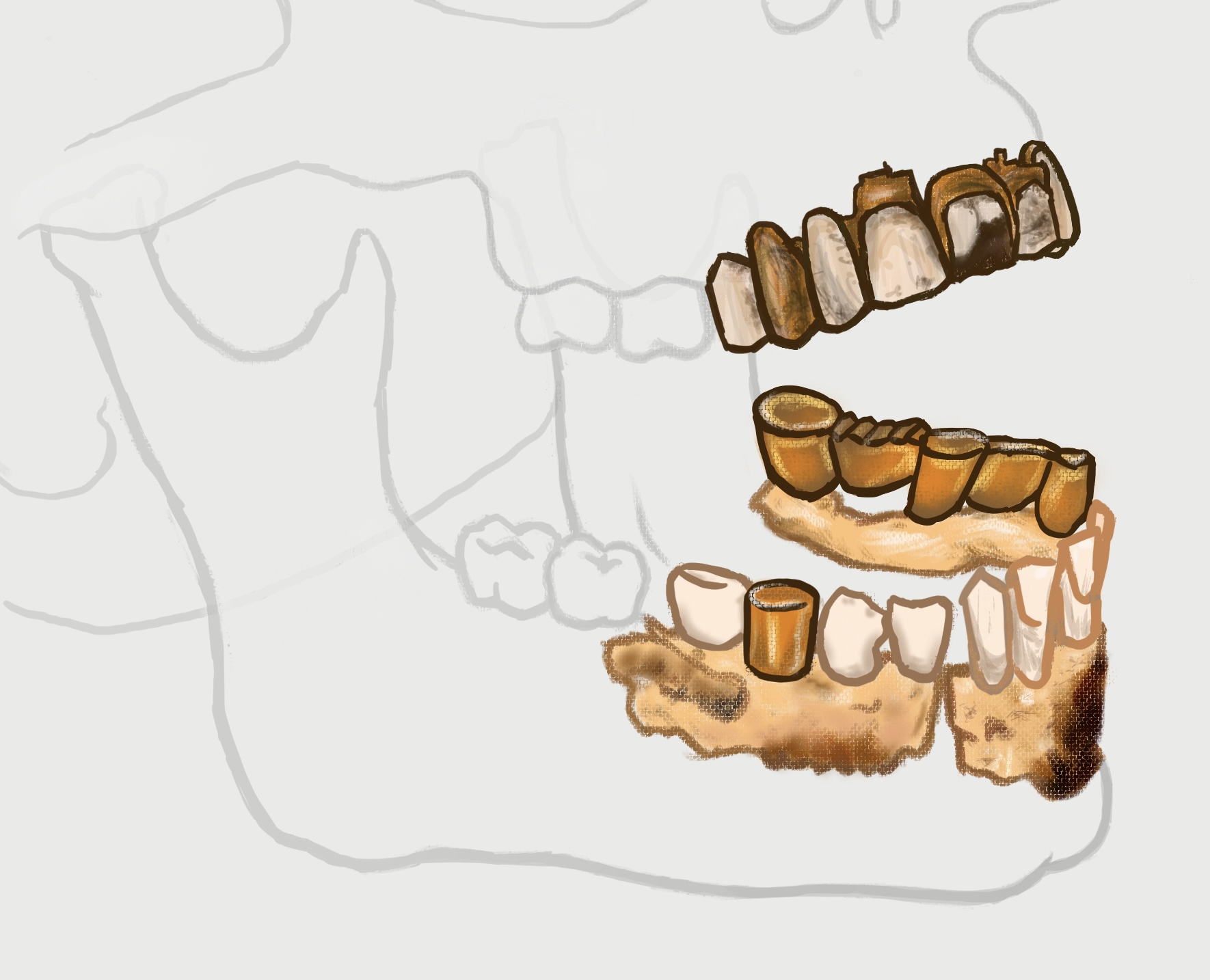
The most important physical evidence consists of jaw fragments, teeth, and complex dental prostheses. In May 1945 Soviet investigators questioned Käthe Heusermann, assistant to Hitler's dentist Hugo Blaschke, and dental technician Fritz Echtmann. Both knew the unusual details of Hitler's bridges, crowns, and other work, and their descriptions were used to identify the recovered dental remains.
The significance is individualization. This was not a generic statement that Hitler had 'bad teeth' but a highly specific combination of missing teeth, crowns, metal bridges, and custom constructions. That strongly supports identification of the material as Hitler's if the object's provenance is correctly reconstructed. The historical question is therefore not only 'do the teeth match?' but also 'how securely can the material be traced from recovery to later archival examination?'
The 1944 X-rays and forensic odontology
X-rays of Hitler's head taken in 1944 were preserved in U.S. records. Forensic odontologists Reidar Sognnaes and Ferdinand Strøm compared radiographic documentation, postwar interrogations of dental personnel, and Soviet-published information about the dental remains. In 1973 they published a detailed odontological identification.
This matters because part of the identification chain lies outside direct Soviet control. The ante-mortem radiographs were created before the alleged bunker death, and their prosthetic features match later documented remains. That correspondence is among the strongest arguments for the bunker reconstruction, but by itself it does not resolve every question about where and under what circumstances the identified material was recovered and preserved.
2017–2018: direct examination of the Moscow remains
A French team led by forensic pathologist Philippe Charlier obtained access in 2017 to jaw and dental remains held in Russian archives and published its findings in the European Journal of Internal Medicine in 2018. The researchers compared morphology and prosthetic details with Soviet records and with Hitler's 1944 X-rays. The study explicitly presented itself as a 'definitive identification.'
This examination gives the bunker account important modern forensic support: the dental and jaw material examined matches Hitler's ante-mortem documentation in anatomical and prosthetic detail. But identification of the examined material should be distinguished from a complete reconstruction of its path from the Reich Chancellery to the present archive. The first is a direct forensic comparison; the second also depends on historical provenance and the Soviet chain of custody.
this article therefore neither minimizes the study nor treats it as a magical solution to every open question. It is a very strong piece of the evidentiary puzzle and must be read alongside witness testimony, X-rays, postwar investigations, and documentation concerning the handling of the remains.
The skull fragment: a real problem, but a separate item
A separate skull-vault fragment with a hole, held by the Russian State Archive and associated with Hitler, attracted major attention. In 2009 a U.S. team reported that DNA from a sample of that fragment was female. The result legitimately raised provenance questions about that particular object and showed why Soviet archival material should not be treated as one indivisible package.
But the skull fragment and the dental jaw are not the same object or the same identification chain. Charlier's 2018 team noted that sex could not be reliably determined morphologically from the heavily heat-altered fragment and that further DNA work would be useful to link the skull and jaw. The skull controversy therefore weakens confidence in that individual fragment; it does not automatically erase the independent dental match.
Gunshot, cyanide, or both?
The identity of the deceased must be separated from the precise mechanism of death. Bunker witnesses described a gunshot injury in Hitler and signs of poisoning in Eva Braun. The Soviet publication of 1968 emphasized cyanide for Hitler as well, but the quality and completeness of the Soviet post-mortem record were later criticized.
A 2005 forensic review noted that the available record does not permit a complete toxicological reconstruction. Charlier's team in 2018 found no gunpowder residue on the teeth or in the oral region, arguing against a shot through the mouth but not necessarily against a temple shot. Two questions therefore remain distinct: whether the examined remains belong to Hitler and exactly how that person died. The second is clearly less settled than the first.
The West German judicial inquiry and death certificate
The absence of an intact publicly displayed corpse also created legal problems. A West German court in Berchtesgaden spent several years from 1952 collecting testimony and documentation about Hitler's death. The inquiry involved dozens of witnesses and analysis of inconsistencies among their statements; an official death certificate was issued in 1956.
That proceeding was not a substitute for forensics but an additional legal and testimonial reconstruction outside the Soviet intelligence chain. Its finding strengthens the bunker account, but it cannot by itself resolve questions dependent on physical identification, provenance of remains, or information to which the West German inquiry may not have had access.
What the FBI files actually mean
The FBI's public Hitler archive is authentic and contains postwar tips, letters, press clippings, and reports of alleged sightings in several countries, including South America. That means such information genuinely circulated and was entered into U.S. government files or, in some cases, checked.
But the authenticity of a document must be separated from the truth of its contents. A perfectly authentic file can record a false report, mistaken identification, rumor, deliberate disinformation, or a genuine sighting. These records should therefore neither be dismissed merely as 'rumors' nor automatically converted into proof of Hitler's presence in South America.
For each lead, the key question is whether it can be connected to additional independent data: the identity of the person, a photograph with demonstrable provenance, travel papers, residence records, communications, or witnesses who did not derive their story from the same original source.
CIA 1955: Colombia, a photograph, and Adolf Schrittelmayor
The best-known later intelligence item is an October 1955 CIA Caracas station memorandum. A source codenamed CIMELODY-3 relayed a friend's story connected with former SS man Phillip Citroen: Hitler was allegedly living in Colombia under the name Adolf Schrittelmayor and later moved to Argentina. A photograph of a man presented as the supposed Hitler was associated with the report.
The document is authentic and therefore historically important. At the same time, it records its own limitation: the station could not reliably evaluate the information. Several possibilities remain open—from a genuine lead to mistaken identity to a fabricated or deliberately planted story. The document is therefore not confirmation of Hitler's postwar residence, but neither is it nothing: it is a concrete lead whose contents remain unverified.
What would move the story from intelligence lead to identification would be additional material: the original photograph with a demonstrable chain of provenance, the identity and biography of the man shown, independent Colombian or Argentine records, and data matching known biometric or medical characteristics of Hitler.

South America: real escape networks and unverified Hitler leads
The South American hypothesis did not arise in a vacuum. Adolf Eichmann escaped to Argentina and lived there as Ricardo Klement; Josef Mengele also reached South America and used multiple identities. Postwar routes, helpers, false papers, and communities in which former Nazis could hide are historically documented.
That creates a real infrastructure in which escape was possible, not an automatic identification of Hitler. If Hitler had survived Berlin, South America would not be an absurd destination precisely because other wanted Nazis used it. But moving from possibility to historical finding requires a personal trail of the same individual.
Conversely, the absence of a complete dossier known today is not logical proof that such a trail never existed. Documents can be lost, destroyed, never created, or remain inaccessible. It is equally possible that sightings arose from resemblance, attention-seeking, postwar anxiety, political interests, or deliberate disinformation. this article therefore accepts neither 'there is no complete dossier, so escape was impossible' nor 'there is an FBI/CIA document, so escape is proven.'
The public evidence currently known gives greater overall weight to the bunker reconstruction, especially because of dental identification and converging witnesses. The South American possibility remains open as an unverified hypothesis unless and until a positive identification chain bridges Berlin in 1945 to a specific postwar life.
Conclusion: an open question, but not equal evidence
The bunker reconstruction is not built from a single official statement. It is supported by multiple accounts from Hitler's immediate circle, dental testimony from 1945, ante-mortem X-rays, later forensic odontology, and modern examination of preserved jaw and dental material. In the evidence currently available, it therefore carries greater cumulative weight than any individual postwar escape story.
That is not the same as claiming that every detail of the official history has been conclusively and independently demonstrated. The body was not publicly identified intact, the remains were burned and then held under Soviet control, Soviet messaging was contradictory, provenance problems arose around the skull fragment, and the precise mechanism of death remains disputed. The article therefore leaves room for the possibility that parts of the standard account are incomplete, mistaken, or deliberately concealed, without treating that possibility as automatic proof of escape.
The same principle applies to Argentina, Colombia, and other proposed postwar locations. FBI and CIA records are authentic historical documents and should not be ignored. But their contents do not currently form a continuous personal identification chain. They may preserve genuine leads, mistaken sightings, or deliberately created stories.
this article therefore does not close the case with an absolute 'definitely bunker' or 'definitely Argentina.' It locks only the evidentiary state: the evidence currently known supports death in Berlin more strongly, but concrete historical gaps remain; postwar South American leads exist, but remain unverified. If new verifiable provenance, biometric material, or an independent documentary chain emerges, the historical reconstruction must remain open to revision.
Sources and further reading
- MI5, ‘Hitler's last days’ — postwar British intelligence summary based on interrogations of bunker personnel.
- Charlier, P., Weil, R., Rainsard, P., Poupon, J., & Brisard, J.-C. (2018). ‘The remains of Adolf Hitler: A biomedical analysis and definitive identification.’ European Journal of Internal Medicine 54, e10–e12. PMID 29779904.
- Marchetti, D., Boschi, I., Polacco, M., & Rainio, J. (2005). ‘The death of Adolf Hitler—Forensic aspects.’ Journal of Forensic Sciences 50(5), 1147–1153. PMID 16225223.
- Sognnaes, R. F., & Strøm, F. (1973). ‘The odontological identification of Adolf Hitler. Definitive documentation by X-rays, interrogations and autopsy findings.’ Acta Odontologica Scandinavica 31(1), 43–69.
- FBI Records: The Vault — Adolf Hitler files; postwar survival rumors and investigative leads.
- CIA, Chief of Station Caracas, HVCA-2592 (3 October 1955), report relaying the CIMELODY-3 / Phillip Citroen Hitler-survival story.
- United States Holocaust Memorial Museum, ‘Adolf Eichmann’ — escape to Argentina under aliases and capture in 1960.
- United States Holocaust Memorial Museum, ‘Josef Mengele’ — postwar flight to South America and death in Brazil.
- Trevor-Roper, H. (1947; later editions). The Last Days of Hitler. British intelligence reconstruction from early postwar interrogations.
- Kershaw, I. (2008). Hitler: A Biography. W. W. Norton.
- Beevor, A. (2002). Berlin: The Downfall 1945. Penguin/Viking.
- Joachimsthaler, A. (1999). The Last Days of Hitler: The Legends, the Evidence, the Truth. Brockhampton Press.
- Petrova, A., & Watson, P. (1995). The Death of Hitler: The Full Story with New Evidence from Secret Russian Archives. W. W. Norton.
- Eberle, H., & Uhl, M. (eds.) (2005). The Hitler Book: The Secret Dossier Prepared for Stalin from the Interrogations of Hitler's Personal Aides. PublicAffairs.
- Vinogradov, V. K., Pogonyi, J. F., & Teptzov, N. V. (2005). Hitler's Death: Russia's Last Great Secret from the Files of the KGB. Chaucer Press.
- Brisard, J.-C., & Parshina, L. (2018). The Death of Hitler. Da Capo Press.
- Linge, H. (2009). With Hitler to the End: The Memoirs of Adolf Hitler's Valet. Frontline Books.
- Misch, R. (2014). Hitler's Last Witness: The Memoirs of Hitler's Bodyguard. Frontline Books.
- Junge, T., & Müller, M. (2004). Until the Final Hour: Hitler's Last Secretary. Arcade.
- O'Donnell, J. P. (1978/2001). The Bunker. Da Capo Press.
- Musmanno, M. A. (1950). Ten Days to Die. Doubleday — postwar investigation and witness interviews concerning Hitler's final days.
- Bezymenski, L. (1968). The Death of Adolf Hitler — published Soviet account and autopsy claims, used critically because of later acknowledged distortions.
- German Federal Court / Berchtesgaden death inquiry, summarized in contemporary reporting on Hitler's 1956 death declaration.
- U.S. National Archives, Nazi War Crimes and Japanese Imperial Government Records Interagency Working Group — archival framework for declassified Nazi-war-crimes records.
- CIA FOIA / Nazi War Crimes Disclosure Act collection — intelligence records released under the disclosure process.
- Smithsonian Magazine (2018), ‘Hitler's Teeth Confirm He Died in 1945’ — report on Charlier team's direct examination.
- ABC News (2009), ‘DNA Test Sparks Controversy Over Hitler's Remains’ — reporting on DNA testing of the Russian skull fragment.
- CNN / Interfax (2009), report on KGB archival account of the 1970 destruction of remains held at Magdeburg.
- Goñi, U. (2002/2009). The Real Odessa: How Perón Brought the Nazi War Criminals to Argentina. Granta.
- Phayer, M. (2008). Pius XII, The Holocaust, and the Cold War. Indiana University Press — context on postwar escape networks and clergy involvement.
- Dunstan, S., & Williams, G. (2011). Grey Wolf: The Escape of Adolf Hitler — influential modern statement of the Argentina escape thesis, used as a claim source rather than independent confirmation.
- History Channel, Hunting Hitler — television series popularizing declassified leads and South American escape scenarios; used as media-history evidence.
- Evans, R. J. (2020). The Hitler Conspiracies: The Third Reich and the Paranoid Imagination. Oxford University Press.
- McKale, D. M. (1981). Hitler: The Survival Myth. Stein and Day — historical study of the postwar survival legend.