The Grand Chessboard — Zbigniew Brzezinski: Eurasia as a Geopolitical Chessboard
How did Zbigniew Brzezinski in 1997 understand Eurasia, American primacy, geopolitical pivots and Ukraine’s special role — and how can the book be compared with later history without confusing similarity with causality?

In his 1997 book The Grand Chessboard, Zbigniew Brzezinski publicly set out a strategy of American primacy in which Eurasia is the central arena of world power.
The book distinguishes geostrategic players from geopolitical pivots and assigns particular importance to Europe, Russia, Ukraine, the Caucasus, Central Asia and China.
Later developments — from NATO enlargement to deepening NATO–Ukraine relations — are important historical context, but they do not by themselves prove that the book caused those policies or that later actors shared Brzezinski’s 1997 motives.
The article therefore separates Brzezinski’s recommendations, primary documents, later history and retrospective comparison to show how the author understood Eurasia as a geopolitical chessboard.
A book about American primacy after the Cold War
Zbigniew Brzezinski published The Grand Chessboard: American Primacy and Its Geostrategic Imperatives in 1997, after the Soviet collapse had left the United States without a comparable global competitor. The book was not a secret plan or classified memorandum but a publicly published geopolitical program by a former National Security Adviser to President Jimmy Carter. Its starting point is explicit: in Brzezinski’s view, the endurance of American global primacy depends above all on how the United States manages the balance of power in Eurasia.
Eurasia is decisive in his framework because it contains most of the world’s population, a large share of economic activity and resources, and nearly all plausible major challengers to U.S. primacy. American strategy is therefore not described mainly as territorial defense, but as geostrategy aimed at preventing the emergence of a dominant Eurasian power capable of excluding or constraining the United States. This is a central thesis of the book itself, not a later claim invented by its critics.
Geostrategic players and geopolitical pivots
Brzezinski distinguishes states that can independently alter regional power balances from states whose importance derives primarily from location. He calls the first group geostrategic players and the second geopolitical pivots. In the book, France, Germany, Russia, China and India are major active players; Ukraine, Azerbaijan, South Korea, Turkey and Iran are among the critical pivots.
The terminology reveals the method. A country may be strategically decisive without being a great power because its position opens or closes routes, separates spheres of influence, affects access to resources or changes the options of a stronger neighbor. Critics may regard that perspective as overly instrumental toward smaller states, but This article does not make that evaluation for the reader; the important point is that this map of players and pivots is foundational to Brzezinski’s analysis.
Europe as America's bridgehead in Eurasia
Brzezinski treats the transatlantic relationship as the foundation of American presence on Eurasia’s western edge. He supports the eastward enlargement of European and Atlantic institutions because a wider, more stable Europe would expand the Western political space and influence Russia’s future orientation. France and Germany receive particular attention as active players in European integration.
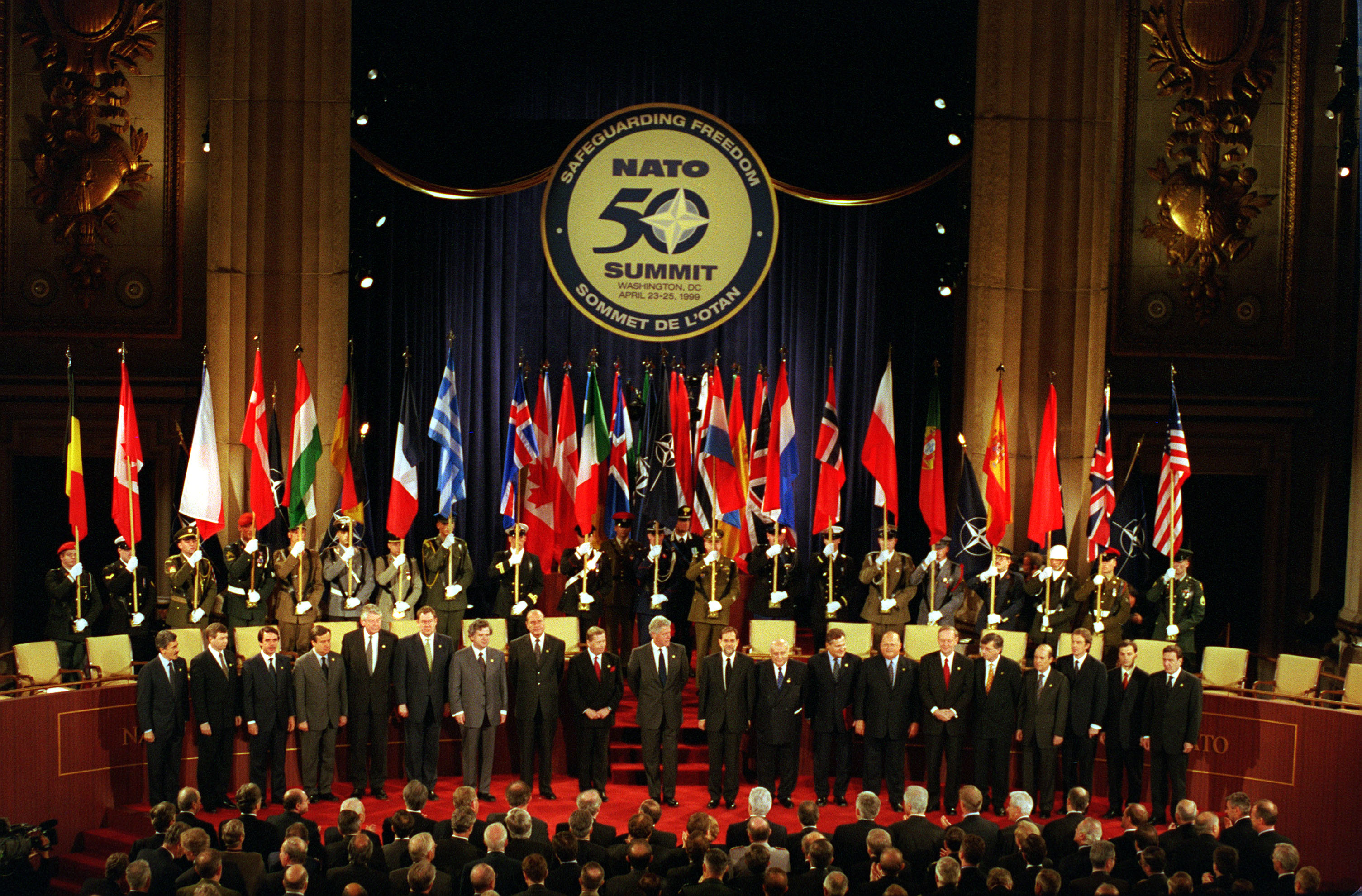
In the same year the book appeared, NATO and Ukraine signed the Charter on a Distinctive Partnership. NATO then admitted Czechia, Hungary and Poland in 1999 and seven additional states in 2004. These are documented historical events, but they do not by themselves prove that enlargement occurred because Brzezinski prescribed it. They are directly relevant, however, to understanding the strategic environment in which his argument was made and how some of the questions in the book later moved from theory into policy.
Russia: European state or renewed Eurasian center?
After the Soviet collapse, Brzezinski portrays Russia as facing a choice between deeper integration with a wider Europe and an attempt to rebuild a special Eurasian sphere. His preferred American outcome is the first: a post-imperial and decentralized Russia linked more closely to Europe rather than the center of a new bloc reassembling the post-Soviet space under Moscow.
The book therefore opposes the restoration of a Russian empire, but not necessarily the existence of a strong Russia as such. Brzezinski’s longer-term vision allows for deeper cooperation between Europe and Russia if Moscow accepts the sovereignty of the former Soviet republics. That qualification matters: his strategy clearly seeks to limit the possibility of Russian imperial restoration, but its declared final horizon is not permanent isolation of Russia.
Ukraine as the most important geopolitical pivot
The most frequently cited part of the book concerns Ukraine. Brzezinski calls it a crucial geopolitical pivot because, in his analysis, its independence changes Russia’s strategic possibilities. His argument is that without political control of Ukraine, Russia has much greater difficulty reconstituting a European-Eurasian empire; Ukraine, meanwhile, could gradually move toward European and Atlantic institutions.
On page 121, Brzezinski even suggests the period 2005–2015 as a reasonable time frame for beginning Ukraine’s progressive inclusion in Western structures. This is not the same as predicting a war or laying out a precise script for later events. NATO and Ukraine signed a distinctive partnership in 1997, an Action Plan followed in 2002, and in 2008 NATO Allies stated in Bucharest that Ukraine and Georgia would become members. Later events therefore give the passage considerable retrospective weight, but it remains a strategic recommendation written in 1997.

The Caucasus and Central Asia: energy, corridors and pluralism
Brzezinski describes the space between the Black Sea, the Caucasus and Central Asia as an arena where the interests of Russia, Turkey, Iran, China and the United States overlap. He singles out Azerbaijan, Uzbekistan and Ukraine as states whose independence helps preserve geopolitical pluralism in the former Soviet area. Azerbaijan is also important in his analysis because of access to Caspian energy resources and transport routes.
Here geopolitics and economics connect directly. Brzezinski discusses not only alliances but pipelines, transport corridors, market access and the prevention of a single power monopolizing a strategic region. His recommendation is that no one power control the area and that it remain open to the wider global economy. This is a recognizable balance-of-power strategy, presented as serving both U.S. interests and wider access.
China, Japan and the eastern edge of the chessboard
In East Asia, Brzezinski identifies China as a major geostrategic player while treating Japan as an economically formidable state whose security relationship with the United States limits its independent geostrategic role. On China, he cautions that automatically treating Beijing as an enemy could become self-fulfilling. His preferred approach combines continued U.S. presence, regional alliances and engagement with China inside a wider balance.
The book is therefore not simply a program of confrontation with every possible competitor. Brzezinski seeks an arrangement in which no single power dominates Eurasia while the United States retains enough influence to function as an external political arbiter. This produces one of the book’s central tensions: it speaks in favor of pluralism and cooperation, but seeks them within a structure in which American primacy remains central.
From American primacy to longer-term cooperation
Some of the book’s sharpest passages use the language of hegemony, empire, vassals, tributaries and preventing rival combinations. Brzezinski deliberately invokes the vocabulary of older empires as an analogy and is unusually direct about the management of American power. This is one reason The Grand Chessboard is so frequently cited in debates about U.S. strategy.
Yet the book’s ultimate horizon is more complicated. Brzezinski argues that American predominance cannot last indefinitely and that the longer-term goal should be a more institutionalized and cooperative global order. His interim prescription remains clear: until such an order exists, American policy should prevent the emergence of a Eurasian challenger capable of displacing the United States. This article therefore treats the book neither as a secret revelation of every later event nor as an irrelevant historical curiosity. It presents it as a public, influential and unusually explicit geostrategy of its period, leaving readers to assess its significance for later Eurasian developments.
Sources and further reading
- WorldCat — The Grand Chessboard, first edition, BasicBooks 1997
- Google Books — The Grand Chessboard, Basic Books
- Google Books — revised edition with epilogue
- Foreign Affairs — Zbigniew Brzezinski, A Geostrategy for Eurasia (1997)
- Foreign Affairs — Brzezinski author archive
- JSTOR — Foreign Affairs Vol. 76 No. 5, A Geostrategy for Eurasia
- NATO — Charter on a Distinctive Partnership with Ukraine, 9 July 1997
- NATO — Relations with Ukraine chronology
- NATO — A short history of NATO / 1999 enlargement
- NATO — Seven new members join NATO, 29 March 2004
- NATO — NATO-Ukraine Action Plan, 22 November 2002
- NATO — Bucharest Summit Declaration, 3 April 2008
- NATO — Ukraine and Georgia membership aspirations, 3 April 2008
- Publishers Weekly — 1997 review of The Grand Chessboard
- Institute of Central Europe — Brzezinski's perspective on Ukraine (2023)
- Taylor & Francis — Ukraine, World Power and Imperialism (2023)
- NATO — Poland and NATO accession history
- Ukraine MFA — history of cooperation with NATO