Gladio and Europe’s Stay-Behind Networks: What Is Documented and What Remains Disputed?
Europe’s stay-behind networks are a documented historical fact. But clandestine infrastructure is not, by itself, proof that Gladio directed every terrorist attack associated with the strategy of tension. Where does the archive end and inference begin?
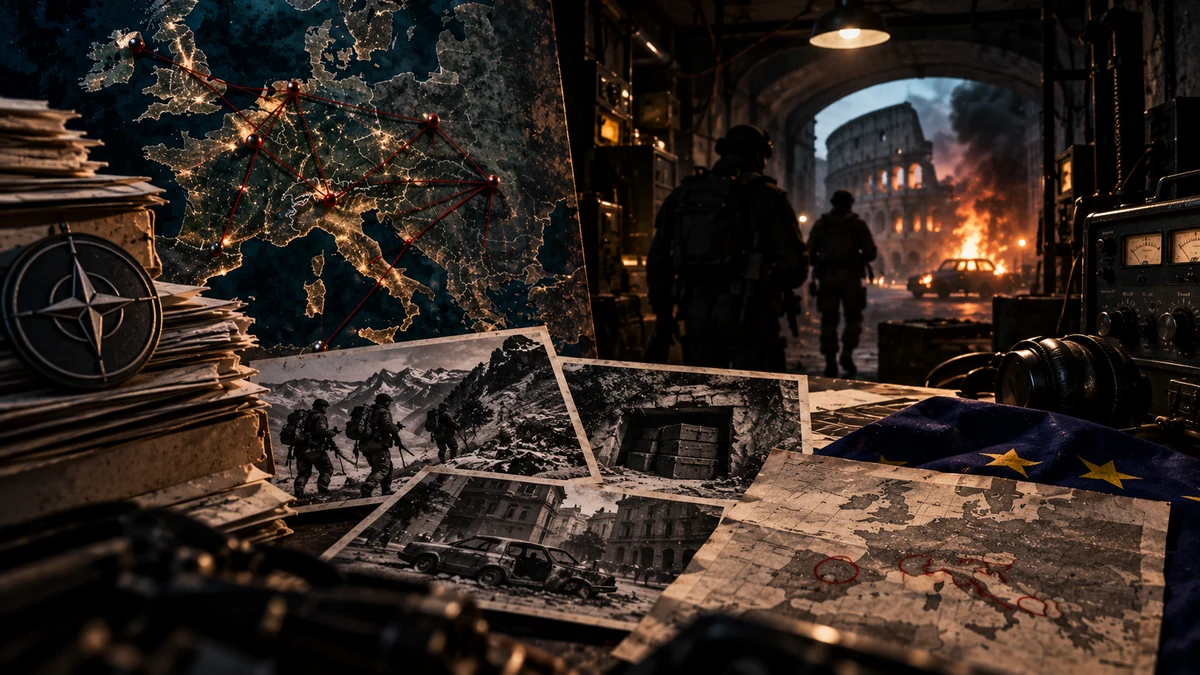
Gladio is not an invented story, but neither is it the name of one single European organization that directed every secret Western operation from one center for decades. Gladio was the codename of the Italian stay-behind structure; similar but nationally organized networks existed in several West European countries. Their official purpose was to prepare people, communications, caches, equipment and plans for resistance, intelligence collection and sabotage in the event of Soviet or Warsaw Pact occupation.
That core is now documented through Italian parliamentary records, the Belgian inquiry, Switzerland's parliamentary investigation, archival scholarship and European documents from 1990. Links among national services, British and American partners and allied coordinating mechanisms are also documented. The harder question is what individual networks actually did in peacetime and whether they were directly connected to terrorist attacks attributed to the so-called strategy of tension.
Two equally bad errors are possible here. The first is an institutional reflex that reduces a clandestine armed infrastructure to a technical Cold War detail and skips the question of who controlled it. The second is to infer from the documented existence of stay-behind networks that every neo-fascist bombing, every state cover-up and every unresolved event must be evidence of the same centrally directed operation. Criticism of power does not deserve a lower evidentiary standard than power itself.
Under a Natural Law standard, defense against a real invasion can be legitimate. But a legitimate end does not erase responsibility for the means. A clandestine armed structure that the public does not know, parliament cannot effectively scrutinize and no clear legal boundary contains creates a moral hazard through its architecture alone. And if such a structure were used to attack innocents or manipulate a population through fear, the act would remain aggression regardless of flag, alliance or anti-communist purpose.
Gladio was not one single 'NATO secret army'
The language must be cleaned up first. Gladio referred to the Italian structure; other countries had their own organizations, codenames, chains of command and histories. In public debate, 'Gladio' later became a convenient label for the wider European stay-behind phenomenon, but that shorthand easily creates a false picture of one centralized army directly commanded by NATO.
Reliable research in national archives shows a more varied system. Norway's network was under national intelligence control and cooperated with British and American services; NATO developed a more systematic interest in stay-behind from the early 1950s. Italian parliamentary materials refer to the Clandestine Planning Committee and Allied Clandestine Committee as allied coordinating forums. Coordination therefore was not a myth, but coordination is not the same as proof of unified operational command over every national network.
That distinction matters. A system can be internationally connected without being a single machine. If the distinction disappears, a real clandestine infrastructure can be inflated into a theory so broad that it can no longer be tested.
Why postwar governments built stay-behind networks
The origins of stay-behind planning make sense in the context of the Second World War. European governments had fresh experience of occupation, broken communications, improvised resistance and difficulty maintaining links with governments in exile. The early Cold War added fear of a Soviet attack on Western Europe.
The concept was straightforward: if conventional forces lost territory, prepared nuclei would remain behind. They could collect intelligence, maintain radio links, organize infiltration and evacuation, hide equipment and, in some plans, carry out sabotage or guerrilla tasks. Norwegian archival research describes precisely such preparation for intelligence and sabotage behind enemy lines.
Acknowledging this matters because the defensive rationale was not simply invented as later propaganda. The problem begins elsewhere: the legitimate question 'what do we do under occupation?' does not automatically justify every secret, every domestic political role or every absence of parliamentary oversight. Defense of the state and unchecked power are not the same thing.
Italy: Gladio, the U.S. connection and allied coordination
Italy is the best documented case and gave the wider phenomenon its most famous name. Parliamentary records refer to agreements between Italian and U.S. services in the creation of the Stay Behind structure, while archival scholarship places bilateral U.S.-Italian cooperation inside the wider history of postwar covert anti-communist activity. Gladio was embedded in the military-intelligence apparatus and prepared for action under occupation or severe crisis.
A 1959 SIFAR document examined by the Italian parliamentary inquiry placed stay-behind planning within an allied context that included the CPC at SHAPE. Later parliamentary discussion described the ACC as a forum among allied services. It is therefore not credible to claim that national networks were entirely disconnected from NATO and allied partners. But those links also do not prove that NATO headquarters issued every instruction to every agent or operation.
After the 1990 disclosure, the Italian government stated that it had found no evidence that Gladio had deviated from its institutional duties. That is an important part of the historical record, not history's final verdict: parliamentary, judicial and archival inquiries followed precisely because the issue remained contested. In 2021 the Italian government broadened declassification of Gladio-related records, underscoring again that public judgment depends on access to archives.

When preparation for occupation acquires a domestic political edge
The most sensitive question is not whether the network existed, but where its mission ended. In 1991 Italian parliamentary debate cited an official 1959 document from which some members concluded that planning contemplated not only foreign occupation but also an internal 'subversive' scenario within an anti-communist framework. Other parliamentarians and former officials rejected or narrowed that interpretation.
This goes to the heart of the democratic problem. If a clandestine military-intelligence structure exists for operation after occupation, the target is relatively clear: an occupying force. If the category of danger slides into domestic politics, the decisive question becomes who defines 'subversion'. A political party, trade union, protest movement or radical opinion is not the same thing as a foreign army.
THY-REALITY draws a strict line here: geopolitical fear cannot create a parallel moral law. A person does not lose rights because an intelligence service places him in an ideological category. If domestic use of a stay-behind network is alleged, it must be shown for the specific structure and operation rather than assumed merely because Cold War anti-communism was real.
Belgium: two networks, a parliamentary inquiry and an important negative finding
The Belgian inquiry is especially useful because it shows how secret history can be investigated without deciding the conclusion in advance. The Senate inquiry confirmed long-standing stay-behind structures, including the military SDRA VIII and civilian STC/Mob. Records described communication points, infiltration and evacuation routes, agents, equipment and cooperation with British and American partners.
The commission also examined suspicions that the network might have been connected to serious crime and political violence in Belgium during the 1980s. A comparison between crime locations and stay-behind operational areas found no correspondence, and the inquiry did not establish concrete facts supporting the hypothesis of such a link. That negative result matters precisely because it is negative.
Critical research cannot accept only documents that confirm suspicion. Belgium confirms that a secret network existed while also showing that existence alone does not prove responsibility for other crimes. The political question nevertheless remains: why was such sensitive infrastructure almost invisible to ordinary democratic scrutiny for so long?
Switzerland's P-26: a clandestine network can be a democratic problem without NATO command
Switzerland's P-26 is methodologically valuable because it breaks another overly simple equation: stay-behind did not necessarily mean NATO membership or NATO command. A Swiss parliamentary inquiry uncovered P-26, an organization prepared for resistance under occupation. Later official summaries stress that it operated without adequate statutory and constitutional basis, without recognized parliamentary control and with extremely limited knowledge at the political top.
The administrative inquiry led by Pierre Cornu concluded, according to the official Swiss summary, that P-26 had not participated in Gladio or NATO's international stay-behind structures. It did, however, have close links with British partners. That combination is instructive: one does not need to prove a 'NATO command' for a clandestine armed organization to remain a serious constitutional problem.
In Swiss parliamentary debate, the defense minister himself framed the central dilemma: a secret armed organization in an open democratic society inevitably produces mistrust. That may be the clearest institutional lesson in the entire story. If a structure exists to defend a free order, then even in peacetime it must withstand the legal and democratic question of who may create, supervise and terminate it.
The European Parliament in 1990: disclosure became an oversight problem
In November 1990 the European Parliament adopted a resolution on the Gladio affair. It proceeded from disclosures by several European governments of decades-old clandestine intelligence and armed structures and explicitly treated their escape from normal democratic control as a problem. Parliament called on states to investigate the structures and secure parliamentary scrutiny.
It is equally important to say what the resolution does not prove. A political resolution is not a criminal judgment and does not, by itself, prove that NATO ordered terrorist attacks. It does show that the democratic-legitimacy issue is not a later internet reinterpretation. At the moment of disclosure, a European institution already recognized the systemic problem: armed and intelligence capabilities had existed for decades in a zone ordinary mechanisms of public accountability barely reached.
A system that asks for trust while being unable to disclose even its existence needs stronger, not weaker, internal oversight. Operational secrecy can be necessary; absence of accountability is not.
The 'strategy of tension': real crimes do not remove the need to prove the link
Italy's Years of Lead are not fictional: left-wing and far-right terrorism, mass-casualty bombings, coup plots, clandestine political networks and documented investigative misdirection all formed part of the period. That made the question of overlap between parts of the stay-behind environment and neo-fascist or other subversive structures a legitimate research question.
A legitimate question is not a final answer. Historian Leopoldo Nuti, using documentation made available to the parliamentary commissions, concluded that the released records do not permit the assumption that Gladio was involved in illegal terrorist activity of the late 1960s and 1970s. More recent archival work by Niccolò Petrelli likewise warns that available records do not establish an operational link between the formal Gladio network and Ordine Nuovo, despite occasional contacts among individuals from those environments.
Peteano also teaches caution. The investigation exposed a neo-fascist perpetrator and serious misdirection, but later parliamentary work judged it practically certain that the explosive used in the attack did not come from a Gladio cache, as was initially suspected. Real state concealment and real far-right terrorism therefore do not justify the automatic equation 'Gladio = every attack'. If a link existed in a specific case, the evidentiary chain must demonstrate it.
FM 30-31B: how a bad document can damage a good investigation
Discussion of Gladio often invokes an alleged supplement to U.S. Field Manual 30-31, known as FM 30-31B, describing the use of violent extremist groups and attribution of attacks to opponents. It is attractive because it appears to fit the strongest version of the 'strategy of tension' theory almost perfectly. That is precisely why it is methodologically dangerous.
The U.S. State Department identified the document as a Soviet forgery, and its authenticity has been the subject of prolonged dispute. THY-REALITY therefore does not use it as evidence for Gladio. Even if a reader distrusts the U.S. denial, distrust does not authenticate a document. The burden of proof remains with the person who wishes to rely on it.
The rule is broader than one document. Weak evidence is a gift to the institution being investigated because it allows the entire subject to be dismissed through one inflated claim. Gladio does not need a disputed manual to be historically important. The existence of stay-behind networks, weapons and equipment caches, foreign-service links, allied coordination and deficient parliamentary scrutiny can be demonstrated with much stronger sources.
Natural Law: defending freedom cannot require abandoning accountability
The most defensible conclusion has two parts. First: European stay-behind networks are historical fact. States secretly prepared people, communications, equipment and resistance for a possible Soviet occupation; national networks cooperated with British and American services and, to varying degrees, allied coordinating bodies. Much of this remained outside the knowledge of the wider political system.
Second: that documented core does not by itself prove a single NATO-directed campaign of terrorist attacks against European civilians. Individual attacks, links and abuses require their own evidence. That is not a defense of the system. It is a refusal to grant critics of power a methodological privilege that we rightly refuse to power itself.
Under Natural Law, legitimate defense is directed against aggression. A person voluntarily preparing resistance against an occupier is morally different from a hidden apparatus manipulating its own population. But a clandestine armed structure without clear legal basis and effective independent oversight already contains the risk of collapsing those two categories.
Sharp criticism of the system does not require inventing a crime that cannot be proved. The documented reality is uncomfortable enough: democracies maintained clandestine armed networks for decades that were, in important respects, outside ordinary public and parliamentary view. If their purpose was to defend freedom, their first moral duty was not to erase in the name of defense the principle of accountability that makes freedom politically worth defending.
Sources and further reading
- European Parliament — Resolution on the Gladio affair, 22 Nov 1990 (OJ C 324): recognition of clandestine intelligence/armed structures and concern over democratic control.
- EU Publications Office — CELEX 51990IP2021, metadata for the European Parliament's 1990 Gladio resolution.
- Italian Parliament, X Legislature — Government/parliamentary report on Operation Gladio and the European stay-behind context; defensive rationale, allied planning and 1990 dissolution.
- Italian Senate, 10 Aug 1991 — parliamentary record concerning requested documentation on agreements between the Italian and U.S. services for creation of the Stay Behind structure and questions of secrecy.
- Italian Chamber of Deputies, 23 May 1991 — Gladio inquiry debate citing a 1959 official document and discussion of external-occupation and internal-subversion scenarios.
- Italian Chamber of Deputies, 29 May 1991 — parliamentary discussion of CPC/ACC, NATO coordination and national stay-behind structures.
- Italian Senate, Commission on Terrorism and Massacres, Doc. XXIII no. 64 vol. III — later review noting the Peteano explosive was practically certainly not from a Gladio cache.
- Presidency of the Council of Ministers (Italy), 15 Sep 2021 — implementation of the 2 Aug 2021 directive extending declassification/archival transfer to Gladio and P2 records.
- Presidency of the Council of Ministers (Italy), declassification committee report 2023–2024 — records Gladio files, including documents from Italy's NATO representation approved for declassification.
- Belgian parliamentary index — Senate document 1117-4 (1 Oct 1991), report of the inquiry into the clandestine international intelligence network known as Gladio/Glaive.
- Belgian Senate inquiry report 1117-4 (1990–1991), reproduced scan — SDRA VIII/STC-Mob structure, archival checks and inquiry into possible links with serious crime.
- Belgian Standing Intelligence Agencies Review Committee, Annual Report 1995 — summary of ministerial directives and missions documented by the 1991 Gladio inquiry.
- Swiss Parliament — PUK EMD page and report index: parliamentary investigation that uncovered P-26 and its lack of adequate legal foundations/oversight.
- Swiss Parliament — Review of the 1987–1991 legislature: P-26 dissolution and Cornu inquiry; summary says P-26 was not part of Gladio/international NATO stay-behind structures but had close British links.
- Swiss Federal Government, 2018 — publication of the anonymized 'media version' of the Cornu report on P-26's foreign relationships.
- Leopoldo Nuti, 'The Italian Stay-Behind network – The origins of operation Gladio,' Journal of Strategic Studies 30(6), 2007 — archival study; released records do not establish Gladio involvement in 1960s–70s terrorism.
- Olav Riste, 'With an eye to history: The origins and development of Stay-Behind in Norway,' Journal of Strategic Studies 30(6), 2007 — national control, British/U.S. cooperation and NATO interest from 1952.
- Olav Riste, 'Stay Behind: A Clandestine Cold War Phenomenon,' Journal of Cold War Studies 16(4), 2014 — comparative review challenging over-centralized and terrorism-wide interpretations.
- Francesco Cacciatore, 'Stay-behind networks and interim flexible strategy: the Gladio case and US covert intervention in Italy in the Cold War,' Intelligence and National Security 36(5), 2021.
- Niccolò Petrelli, 'Through a Glass, Darkly: US-Italian Intelligence Cooperation, Covert Operations and the Gladio Stay-Behind Programme,' Diplomacy & Statecraft 35(1), 2024 — archival study distinguishing Gladio from other covert anti-communist networks and noting lack of evidence for an operational Gladio–Ordine Nuovo link.
- CIA Center for the Study of Intelligence, 'The Intelligence Officer's Bookshelf,' Studies in Intelligence 49(3), 2005 — confirms stay-behind networks while emphasizing evidentiary problems in claims of government-directed Gladio terrorism.
- U.S. Department of State, 20 Jan 2006 (archived) — 'Misinformation about Gladio/Stay Behind Networks Resurfaces'; identifies FM 30-31B as a Soviet forgery and denies U.S.-directed stay-behind terrorism.