Operation Condor: A Cross-Border Network of Repression in South America
Operation Condor was a documented network of South American dictatorships for cross-border tracking, abduction, torture, disappearance and assassination. What do the archives and judgments prove — and where must overclaiming be rejected?
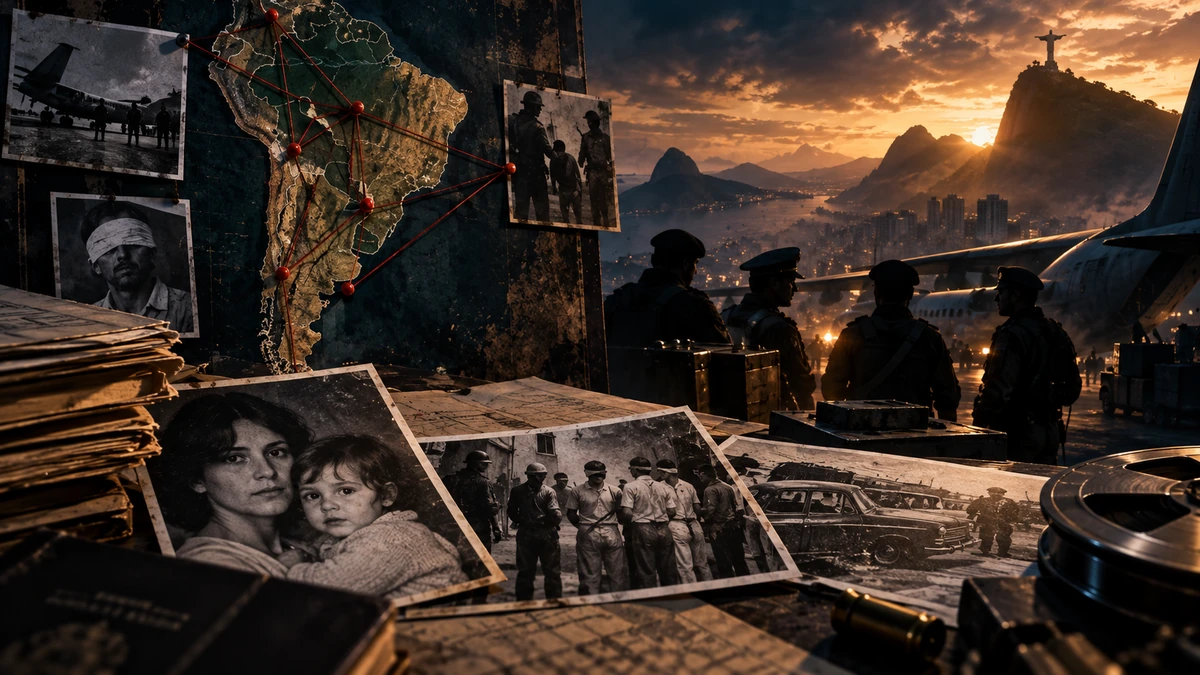
Operation Condor is not a legend produced only by later Cold War suspicions. Its core is documented in the Southern Cone security services' own records, declassified U.S. intelligence reporting, Paraguay's Archives of Terror and criminal proceedings in several countries. In November 1975, representatives of the intelligence services of Chile, Argentina, Uruguay, Paraguay and Bolivia met in Santiago and formalized a regional cooperation system that took the name Condor. Brazil joined shortly afterward, while Peru and Ecuador participated later.
On paper, the network was framed as cooperation against 'subversion' and 'terrorism'. In practice, it enabled the exchange of files, cross-border tracking of political opponents, joint arrests, clandestine transfers of prisoners, torture, enforced disappearance and planning for assassinations even beyond South America. The boundary between state security and state terror did not disappear because uniformed institutions carried out the repression. Institutional organization increased its reach.
Condor therefore matters methodologically as well. It shows how several states can build a secret infrastructure without a single supreme 'world center' ordering every individual crime. The network had shared communications and intelligence mechanisms, while the degree of participation varied by country, time and operation. That is enough to establish organized transnational repression — and also a reason not to attribute every murder or disappearance to one central command without evidence.
Under the Natural Law lens used by THY-REALITY, the basic problem is simpler still: labeling someone an 'enemy' does not give the state ownership over that person. A border does not turn kidnapping into lawful extradition, a secret agreement does not turn torture into a legitimate security method, and a shared interest among regimes does not turn assassination into defense. Condor is a case in which positive law, military hierarchy and bureaucracy combined to produce a system that was organized — and for that very reason morally harder, not easier, to excuse.
What Operation Condor was — and what it was not
Operation Condor is best described as a system of cross-border coordination among the security and intelligence apparatuses of several South American dictatorships in the 1970s. The founding minutes of 28 November 1975 call for exchanging information on people and organizations linked to 'subversion', creating a coordinating office, establishing direct service-to-service contacts, standardizing files and developing a technical system for transmitting data. This is not a later interpretation by opponents of the regimes; it is a document produced by the system itself.
Later CIA reporting showed that cooperation went beyond ordinary information exchange. In 1976 U.S. intelligence reported a shared data system, covert operations and plans for teams that would travel outside South America to locate and 'liquidate' selected targets. DIA reporting from the same year also described joint Argentine-Uruguayan operations in Buenos Aires.
But Condor was not a single secret super-state above the participating countries. National services retained their own chains of command, prisons, enemy lists and operations. Some actions were bilateral, some multilateral, and some occurred in the same repressive environment without a demonstrable link to the formal Condor mechanism. That distinction protects the article from two errors at once: denying the network and turning the network into a universal explanation for every crime in the region.
A repressive infrastructure existed before Condor
Formalization in 1975 did not create repression from nothing. Military, police and intelligence services in the region had already exchanged information and cooperated against political opponents. A later CIA internal review noted that service-to-service cooperation predated Condor's formal organization, and U.S. records also show DINA chief Manuel Contreras discussing regular intelligence exchanges with Argentine and Brazilian services in 1975.
This matters for causation. Condor did not cause every repressive practice of the Southern Cone dictatorships. More precisely, it connected and standardized existing national apparatuses and made it possible for a political refugee to remain reachable after crossing a border. Exile, which should at least have provided partial safety from a former government, became another operational space for the same persecution.
The category of 'subversion' also required little evidentiary discipline. Some targets belonged to armed organizations, but others were trade unionists, students, political activists, refugees, relatives and people with no demonstrated role in armed activity. When a state expands a danger category until political identity, family association or exile can trigger it, security language becomes an administrative bridge to collective punishment.
Architecture: data bank, communications and operational cooperation
The founding document proposed centralized coordination, standardized records and a technical link between participating services. Later documents and scholarship describe a data bank in Santiago and a dedicated communications system commonly known as Condortel. The point was not merely to archive the past but to enable rapid tracking of people, contacts, movements and organizations.
Contemporary research by Francesca Lessa and Lorena Balardini describes Condor as having intelligence, communications and operational pillars. Infrastructure was therefore central: state A could pass data to state B, officers from one country could participate on another country's territory, and a prisoner could move from one secret jurisdiction to another without any lawful extradition procedure.
Bureaucratic form does not reduce violence; it can make violence more efficient. A card index, encrypted channel and coordinating office look administrative in isolation. When connected to unlawful abduction and torture, they become components of a repressive machine. Moral evaluation cannot stop at the technical name of the function.

When a border stops protecting the person
Condor's defining feature was transnational reach. A target was no longer safe merely because he or she had left the persecuting state. Data crossed borders, agents crossed borders and, in many cases, kidnapped people crossed borders as well — without a judge, without public extradition and without any practical ability to prove where they had been taken.
The Plan Cóndor database now records 805 victims of transnational repression between 1969 and 1981. Its authors stress that this is a conservative, methodologically assembled count rather than a final list of every victim. Documented practices include illegal detention and torture, murder and enforced disappearance, and the abduction of children. Uruguayans form the largest nationality group in the dataset, while many crimes took place in Argentina, where large numbers of political exiles had sought refuge.
Here the phrase 'cross-border cooperation' becomes dangerously sterile. When cooperation is designed to find a person, seize that person without process, torture, transfer or eliminate them, we are not describing administrative efficiency. We are describing several states jointly closing the space in which an individual could invoke basic rights.
Gelman and Goiburú: when a judgment reconstructs the secret network
The case of María Claudia García de Gelman shows how the transnational mechanism operated at the level of an individual life. The nineteen-year-old pregnant Argentine was abducted in Buenos Aires in August 1976 by Argentine and Uruguayan agents. She was later clandestinely transferred to Uruguay, where she gave birth to her daughter Macarena; the child's identity was suppressed and María Claudia disappeared. The Inter-American Court of Human Rights placed the case in the context of coordinated repression and Operation Condor.
In Goiburú v. Paraguay, the same court considered the enforced disappearance of Paraguayan opponents of the Stroessner regime within the broader setting of regional repression. The Court emphasized the exceptional gravity of enforced disappearance as a multiple and continuing violation and the state's duty to investigate and punish those responsible.
Such cases matter more than broad political rhetoric. A secret system can be reconstructed through the path of a concrete person: who was searching for them, who seized them, which clandestine center held them, which foreign agents participated, where they were moved and which records survived. Truth about a secret network is built from intersecting archives, testimony and judicial findings, not from intuition.
The Archives of Terror: paper that outlived the regime
In 1992, a collection of Paraguayan police and security records was discovered that became known as the Archives of Terror. UNESCO later added the collection to the Memory of the World register and explicitly notes that it contains evidentiary material on Operation Condor as well as arbitrary imprisonment, torture, disappearance and the exchange of detainees with foreign countries without judicial warrants.
Its importance is twofold. First, it shows that repression did not exist only in oral orders and rumor; it generated forms, lists, card files, telegrams and administrative traces. Second, it shows why access to archives is a political question. A regime can control the story for decades when it also controls the documents by which that story could be tested.
But an archive is not magical completeness. Surviving documents prove what they contain; they cannot automatically fill every destroyed file or unwritten order. The correct method is therefore the same as in “Secrecy, Classification and Declassification: How the State Produces Secrets”: absence of a record is not automatic proof of innocence, but neither is it a license to fill the gap with whatever narrative we prefer.
Letelier and 'Phase Three': assassination beyond the region
Condor documents from 1976 show that participating services discussed operations in Europe against political targets. A July CIA report described planned teams for France whose basic mission was to locate and 'liquidate' senior targets. That goes far beyond any honest definition of intelligence collection.
The most famous assassination of this period occurred on 21 September 1976 in Washington, when a car bomb killed former Chilean foreign minister Orlando Letelier and his colleague Ronni Karpen Moffitt. DINA responsibility and the role of its operatives are well documented. An FBI cable after the bombing, drawing on a source in Argentina's SIDE, reported that the killing may have represented a so-called 'Phase Three' Condor mission — the operational level for physical elimination of targets.
Careful wording matters here. The documents strongly connect DINA, an international assassination infrastructure and the concept of Condor's third phase, but it is unnecessary to claim that every Condor member jointly approved the particular bomb in Washington. The documented core is already grave enough: a state intelligence service carried out a political assassination in a foreign capital, and U.S. investigators analyzed it within a documented regional assassination architecture.
What the United States knew — and what the documents do not prove
U.S. records undermine two comfortable stories at once. They do not establish the simple claim that the United States created Condor and directly commanded every operation. But they do establish that U.S. authorities were not blind. CIA, DIA, FBI and State Department reporting in 1976 contained substantial detail about Condor's structure, joint operations and plans for assassinations abroad.
In August 1976 the State Department prepared a diplomatic warning to Chile, Argentina and Uruguay because it had information that Condor might include assassinations of political targets at home and abroad. On 16 September Henry Kissinger instructed that no further action be taken on the initiative. Five days later Letelier and Moffitt were killed in Washington. In October, a U.S. channel did raise Condor with Manuel Contreras, who denied its assassination dimension.
This chronology does not prove that Kissinger ordered or caused the bombing. It proves something different, and morally serious in its own right: senior diplomacy had been informed of a danger of international political murder, a formal warning had been prepared, and that initiative was then stopped. Natural Law does not measure responsibility only by asking who held the detonator; it also asks what a person with power to warn or restrain a danger knew, and what that person did with that power.
When courts break the language of 'security cooperation'
In 2016 an Argentine federal tribunal, after a major historical trial, found the existence of a criminal association or formal system of repressive coordination among the dictatorships and convicted a number of former military and intelligence officials. CELS described the judgment as the first time a national court had proved Operation Condor as a criminal conspiracy on such a scale.
Judicial findings matter because secret structures often survive the fall of regimes through a language of denial: there was no order, no shared policy, no knowledge, only isolated excesses. But when meeting minutes, communications records, foreign intelligence reports, victim trajectories, testimony and national archives are combined, a structure becomes visible that no single document could reveal by itself.
Justice in such cases is slow and incomplete. Many perpetrators died without judgment, many families still lack full answers, and national amnesties and institutional resistance delayed proceedings for decades. But late judgments still matter: an official seal cannot forever convert organized violence into an untouchable state secret.
Natural Law: border, order and ideology do not erase the person
Condor arose amid real political violence, armed revolutionary organizations, Cold War conflict and regime fears of losing power. That is historical context, not a moral permission slip. The existence of a violent adversary can justify proportionate defense against a concrete attack; it cannot justify a secret system in which a person disappears from law because an institution placed a name on a list.
Positive law under dictatorships was often subordinated to regime survival, while secret arrangements created a parallel operational space. Under Natural Law, however, abduction remains abduction, torture remains torture and the intentional killing of an unarmed political target remains aggression even when the operation is planned in a general staff office, transmitted over a secure channel and entered into an official file.
The most important lesson of Condor is therefore not that we should believe every theory about secret networks. It is the opposite: when a secret network really exists, it can and should be proved more rigorously. And once it is proved, we should not sterilize it with bureaucratic language. Operation Condor showed what happens when states begin treating the political human being as a cross-border security object rather than a bearer of inherent rights. Bureaucracy can organize violence; it cannot grant violence moral legitimacy.
Sources and further reading
- National Security Archive — DINA, 'Acta de Clausura de la Primera Reunión Interamericana de Inteligencia Nacional,' 28 Nov 1975: founding minutes of Operation Condor, intelligence exchange, coordination and technical system.
- National Security Archive — CIA cable, 25 Jun 1976: Condor meeting, computerized data bank and covert operational cooperation among Southern Cone services.
- National Security Archive — CIA cable, 21 Jul 1976: proposed Condor teams in France and reported mission to locate and 'liquidate' senior targets.
- National Security Archive — DIA report, 1 Oct 1976: joint Argentine-Uruguayan operations in Buenos Aires and Condor cooperation against OPR-33.
- National Security Archive — FBI 'Condor: Chilbom' cable, 28 Sep 1976: reporting on the Letelier-Moffitt assassination and possible Condor 'Phase Three' connection.
- National Security Archive — U.S. Department of State cable, 23 Aug 1976: planned démarche warning Chile, Argentina and Uruguay about reported Condor assassination plans.
- National Security Archive — U.S. Department of State, 'Actions Taken,' 16 Sep 1976: Kissinger instruction that no further action be taken on the Condor démarche initiative.
- U.S. Department of State, Foreign Relations of the United States — memorandum of 8 Oct 1976 on approach to DINA chief Manuel Contreras and U.S. concern over Condor assassination planning.
- U.S. Department of State, Foreign Relations of the United States — 1975 records on Manuel Contreras, DINA and pre-Condor intelligence exchanges with Argentine and Brazilian services.
- UNESCO Memory of the World — Archivos del Terror: Paraguayan police records documenting dictatorship-era repression and evidentiary material on Operation Condor.
- Inter-American Court of Human Rights — Gelman v. Uruguay: enforced disappearance, clandestine transfer, identity suppression and Operation Condor context.
- Inter-American Court of Human Rights — Goiburú et al. v. Paraguay: enforced disappearances, state responsibility and regional repression context.
- CELS — 27 May 2016: Argentine Operation Condor trial verdict finding a formal system of repressive coordination and criminal conspiracy.
- National Security Archive — Operation Condor Verdict: GUILTY! (2016): declassified records introduced in the Argentine trial and documentary chronology.
- Francesca Lessa & Lorena Balardini, International Studies Quarterly (2024) — 'No Safe Haven: Operation Condor and Transnational Repression in South America': archival, legal and dataset-based study.
- Plan Cóndor — Database of South America's Transnational Human Rights Violations: 805 documented victims and case-level records.
- Plan Cóndor — Data gathering and methodology: source sets, inclusion criteria and conservative methodology behind the 805-case database.
- National Security Archive — 'Operation Condor: A Network of Transnational Repression 50 Years Later' (2025): updated declassified-document synthesis on formation, membership and operations.
- FBI Vault — Orlando Letelier records: released FBI investigative records concerning the 21 September 1976 Washington car-bomb assassination.
- National Security Archive / U.S. Senate 1979 staff report — foreign intelligence activities in the United States, DINA and Operation Condor's capacity for overseas assassination operations.