The Empty Tomb: Why Do the Gospels Differ?
All four Gospels know an empty-tomb tradition, yet they differ over the women, timing, messengers, reactions, Galilee, and Jerusalem. What belongs to the common core, and what reflects each evangelist’s literary shaping?
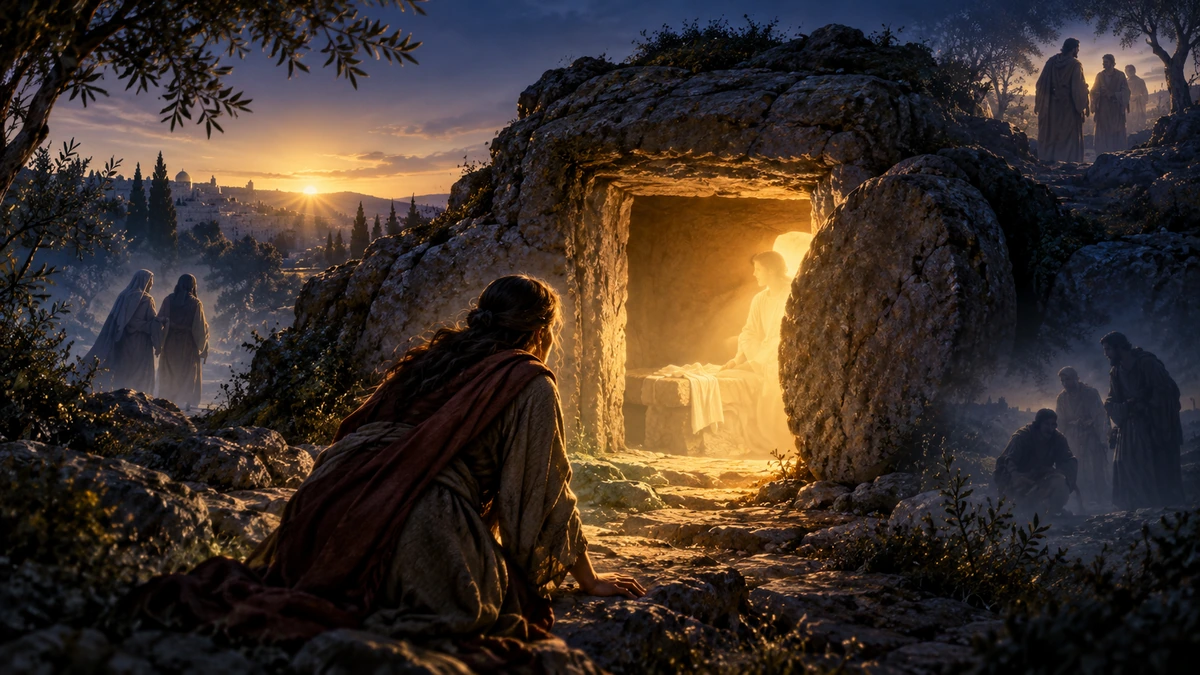
All four canonical Gospels narrate that Jesus’ tomb was found open or empty on the first day of the week. Yet when the texts are placed side by side, obvious differences appear: who arrives, when they arrive, how many heavenly messengers are present, whom the women tell, where Jesus appears, and whether the narrative centre moves toward Galilee or remains in Jerusalem.
There are two poor ways to handle these differences. We can flatten them into one composite story and lose the voice of each evangelist, or we can declare them proof that nothing happened. Neither conclusion follows from the texts by itself.
The article therefore reads each version separately, maps the shared core, and only then tests three possibilities: multiple early memory-paths, literary-redactional reshaping of an older tradition, and harmonization of several events into one sequence.
The question is not which Gospel “wins,” but what their differences tell us about the formation of Easter tradition—and how much history can responsibly be reconstructed from it.
Four Narratives: Let Each Speak on Its Own First
The empty tomb is one of the few scenes narrated by all four canonical Gospels, yet none tells it in exactly the same way. This is not merely a problem for harmonization; the differences are also historical data about how Easter tradition was told, transmitted, and theologically shaped.
The safest starting point is therefore synoptic: ask first what each Gospel actually says, and only then look for a common core. If the stories are too quickly merged into one composite sequence, we may inadvertently add events that no individual Gospel narrates and blur each evangelist’s distinctive emphasis.
In all four, Mary Magdalene is connected with the first visit to the tomb; the action occurs on the first day of the week; the stone or entrance no longer blocks access; Jesus’ body is not where the visitors expect it to be; and news then reaches the disciples. Beyond that common core, the narratives diverge quickly.
Mark: An Open Tomb and an Open Ending
In Mark 16:1–8, Mary Magdalene, Mary the mother of James, and Salome come very early after sunrise to anoint Jesus. The stone has already been rolled back. Inside they see a young man in white who says that Jesus has been raised and is not there, and sends them to the disciples and Peter with the promise of a meeting in Galilee.
The narrative then ends surprisingly: the women flee in fear and say nothing to anyone. According to current editorial consensus, the earliest attainable form of Mark ends at 16:8; the longer ending in 16:9–20 is a later textual layer. The earliest extant Gospel ending therefore does not narrate a meeting between the risen Jesus and the disciples; it announces one.
The ending can be read as a lost conclusion, deliberate literary openness, or a theological choice. The text itself does not settle the question. What matters here is that later evangelists do not preserve Mark’s tension in the same form.

Matthew: Angel, Guards, and an Encounter with Jesus
Matthew 28 reshapes the scene. Mary Magdalene and “the other Mary” come to the tomb. Matthew narrates an earthquake and the descent of an angel who rolls away the stone and sits on it; the guards become like dead men from fear. The women receive the same basic message—Jesus is not here, he has been raised, the disciples should go to Galilee—but they leave not only in fear but with great joy and run to tell the disciples.
Jesus then meets them on the way; they take hold of his feet and worship him. Matthew later adds the story of the guards and the report that the disciples stole the body at night. The empty tomb thus also becomes an answer to a rival explanation for the missing body.
If Matthew used Mark, as most Synoptic scholars hold, the contrast is especially instructive: Mark’s flight and silence become successful proclamation, the angel is more explicit, guards are added, and Jesus appears to the women before the meeting of the eleven in Galilee.
Luke: Two Figures, Remembering, and a Jerusalem Centre
Luke 24 speaks of women in the plural and later names Mary Magdalene, Joanna, Mary the mother of James, and others. They come at early dawn with spices, find the stone rolled away, and do not find the body. Two men in dazzling clothes stand beside them. Their message is not primarily “go to Galilee,” but “remember how he told you, while he was still in Galilee.”
The women remember and tell the eleven, who initially disbelieve them; Peter then runs to the tomb. Luke thus shifts the spatial emphasis: Galilee is where Jesus had spoken earlier, while the Easter events unfold in Jerusalem and its surroundings. Later appearances in Luke 24 lead to the instruction that the disciples remain in the city.
This need not mean that Luke “denies” Galilean traditions; it does mean that his extant narrative wants to carry the Easter story from Jerusalem into the continuation in Acts.
John: Mary Magdalene, Two Disciples, and Personal Recognition
John 20 begins differently. While it is still dark, only Mary Magdalene is named. When she sees the removed stone, she does not infer resurrection but tells Peter and the beloved disciple, “They have taken the Lord out of the tomb, and we do not know where they have laid him.” The plural “we do not know” leaves room for a broader traditional background even though John focuses the narrative on Mary.
Peter and the other disciple run to the tomb and inspect the linen wrappings and face cloth. Only later does Mary see two angels and then Jesus, whom she initially fails to recognize. The scene resolves personally when Jesus calls her by name.
John therefore uses the empty tomb differently from the Synoptics: not only as the site of an announcement but as a movement from a mistaken explanation—the removed body—through signs to recognition. The relationship between John and the Synoptics remains debated; modern positions range from substantial independence to creative use of Synoptic traditions.
What Is Shared, and What Really Differs?
A fair comparison should register stable points as well as divergences. The table below does not decide which version is “right”; it shows where the texts converge and where each evangelist shapes a different scene.
| Question | Mark 16:1–8 | Matthew 28:1–10 | Luke 24:1–12 | John 20:1–18 |
|---|---|---|---|---|
| Who first comes? | Mary Magdalene, Mary mother of James, Salome | Mary Magdalene and the other Mary | Mary Magdalene, Joanna, Mary mother of James, and others | Mary Magdalene is the only one named initially; her “we do not know” may preserve a broader background |
| Time | very early; sun has risen | as the day was dawning | at early dawn | while it is still dark |
| Stone | already rolled back | an angel rolls it back in the narrative | already rolled away | already removed |
| Heavenly messenger | one young man in white | one angel | two men in dazzling clothes | later two angels before Mary |
| First response | fear, flight, silence | fear and great joy; they run to tell | the women tell; disciples initially disbelieve | Mary first concludes that the body has been taken |
| Jesus at/near the tomb? | not in the attainable ending through 16:8 | the women meet him on the way | not in the tomb scene | Mary meets him outside the tomb |
| Geographic emphasis | future meeting in Galilee | Galilee | Jerusalem; memory of words spoken in Galilee | Jerusalem in ch. 20; Galilee in ch. 21 |
Paul Is Earlier Than the Gospel Narratives—and Says Less
The earliest surviving Christian text about resurrection is not a Gospel but Paul’s 1 Corinthians 15, usually dated to the mid-50s CE. Paul says that he received and handed on a tradition: Christ died, was buried, was raised on the third day, and appeared to Cephas, the Twelve, and others.
The formula does not narrate a tomb visit and does not mention a stone, Joseph of Arimathea, or the women. That silence matters, but its meaning is not self-evident. Some scholars argue that bodily resurrection and the sequence “buried—raised” presuppose an empty tomb; others caution that a short Pauline summary cannot supply narrative details it does not state.
The secure conclusion is narrower: belief in Jesus’ death, burial, resurrection, and appearances is documented before the written Gospel tomb narratives. How fully the story of discovering the empty tomb had already been shaped at that earlier stage cannot be learned from Paul alone.
Why Do the Narratives Change? Sources, Memory, and Editorial Purpose
For the Synoptics, literary relationships matter. Markan priority remains the majority starting point, although solutions to the Synoptic Problem are not fully settled. If Matthew and Luke knew Mark, then their differences are not four fully independent testimonies to every detail; they are also evidence of how later writers reworked an earlier written account.
Such reworking is not automatically “invention” in the modern sense. Ancient authors adapted traditions to literary purpose, audience, and theological emphasis. Matthew stresses fulfilment, the authority of the risen Jesus, and the dispute over a stolen body; Luke links Easter day to Jerusalem and the narrative continuation in Acts; John develops personal recognition and forms of witness.
Different oral and local traditions may also have existed. Because we do not possess a recording of their development, what can be observed directly in the texts must be distinguished from hypotheses about the path by which a particular detail arose.
Harmonization: Possible Solution or a New Fifth Story?
Traditional harmonization tries to combine all four accounts into one sequence: several women may have arrived at different moments; one evangelist can mention one messenger even if two were present; Mary may have separated from a group; Jesus may have appeared more than once; Galilee and Jerusalem need not conflict if events unfold over several days.
Some such scenarios are logically possible. Their limitation is that they often add temporal steps and movements that no Gospel itself narrates. Harmonization can therefore show that two statements are not necessarily formally incompatible, but it cannot by itself establish that the reconstructed sequence is what actually happened.
The opposite approach reads each Gospel as an independent narrative and explains the differences mainly through redaction and development of tradition. That approach also has a limit: literary shaping by itself does not prove that no historical core lies behind the story. We learn most when the literary and historical questions are kept distinct.
What Can History Conclude—and What Can It Not?
Scholarship remains divided over the historicity of the empty tomb. Arguments in favour stress the early linkage of burial and resurrection, the persistence of women witnesses, the shared core across all four Gospels, and the possibility of Jewish burial for a crucified person before a feast. Other scholars point to Paul’s lack of a tomb-discovery narrative, the conspicuous Gospel differences, apologetic development, and the possibility that narrative form grew together with Easter faith.
The burial itself also requires separate judgment. Greco-Roman evidence shows that crucified bodies were sometimes left exposed and sometimes released for burial; neither “Romans never allowed burial” nor “burial in a private tomb was routine” is sufficiently precise. All four Gospels connect Jesus’ burial with Joseph of Arimathea, while giving the character somewhat different contours.
The most secure textual conclusion is therefore more modest: very early Christian tradition proclaims that Jesus died, was buried, and was raised; all four Gospels know an empty-tomb tradition with Mary Magdalene in a central role; the details are not uniform and have been literarily shaped. Moving from that conclusion to a historical or theological verdict requires additional assumptions.
Open Question: What Do the Differences Tell Us?
The differences among the Gospels can be experienced as a problem, but they can also be read as data about the history of tradition. Mark leaves the reader with fear and expectation; Matthew resolves the silence in proclamation and appearance; Luke places Jerusalem at the centre of the continuation; John turns the empty tomb into a path toward personal recognition.
If there were only one mechanically copied report, we might expect greater uniformity. If there were four wholly unrelated stories, the stable core—the first day of the week, Mary Magdalene, an opened tomb, and the missing body—would be harder to explain. The texts stand somewhere between those extremes: connected tradition narrated by different authors in different ways.
Do the differences mainly preserve several early memory-paths around the same event, or do they show Easter faith acquiring an increasingly developed narrative form over time—and how much of both processes could have been happening at once?
Sources and further reading
- Bible Gateway — Mark 16:1–8 (NRSVUE) — primary text for Mark’s empty-tomb narrative and note on the ending at 16:8.
- Bible Gateway — Matthew 28:1–10 (NRSVUE) — primary text for Matthew’s women, angel, guards, and appearance of Jesus.
- Bible Gateway — Matthew 28:11–15 (NRSVUE) — primary text for the guard report and stolen-body counter-narrative.
- Bible Gateway — Luke 24:1–12 (NRSVUE) — primary text for Luke’s women, two men, remembrance, and Peter’s visit.
- Bible Gateway — John 20:1–18 (NRSVUE) — primary text for Mary Magdalene, Peter, the beloved disciple, two angels, and recognition of Jesus.
- Bible Gateway — 1 Corinthians 15:3–8 (NRSVUE) — Paul’s received tradition of death, burial, resurrection, and appearances.
- H. A. G. Houghton, “Unfinished Business: The Ending of Mark in Two Catena Manuscripts,” New Testament Studies 69 (2023) — current textual-critical confirmation that the earliest attainable Mark ends at 16:8.
- Marie Noonan Sabin, “The Unending Revelation: Mark 16:8 as a Theological Choice,” in Reopening the Word (Oxford, 2002) — literary/theological reading of Mark’s ending.
- J. Michael Winger, “When Did the Women Visit the Tomb?,” New Testament Studies 40 (1994) — concise catalogue of major variations among the Gospel tomb narratives.
- Stephen P. Ahearne-Kroll (ed.), The Oxford Handbook of the Synoptic Gospels, “The History and Prospects of the Synoptic Problem” (2023) — current overview of agreements, discrepancies, and literary dependence among the Synoptics.
- Harold W. Attridge, “John and other Gospels,” The Oxford Handbook of Johannine Studies (2018) — survey of changing views on John’s relation to the Synoptics.
- Frans Neirynck, “John and the Synoptics: the Empty Tomb Stories,” New Testament Studies 30 (1984) — detailed study of Johannine and Synoptic empty-tomb relations.
- Jerome Murphy-O’Connor, “Tradition and Redaction in 1 Corinthians 15:3–7,” in Keys to First Corinthians (Oxford, 2009) — analysis of the early received formula behind Paul’s wording.
- Oxford Bibliographies — “1 Corinthians” (2025) — current reference overview; dates the letter usually to 53–55 CE.
- John Granger Cook, “Resurrection in Paganism and the Question of an Empty Tomb in 1 Corinthians 15,” New Testament Studies 63 (2017) — argues that Paul’s resurrection language presupposes an empty tomb while not proving the later Gospel narratives.
- Outi Lehtipuu, “What Is Resurrection?,” Debates over the Resurrection of the Dead (Oxford, 2015) — diversity and ambiguity of resurrection concepts in early Jewish and Christian texts.
- John Granger Cook, “Crucifixion and Burial,” New Testament Studies 57 (2011) — Greco-Roman evidence that crucified bodies could either remain exposed or be released for burial.
- William John Lyons, Joseph of Arimathea: A Study in Reception History, ch. 1 “The Biblical Joseph” (Oxford, 2014) — compares the four earliest canonical portraits of Joseph and their redactional development.
- Oxford Research Encyclopedia of Gender and Women’s History — “Mary Magdalene and the Early Jesus Movement” (2026) — Mary Magdalene as the only person explicitly linked across the Gospels with Jesus’ death, burial, and resurrection events.
- W. L. Craig, “The Historicity of the Empty Tomb of Jesus,” New Testament Studies 31 (1985) — a classic argument in favour of the historical empty-tomb tradition.
- M. David Litwa, “Empty Tombs and Translation,” How the Gospels Became History (Yale, 2019) — literary-comparative approach to empty-tomb and disappearance motifs in Mediterranean narrative.
- Gerald O’Collins and Peter Carnley, “The Resurrection: The State of the Questions,” The Resurrection: An Interdisciplinary Symposium (Oxford, 1998) — overview of continuing disputes over appearances, the empty tomb, and historical method.