The Economy of Occupation: Who Benefits from Palestinian Land?
What are the economic effects of the occupation of Palestinian land? A review of access to land, water, infrastructure and development opportunities.
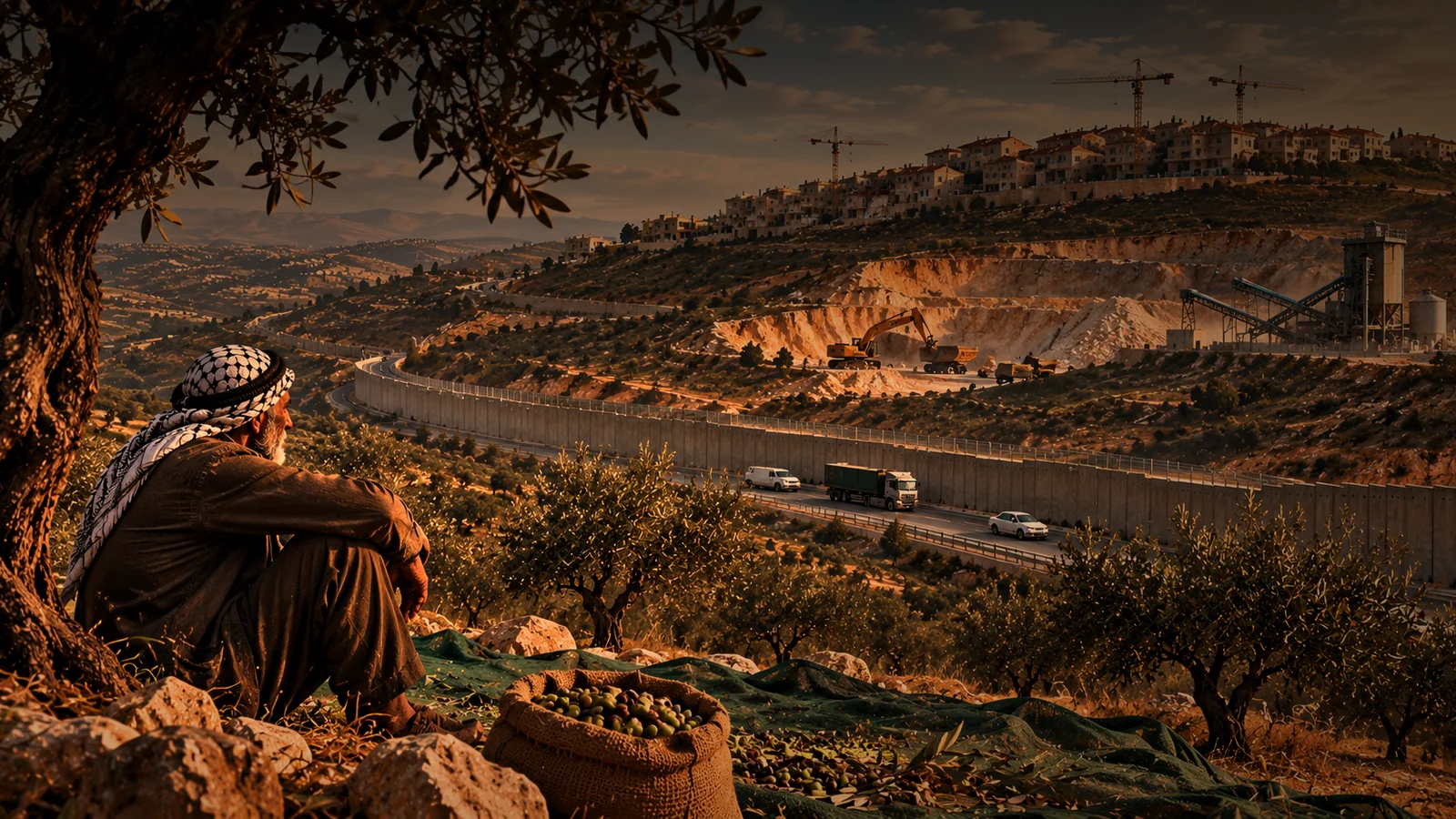
Symbolic editorial illustration of land, infrastructure and quarrying in the context of occupation; not a depiction of a verified event, location or company.
Land as an Economic Question: Who Has the Opportunity to Develop?
Discussions of occupied Palestinian land often stop at borders, security, homes, and new settlements. But land is also a source of future income: olive trees grow on it, roads cross it, water and stone lie beneath it, and it may support a factory, a hotel, or a home. Those who control access to these opportunities also shape who can accumulate wealth, who has access to jobs, and who faces higher business costs.
This article does not claim that every resident of an Israeli settlement has the same financial interest, that every Israeli company operates in occupied territory, or that earning revenue is in itself proof of unlawful conduct. Our focus is on the mechanism: which public authority authorizes land use, who builds infrastructure, who carries out economic activity, who earns revenue from it, and who loses an equivalent opportunity because of restrictions. Answering these questions requires distinguishing legal responsibility, economic effects, and individual culpability.
The study focuses on the West Bank, including Area C, and East Jerusalem. Under the Oslo arrangements, Area C accounts for approximately 60–61 percent of the West Bank and remains under Israeli administration in fields that include spatial planning. As early as 2013, the World Bank warned that Palestinians' fragmented access to this economically important, interconnected area constrained agriculture, construction, quarrying, tourism, and other activities. At the time, it estimated that lifting the restrictions could have an annual economic effect of approximately USD 3.4 billion, equivalent to about 35 percent of the Palestinian GDP of that period. This is an estimate made in 2013 under the prices and circumstances prevailing then, not an annual loss measured in 2026. [1]
There have been no Israeli civilian settlements in Gaza since 2005. Accordingly, Gaza appears in this article's broader macroeconomic calculations, but not as an area with the same present-day settlement infrastructure. Such geographical precision is not a minor detail: it determines whether we are comparing like with like.
What Does Lost Palestinian Economic Potential Mean?
In February 2026, UNCTAD published a study estimating that the Palestinian economy lost USD 212.2 billion in potential GDP between 2000 and 2024, expressed in constant 2015 US dollars. This is a model-based comparison of actual economic development with a different, hypothetical trajectory without certain occupation-related restrictions, closures, and consequences of military operations. It is not an invoice that could simply be presented to an individual company, nor does it mean that an equivalent amount of cash was transferred from Palestinians to an identifiable Israeli recipient. [2]
The study considers restrictions on movement and trade, limited access to productive resources, military operations, and the effects of curbs on economic activities. A separate UNCTAD report, published in August 2025, estimated USD 170.8 billion in unrealized potential GDP for the West Bank over 2000–2024, based on three specifically defined types of disruption. This narrower estimate excludes certain other geographical and economic effects. The USD 170.8 billion and USD 212.2 billion figures must therefore not be added together: the models overlap methodologically. [2] [3]
The difference between an actual and a potential economy is more than a statistical abstraction. A farmer who cannot reliably reach their land faces different risks from a farmer who can. A builder with no realistic prospect of obtaining a permit cannot plan on the same terms as a builder able to develop housing and transport links. A trader facing extra checkpoints, delays, and import restrictions bears costs that are reflected in product prices and the ability to compete. The effects carry through to wages, the tax base, credit risk, and public services.
The two UNCTAD macroeconomic studies also employ different counterfactual baselines, so they differ in which shocks and restrictions each model removes. Their results are estimates conditional on assumptions, not directly observed financial flows. Nor would it be fair to attribute every economic difficulty to a single cause. Political uncertainty, domestic governance, violence by Palestinian armed groups, conflict, and international conditions also affect business activity. The analytical question is how much additional impact identifiable restrictions have, and who determines whether they remain in place. UNCTAD addresses this with modelling, not a census of every individual business loss. [2] [3]

What Is the Settlement Economy Worth — and What Does a Large Number Not Tell Us?
The February 2026 UNCTAD study offers another major estimate: USD 832.7 billion in cumulative economic value attributed to settlements and East Jerusalem during 2000–2024, in constant 2015 US dollars. For 2024 alone it estimates USD 53 billion. The figure deserves attention, but also careful explanation. [2]
In UNCTAD's methodology, this value is not calculated from the accounting records of companies operating in settlements. The estimate takes Israeli GDP and attributes a share to settlements and East Jerusalem according to their population relative to Israel's total population. The model assumes that GDP per capita in these areas equals the Israeli average. Accordingly, Table 6 multiplies Israeli annual economic activity by a population share that rises from 11.0 to 12.6 percent over the period. This imputation is sensitive to the assumption of equal productivity, to how East Jerusalem is geographically defined, and to the fact that a person's residence and the place where value added is produced need not be the same. Differences in sectoral productivity, cross-border commuting, and ownership of business assets are therefore not measured directly. The result is a proxy for attributed economic value, not a directly measured return from the land, not an aggregate of company profits, and not proof that every element of attributed value arose from an unlawful act. This is precisely why the expression “economic value associated with settlements” cannot automatically be turned into the claim “this much money was stolen.” [2] [3]
Likewise, USD 832.7 billion and USD 212.2 billion do not describe opposite sides of the same transaction. The first is a proxy for the economic scale of the areas concerned; the second is a model-based estimate of Palestinian activity that did not materialize. The difference between them is not Israeli net profit, and adding them together would not produce a meaningful measure of harm.
A further distinction is between public spending on settlement infrastructure and the revenue received by a private company. A government may subsidize transport or services; a concessionaire may enter into a long-term contract; road users may save time; and property owners may expect land values to rise. These are different benefits that require different evidence: legislation, budgets, tenders, contracts, financial statements, and implementation records. A large aggregate figure does not replace evidence identifying a particular beneficiary.
Companies in the Settlement Economy: What Did OHCHR Find?
On 25 September 2026, the Office of the United Nations High Commissioner for Human Rights (OHCHR) updated its database of companies associated with specified activities in Israeli settlements. The database lists 214 companies from 11 countries. In its latest review, OHCHR assessed 126 additional companies, included 61 of them, and removed five that had previously been listed. The reporting period for this update covered 2 August 2019 to 15 April 2026. OHCHR also stated that 255 of the 596 companies initially identified in submissions had yet to be assessed in the two latest review rounds. Because the Office cannot proactively reassess every previous inclusion, the database is not an exhaustive inventory of settlement-linked business activities or a real-time verification of each company's operational status on publication day. [18] [4] [5]
In assessing involvement, OHCHR uses the framework of the UN Guiding Principles on Business and Human Rights. In 2026, it classified 200 companies as contributing to an adverse impact on the right to self-determination and 14 as directly linked to such an impact. It found none in the highest category of causing an adverse impact under this methodology. OHCHR primarily assessed the right to self-determination rather than every potential human-rights impact of every company, so its conclusions should not be extended beyond their actual scope. These categories are not equivalent to criminal convictions, assessments of damages, or statements of profit. The underlying report expressly applies a “reasonable grounds to believe” threshold for inclusion, lower than the criminal standard, and describes the database as neither a judicial nor a quasi-judicial process. [4] [5] [18]
The 2026 group of enterprises reviewed included sectors such as agriculture, transport, storage, waste management, energy, food, and hospitality. Other activities covered by the overall OHCHR mandate include infrastructure and financing, but this does not mean the latest group of 126 companies was drawn equally from every sector. This raises questions extending far beyond the construction of new homes. Does a company provide infrastructure that enables settlements to expand? Does it offer accommodation within them? Does it operate a facility or extract materials in an area where land rights are disputed? Can it identify the risk and prevent or mitigate it, or end its involvement with the activity? Each answer must be individual and supported by evidence. [4] [6]
Particular care is needed when discussing banks and investors. Financing construction, conducting general business in the Israeli market, holding shares, and lending to a specific settlement project are not the same thing. A claim that a particular bank financed a particular settlement requires a loan or project source, or a sufficiently detailed official record. For that reason, this edited study does not attribute undocumented transactions to individual banks. Nor is a shareholder automatically responsible for every action of a subsidiary: legal, supervisory, and factual connections matter.
The OHCHR database is an important starting point for research, not a final judgment on every economic relationship. Its methodology and the affected companies' right of reply belong in public scrutiny, rather than being buried in footnotes.

Public Revenues, Tax Clearances, and Financial Dependence
The economic benefits and costs of occupation are not limited to private companies. Of particular importance is the system of clearance revenues: taxes and other receipts that Israel collects and transfers or settles in relation to the Palestinian Authority under the agreed economic framework. This dependence affects the Palestinian budget, salary payments, healthcare, education, and the public sector's creditworthiness. [7] [8]
In a report dated 24 September 2026, UNCTAD estimated that deductions and withheld revenues between January 2019 and March 2026 together exceeded USD 3.67 billion, under the report's methodology and exchange rates. That same month, the United Nations Special Coordinator for the Middle East Peace Process (UNSCO) stated that Israel was still withholding approximately USD 6 billion in clearance revenues. These figures use different definitions or accounting cut-offs; without a full reconciliation of the accounting categories, we neither treat them as the same balance nor add them together. [7] [8]
Neither estimate establishes that the entire amount withheld can be recorded as settlement income or the profit of a particular company. This is a public-finance relationship between authorities. Withholding funds can directly limit payments to suppliers and indirectly increase risks for banks and households. According to UNCTAD, arrears associated with healthcare liabilities had reached approximately USD 1.1 billion by the end of 2025. This indicates the scale of fiscal pressure, not necessarily the effect of one measure alone. [7]
Some deductions also concern payments for services, such as electricity and water, which must be distinguished from unilateral withholding. Israeli authorities justify certain further deductions under domestic law and on security grounds, including objections to specified Palestinian Authority payments to prisoners or to families of people whom Israel links to attacks. This describes the official Israeli argument; it is not a finding about the liability of the recipients or the legality of each withholding. In June 2026, the Knesset adopted an additional amendment providing for deductions relating to certain compensation awards for victims of attacks. These documents explain Israel's legal rationale, but do not in themselves resolve whether the measures comply with international obligations. Every type of deduction, its legal basis, and its actual accounting treatment must be examined separately. [7] [8] [9] [19]
Water, Quarries, and Natural Resources: Who Decides How They Are Used?
Water is both economic infrastructure and a basic necessity of life. For 2022, the Palestinian Central Bureau of Statistics (PCBS) reported purchases of 98.8 million cubic metres of water from the Israeli water company Mekorot — around 22 percent of the available water recorded at the time in the Palestinian territories under the statistical definition used. In the PCBS historical table covering 2013–2023, however, the purchase category is labelled “Mekorot & Hagihon” for both 2022 and 2023. Its 2023 figure is 98.5 million m³ purchased from the two suppliers combined. Consequently, the 2022 press-release attribution to Mekorot and the later combined supplier label are not sufficient to isolate Mekorot’s 2022 volume independently. Under the same statistical framework, this represented about 24.9 percent of the total 396.1 million m³ of water available. The regional breakdown was 82.3 million m³ for the West Bank and 16.2 million m³ for Gaza. The 2023 table excludes parts of Jerusalem annexed in 1967 and notes how the war affected data collection and availability in Gaza. The difference of 0.3 million m³ between the two reported years does not establish that access to drinking water improved: supplier classification, water quality, and actual household access must also be assessed. [10] [11] [21]
The volume purchased does not allow us to calculate Mekorot's profit: doing so would require prices, costs, supply obligations, and the financial statements of the relevant legal entity. The data do, however, reveal structural dependence on the supply and management of water infrastructure. In its 2024 advisory opinion, the International Court of Justice (ICJ) examined the use of natural resources in occupied territory and found that Israeli restrictions on Palestinian access to water, together with the diversion of a large share of resources for the benefit of its own population, including settlers, were incompatible with certain obligations of an occupying power. This is a legal conclusion about state conduct, not a separate judgment on Mekorot's profits. [12]
Quarries offer another example. The German group Heidelberg Materials, through its subsidiary Hanson Israel, is linked to the historical operation of the Nahal Raba quarry. The group acknowledges its past operations but states in a public response that it ceased activity at the quarry and its associated asphalt and concrete plants in 2023. The company disputes its inclusion in OHCHR's updated database, arguing that the complex remains closed. [13]
This case shows why research cannot stop at the label “a company exploits a quarry.” We must distinguish who held the concession, who owned the facility, when operations took place, whether a permit amendment was requested or approved, whether the plant was actually operating in a given month, and whether the company received income. Historical operations are documented; the cited sources do not establish that the facility was operating in November 2026. Critical publications and company claims should be checked against the same time periods and not presented as mutually exclusive if they refer to different dates. [13] [14]
The legal issue is broader than the current operating status of one site. The Hague Regulations and the ICJ's 2024 advisory opinion place limits on the use of natural resources administered by an occupying power and require the interests of the local population to be protected. This informs the assessment of economic arrangements, but it does not automatically constitute a criminal conviction of every employee, business partner, or shareholder. [12]
Construction, Public Transport, and E1: When Does a Contract Become an Economic Benefit?
A transport link may provide a public service while also increasing property values and changing access to land. Those who build roads, water networks, railways, or industrial zones may receive public payments, concession revenues, or long-term contracts. This is why infrastructure projects must be assessed according to their actual geographical and contractual connections with settlements, not merely by the names of their contractors.
On 8 August 2019, the Spanish company CAF publicly confirmed that a consortium formed with the Israeli company Shapir had been awarded the J-Net Jerusalem light-rail project. According to CAF's announcement, the total expected project value exceeded EUR 1.8 billion, while the supply component assigned to the CAF group was expected to exceed EUR 500 million. The project included construction of tracks and stations, supply and refurbishment of rolling stock, signalling, and longer-term operation and maintenance. In a public statement dated 25 September 2025, CAF stated that each partner held a 50 percent stake in the project company, that operation of the initial section of the network had begun in 2021, and that construction works were then expected to be completed in 2027. Contract value is not net profit; planned scope is not a payment already received; and an ownership split is not an accounting record of distributions to individual partners. [15] [20]
The project forms part of the debate over infrastructure connecting different parts of Jerusalem, including contested settlement areas. Any legal assessment must examine the actual route, the territory's status, each consortium member's role, and effective human-rights due-diligence measures. In its 2025 statement, CAF argues that the railway serves different communities, that it undertook human-rights due diligence, and that in its legal view the project does not violate international law. This is a company statement, not an independent final judicial determination of all potential effects of the project. Such arguments must be presented and then assessed alongside the findings of competent international bodies, the route itself, and the impact on the right to self-determination. [20] The tender value is the beginning of an investigation, not its legal conclusion. [15] [12]
A second case is E1, the area east of Jerusalem already discussed in PL-06. Development planning, issuing a tender, selecting a contractor, actual construction, and making a payment are five different events. A planned number of housing units is not a measure of completed work, still less a contractor's profit. Likewise, the demolition of structures on the ground does not prove that a contractor has already been selected for a future housing tender. PL-07 does not repeat the entire chronology set out in PL-06; it notes only that land-use decisions can lay the groundwork for future financial benefits, which later research must establish through contracts and payments.

Who Benefits — and Who Bears the Costs?
The question “who benefits?” often becomes imprecise when different groups are collapsed into one supposed winner. The effects of the settlement economy may be distributed among several kinds of actor:
- Public institutions may collect revenues, make land-use decisions, allocate subsidies, or redirect budget priorities. These claims must be checked against budgets and administrative acts.
- Concessionaires and contractors may obtain contracts and revenues from construction, utilities, transport, or resource extraction. The contract price does not reveal the profit margin.
- Property owners and settlement residents may benefit from infrastructure services, location, or property values. The benefits vary, and in themselves do not determine anyone's personal legal responsibility.
- Palestinian households and businesses may lose time, market opportunities, access to fertile land, water, and credit. Some Palestinians may also be employed by Israeli employers: the immediate loss of a job may be a real short-term cost, without resolving the longer-term question of economic dependence.
- Investors, banks, and foreign business partners may be directly involved, indirectly linked, or entirely unconnected to a particular activity. Merely describing someone as “an investor in the Israeli economy” is not evidence of participation in settlements.
This distinction enables a more precise question: Which decision makes which economic benefit possible, and what evidence links that benefit to a particular recipient? The same standard applies to harm. Is it demonstrated through accounts, records of destroyed property, evidence that a plot is inaccessible, or a macroeconomic model?
For numerical claims, a compact reference table is useful:
| Figure | What it actually measures | What it does not prove |
|---|---|---|
| USD 212.2 billion (UNCTAD, 2000–2024) | Estimated lost potential Palestinian GDP | Damages already awarded or a cash transfer to another party |
| USD 832.7 billion (UNCTAD, 2000–2024) | Population-based approximation of the GDP attributable to settlements and East Jerusalem | Actual profits of all companies |
| 214 companies (OHCHR, 2026) | Companies listed in a database concerning specified activities | 214 criminal convictions |
| More than EUR 1.8 billion (CAF, 2019) | Published value of the J-Net project | Payments already made or the profit margin of any individual company |
| More than USD 3.67 billion (UNCTAD, 2019–March 2026) | Deductions and withheld public revenues according to the report's methodology | Financial gains of a private company |
Research integrity does not weaken criticism. On the contrary, it makes criticism verifiable and prevents it from being undermined by a single confusion between revenue and profit.
Accountability: What Does the Law Establish, and What Must Research Still Prove?
In its published historical legal position, Israel's Ministry of Foreign Affairs describes the West Bank as disputed territory, whose final status should be resolved through negotiations. It emphasizes that the Oslo agreements temporarily assigned certain powers to Israel in Area C. The Israeli argument is that spatial planning and administration under such an arrangement do not automatically settle the question of permanent sovereignty. This position must be presented accurately rather than ignored or distorted. [16]
But international legal assessment is not confined to what a provisional administrative arrangement permits. In its advisory opinion of 19 July 2024, the International Court of Justice found that Israel's continued presence in the Occupied Palestinian Territory was unlawful. It expressly found that Israeli policies concerning settlements, interference with land, and the exploitation of natural resources were inconsistent with certain international legal obligations. The Court also addressed the Palestinian people's right to self-determination. The opinion is advisory and, as such, is not a judgment in a criminal case. In paragraphs 124–133, it examined the economic use of natural resources and Palestinians' rights in relation to them. Temporary powers under Oslo do not, by themselves, override these legal findings. The advisory opinion is an authoritative judicial interpretation of international law, but not a criminal conviction of an individual company. [12]
For companies, the UN Guiding Principles on Business and Human Rights are relevant: businesses should identify, prevent, and mitigate risks, monitor consequences, and respond appropriately. A company selling goods in Israel does not stand in the same factual position as a company holding a direct contract for settlement infrastructure. Likewise, criticizing the actions of a state, a company, or particular settlers is not criticism of Judaism, the Jewish population as a whole, or Israeli citizens as a group. [6]
The sources examined so far support the conclusion that Israeli administration of land and resources, together with settlement infrastructure, creates economic opportunities for some actors, while Palestinians bear substantial economic costs because of restrictions on access. Individual examples reveal specific commercial and institutional connections. What remains unproven is precisely how much net profit each company named in this study derived from activities in occupied territory in any particular year, or whether all economic benefits arose through the same legal mechanism.
The following questions therefore remain open for further verification: which actual payment transactions are linked to settlement infrastructure projects; how the operating periods differ from one company to another; how withheld public revenues are accounted for; and whether new disclosures by companies or state bodies change the account of the current situation. These uncertainties are not a reason to discard the findings already supported by evidence. They are a reason not to cross the line between evidence and conjecture.
Conclusion. Occupation is not only a matter of who controls land, but also of who can freely plan a future on it. Access to resources, building permits, roads, water, and markets can shape economic inequality across generations. If we want to speak about justice and accountability, we must be able to identify not only the system, but its decisions, documents, and verifiable consequences — while preserving the dignity of everyone affected by the conflict.
Sources and further reading
- ** World Bank, Area C of the West Bank and the Future of the Palestinian Economy, assessment of the potential and estimates from 2013 (2014 event). source Source
- ** UNCTAD, The cumulative economic cost of occupation for the Palestinian people (2000–2024) and the long road to recovery, 17 February 2026; especially Chapter IV and Table 6 (printed p. 30, PDF p. 36), population-share imputation methodology. source Source
- ** UNCTAD, Economic costs of the Israeli occupation for the Palestinian people, A/80/356, 29 August 2025; especially paras. 48–50 on the population-based proxy and narrower model-based loss estimate. source Source
- (P; UN summary of OHCHR release)** OHCHR, UN Human Rights updates list of companies involved in Israeli settlements in occupied Palestinian territory, 25 September 2026 (214 companies; original report A/HRC/63/20). Public UNISPAL digest recording the OHCHR update, 8 October 2026: source Source 1 Source 2
- ** UN Human Rights Council, 31st Meeting — 63rd Session, official UN transcript of the 29 September 2026 presentation by Deputy High Commissioner Awa Dabo (214 companies; scope and cut-off 15 April 2026): source Source 1 Source 2
- ** OHCHR, Guiding Principles on Business and Human Rights, 2011 (normative framework, not a judgment against a company). source Source
- ** UNCTAD, Report on UNCTAD assistance to the Palestinian people: Developments in the economy of the Occupied Palestinian Territory, TD/B/73/2, 24 September 2026. source Source
- ** UNSCO, Report to the Ad Hoc Liaison Committee, 24 September 2026; particularly section 4.1 on tax revenues. source Source
- ** Israeli Ministry of Foreign Affairs, Palestinian Compliance with the Oslo Accords: A Legal Overview, 6 August 2023 (official Israeli legal interpretation). source Source
- ** PCBS, World Water Day 2024, 20 March 2024; data for 2022. source Source
- ** PCBS, Selected Indicators for Water Statistics in Palestine, 2013–2023, published 25 June 2025. source Source
- ** International Court of Justice (ICJ), Legal Consequences arising from the Policies and Practices of Israel in the Occupied Palestinian Territory, including East Jerusalem, advisory opinion, 19 July 2024, especially paras. 124–133 (natural resources) and the operative findings concerning the unlawful continued presence; the link provides the complete text and official language versions. source Source
- ** Heidelberg Materials, official response concerning inclusion in OHCHR's database and the status of the Nahal Raba complex; company statement, not an independent audit. source Source
- ** Heidelberg Materials, response to the research organization Who Profits, 14 July 2025 (history of the Hanson acquisition; company position). source Source
- ** CAF, official announcement of the consortium with Shapir, Jerusalem Tram Project, 8 August 2019; total project value above EUR 1.8 billion, CAF supply component above EUR 500 million. source Source
- ** Israeli Ministry of Foreign Affairs, Legal Aspects: Legal Status of the Land (2004; historical government position). source Source
- ** ICRC, Fourth Geneva Convention, Article 49. source Source
- OHCHR, Business and Human Rights — official European-office explainer: source ; original UN Human Rights Council report A/HRC/63/20** (25 September 2026), especially paras. 19–25, 33–39. The OHCHR production-site database link (automated access restricted) is source Source 1 Source 2 Source 3
- ** Knesset, notice concerning adoption of an amendment to the law on withholding certain Palestinian revenues, 9 June 2026. source Source
- ** CAF, Notice of other relevant information related to the Jerusalem project, 25 September 2025 (CAF–Shapir 50/50 shareholding, operation beginning in 2021, anticipated construction completion in 2027, and the company's legal rationale). source Source
- ** PCBS, Annual Available Water Quantity in Palestine by Region and Source, 2023, published 25 June 2025 (98.5 million m³ combined, 82.3 West Bank, 16.2 Gaza; territorial exclusions). source Source
Source type: P = official/primary; ST = statement by an organization or company (corresponding to Slovenian label IZ). Providing a link does not mean endorsing every interpretation offered by that source. The geographical scope and year of the data are specified in the article. Verification cut-off: 12 November 2026.