Difficult Gospel Passages: Raised Saints and the Different Accounts of Judas’s Death
What does Matthew’s strange scene of opened tombs and raised saints mean, why is it absent from the other Gospels, and how should we read the different accounts of Judas’s death in Matthew and Acts?
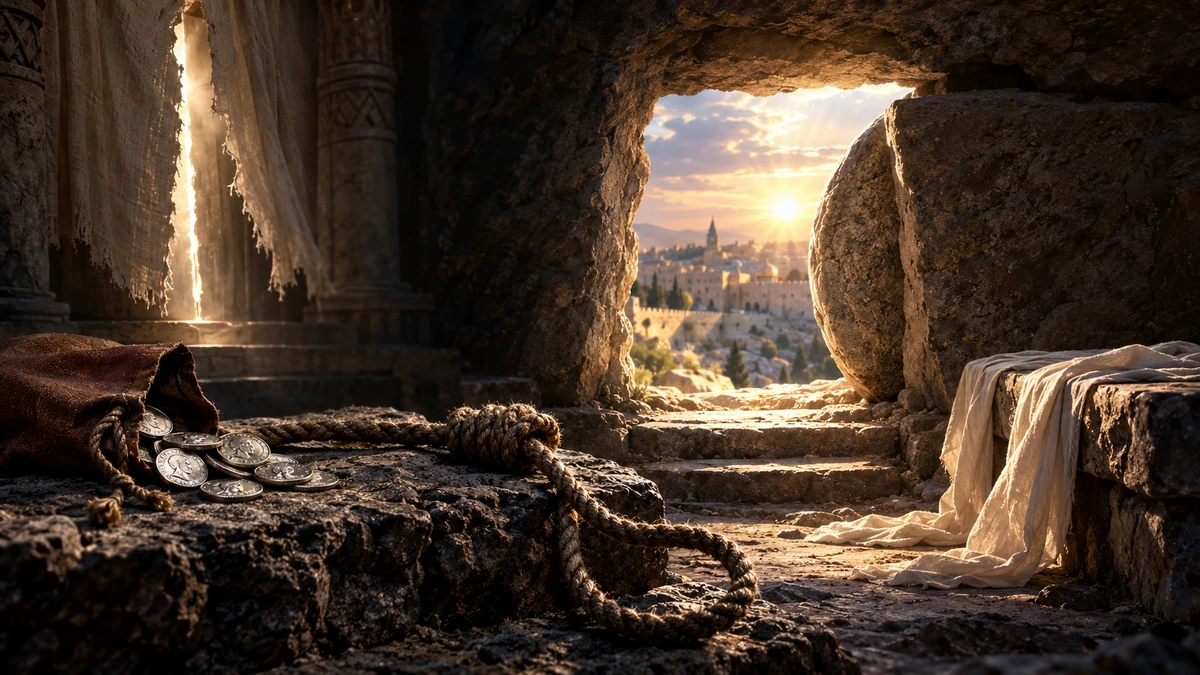
Some Gospel passages are difficult not because they are badly translated but because they force us to distinguish narrative, theology, and historical reconstruction. Two unusually sharp examples stand close together in the New Testament story: Matthew’s scene of opened tombs and raised saints at Jesus’s death, and the different accounts of Judas’s end in Matthew and Acts.
In the first case the difficulty is not a contradiction between two Gospels but almost the reverse: Matthew alone says that tombs opened, that the bodies of many saints were raised, and that after Jesus’s resurrection they entered the “holy city” and appeared to many. Mark, Luke, John, and Paul do not narrate this scene.
With Judas we have two accounts that partly overlap and partly diverge. Matthew describes remorse, returned silver, hanging, and priests who purchase a potter’s field. Acts says Judas acquired a field with the reward of wrongdoing and then fell and burst open. Both traditions know a “Field of Blood,” but they explain it differently.
The aim is therefore not to choose between “everything harmonizes perfectly” and “everything is invented.” A more useful question is: what does each author actually say, which older motifs are being used, what can be harmonized, and what does a harmonization add that no text itself states?
First the text: what does Matthew actually say?
Matthew 27:51–54 places the strange scene immediately after Jesus’s death. The temple curtain tears, the earth shakes, rocks split, tombs open, and “many bodies of the saints who had fallen asleep” are raised. The next sentence adds that after Jesus’s resurrection they came out of the tombs, entered the holy city, and appeared to many. The scene then ends with the centurion and guards responding to the signs by acknowledging Jesus’s special status.
The text does not identify these saints, say how many there were, specify to whom they appeared, tell us what later happened to them, or clarify whether their raising is permanent in the same sense as Jesus’s resurrection. The chronology is also unusual: the tombs open at Jesus’s death, while their emergence is explicitly placed after his resurrection. Ancient and modern interpreters have therefore had to decide how precisely verses 52 and 53 relate to each other.
One further point matters: this is not an isolated miracle inserted into an ordinary narrative sequence. Daniel Gurtner notes that after Jesus’s death Matthew briefly moves the reader out of the normal Golgotha scene into a broader, almost meta-narrative sequence of signs. The opened tombs should first be interpreted inside that sequence.
Why is the scene so unusual?
Mark knows the torn temple curtain and the centurion’s confession but does not mention opened tombs. Luke and John do not narrate this scene either, and Paul’s early formulas about Jesus’s death and resurrection do not mention a group resurrection of saints in Jerusalem. Matthew 27:52–53 is therefore distinctive to Matthew.
That fact alone does not prove the event did not happen. The evangelists often select different episodes and traditions. But for historical reconstruction it matters that we do not possess several independent early witnesses to this specific scene. If the passage is read as a literal public raising of multiple people who then appeared to many in Jerusalem, the silence of other early narratives is at least evidence to be weighed — not an automatic disproof.
Modern scholarship has therefore developed several types of interpretation. Serge Wüthrich explicitly surveys historical, causal, and semiological or symbolic readings; Ronald Troxel, Donald Senior, and others show how tightly the passage is embedded in Matthew’s literary and theological shaping of Jesus’s death. The debate is thus not simply between “believers” and “skeptics,” but also between different ways of understanding ancient apocalyptic narrative.
Ezekiel 37: opened graves as a language of restoration
The closest Old Testament echo is often found in Ezekiel 37. In the vision of the dry bones God promises Israel: “I am going to open your graves and bring you up from your graves.” In its original context the passage speaks of Israel’s restoration, not a report that individual corpses literally rose in Ezekiel’s day. Yet the language of opened graves and renewed life became a powerful Jewish eschatological vocabulary.
Donald Senior connected Matthew’s scene with the Ezekiel tradition and the broader language of a new age, judgment, and restoration. Other scholars have proposed additional parallels in the prophets, apocalyptic texts, and 1 Enoch. Troxel, for example, argues for a connection with 1 Enoch 93.6 and reads the episode as part of Matthew’s construction of the centurion’s confession.
There is therefore no need to claim one single demonstrable literary source. It is safer to say that Matthew is using language already associated in Jewish tradition with divine intervention, opened graves, restoration, and eschatological reversal. That helps explain the meaning of the scene without by itself settling its historicity.
History, apocalyptic image, or both?
Read as ordinary chronicle, the passage makes a very strong historical claim: several dead people rose, entered Jerusalem, and appeared to many. Read as apocalyptic-theological narrative, the opened graves announce that Jesus’s death already opens the age of resurrection and the new world. Between those poles are readings in which Matthew narrates an event through densely symbolic and scriptural language.
Historical method reaches a limit here. We do not have independent contemporary documentation of the event, but a miraculous event cannot be disproved merely because other sources fail to mention it. At the same time, a historian cannot simply extract every detail from Matthew’s theologically shaped passage as independently confirmed chronicle.
The strongest conclusion is therefore narrower: Matthew intends Jesus’s death to appear as an event of cosmic and eschatological significance. Whether the opened tombs are primarily a report of physical events, primarily an apocalyptic image, or an event already interpreted through apocalyptic language remains disputed.
Judas in Matthew: remorse, silver, and hanging
Matthew 27:3–10 gives the first of two canonical narratives about Judas’s end. Judas sees that Jesus has been condemned, regrets what he has done, returns the thirty silver pieces, and confesses that he has betrayed innocent blood. The priests refuse to place the money in the temple treasury because it is “blood money.” Judas then leaves and hangs himself, while the priests use the silver to buy the potter’s field for burying foreigners.
Matthew thus embeds Judas’s death in the wider theme of innocent blood. Judas becomes a witness to Jesus’s innocence while the religious authorities reject responsibility. Ulrich Luz notes that the episode belongs to Matthew’s special material and that Judas attempts in some measure to undo what he has done, though the narrative does not restore him to his former role.
The ending is even more literarily shaped: Matthew links the thirty pieces of silver, the temple, the potter, and the field to Scripture. The text attributes the quotation to Jeremiah, although its clearest wording echoes Zechariah 11:12–13; field and potter motifs may also recall Jeremiah. Graham Stanton shows how Matthew adapts and integrates scriptural citations into his own narrative; Origen and Jerome already noticed the problem that Matthew 27:9 names Jeremiah while the wording most clearly echoes Zechariah. The precise mechanism behind this composite citation remains disputed.
Judas in Acts: field, fall, and judgment
Acts 1:18–20 gives a different summary. Judas is presented as a man who acquired a field with the reward of wrongdoing; then, falling headlong, he burst open in the middle, and his intestines spilled out. The event became known to the people of Jerusalem, who called the place Hakeldama — Field of Blood.
In Matthew the field is purchased after Judas’s death by the priests using the returned money, and its name derives from blood money. In Acts acquisition is attributed to Judas, and the name is connected with his bloody end. The difference therefore concerns more than the mode of death; the causal story of the field and its name is also different.
Arie Zwiep has analyzed Acts 1:15–26 in the broader ancient context of stories about the death of the wicked and divine retribution. In Luke’s narrative Judas’s end primarily explains why his place among the Twelve must be filled. The death is therefore not a neutral biographical note but part of a story of judgment, restoration of the Twelve, and continuation of the mission.
The two canonical accounts side by side
The comparison shows that Matthew and Acts share several elements — Judas, money, a field near Jerusalem, and the name Field of Blood — but connect them in different sequences. It is therefore not enough to compare only “he hanged himself” with “he fell”; the whole narrative chain matters.
| Element | Matthew 27:3–10 | Acts 1:18–20 | Agreement / difference |
|---|---|---|---|
| Judas after the betrayal | regrets it, returns silver, confesses innocent blood | remorse is not mentioned | different emphasis on Judas’s inner state |
| Money | Judas returns it to the priests | called the reward of wrongdoing | both link money to the betrayal |
| Who acquires the field | the priests buy it with returned silver | Judas acquires it with the reward | clearest narrative difference |
| Mode of death | Judas hangs himself | he falls headlong and bursts open | different descriptions of death |
| Name of the place | Field of Blood because of blood money | Field of Blood after Judas’s bloody end | same name, different etiology |
| Scriptural frame | Jeremiah/Zechariah, thirty pieces, potter’s field | Psalms 69 and 109, replacement of Judas’s office | each author embeds the death in a different scriptural interpretation |
| Narrative function | Jesus’s innocence and responsibility for blood | judgment on Judas and replacement of the Twelfth | different theological function for the same figure |
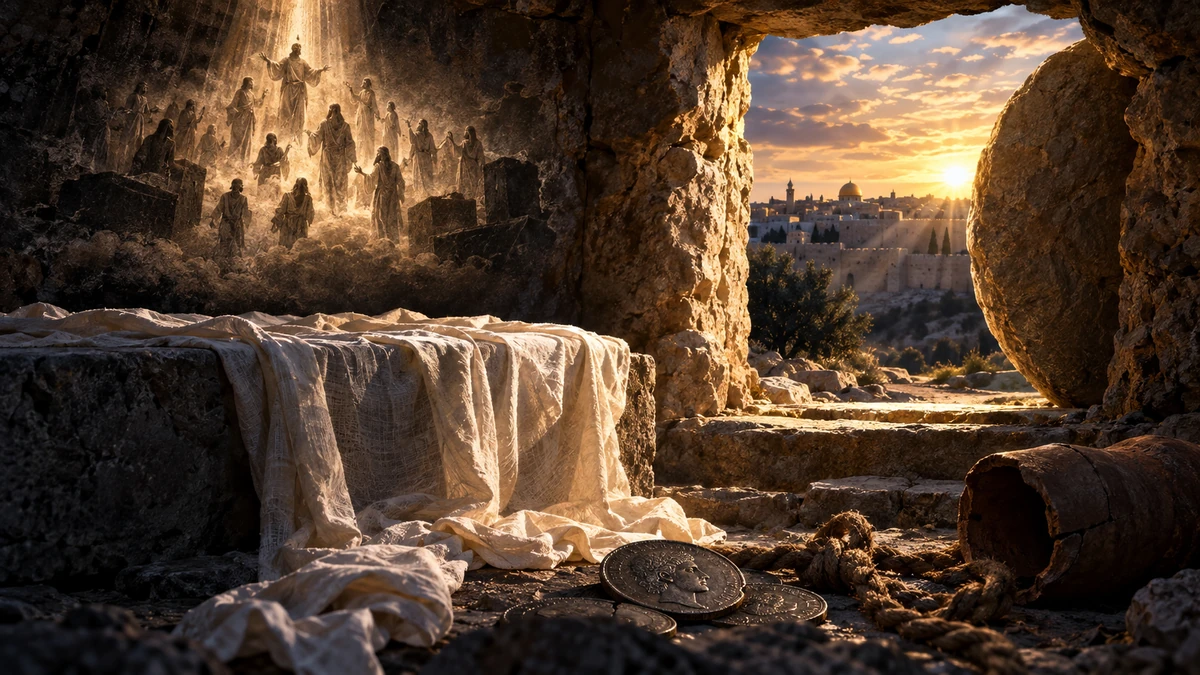
Harmonization: hanging and falling can happen in sequence — but what follows from that?
The best-known harmonization says Judas first hanged himself and then the rope or branch failed, causing the body to fall and burst open. The field can likewise be harmonized by saying that the priests purchased it with Judas’s money and therefore effectively purchased it on his behalf or as a consequence of his money. Such a scenario is logically possible.
But logical possibility is not the same as textual attestation. Matthew does not say that Judas’s body later fell, Acts does not mention a rope, and the two sources explain both ownership of the field and the name Field of Blood differently. The harmonized sequence is therefore a third reconstruction, built from elements of both stories plus additional assumptions.
That does not make harmonization wrong; it clarifies its status. If the aim is to show that the two stories are not physically impossible to combine, harmonization may succeed. If the aim is to determine what each author meant and which tradition is historically earliest, the narratives must first be allowed to remain distinct.
Papias: a third early death tradition about Judas
The story does not stop with the two canonical versions. Fragments attributed to Papias of Hierapolis preserve an even more grotesque tradition in which Judas does not simply die in Matthew’s or Luke’s manner but becomes monstrously swollen, decays, and functions as an example of the punished wicked. The account survives in later indirect witnesses and must therefore be used cautiously.
Candida Moss has shown that Papias’s description fits ancient literary and medical images in which swelling, worms, and bodily corruption could mark greed, sin, and divine punishment. Christopher Zeichmann also stresses the rhetorical, almost ekphrastic exaggeration of the scene.
Papias is therefore not simply a “third eyewitness” from whom the true anatomy of Judas’s death can be calculated. His value lies elsewhere: he shows that Judas’s horrific end developed very early in several narrative directions. Moss also notes that elements of the Papias tradition may already echo canonical stories, so complete independence should not be assumed.
What historical core can remain?
For Judas’s death the shared historical core is narrower than later harmonizations. Very early Christian tradition knows Judas as one of the Twelve and the betrayer; Matthew and Luke-Acts both know a shameful end and connect money or death with a Field of Blood known to Jerusalem’s residents. But the precise mode of death, the direct purchaser of the field, and the reason for its name are not uniform.
For the raised saints the situation is even more limited. We have one canonical narrative deeply embedded in Matthew’s apocalyptic and scriptural symbolism, without independent early narrative confirmation. A historian can therefore describe Matthew’s claim and its literary environment with confidence; it is much harder to determine what concrete event — if any — lies behind that narrative form.
Both cases reveal the same methodological rule: a text does not become less interesting when its differences and literary shaping are acknowledged. On the contrary, only then can we distinguish between what a source claims, what the author is doing with the story, and what history can independently reconstruct.
An open question
Matthew’s raised saints and Judas’s death are two different problems, yet together they show why reading the Gospels requires more than choosing between literalism and rejection. In one case we have one highly theological narrative without a parallel; in the other we have several early narratives that share a core but organize details and meaning differently.
It is possible to defend a historical core in both traditions without claiming that we possess a complete chronicle. It is also possible to recognize strong apocalyptic, scriptural, and moral shaping without automatically concluding that the authors preserved no historical memory at all.
Do these passages primarily expose uncomfortable seams between different early traditions — or do those very seams show how the first Christians interpreted historical memory through the language of Scripture, judgment, and resurrection? And how much of both can be true at once?
Sources and further reading
- Bible Gateway — Matthew 27:50–54 (NRSVUE) — primary text for the torn veil, earthquake, opened tombs, raised saints, and centurion’s response.
- Bible Gateway — Matthew 27:3–10 and Acts 1:18–20 (NRSVUE) — the two canonical accounts of Judas’s death and the Field of Blood.
- Bible Gateway — Ezekiel 37:12–14 (NRSVUE) — primary text for the opened-graves restoration motif.
- Bible Gateway — Zechariah 11:12–13 and Matthew 27:9–10 (NRSVUE) — primary comparison for the thirty pieces of silver and Matthew’s Jeremiah attribution.
- Ronald L. Troxel, “Matt 27.51–4 Reconsidered: Its Role in the Passion Narrative, Meaning and Origin,” New Testament Studies 48 (2002), 30–47 — argues for Matthean literary creation and explores 1 Enoch 93.6 as a source motif.
- Donald Senior, “The Death of Jesus and the Resurrection of the Holy Ones (Mt 27:51–53),” Catholic Biblical Quarterly 38 (1976), 312–329 — classic study of Ezekiel and eschatological background.
- M. de Jonge, “Matthew 27:51 in Early Christian Exegesis,” Harvard Theological Review 79 (1986), 67–79 — places Matthew 27:51–53 in its literary context and surveys early interpretation.
- Serge Wüthrich, “Naître de mourir: la mort de Jésus dans l’Évangile de Matthieu (Mt 27.51–56),” New Testament Studies 56 (2010) — reviews historical, causal, and semiological approaches to Matthew’s apocalyptic signs.
- Daniel M. Gurtner, The Torn Veil: Matthew’s Exposition of the Death of Jesus (Cambridge University Press, 2007) — literary and theological study of Matthew 27:51–53 within the Passion narrative.
- Craig A. Evans, Matthew (Cambridge University Press, 2012), sections on Matthew 27:3–10 and 27:51–54 — historical and literary commentary on Judas and the signs at Jesus’s death.
- Ulrich Luz, The Theology of the Gospel of Matthew (Cambridge University Press, 1995), chapter “Passion and Easter (Matthew 26–28)” — Matthew’s theological shaping of Judas and the Passion.
- Graham Stanton, “Matthew,” in It Is Written: Scripture Citing Scripture (Cambridge University Press, 1988) — Matthew’s formula quotations and the long-recognized Jeremiah/Zechariah problem in Matthew 27:9.
- Arie W. Zwiep, Judas and the Choice of Matthias: A Study on Context and Concern of Acts 1:15–26 (Mohr Siebeck, 2004) — major study of Acts 1, Matthew 27, Papias, and ancient traditions of the wicked person’s death.
- Candida R. Moss, “A Note on the Death of Judas in Papias,” New Testament Studies 65 (2019), 388–397 — Papias, ancient medical/rhetorical imagery, and the pedagogical function of Judas’s grotesque death.
- Christopher B. Zeichmann, “Papias as Rhetorician: Ekphrasis in the Bishop’s Account of Judas’ Death,” New Testament Studies 56 (2010), 427–429 — rhetorical analysis of Papias’s description.
- Jonathan Cahana, “Salvific Dissolution: The Mystery of the Betrayal between the New Testament and the Gospel of Judas,” New Testament Studies 63 (2017), 111–124 — Matthew and Acts as differently shaped narratives of Judas’s punishment.
- David Daube, “Judas,” Israel Law Review 29 (1995), 9–31 — contrasts Matthew’s self-punishment by hanging with Acts’ divinely inflicted violent end and discusses early interpretation.
- Stephen C. Carlson, Papias of Hierapolis: Exposition of Dominical Oracles. The Fragments, Testimonia, and Reception of a Second-Century Commentator (Oxford University Press, 2021) — modern critical edition controlling the fragmentary Papias tradition.
- Cambridge bibliography for The Torn Veil — documentation of the main scholarly literature on Matthew 27:51–54, including Senior, Witherup, Troxel, Wenham, and related studies.
- Mohr Siebeck — Judas and the Choice of Matthias, publisher description — confirms the study’s focus on Acts 1:15–26, Matthew 27:3–10, Papias, and traditions of divine retribution.