Dark History of the Popes — Brenda Ralph Lewis: vice, murder, corruption, and historical context
Brenda Ralph Lewis moves from the Cadaver Synod and the Cathars to the Borgias, Galileo, and Pius XII; this article compares her dark episodes with newer scholarship and separates documented history from polemical framing.
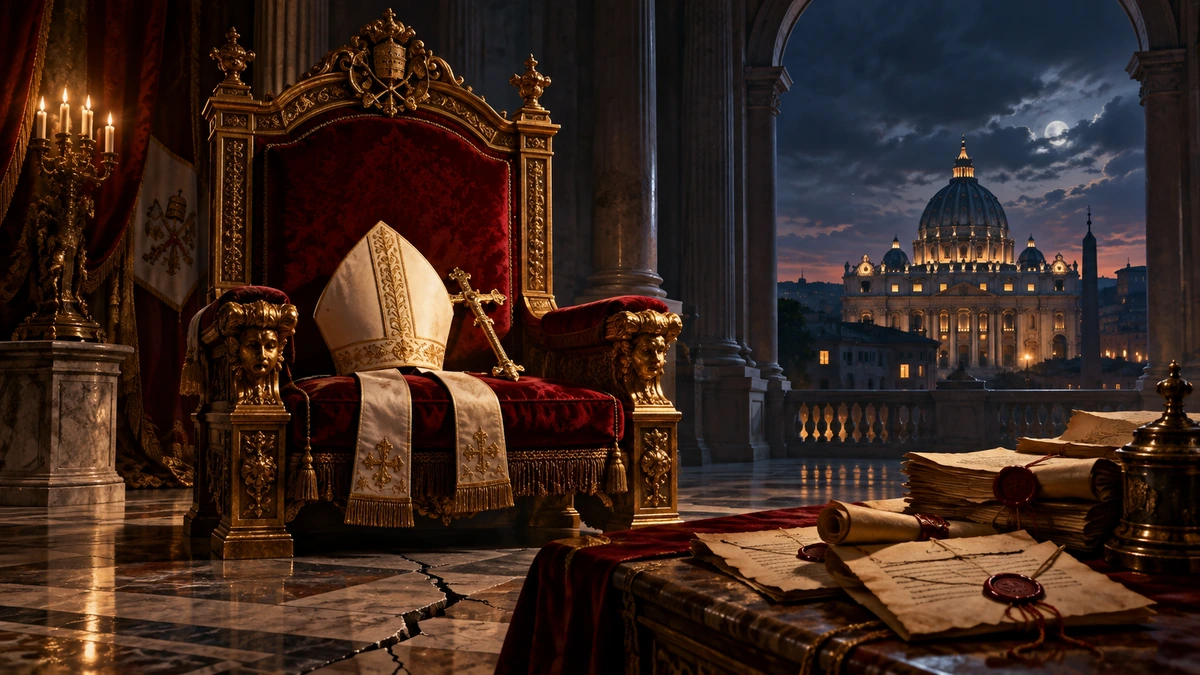
In Dark History of the Popes: Vice, Murder and Corruption in the Vatican, Brenda Ralph Lewis does not write a general history of the papacy. She deliberately selects some of its darkest episodes. Amber Books’ current page lists 256 pages, roughly 78,000 words, and more than 200 photographs or artworks; the chronological span runs from the early Middle Ages to Pius XII and the Second World War. The table of contents shows how selective the project is: the Cadaver Synod and early Vatican scandals, two chapters on the Cathars, popes and witchcraft, the Borgias, Galileo, two chapters on the “Prisoner of the Vatican,” and a closing chapter on Pius XII and Nazism. [1][2]
That selection concentrates on cases in which religious authority, family networks, temporal power, violence, and institutional self-preservation became unusually visible. At the same time, a collection of extreme cases cannot by itself tell us how representative they were of almost two millennia of papal history. This article therefore treats Lewis neither as an indictment of Catholicism nor as an excuse for the papal institution. It follows the book’s themes while distinguishing well-documented events, the author’s framing, and later historiographical debate.
A book that begins with the darkest episodes
Lewis’s book belongs to popular history. The publisher presents it as a history of “vice, murder and corruption,” built in part from diaries, letters, diplomatic reports, and records of ecclesiastical courts. [1] Yet the structure itself makes clear that this is not a neutral cross-section of every pontificate. Its nine chapters are organized around conflicts, scandals, and contested periods rather than ordinary church administration, theology, diplomacy, charity, or reform. [2]
Studying an institution through its crises is a legitimate historical approach as long as the selection is not mistaken for a statistical portrait of the institution as a whole. The article therefore asks: what mechanisms of power do these cases reveal, and how strong are the sources through which we know them?
The Cadaver Synod: when a political conflict reached into the grave
The first major scene is almost too strange to require literary embellishment. In 897, the remains of Pope Formosus were exhumed and placed on trial by order of his successor Stephen VI. After conviction, three fingers of the corpse’s right hand—associated with the papal blessing—were cut off, and the affair contributed to religious and political outrage in Rome. A modern historical review confirms the core of this account. [3]
Lewis places the episode alongside stories of the so-called “Rule of the Harlots,” or saeculum obscurum, and Pope John XII. Here greater caution is needed. The violent struggles of Roman aristocratic factions and the power of family networks have a historical basis, but some of the most colorful accusations come from hostile chroniclers. Antoni Grabowski’s study of Liudprand of Cremona shows how John XII was deliberately constructed in the narrative as an ultimate monstrous figure. [4]
That does not mean early papal scandals should be dismissed as propaganda. It means something more demanding: political violence, patronage, and moral accusations have to be reconstructed together with the question of who told the story, whom it served, and how it was composed.

The Cathars: mass violence is historical; the label “genocide” is not self-explanatory
Lewis titles two chapters with the word “genocide” and devotes them to the Cathars and the Albigensian Crusade. The core violence is not in doubt: after 1208 Pope Innocent III supported a crusade against heresy in southern France, followed by campaigns, sieges, and massacres, with Béziers in 1209 becoming the most famous symbol. [5]
Modern scholarship, however, warns against simply projecting the word “genocide” backward without explanation. In The Cambridge World History of Genocide, Mark Gregory Pegg describes “genocidal moments” and deliberately destructive violence while also noting that the victims do not map neatly onto the protected groups of the modern legal definition of genocide. He goes further, challenging the idea of a single clearly bounded, self-conscious “Cathar” religious body of the kind later literature often assumes. [5]
Lewis’s chapter title therefore captures the reality of mass religious-political violence but already embeds an interpretive conclusion that a modern article needs to unpack. A more precise formulation is: the destructive crusade and repression are well documented; their placement within the modern category of genocide remains a historiographical and legal question.
Popes and witchcraft: responsibility without a single causal line
The chapter on witchcraft enters another field where popular history can collapse into an overly simple formula: “a pope started the witch hunts.” Papal documents did help shape a repressive framework. In the recent Cambridge History of the Papacy, Matteo Duni shows that popes from the thirteenth through the seventeenth centuries issued pronouncements on magic, sorcery, and witchcraft, and that papal support for persecutors in some periods contributed to the development of ideas about diabolical witchcraft. [6]
Especially famous is Innocent VIII’s 1484 bull Summis desiderantes affectibus, which supported the work of inquisitors in German lands. But it does not follow that one document created the whole European witch hunt. Persecutions unfolded through different local legal systems, chronological peaks, and secular as well as ecclesiastical actors. Even within Catholic inquisitorial institutions, practice was not uniform across time. [6]
Historical responsibility is therefore more distributed, not less real. Papal authority could legitimize particular ideas and procedures; concrete waves of persecution were not simply commands issued from one central room.
The Borgias: documented nepotism and a layer of black legend
Rodrigo Borgia, Pope Alexander VI from 1492 to 1503, is almost an ideal figure for a book with this title. Family advancement is not a later invention: the Enciclopedia dei Papi and Treccani place his career within a network of nepotism, wealth, and benefit that began with the rise of his uncle Callixtus III; Alexander VI then conspicuously promoted his own children and relatives. [7]
Yet the Borgias also demonstrate a second danger: once the historical core is genuinely scandalous, ever more dramatic stories easily accumulate around it. The historiography of Alexander VI was for centuries part of a broader struggle between anti-Catholic polemic and Catholic apologetics. A Cambridge study of the opening of the Vatican archives shows how both accusatory and defensive constructions gathered around the “Borgia pope.” [8]
The article therefore separates these layers in two stages: first acknowledge well-documented patterns—nepotism, dynastic politics, wealth, and temporal ambition—then test every sensational story about poisoning, incest, or secret murder separately rather than treating the family’s reputation as proof in itself. [7][8]

Galileo: a real condemnation and the later simplification of a symbol
Lewis’s Galileo chapter treats one of the most famous conflicts between ecclesiastical authority and the new science. The basic facts are solid: controversy over Copernican heliocentrism led to proceedings before the Roman Inquisition in 1633; Galileo was required to recant support for a position treated as contrary to the Church’s decisions, and he spent the remainder of his life under a form of house arrest.
Yet this event also became a symbol whose meaning often grew wider than the case itself. When John Paul II presented the conclusions of a long-running commission in 1992, he spoke publicly of acknowledged errors, of the failure of most theologians at the time to distinguish Scripture properly from its interpretation, and of the way the Galileo affair had become a myth of supposedly necessary incompatibility between science and faith. [9]
That later acknowledgement does not erase the 1633 proceedings. It does show why it is more precise to discuss a concrete conflict among scientific demonstration, biblical hermeneutics, personal politics, and institutional jurisdiction than to turn one trial into a timeless formula about all religion and all science.
The “Prisoner of the Vatican”: scandal gives way to sovereignty
The two chapters titled “The Prisoner of the Vatican” shift the center of gravity from personal vice to the political history of the Papal States. In 1870, Rome was annexed to the Kingdom of Italy and the papacy lost the remainder of its temporal territory. The resulting “Roman Question” lasted for decades; popes rejected the legitimacy of the new settlement and described themselves as prisoners of the Vatican.
The Lateran Treaty of 1929 formally settled the dispute. Its preamble explicitly refers to the “Roman Question” created by the annexation of Rome in 1870 and to the creation of Vatican City as the territorial basis for the Holy See’s independence. [10]
This part of Lewis’s book matters precisely because it shows that a “dark history” is not always a history of personal scandal. It is also a story about what happens when an institution claiming spiritual universality simultaneously loses territorial sovereignty and has to renegotiate its place within the modern nation-state.
Pius XII: a chapter that cannot be read the same way after 2020
Lewis closes with Pius XII and his conduct during Nazism, the Second World War, and the Holocaust. A present-day reader has to remember that the book appeared before the fuller Vatican archival holdings for the pontificate of Pius XII were opened to researchers. Those collections became available in March 2020, and subsequent scholarship has stressed that the vast, dispersed material requires cross-checking among multiple church and state archives. [11]
One point is well documented: Pius XII did not publicly and directly condemn Nazi policies toward Jews in the way his critics expected from the moral authority of his office. The United States Holocaust Memorial Museum states this explicitly in its account of occupied Rome. The same account also emphasizes that many Catholic institutions in Rome provided shelter and assistance to Jews; more than 10,000 Roman Jews survived, while about 1,800 were deported. [12]
The current debate is therefore not fairly captured either by a single label such as “Hitler’s Pope” or by the opposite apologetic picture in which every silence is itself evidence of a hidden rescue strategy. David Kertzer’s work with the newly opened archives emphasizes the pope’s public silence and concern for protecting the institutional Church; Nina Valbousquet, meanwhile, warns against sensationalist or apologetic readings of isolated documents without broader archival cross-checking. [11][13]
What Lewis’s book shows well — and where it needs a brake
The book’s strength is chronological concreteness. Instead of an abstract argument about a “corrupt institution,” it gives the reader scenes, people, and turning points: a corpse on trial, crusading violence against heresy, papal decrees on magic, Borgia family politics, Galileo’s prosecution, the loss of the Papal States, and the moral dilemma of the Second World War. The publishing design, with more than 200 images, reinforces that vivid popular-history method. [1][2]
Its limitation is the same feature turned around. When history is assembled almost entirely from extreme cases, it creates a strong sense of continuous scandal even though the cases are separated by centuries, different legal systems, different political structures, and very different kinds of evidence. Some chapter titles—most notably “genocide” for the Cathars—are also interpretively stronger than the degree of scholarly agreement that can be assumed without explanation. [5]
The book is therefore most useful as a guide to dark episodes, not as a measurement of papal history as a whole. Its questions are often worth following; its framing should be checked against newer specialist scholarship.
What remains of a “dark history”
After that checking, the core of the book does not disappear. The Cadaver Synod happened. Religious-political violence against the population of Languedoc happened. Papal decrees participated in the history of suppressing magic. Alexander VI’s nepotism is not an invention. Galileo was condemned. The papacy lost its state after 1870 and regained sovereignty in a different form in 1929. Pius XII’s public silence in the face of the persecution of Jews remains a serious subject of historical judgment. [3][5][6][7][9][10][12]
But none of this yields one simple story of “the Vatican” acting as an unchanging agent across a millennium. A pope, the curia, local churches, temporal rulers, inquisitorial tribunals, the diplomatic apparatus, and individual Catholic institutions did not always act alike or even in the same direction. That is the most useful supplement to Lewis’s dark panorama: a long-lived institution accumulates scandals and reforms, victims and its own attempts at correction—and historians have to establish each layer separately.
Sources and further reading
- Amber Books — Dark History of the Popes, official publisher page; bibliographic details, scope, method description, and author profile. Source
- Google Books — Brenda Ralph Lewis, Dark History of the Popes: Vice, Murder and Corruption in the Vatican, Park Lane, 2009; bibliographic record and book structure. Source
- Muhammad Bilal and R. Shane Tubbs, “Popes convict dead Pope Twice! The unbelievable Cadaver Synod,” Clinical Anatomy 29(2), 2016; historical review of the 897 Cadaver Synod. Source
- Antoni Grabowski, “Liudprand of Cremona’s papa monstrum: the image of Pope John XII in the Historia Ottonis,” Early Medieval Europe 23(1), 2015; analysis of the literary construction of John XII in Liudprand’s account. Source
- Mark Gregory Pegg, “The Albigensian Crusade and the Early Inquisitions into Heretical Depravity, 1208–1246,” in The Cambridge World History of Genocide, 2023; crusade violence, “genocidal moments,” and the problem of the category “Cathars.” Source
- Matteo Duni, “The Popes and Magic,” in The Cambridge History of the Papacy, 2025; papal pronouncements on magic, witchcraft, and repression from the thirteenth to the seventeenth centuries. Source
- Treccani, Enciclopedia dei Papi — “Alessandro VI”; biographical and institutional context for Rodrigo Borgia, nepotism, and his pontificate. Source
- Owen Chadwick, “The Borgia Pope,” in Catholicism and History: The Opening of the Vatican Archives; historiographical conflict between anti-Catholic and apologetic images of Alexander VI. Source
- John Paul II, Address to the Pontifical Academy of Sciences, 31 October 1992; conclusions of the Galileo commission, acknowledged errors, and the relationship between science and biblical interpretation. Source
- Holy See–Italy, Lateran Treaty, 11 February 1929; primary document on the settlement of the “Roman Question” and the creation of Vatican City State. Source
- Nina Valbousquet, “The Opening of the Vatican Archives for the Pontificate of Pius XII: Controversial Memory, Scholarly Debates, and Archival Approaches,” Revue d’histoire moderne & contemporaine 69-1, 2022; methodology after the 2020 opening of the Pius XII archives. Source
- United States Holocaust Memorial Museum, Holocaust Encyclopedia — “Rome”; deportation of Roman Jews, Pius XII’s public silence, and assistance provided by Catholic institutions hiding Jews. Source
- Brown University, “Using newly unsealed archives, Brown professor takes fresh lens to Pope Pius XII at war,” 15 July 2022; David Kertzer on cross-reading Vatican and state archives and Pius’s public silence. Source