Chakras: A History of the Subtle Body in Indian Traditions
The seven rainbow chakras are not one unchanged ancient system. Tantric sources preserve multiple subtle anatomies; an influential six-centre model with Sahasrāra was transformed in the West through Woodroffe, Theosophy and later New Age culture into today’s familiar scheme.
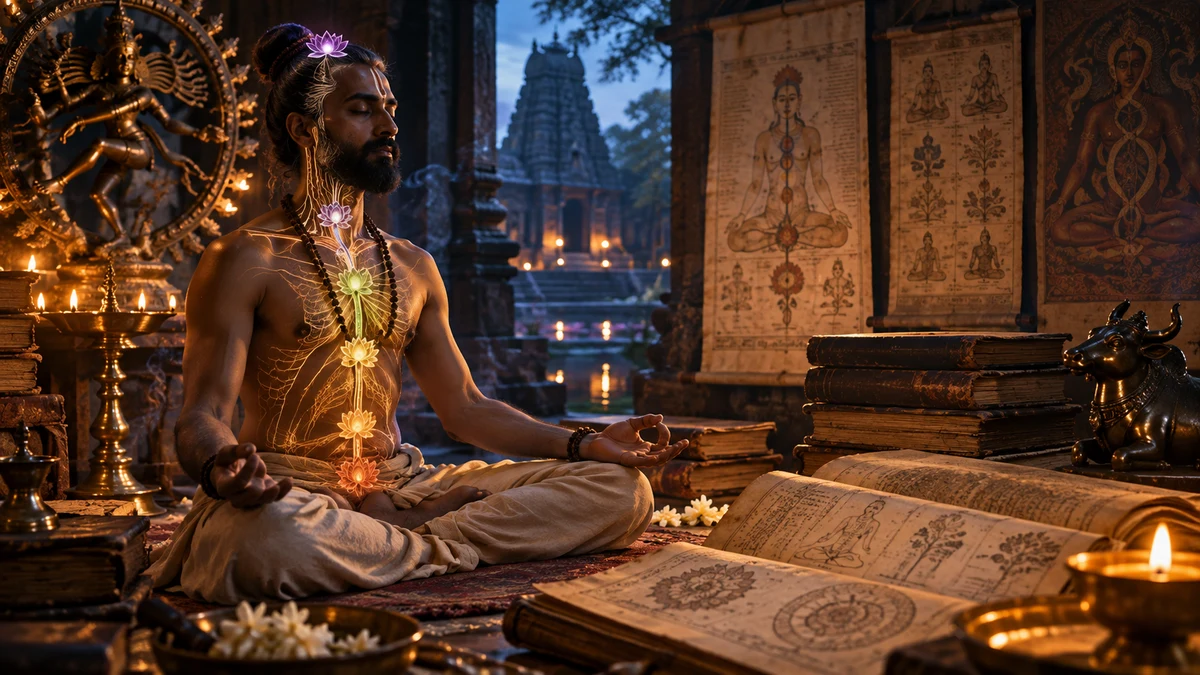
Today the image of the chakras can seem self-evident: seven coloured centres aligned from the base of the spine to the crown, each with its own colour, psychological theme and sometimes a corresponding gland. Historical sources tell a more interesting story. Indian traditions did not preserve one single, immutable ‘seven-chakra system’. They developed multiple maps of the subtle body, with different numbers of centres, names, deities, mantras and ritual purposes.
The Sanskrit word cakra means wheel or circle and has uses far broader than the modern idea of an energy centre. The technical use of cakras as nodes of a subtle body becomes especially important in Tantric and yogic traditions, where the body is not only physical anatomy but also a ritual microcosm: a network of channels (nāḍī), breath or vital force (prāṇa), mantras, deities and visualisations.
This also means that three histories need to be distinguished: Indian textual and ritual systems, their early-modern and colonial translation, and the Western standardisation that produced the familiar seven-colour rainbow model. Arthur Avalon, or John Woodroffe, popularised an influential Tantric model in 1919 built around six cakras with Sahasrāra above; C. W. Leadbeater published a different Theosophical system in 1927, with colourful clairvoyant ‘vortices’, which strongly shaped later Western imagery.
The question, then, is not simply whether chakras are ‘real’ in one undifferentiated sense. A better question is: what did chakras mean within their historical traditions, how did their map change, and what can — and cannot — modern anatomy say about them?
A chakra was not always ‘one of seven’
In popular modern language, chakra is almost automatically understood as one of seven energy centres. Historically that is too narrow. Sanskrit cakra means wheel, circle, disc or circular formation and appears in political, religious, cosmological and ritual vocabularies. Only in particular yogic and Tantric settings does it become a technical term for inner centres of a subtle body.
Even there, no single map existed. Glen Hayes’s Oxford survey of Tantric ‘esoteric physiology’ stresses the plurality of systems: subtle bodies may be made of channels, centres, drops, winds, syllables, deities and cosmological levels. Their form depends on a particular text, initiation and ritual goal, not on one universal anatomical atlas.
This is the first major historical boundary. If one late seven-centre scheme is declared to be ‘the ancient Hindu anatomy’, several traditions are collapsed into something the sources themselves do not present. It is more accurate to speak of a family of related subtle anatomies.
Basic rule: similar names and locations do not mean that every chakra system is the same system.
When did the subtle body of channels and centres emerge?
Geoffrey Samuel places a major development of practices based on internal nāḍī networks and cakra junctions especially in Śaiva and Buddhist Tantric traditions from roughly the eighth to tenth centuries. This does not mean India previously lacked breath practices, inner-body ideas, ascetic techniques or cosmological symbolism. It means that the characteristic later Tantric map should not simply be projected unchanged back into the earliest Vedas.
André Padoux explicitly warns against treating Tantra as though it were simply already present in the Veda. Tantric traditions drew on older backgrounds, but their distinctive initiations, techniques and bodily visualisations took shape later. This matters because modern marketing often speaks of an ‘ancient Vedic seven-chakra system’ as though a single scheme existed from the beginning.
The historical picture is more gradual: older ideas of breath, inner power, ascetic embodiment and cosmic correspondences met new Tantric ritual, mantra and visualisation. From this emerged systems in which the human body became a microcosm that could be ritually transformed.
An ancient background is not the same as an unchanged ancient system. Chakra systems have prehistories, but their recognisable Tantric forms belong to specific later traditions.
What is the ‘subtle body’? Nāḍī, prāṇa, lotuses and mantra
In Tantric systems, chakras are not merely coloured points. They are connected with networks of nāḍīs, inner channels through which prāṇa or other subtle forces move. Suṣumṇā often functions as the central channel, with iḍā and piṅgalā beside it. The Haṭha Yoga Pradīpikā discusses purification of nāḍīs, entry of prāṇa into the middle channel and the awakening of kuṇḍalinī.
A centre may be visualised as a lotus with a particular number of petals. Its petals carry syllables; its centre may contain geometric figures, elements, deities, animals, seed syllables and other ritual correspondences. These are not mere decoration but components of inner visualisation, recitation and ritual placement (nyāsa).
For that reason, ‘subtle anatomy’ can mislead if it is understood as an invisible duplicate of modern physiology. In its historical settings this is a ritual-cosmological body: a way of structuring world, deity, mantra and practitioner within a single inner space.
A chakra in a Tantric text can simultaneously be a location, lotus, mantra, deity, element and stage of practice. It is not necessarily just an ‘energy organ’.
Six chakras and the thousand-petalled lotus: from Ṣaṭcakranirūpaṇa to Sahasrāra
One of the most influential systems to reach the West is Pūrṇānanda’s Ṣaṭcakranirūpaṇa — literally the ‘description of six circles’. In Woodroffe’s presentation, the principal centres are mūlādhāra, svādhiṣṭhāna, maṇipūra, anāhata, viśuddha and ājñā. Above them stands sahasrāra, the thousand-petalled lotus at the crown, often not counted as a seventh chakra in exactly the same sense as the six lower centres.
A modern critical edition of chapter 25 of the Śāradātilakatantra likewise refers to six cakras or lotuses and adds the thousand-petalled lotus above the list. The Garuḍa Purāṇa and some later Upanishadic texts similarly enumerate six named centres together with a special upper level.
This is the source of a modern misunderstanding. Once six centres plus Sahasrāra are placed in one vertical graphic, we quickly obtain seven locations. Historically, however, that does not always mean ‘seven equivalent chakras’. Sahasrāra is frequently the goal, transcendent seat or level beyond the system rather than simply the next wheel of the same type.
| Common modern name | Traditional location / role in an influential six-cakra model |
|---|---|
| Mūlādhāra | Base centre in the lower trunk; starting point of kuṇḍalinī in many late systems. |
| Svādhiṣṭhāna | Lower-trunk centre with its own syllables and symbols. |
| Maṇipūra | Navel-region centre, often associated with the fire element. |
| Anāhata | Heart centre, often a twelve-petalled lotus. |
| Viśuddha | Throat centre, often a sixteen-petalled lotus. |
| Ājñā | Centre between the brows, often a two-petalled lotus. |
| Sahasrāra | Thousand-petalled lotus above the six centres; often a goal or transcendent level rather than simply an equal ‘seventh chakra’. |
The best-known modern sevenfold scheme has genuine Tantric roots, but modern counting and standardisation are not identical to every classical source.
Kuṇḍalinī: ascent through the centres is more than a wellness metaphor
In influential haṭha and Tantric sources, chakras are closely connected with kuṇḍalinī, the sleeping power or goddess said to be coiled at the base centre. The Haṭha Yoga Pradīpikā describes awakening kuṇḍalinī, piercing the lotuses and directing prāṇa into suṣumṇā. The aim is not simply relaxation or mood improvement but radical transformation of consciousness, samādhi and liberation.
These practices are historically linked to guidance by a guru, prāṇāyāma, bandhas, mudrās, mantra and initiation. The popular phrase ‘opening the chakras’ often sounds like gentle psychological self-help; classical texts describe a much more demanding discipline in which cosmology is enacted within the body.
None of this requires treating the traditional explanation as biomedical anatomy. It only requires not translating it into a completely different category. When kuṇḍalinī is reduced to ‘nerve energy’ or a chakra to a ‘gland’, the religious and ritual architecture that generated the system can disappear.
The historical meaning of a practice is not the same thing as a modern therapeutic interpretation. Both may exist, but they should be labelled as different layers.
There is no single map: four, five, six, seven and more centres
Different Hindu and Buddhist Tantric traditions organise subtle embodiment differently. Samuel and Hayes both stress that the systems are not uniform. Some use fewer centres, others more; traditions shift locations, alter names or assign different divine and cosmological functions.
Even Sanskrit sources that emphasise six principal centres mention additional locations such as lalana, manas, soma, bindu or various ādhāras. Woodroffe himself noted in the early twentieth century that texts speak of other centres and that some systems enumerate many more than six.
This plurality matters methodologically. If two traditions speak of a ‘heart centre’, they are not necessarily describing the same entity with the same function. Comparison is possible, but it should preserve difference between systems before searching for shared patterns.
Traditional diversity is not evidence of confusion. It shows that subtle anatomies served different practices and cosmologies rather than one medical standard.
How the West acquired a rainbow of seven chakras
Western understandings of chakras took shape through translation, Orientalism, Theosophy, occultism, psychology and later New Age culture. Writing as Arthur Avalon, John Woodroffe introduced the Ṣaṭcakranirūpaṇa to a broad English-speaking audience in The Serpent Power (1919). His influence was immense, but he was translating a specific Tantric model, not ‘all Hindu chakras’.
C. W. Leadbeater’s The Chakras (1927) made another important move. His illustrations depict the centres as colourful vortices allegedly perceived clairvoyantly and connect them with Theosophical ideas of vitality, the etheric body and bodily structures. In important details his map differs from Woodroffe’s Tantric presentation — including a prominent spleen centre.
Across the twentieth century, psychological meanings, rainbow colours, endocrine glands, musical notes, personality themes and therapeutic language accumulated around the system. The history reconstructed by Kurt Leland shows that the familiar Western package of correspondences did not arrive as one ancient table; it emerged gradually through multiple modern authors.
When a modern infographic shows seven chakras in a perfect red–orange–yellow–green–blue–indigo–violet sequence, we are looking at a modern synthesis with Indian roots — not a photograph of one ancient system.

Chakras and science: what can be said without mixing categories
Confusion is greatest when a symbolic and ritual map is simply declared to be hidden biomedical anatomy. Modern esoteric sources often correlate chakras with nerve plexuses or endocrine glands. Such parallels may be metaphorically or interpretively interesting, but historically they are not identical to the original Tantric descriptions, and similarities of location do not by themselves establish anatomical identity.
Modern anatomy can measure nerves, glands, blood flow, electrical activity and hormonal signalling. Traditional chakras in the sources also consist of mantras, deities, elements, lotuses and cosmological levels. These are different kinds of map. Evidence that meditation or breathing affects the nervous system is not automatically evidence that a particular chakra is an anatomical organ.
A historical approach does not require mocking the tradition. Chakra systems are real as religious technologies of embodiment, attention and meaning: for centuries they have structured meditation, ritual and understandings of the human person. Whether they additionally describe independently measurable subtle entities is a different empirical question, and traditional authority alone is not laboratory evidence.
| Claim | Safest status |
|---|---|
| Chakras are important in multiple Tantric and yogic traditions. | Historically well documented. |
| There is only one ancient seven-chakra system. | No; sources preserve multiple systems. |
| Six centres plus Sahasrāra form an influential classical model. | Yes, especially in later Tantric and haṭha sources. |
| The modern rainbow colour sequence is unchanged from antiquity. | No; major standardisation is modern. |
| Chakras are identical to endocrine glands or nerve plexuses. | Interpretive correspondence, not established anatomical identity. |
| Meditation, breathing or yoga can affect the body. | Yes, but that alone does not verify the entire traditional subtle anatomy. |
The most useful position is not to choose between ‘everything is literal anatomy’ and ‘everything is empty fiction’. We can first understand what the system historically meant, and then test each modern empirical claim with the tools appropriate to it.
Sources and further reading
- Hayes, Glen A. (2023). “Esoteric Physiology and Subtle Body Systems.” In The Oxford Handbook of Tantric Studies, pp. 197–224. Scholarly overview emphasizing the plurality and ritual/textual context of tantric subtle-body systems.
- Samuel, Geoffrey (2008; online 2012). The Origins of Yoga and Tantra, chapter 11, “Subtle bodies, longevity and internal alchemy.” Cambridge University Press. Describes the rise of channel-and-cakra subtle physiology in Śaiva and Buddhist traditions, especially from the eighth to tenth centuries.
- Padoux, André (2017). The Hindu Tantric World: An Overview, chapter 2, “Origins, History, Expansion.” University of Chicago Press / Oxford Academic. Notes that Tantra as a historical phenomenon should not simply be projected back into the Veda.
- Padoux, André (2017). The Hindu Tantric World: An Overview, chapter 5, “The Tantric Body.” Scholarly treatment of yogic and ritual bodies in Hindu Tantra.
- Flood, Gavin (2019). “Hinduism and Meditation: Tantra.” In The Oxford Handbook of Meditation. Describes visualization of a vertical subtle axis and hierarchical levels of experience in Hindu tantric meditation.
- Bühnemann, Gudrun (2011). “The Śāradātilakatantra on yoga: A new edition and translation of chapter 25.” Bulletin of the School of Oriental and African Studies. Notes six cakras/lotuses with the thousand-petalled lotus added above them.
- Svātmārāma, Haṭha Yoga Pradīpikā, trans. Pancham Sinh (1914), chapter II. Primary-text translation on nāḍīs, suṣumṇā and prāṇāyāma.
- Svātmārāma, Haṭha Yoga Pradīpikā, trans. Pancham Sinh (1914), chapter III. Primary-text translation describing awakened kuṇḍalinī piercing the lotuses/centres.
- Svātmārāma, Haṭha Yoga Pradīpikā, trans. Pancham Sinh (1914), chapter IV. Primary-text translation connecting kuṇḍalinī, suṣumṇā and samādhi.
- Woodroffe, John (Arthur Avalon), Shakti and Shakta, chapter 5. Summarizes Pūrṇānanda’s Ṣaṭcakranirūpaṇa as a ‘description of the six circles’ and its lotus/mantra symbolism.
- Woodroffe, John (Arthur Avalon), Shakti and Shakta, chapter 29. Discusses the six principal cakras and the Sahasrāra above them, while noting that other texts enumerate additional centres.
- Garuḍa Purāṇa, chapter XV, public-domain translation. Lists six cakras from mūlādhāra through ājñā and the thousand-petalled lotus above.
- Varāha Upaniṣad, in Thirty Minor Upanishads, trans. K. Narayanasvami Aiyar. Describes six cakras beginning with mūlādhāra and links them to Śakti and kuṇḍalinī.
- Cox, Simon (2021). The Subtle Body: A Genealogy, chapter 3, “Oriental Origins.” Oxford University Press. Traces how ‘subtle body’ language developed in Western translations and comparative esotericism.
- Goodrick-Clarke, Nicholas (2008). The Western Esoteric Traditions, chapter 11, “Helena Blavatsky and the Theosophical Society.” Oxford University Press. Documents Theosophy’s synthesis of Eastern religious doctrines with Western esotericism.
- Leadbeater, C. W. (1927). The Chakras. Theosophical monograph presenting a distinct modern clairvoyant and colour-based chakra model.
- Theosophy World, “Chakra.” Theosophical reference entry documenting later gland, colour and seven-centre correspondences within that tradition.
- Leland, Kurt (2016). Rainbow Body: A History of the Western Chakra System from Blavatsky to Brennan. Historical synthesis of how the familiar Western chakra model developed through Theosophy, psychology and New Age culture.
- Wikimedia Commons / C. W. Leadbeater, Leadbeater’s Chakras Pictures (1927). Public-domain visual documenting Leadbeater’s modern clairvoyant chakra representations.