Cannabis and Natural Law: Freedom, Harm, and the Limits of Coercion
Cannabis is not good because it is natural, nor wrong because law prohibits it. What can Natural Law tell us about private use, harm to others, bodily autonomy and the legitimate limits of state coercion?
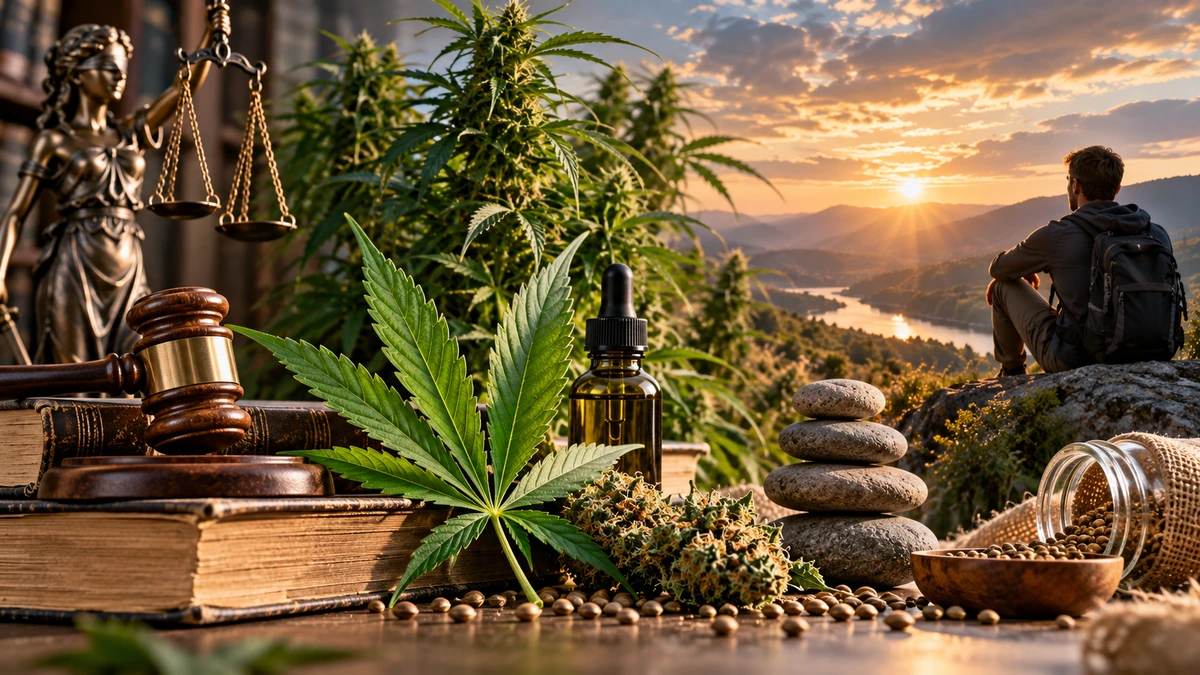
Cannabis is a plant, but that does not make its use morally good. The reverse is equally true: if the law classifies it as a controlled drug, that does not make every use morally wrong. Natural law cannot rest either on the slogan “natural means good” or on “illegal therefore wrong.” Both shortcuts avoid the more important moral questions: who is wronged, what kind of harm is involved, and when coercion is justified.
Cannabis therefore brings together two different questions. The first is medical: what risks depend on THC, route of administration, frequency, age and individual vulnerability? The second is political and moral: which of those risks give a community the right to punish an adult, seize property or prohibit a decision about their own body? Health risk is relevant evidence, but it is not by itself an answer to the legitimacy of coercion.
This article therefore does not portray cannabis as harmless and does not argue that every market should be rule-free. It distinguishes private use and possession from impaired driving, sales to minors, deceptive labeling, unsafe products and other situations in which conduct directly affects the rights or safety of others. At the same time it applies the same moral test to the state: if the state uses force, punishment or imprisonment, that intervention must also be justified, proportionate and directed toward real harm.
Natural law does not ask only whether cannabis use is wise. It also asks whether coercion against the user is just.
“Natural” is not a moral argument
The word natural has a special appeal in discussions of cannabis. The plant grows from the earth, its active compounds were not invented in a modern laboratory, and humans have used it for a very long time. None of this by itself determines the moral value of an act. Poisonous mushrooms, bacterial toxins and dangerous plants are natural as well. From the fact that something is natural it does not follow that it is safe, beneficial or right.
The same error appears when moral judgment is handed over to a legal label. Law may permit, regulate or prohibit a substance, but positive law is not identical with moral truth. History contains legal forms of injustice and illegal acts that later generations came to regard as morally justified. THY-REALITY has already established this distinction in its Natural Law series: legality describes a legal order; it is not final proof of rightness.
Cannabis therefore cannot be defended merely because it is natural, and it cannot be condemned merely because of its legal classification. We need a standard capable of judging both the conduct of the individual and the conduct of the authority that seeks to restrain it.
Natural law and the limits of human law
The natural-law tradition is not a single theory, but it contains an important distinction between moral order and human legislation. Thomas Aquinas explicitly argued in the Summa Theologiae that human law does not prohibit every vice, but chiefly the more serious acts that harm others and without whose prohibition society could not be maintained. This is not a modern libertarian theory and it is not an argument about cannabis specifically. It is, however, an important limit on the idea that the state should criminally prohibit every act someone considers immoral or unwise.
Aquinas also distinguishes just from unjust human laws. Law should be ordered to the common good, the lawgiver should not exceed legitimate authority, and burdens should not be imposed unjustly. This framework matters for drug policy because it requires two examinations: first the user’s act, and then the state’s act in forcibly preventing it.
When the aim is to prevent concrete harm to others, legal restriction is easier to justify. When the aim is to force an adult to make a choice that government regards as healthier or more virtuous for that person, a further explanation is required as to why warning, education, regulation or treatment would not be enough.
The body, self-government and consent
In one important branch of natural-rights and classical-liberal thought, the person is treated as having authority over his or her own person. John Locke wrote in the Second Treatise of Government that every person has “property in his own person.” That sentence does not yield the simple modern formula that anything we do to ourselves is permitted; Locke also limits rights through natural law and duties toward others. Yet the idea emphasizes something important: authority over an adult body does not automatically belong to another person or to the state.
John Stuart Mill later formulated, from a liberal rather than strictly natural-law tradition, the famous harm principle: coercion against a competent adult is most easily justified to prevent harm to others, not simply because the conduct may be bad for that person. Mill is therefore not proof of what “Natural Law says,” but he is a useful example of a standard that clearly distinguishes paternalism from the protection of other people’s rights.
For cannabis this means asking whether an adult understands the relevant consequences and whether the conduct affects others. Autonomy is not the same as infallibility. A person may possess a right to make a poor decision if that decision does not impose an unacceptable risk on people who did not consent to it.
Risk to oneself is not the same as harm to another
Cannabis is not risk-free. Some users develop cannabis use disorder, with higher risk associated with frequent use and earlier initiation. Acute use can impair reaction time, coordination, judgment and memory. Meta-analyses associate more frequent use with a higher risk of psychosis, with risk increasing as use becomes more frequent. Smoking adds respiratory harms that are not identical to those of other routes of administration.
These facts matter morally because responsible choice requires truthful information. The natural-law question begins at the next step: does a risk knowingly taken mainly by a competent adult automatically give someone else a right to use criminal coercion? If the answer were yes without an additional standard, the same principle would have to be applied consistently to alcohol, tobacco, dangerous sports, unhealthy diets, chronic sleep deprivation and many other self-imposed risks.
This does not mean all of those cases must be regulated identically. It means the difference needs to be justified by more than the historical label “drug.” Natural law requires a symmetrical standard: comparable forms of risk should be judged through comparable principles.
When cannabis use becomes a question of other people’s rights
The clearest example is impaired driving. Cannabis can impair abilities needed for safe driving, so the driver is no longer risking only personal welfare. The increased risk is transferred to people who did not consent to the decision. Here the case for restriction is much stronger than with private use at home, even though individual THC impairment is harder to measure than blood alcohol impairment.
The same applies to work in which sobriety is a direct condition of other people’s safety: piloting, operation of dangerous machinery, certain medical tasks or handling weapons. The moral question also changes when a seller deceptively labels a product, hides THC concentration, distributes contaminated goods, uses coercion, or exposes others in a shared space to unwanted smoke or another direct nuisance.
The important distinction is therefore not “cannabis versus non-cannabis,” but the transition from self-regarding conduct to interference with another person’s safety, body, property or informed choice. At that point an identifiable victim or clearly non-consensual risk appears, and with it a stronger reason for legal restraint.
Minors, decision-making capacity and protection
The situation of children and adolescents differs because their capacity for long-term judgment and their legal autonomy are not the same as those of a competent adult. Earlier initiation is associated with greater risk of cannabis use disorder, and concerns also arise regarding learning, mental health and frequent use during development. Restricting sales to minors therefore need not rest on the same paternalism as punishing a competent adult for private use.
Protecting young people, however, is not the same as punishing young people. There is an important difference between age limits on sales, preventing commercial targeting of children, education and early assistance on one hand, and criminally marking a young user on the other. If the goal is harm reduction, the intervention should plausibly serve that goal rather than create additional harm of its own.
Contemporary policy research finds heterogeneous effects of legalization on youth use; some meta-analyses find modest increases under recreational legalization, while results vary with age, regulatory model and local context. That is an argument for careful regulation, not for moral panic.
Possession, cultivation, sale and advertising are not the same act
Legal debate often compresses very different acts into a single category. An adult holding a small amount for private use is not doing the same thing as a corporation selling high-potency products, advertising to minors or concealing product composition. Likewise, home cultivation for personal use is not identical to unregulated commercial distribution of an unknown product.
A natural-law analysis should therefore examine the actual relationships created by an act. Possession primarily raises questions of authority over one’s body and property. Sale introduces contract, truthfulness of information, product safety and responsibility to the buyer. A large commercial market adds advertising, concentration of economic power and incentives to expand consumption.
Decriminalization of personal use, legalized production, commercialization and a completely unregulated market are therefore not synonyms. One can oppose criminal punishment for private possession while still supporting age limits, quality standards, advertising restrictions or rules against impaired driving.
Prohibition has consequences too
If responsibility for consequences is a basic moral principle, it is not enough to evaluate only the consequences of cannabis. We must also evaluate the consequences of the policy used against it. Criminal prohibition entails arrests, searches, seizures, fines, criminal records and, in some systems, imprisonment. These are real exercises of state power over people and therefore themselves require moral justification.
Some international human-rights bodies have called for decriminalization of personal drug use and possession and for health-based rather than punitive responses to substance-use disorders. That position does not prove that every decriminalization model is good. It does show that proportionality of criminal coercion is a serious question even within international legal institutions.
Prohibition can also create secondary effects: illicit markets lack ordinary quality-control mechanisms, users may have more difficulty verifying potency and composition, and a criminal record can affect employment, housing and social position long after the original act. If law produces these effects, a moral balance must count them rather than treating state intervention as neutral.
International control is positive law, not moral proof
Cannabis remains under international control within the 1961 UN Single Convention on Narcotic Drugs. In 2020 the UN Commission on Narcotic Drugs, following a WHO recommendation, removed cannabis and cannabis resin from Schedule IV of that convention, where they had been subject to an especially strict classification, while retaining cannabis in Schedule I and therefore under international control. The change recognized medical value; it was not general legalization.
That legal history matters, but it does not settle the moral question. An international treaty tells us what obligations states have accepted and which controls are available. It cannot by itself prove that every act restricted by the treaty is a wrong under Natural Law.
The reverse is also true. If a state legalizes something, that does not prove it is harmless or virtuous. Positive law and moral judgment can overlap, but they are not the same level of analysis.
What remains after the Natural Law test?
Once health risk, private choice, harm to others and state coercion are separated, a more precise answer emerges. Cannabis is not morally good because it is a plant, and it is not morally neutral simply because someone uses it privately. Responsible persons should take account of health risks, the possibility of dependence, their own vulnerabilities, obligations to others, and situations in which use affects judgment or capacity.
Yet where a competent adult privately uses or possesses cannabis without directly infringing other people’s rights, the natural-law case for criminal coercion is substantially harder to make. The advocate of punishment must show more than that the behavior is risky or personally disapproved of: there must be a sufficiently concrete wrong, a proportionate sanction, and a reason why a less restrictive response is inadequate.
Where non-consensual risks to others arise—impaired driving, sales to minors, fraudulent labeling, unsafe products, coercion or direct safety hazards at work—the reason for restriction becomes much stronger. This yields a principle broader than cannabis: freedom does not include a right to impose one’s harms on others, while responsibility does not imply that authorities may criminally manage every private risk.
Natural law therefore does not produce a simple slogan “for” or “against” cannabis. It poses the harder question: are we applying the same moral standard to the individual and to the institution that uses force against that individual? That is where a debate about a drug becomes a debate about freedom, responsibility and legitimate authority.
Sources and further reading
- THY-REALITY — Kaj je Naravni zakon? / What Is Natural Law? (LOCKED): distinction between natural law, laws of nature and positive law; legitimacy is not created by legality alone.
- THY-REALITY — Naravni zakon ni stvar prepričanja / Natural Law Is Not a Matter of Belief (LOCKED): symmetry test for moral claims and state coercion.
- THY-REALITY — Sila in nasilje nista ista stvar / Force and Violence Are Not the Same Thing (LOCKED): conditions under which force may be defensive rather than aggressive.
- THY-REALITY — Ali so vse pravice lastninske pravice? / Are All Rights Property Rights? (LOCKED): self-ownership, bodily autonomy and limits of property language.
- THY-REALITY — Ali soglasje legitimira oblast? / Does Consent Legitimize Authority? (LOCKED): consent, political authority and limits of inferred consent.
- THY-REALITY — Uporaba konoplje skozi zgodovino / Cannabis Use Through History (LOCKED): historical distinction between fiber, food, medicine, ritual and psychoactive use.
- THY-REALITY — Ko rastlina postane droga: prohibicija, moralna panika in zakon / When a Plant Becomes a Drug (LOCKED): multi-causal history of cannabis prohibition and legal classification.
- THY-REALITY — Informirano soglasje: komu pripada odločitev o človeškem telesu? / Informed Consent: Who Owns the Decision About the Human Body? (LOCKED): bodily autonomy, competence and the least-restrictive principle.
- Thomas Aquinas — Summa Theologiae, I-II, Question 96, Article 2: human law does not prohibit every vice and chiefly prohibits serious acts harmful to others.
- Thomas Aquinas — Summa Theologiae, I-II, Question 96, Article 4: distinction between just and unjust human laws.
- John Locke — Second Treatise of Government, Chapter V, §27: “every Man has a Property in his own Person,” within Locke’s wider natural-law framework.
- John Stuart Mill — On Liberty (1859): harm principle and sovereignty over one’s body and mind; used as a liberal comparison, not as a natural-law authority.
- World Health Organization — The health and social effects of nonmedical cannabis use: technical brief (2026): updated public-health evidence on nonmedical cannabis use.
- Centers for Disease Control and Prevention — Cannabis and Public Health: Cannabis Use Disorder (updated 2024): frequency and early initiation as risk factors for cannabis use disorder.
- Centers for Disease Control and Prevention — Cannabis and Driving (2024): impairment of reaction time, coordination, judgment and the difficulty of mapping THC concentration to individual impairment.
- National Academies of Sciences, Engineering, and Medicine — The Health Effects of Cannabis and Cannabinoids (2017): consensus synthesis of therapeutic effects and health risks.
- Marconi A. et al. / related systematic-review literature — Risk thresholds for frequency of cannabis use and psychosis (systematic review and meta-analysis, 2022): dose-response relationship with more frequent use.
- Pawar A.K.S. et al. — Medical and Recreational Cannabis Legalization and Cannabis Use Among Youth in the United States (systematic review and meta-analysis, 2024): heterogeneous policy effects; modest higher odds under recreational legalization.
- UN Working Group on Arbitrary Detention — A/HRC/47/40 (2021): recommendation to decriminalize personal drug use/possession and favor health responses over detention for minor nonviolent drug offenses.
- World Health Organization / UN Commission on Narcotic Drugs — 2020 cannabis scheduling decision: cannabis removed from Schedule IV of the 1961 Convention but retained in Schedule I under international control.