Who Are the Descendants of the Biblical Hebrews?
What links ancient Hebrews with communities today? A review of historical texts, archaeology and the limits of genetic research.
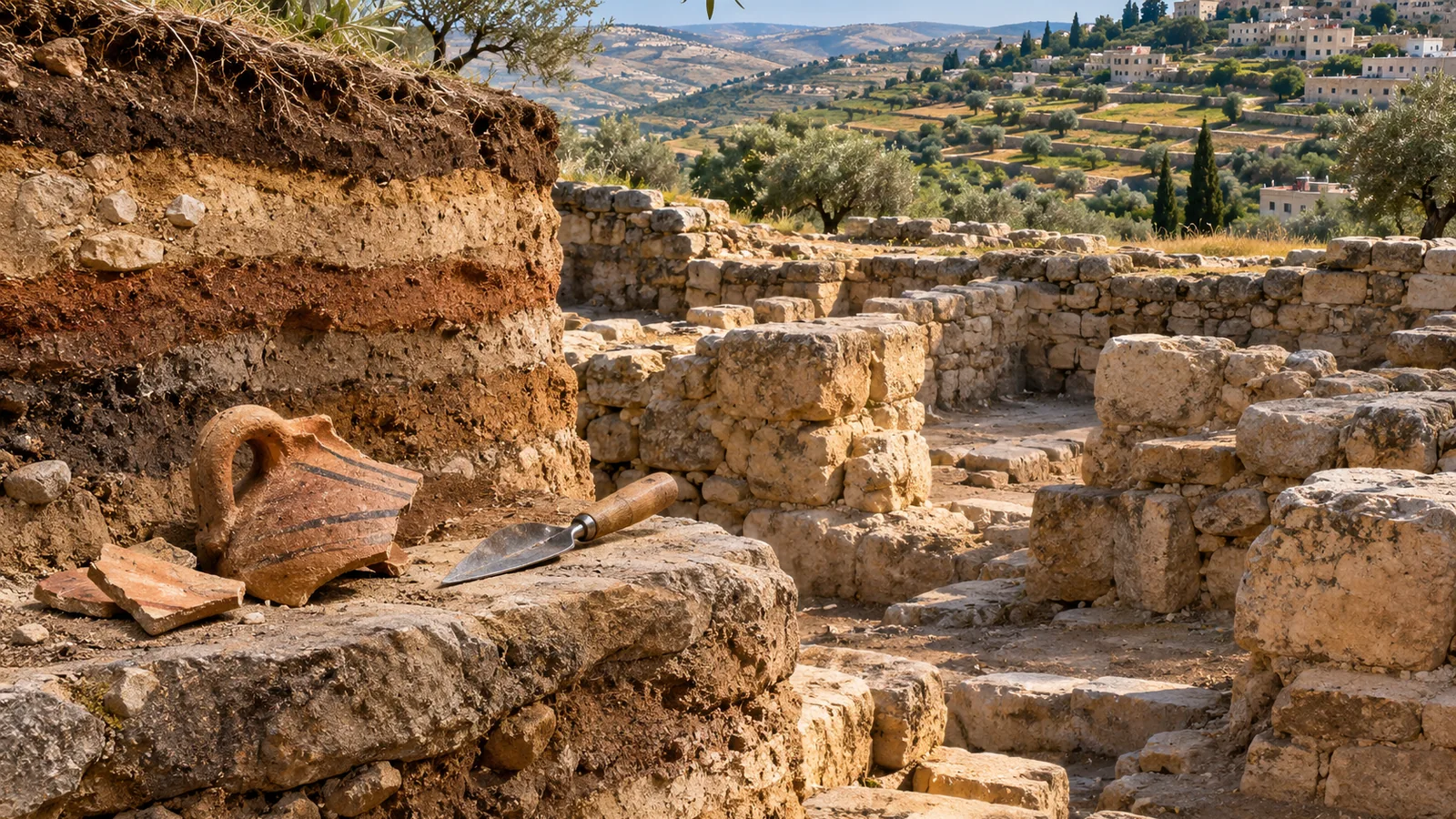
Editorial illustration, not a documentary photograph.
Editorial note: References marked [P11-xx] connect key statements to research, primary sources, and scholarly reviews. For some monographs, only public summaries were available; details from inaccessible chapters are not presented as directly verified facts.
Who Has the Right to Say, “We Come From Here”?
When we discuss Israel and Palestine, arguments about the land often reach thousands of years into the past. Some emphasize the ancestors of today's Jews in ancient Israel and Judea; others point to the long history of families, villages, towns, and religious communities in what is now Palestine. Who actually has more in common with the region's ancient inhabitants? Can archaeology and genetics tell us who is a “real” descendant of the biblical Hebrews?
We can offer only a partial answer about historical connections: many present-day Jewish communities have documented historical and genetic connections to the Levant; Palestinian communities developed from diverse local and migrant populations over long periods of cultural, linguistic, and religious change. Neither group has a single shared pedigree. Nor can their “authenticity” be measured by a single number: modern nationalities, ancient designations, and statistically modeled ancestral genetic components are not the same categories. [8]; [11]; [2]
Our research task is not to prove which modern nation is biologically more entitled to live in this region. We must examine what can be demonstrated about the past—and what does not follow from that evidence.
Hebrew, Israelite, Judean, Jew, and Palestinian: Words From Different Periods
First, we need to clarify terms that are often collapsed into a single label in public debates.
| Term | Historical use and necessary caution |
|---|---|
| Hebrew (ʿivri) | A term found in ancient biblical texts; it does not denote a modern, genetically identifiable population. |
| Israelite / Israeli | In ancient sources, “Israelite” can designate a member of early Israel or the historical kingdoms of Israel. Today, “Israeli” also denotes a citizen of the State of Israel, regardless of religion or ancestry. |
| Judean / Jew (yehudi) | Historically linked to Judah or Judea, the designation acquired broader religious and ethnocultural meanings as circumstances changed. The distinction between “Judean” and “Jew” can depend on period and context. |
| Samaritan | A member of a distinct religious community with an ancient tradition of descent from Israelites and a connection to Mount Gerizim. |
| Palestinian | A present-day national and regional identity with its own historical development, not an ancient genetic category. |
The “Canaanites” of archaeological literature were not a single genetically pure, unchanging population either. The name describes a historical and cultural setting that encompassed diverse communities across different centuries. When a study associates ancient remains with “Canaanite” material culture, it does not establish that every person studied belonged to one particular modern nationality. [5]; [8]
This distinction is essential to the political debate as well. Israel today is a state with Jewish and non-Jewish citizens of varied family origins; a Jew may belong to the Jewish people while living outside Israel. Palestinian identity likewise encompasses people of different religions and family histories, both in their homeland and in the diaspora. None of these categories can simply be projected back to 1200 BCE.
The Earliest Extrabiblical “Israel” and the Emergence of Communities in Canaan
One of the most valuable material sources is the Merneptah Stele, an Egyptian royal inscription dating to approximately 1208 BCE. Among the places and groups named in the pharaoh's victory inscription is Israel. The signs used in the inscription identify it as a people rather than a city or an already attested territorial state. It is the earliest generally accepted extrabiblical reference to the name Israel. [21]
What does this establish? That an Egyptian writer at the end of the thirteenth century BCE knew of a group called Israel. What does it not establish? It does not prove the details of a conquest of Canaan, the genealogies of later kings, or a connection to particular families alive today. Moreover, it is a triumphalist propaganda inscription, not a neutral population census.
Archaeologists debate several models for the origins of early Israel: immigration or conquest from outside, gradual settlement, changes within the highland communities of Canaan, pastoral migrations, and combinations of these processes. In a scholarly review, Ann E. Killebrew explains why these interpretations remain subjects of study, and why modern scholarship has paid particular attention to the indigenous Canaanite roots of early Israel. [5]
It would therefore be scientifically inaccurate to say either that “all ancient Israelites were simply foreigners” or that “every biblical account of their origins has been archaeologically confirmed.” Archaeological evidence is fragmentary, and historical reconstructions vary in evidentiary strength.
Canaan Was Not Empty, Nor Did Its History Belong to a Single Name
The Late Bronze Age and Iron Age Levant contained towns, rural communities, trading routes, different beliefs and languages, and political entities. Present-day geographical names do not correspond to the borders of those times. For centuries, the region was shaped by Egyptian influence, coastal cities, local kingdoms, and later empires. Early Israel formed part of this wider history; it did not emerge outside it. [20]; [5]
Similar pottery styles or burial practices can suggest cultural contacts, but without further evidence they are not a census of nationalities. Equally, an ancient person could not know which modern states and nations would emerge thousands of years later. Whenever someone uses the word “first,” we must therefore ask: first in which period, in which territory, and according to which criterion?
This historical complexity does not diminish the documented ancient Jewish connection to the land. But it prevents the simplification that the entire region has always belonged to one unchanged people, and that everyone else who lived there was merely an incidental visitor to its history.
The Jewish Diaspora: Before and After 70 CE
The Jewish diaspora did not begin on a single day when the Romans destroyed the Second Temple in Jerusalem in 70 CE. Migration, forced departures, military service, and economic connections had helped establish Jewish communities centuries earlier. For example, a Jewish military community is documented on the Egyptian island of Elephantine in the fifth century BCE, with surviving Aramaic legal and other records. [22]; [23]
Jewish communities also lived in Egypt and elsewhere around the Mediterranean during the Hellenistic period. The destruction of the Temple, subsequent wars, and Roman rule were profound ruptures, but they do not mean that all Jews were expelled from a given area at once or that every Jewish presence in the region disappeared. [19]
Jewish communities later lived in European, North African, and Middle Eastern settings, migrated, maintained customs and languages, and incorporated new members to varying degrees. Their histories are genuinely connected, but they are not the story of one biologically unchanged population. Jewish belonging is also shaped by tradition, community, culture, and religious rules; genetics alone can neither validate nor invalidate it.
Palestinian History: Arabization Is Not the Same as Complete Population Replacement
When Arab Muslim armies took control of much of the Levant in the seventh century, the local population did not undergo an instant and total linguistic, religious, and demographic transformation. The transition from the Byzantine to the early Islamic period was regionally varied and often gradual. Drawing on numerous sites in Palestine and Jordan, archaeologist Gideon Avni describes the continuity of many settlements and elements of material culture, regionally different patterns of change, and the emergence of new communities. His synthesis does not prove an absence of migration. Christian communities remained prominent in some places for several more centuries. [2]; [3]
Arabization refers to the spread of the Arabic language and associated cultural expressions, while Islamization refers to the spread of Islam; the two processes should not be equated. A family can change its language or religion over generations without all its ancestors having come from elsewhere. Yet this does not mean that Arab or other migrations never occurred: they did, at different times and with varying regional consequences. [4]; [2]
Palestinians are not exclusively Muslim, either: Palestinian Christians and other communities are part of the region's history. From the linguistic label “Arab,” we cannot automatically conclude that the entire lineage of a particular modern family migrated from the Arabian Peninsula in the recent past. Nor can we claim, without genealogical and local evidence, that every one of its ancestors lived continuously in the same village since the Bronze Age. That would require independent local and family records.
Ancient DNA: What Did the 73 Individuals Studied in 2020 Actually Show?
A study by Lily Agranat-Tamir and colleagues, published in 2020 in Cell, newly generated DNA data for 73 ancient individuals from five archaeological sites in the southern Levant, dating to the Bronze and Iron Ages. Together with previously published data, it considered a wider set of 93 individuals from nine sites. After close relatives and samples with less suitable data were excluded, particular genomic analyses involved fewer individuals. Neither 73 nor 93 constitutes a representative sample of all “Canaanites,” much less of all biblical Hebrews. [14]
The researchers found that the groups studied, associated with “Canaanite” material culture, were often genetically related to one another. They modeled their ancestry using components related to earlier local Neolithic inhabitants and people genetically related to populations from the Zagros Mountains or the Caucasus. The authors also note migrations that changed the relative proportions of those components in certain periods. [8]
In comparisons with present-day populations, the authors found substantial ancestral components in many Levantine, Jewish, and Arabic-speaking groups that were statistically related to ancient Middle Eastern reference samples. They also identified additional influences that the available ancient DNA cannot fully explain—an important reminder of migration and admixture after the Bronze Age. The authors explicitly distinguish modeled similarity to reference populations from proof of direct descent from particular ancient individuals. [14]
This was not a study that identified “true biblical blood.” An ancestry component is the outcome of a statistical model based on selected reference samples—not a directly measured percentage of membership in an ancient people, and certainly not a measure of moral, religious, or national authenticity. Results can change with new discoveries, different models, and improved sampling. That is precisely why this article will not calculate which nation is “more Canaanite.”
The Broader Genetics of the Levant: Continuity, Migration, and the Limits of Comparison
A study by Haber and colleagues (2017) analyzed genomes from five Bronze Age individuals from Sidon and 99 present-day Lebanese individuals. It found substantial population continuity between the ancient and modern samples, alongside additional later genetic influences. These findings concern the Lebanese region and the samples examined; they do not quantify the origins of every person in the Middle East. [7]
Almarri and colleagues (2021) examined 137 high-coverage genomes from eight Middle Eastern populations. The composition of the dataset matters: it included several Arab or regional groups and did not provide balanced representation of all Jewish and Palestinian populations. The study documents complex demographic processes, differences between the Levant and the Arabian Peninsula, and multiple layers of historical admixture. [9]
A study by Haber and colleagues (2013) compared a broader set of present-day Levantine communities and identified population structure associated in part with religious and cultural boundaries. Such analysis can reveal relationships and differences among statistical samples, but it does not produce two pure, unchanging biological nations or establish whose rights are greater. Different reference datasets and genetic methods answer different questions; their results should not be added together or compared as if their percentages were directly equivalent. [12]
The common lesson of these studies is quite different from the political slogan “they all come from here” or “none of them comes from here”: the history of the Levant involves genuine continuities and genuine changes, intertwined over time.
Ashkenazi, Sephardi, Mizrahi, and Other Jewish Communities
The terms Ashkenazi, Sephardi, and Mizrahi primarily refer to different historical, cultural, ritual, and regional traditions. In its broader ritual sense, Sephardi can include communities that are regionally classified as Mizrahi; the labels are not always mutually exclusive, much less three biologically separate “races.” A study by Behar and colleagues (2010) analyzed individuals from 14 Jewish diaspora communities and compared them with many non-Jewish populations. It identified genetic links to the Levant in a large proportion of the Jewish communities studied, while some communities, including those in India and Ethiopia, also showed substantial local genetic influences. [11]
Similarly, Atzmon and colleagues (2010) compared seven Jewish groups (including Iranian, Iraqi, Syrian, Italian, Turkish, Greek, and Ashkenazi Jews). They found shared Middle Eastern connections among the groups examined, alongside regionally varying genetic contributions. The study does not support conclusions about every individual, nor does it show that all Jewish communities have identical genetic histories. [16]
For Ashkenazi Jews, we also have an informative historical snapshot: Waldman and colleagues (2022) studied the genomes of 33 Jews from fourteenth-century Erfurt. Their data show affinities with present-day Ashkenazi samples and greater diversity within that medieval community than later samples alone might suggest. This is not evidence about all Jews, or about Palestinians, but about a particular community in a particular time and place. [10]
These findings matter in light of the frequently repeated claim that European Jews have “no connection whatsoever” to the ancient Levant. Such blanket denials are inconsistent with the research cited. Yet these same studies do not justify the opposite conclusion that every Jew has an identical, unchanged ancient pedigree, or that a genetic connection confers an exclusive property right.
The Samaritans and an Often-Overlooked Question of Continuity
The Samaritans have their own religious tradition, centered on Mount Gerizim near Nablus, and understand themselves as descendants of ancient Israelite groups. Their community is distinct from modern Judaism, although it shares many ancient elements with it. A Palestinian tentative nomination concerning Mount Gerizim, published on UNESCO's website, describes the Samaritans' historical and religious association with the area. Because this is a tentative-list submission, it should be read as a presentation of that heritage, not as independent proof of every religious tradition. [18]
A study by Shen and colleagues (2004) and a later study by Oefner and colleagues (2013) examined Samaritan male genetic lineages in small samples and compared them with those of Jewish communities, including the Cohanim. The results support certain historical connections and aspects of the traditional account of origins, but they do not establish that each living Samaritan or Jew can be linked to a specifically named biblical ancestor. Given the small samples and the particular inherited lineages examined, the findings cannot be generalized to the entire genome or to every inhabitant of the region. [15]; [17]
Their very existence demonstrates why the history of ancient Israelite and related groups cannot be described solely through today's political binary of “Jew or Palestinian.”
When Did Palestinian Identity Emerge, and What Does That Tell Us About Ancestry?
Modern national identities are not fossils from the Bronze Age. In his historical study Palestinian Identity, Rashid Khalidi examines the formation of Palestinian national consciousness in the late Ottoman period and under British rule, through local attachments, religious communities, Arab identity, the press, education, and political change. A modern identity can acquire a clearer political name even when particular families, places, and cultural bonds have existed for much longer. [6]; [13]
Therefore, saying that “Palestinian national consciousness took shape in the modern era” does not mean that the population did not previously exist or that all ancestors of today's Palestinians were recent immigrants. Exactly the same historical principle applies to the modern national designations of other communities: the emergence of modern institutions or names does not erase older cultural and family connections.
Palestinian communities are heterogeneous: people live in different areas, have different family histories, and belong to different religions. Historical changes in language and religion, as well as migration, did not affect every place in the same way. For a particular family, the most appropriate evidence of its history is a documented genealogy, local archive, land record, or other individual source. Statistical comparisons of present-day populations can provide wider context, but cannot identify that family's distant ancestors by name.
Can DNA Determine Who Owns the Land?
Imagine that someone has incontrovertible proof of an ancestral connection to an ancient population in a particular area. What follows? It may be an important part of their personal history, cultural belonging, identity, and relationship to a place. But it does not mean that the document can extinguish the rights of a family living on the land today and protected by law. Conversely, the absence of a demonstrable ancient pedigree does not diminish anyone's right to protection of their life and home.
We must distinguish five different questions: ancestry, religious tradition, personal or group identity, specific property rights, and state sovereignty or self-determination. Each requires a different body of evidence. Genetics does not inspect land registers or issue rulings under international law. Historical attachment to a territory does not justify violent attacks on civilians, dispossession without a legal basis, or collective punishment; the same standard applies to every people and every religion.
At the legal level, the International Court of Justice (ICJ) examined the legal consequences of Israeli policies and continued presence in the occupied Palestinian territory in its advisory opinion of July 19, 2024. It did not rule on the genetic authenticity of present-day inhabitants. The legal questions surrounding occupation, settlements, private property, and self-determination are addressed in PL-02 and PL-03; PL-12 will draw together the legal and moral conclusions. [1]
Conclusion: Several Historical Connections Can Coexist
The available evidence does not support the idea that all present-day Jews are unrelated newcomers with no ancestors in the Levant. Nor does it support the sweeping claim that all Palestinians are recent outsiders with no historical connection to the land. The first claim denies the documented history of many Jewish communities; the second overlooks the long and changing history of local populations. Alongside both histories are the Samaritans and numerous other regional communities. [11]; [2]; [15]
Evidence-based conclusion: historical and genetic links are multilayered, unevenly studied, and cannot be reduced to a single test of who is a “real” descendant of the Hebrews. The author's moral assessment: one people's genuine connection to the land does not erase another people's genuine connection or present-day rights. No one acquires a right to another family's home merely because they can trace their ancestors, with greater or lesser certainty, into the distant past.
This is not a denial of history. It is respect for the limits of historical evidence—and for the dignity of people living today.
Note on Sources
References marked [P11-xx] lead to primary sources, peer-reviewed research, and scholarly presentations listed in registers V1–V3. For some monographs, only a public abstract or catalog entry could be checked, so details from inaccessible chapters have not been inferred.
Sources and further reading
- ICJ — 2024 advisory opinion on Israeli policies and practices in the occupied Palestinian territory Source
- Gideon Avni, The Byzantine-Islamic Transition in Palestine: An Archaeological Approach (Oxford University Press, 2014) Source
- Gideon Avni — chapter from the archaeological study of the Byzantine–Islamic transition in Palestine (Oxford Academic) Source
- Edinburgh University Press — scholarly book chapter, publisher abstract (Oxford Academic) Source
- Oxford Academic — scholarly chapter in an edited collection, publisher abstract Source
- Rashid Khalidi, Palestinian Identity: The Construction of Modern National Consciousness (Columbia University Press) Source
- Haber et al. — genomic continuity and admixture in the Levant using ancient Canaanite and present-day Lebanese sequences (2017) Source
- Agranat-Tamir et al., The Genomic History of the Bronze Age Southern Levant (Cell, 2020) Source
- Almarri et al., The genomic history of the Middle East (Cell, 2021) Source
- Waldman et al., Genome-wide data from medieval German Jews show that the Ashkenazi founder event pre-dated the 14th century (Cell, 2022) Source
- Behar et al., The genome-wide structure of the Jewish people (Nature, 2010) Source
- Haber et al., Genome-Wide Diversity in the Levant Reveals Recent Structuring by Culture (PLOS Genetics, 2013) Source
- Louis A. Fishman, The Emergence of a Collective Palestinian Identity, in Jews and Palestinians in the Late Ottoman Era (2020) Source
- Agranat-Tamir et al. — open-access text of The Genomic History of the Bronze Age Southern Levant (PubMed Central) Source
- Shen et al., Reconstruction of patrilineages and matrilineages of Samaritans and other Israeli populations (Human Mutation, 2004) Source
- Atzmon et al., Abraham’s Children in the Genome Era, genetic study of Jewish communities (AJHG, 2010) Source
- Oefner et al., Genetics and the history of the Samaritans, Samaritan and Cohanim genetic affinities (Human Biology, 2013) Source
- UNESCO World Heritage Centre — tentative heritage listing for Palestine (entry 5706) Source
- Cambridge University Press, The Cambridge History of Judaism — chapter on the diaspora in the Roman period before 70 CE Source
- Cambridge University Press, Israel’s History and the History of Israel — chapter on society around 1150–1050 BCE Source
- Posen Library — Merneptah Stele, an early inscription mentioning Israel Source
- Posen Library — guide to ancient Jewish communities in the diaspora Source
- Posen Library — Jews of Elephantine in their own words Source