When the System Fails: Local Preparedness for Disasters and Major Disruptions
A practical local-preparedness framework: which essential functions must survive disruption and which fallback pathways a community needs.
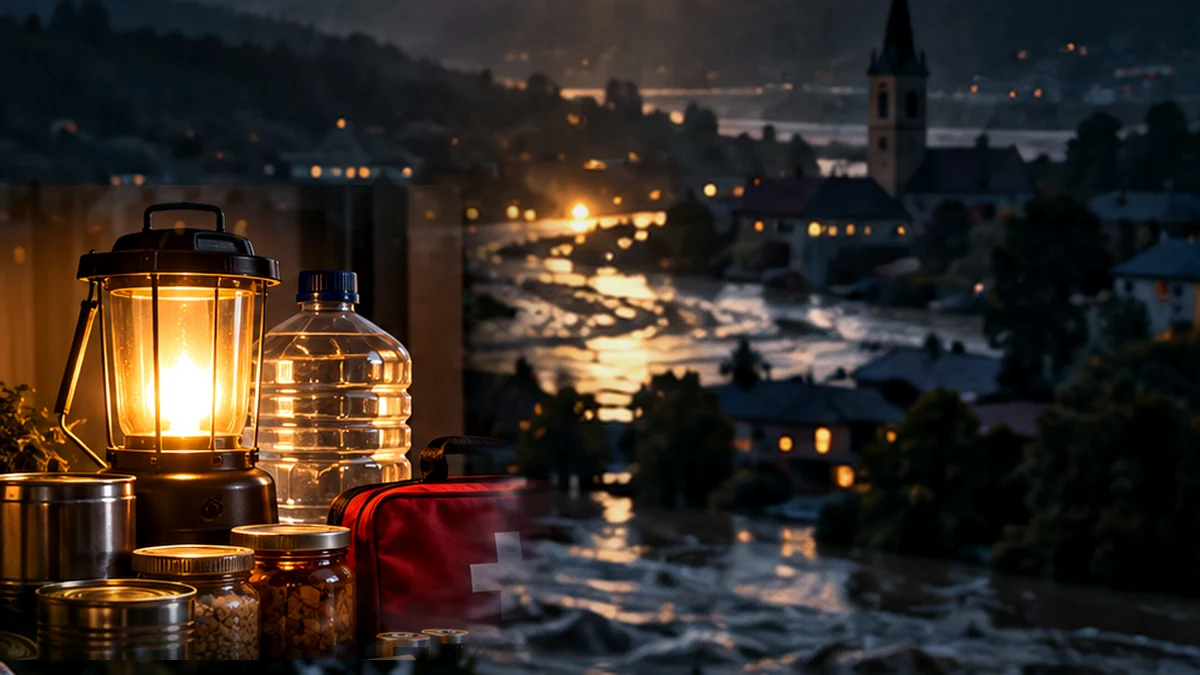
When electricity fails for five minutes, it is an inconvenience. When it fails for two days and pumps, mobile networks, card payments, parts of retail and traffic signals also stop working, the same outage becomes a system problem. A disaster rarely affects only one device: the shock travels through connections between water, energy, communications, transport, health care, supplies and the people who maintain those systems.
the articles from “Food: How Much Locality Increases Resilience?” through “The City as a Network of Communities: Decentralisation Without Fleeing to the Countryside” built local material resilience piece by piece: food, water, energy, infrastructure and the city as a network of communities. This article places them in the same crisis moment for the first time. The question is no longer only how each system is organised on an ordinary day, but what happens when several normal pathways stop working at once.
Preparedness is not living in fear of catastrophe. It is an agreed answer, made in advance, to a simple question: which basic functions must we preserve if the normal pathway temporarily fails?
We do not plan the catastrophe; we plan the loss of function
The list of possible disasters is almost endless: earthquake, flood, ice storm, fire, heatwave, epidemic, cyber incident, major power failure, damaged road or interrupted supply chain. If we create a completely separate plan for every scenario, we can easily produce documentation that nobody knows how to use when it is actually needed.
A more useful starting point is functional. We ask: what do we do if there is no safe drinking water; no electricity; no mobile network or internet; no normal access to food and medicines; the main road is closed; the local health point operates at reduced capacity; or some people must temporarily leave the area? Different hazards can cause the same functional failure, so the same preparation often helps across several threats.
Slovenian protection and rescue plans follow a similar logic: before an event, they specify forces and resources, information and warning, activation, command, protective measures, and personal and mutual protection. A household does not need to imitate a state plan. The lesson is simpler: good emergency response is agreed before the emergency, not invented in the middle of it.
FEMA uses the term community lifelines for the most fundamental services whose stabilisation allows the rest of a community to function. UNDRR similarly emphasises continuity of water, wastewater, energy, transport, waste and digital communications because health, education and economic activity depend on them.
A local community can create a shorter list of its own. It will usually include safe water and sanitation; food and basic supplies; heat or cooling depending on the season; urgent health care and medicines; communication and warning; access or transport; minimum electricity for critical equipment; and a safe place for people who cannot remain at home.
This changes the perspective. If the objective is “maintain communication”, the answer is not necessarily a second phone on the same network. If the objective is “maintain safe water”, the answer is not necessarily only a larger tank. Define the function first, then test several different ways to preserve it.
A small personal buffer buys time for the community
In 2025, the European Commission's Preparedness Union Strategy set a direction for the population to develop basic self-sufficiency for at least 72 hours. This is not a bunker recipe and it does not mean every crisis ends in three days. It is a practical minimum: if households can cover basic needs during the first hours or days without immediate outside delivery of everything, emergency services have more room to focus on people who urgently need assistance.
Current Slovenian guidance for earthquakes and floods similarly recommends supplies of drinking water, food, regular medicines, first aid, hygiene items, a battery radio and flashlight, and some cash; it also specifically notes the needs of babies, older people, patients and pets. Earthquake guidance explicitly warns that electricity, gas, water, sewage, heating, telephones and internet may all be disrupted at the same time.
The point of a personal reserve is a bridge, not self-sufficiency. Water runs out, medicines expire, batteries are not a seasonal energy system, and a household cannot reproduce a hospital or water utility at home. Good preparedness therefore combines three layers: a personal buffer, local mutual assistance and wider professional systems.
A map of people matters as much as a map of equipment
In 2026, WHO Europe published a dedicated toolkit for community mapping in health emergencies. Its starting point is useful much more broadly: a community needs to understand its existing resources, capacities, organisations and vulnerabilities before trying to activate them under pressure.
A local map therefore includes more than a generator, water tank and van. It includes people: who knows first aid, who is an electrician or plumber, who has radio experience, who can check on older neighbours, who can organise cooking or logistics, who has a vehicle, who knows a building, and who can communicate with residents who otherwise receive information less easily. It must also recognise who may need assistance: people with limited mobility, dependence on powered medical equipment, regular medicines or specialised care.
Such a register should be voluntary, proportionate and protected. We do not need a public database of neighbours' health information. We need prior agreement about who will check on whom and what capacities people voluntarily offer when normal pathways fail.
Communication can fail before the community does
In a crisis, the information problem can arrive before material supplies run out. Mobile networks become overloaded, the internet fails, devices cannot be charged, and old photographs, rumours and conflicting instructions spread online. Communication therefore needs a fallback route and agreed information sources.
Slovenia maintains a continuous network of notification centres and the emergency number 112, while protection and rescue plans explicitly include monitoring, information and warning. At household or neighbourhood level, simple agreements help: where do we meet if phones fail; who is an out-of-area contact; which official channel do we monitor; who carries information to people without digital access; and how do we distinguish confirmed information from rumour?
A battery-powered radio still appears in Slovenian preparedness guidance for a reason: it does not depend on a functioning mobile data network. Larger communities may also have radio or other backup communications, but they need to be legal, understood and tested in advance. Backup communication that nobody knows how to use is not a backup.
Redundancy means different pathways, not merely more of the same
Two devices improve resilience only if they do not fail from the same cause. Two electric pumps on the same supply do not solve a prolonged outage. Two phones do not solve a mobile-network failure. Two roads that both cross the same flooded bridge are not two independent routes.
Good redundancy therefore looks for diverse pathways. For water this may mean stored water and an agreed alternative source; for energy, the grid plus local generation, storage or safely designed backup for selected critical loads; for communication, mobile networks plus radio and a physical meeting point; for transport, another road or a known walking route; for supplies, several supply paths rather than one warehouse.
UNDRR's resilient infrastructure principles therefore focus not only on the robustness of a device but on continuity of the critical service. “Who Maintains Shared Infrastructure?” asked who maintains infrastructure. This article adds: does this function have a fallback, who activates it, and how long can it operate without normal supply?
Local help must connect to professional response
The most resilient community is not one in which every resident tries to become a firefighter, rescuer, doctor and electrician. Improvisation can create new casualties. Local preparedness means that residents can protect themselves, help within the limits of their competence, relay useful information quickly and reduce unnecessary demand on professional services where specialised intervention is not required.
Slovenia already has a practical infrastructure for this: the protection and rescue system combines the state, municipalities, professional services and a very large volunteer component. GOV.SI lists 36,899 volunteer members in operational units of associations and other organisations, representing the majority of protection, rescue and assistance forces. Volunteering is therefore not an alternative to a coordinated system; it is already one of its important components.
The IFRC's modern contingency-planning guidance similarly emphasises advance roles and readiness, while its volunteer standards emphasise safety, training and well-being. Help is valuable when it reduces harm; courage without competence can increase a crisis.
A plan nobody has tested is a hypothesis
It is easy to write in an emergency plan: “we will open the community centre if needed”, “we will provide backup water” or “we will notify vulnerable residents”. Each sentence hides a chain of practical questions. Who has the key? Who can reach the building? Where is the contact list? Who can authorise a cost? Who transports the water? What if the one person who knows all of this is away?
Exercises therefore matter more than beautiful documents. The EU preparedness strategy calls for regular exercises across services; UNDRR and WHO likewise emphasise readiness, coordination and mechanisms created in advance. A local exercise does not need to be a large simulation. It can be thirty minutes: assume there is no electricity and no mobile network — who performs the first five actions?
A good exercise nearly always discovers boring but valuable failures: a phone number is obsolete, the key is with the wrong person, the backup battery is empty, the medicine list is outdated, or two groups each assume the other will perform the same task. That is the success of the exercise, not its failure. It is better for a system to break on paper on a quiet afternoon than during a flood at night.
After first response comes the harder part: continuity and recovery
The first hours of a disaster are dramatic, but much damage appears later if basic functions do not return quickly enough. WHO therefore places specific emphasis on continuity of essential services during health emergencies, while UNDRR's current strategy includes recovery readiness as a central element of resilience.
A community therefore needs to know not only how to react but how to move from improvised crisis operations back to stable functioning. Who checks whether water is safe? How are medicines replaced? When can a school or community building reopen? How is damage documented? Who supports people whose homes are unusable? How does assistance continue after the first wave of volunteers fades?
Recovery is also a learning moment. After disruption, record what worked, what was too slow, which dependency was unexpected, and which backup existed only on paper. Resilience is not a condition achieved once; it is a loop: prepare → event → learn → prepare better.
For a household, building, association, neighbourhood or small community, this article can be translated into ten concrete questions:
- Which three to five functions must continue? Water, medicines, heat, communication, transport, cold chain or something else?
- Which local events are realistically plausible? Flood, earthquake, ice storm, fire, heat, power failure, road closure or another disruption?
- Which single failure could affect several functions at once? One transformer, one pump, one bridge, one connectivity provider, one person holding all the knowledge?
- What personal buffer do we have? Water, food, regular medicines, first aid, lighting, radio, cash and other needs for at least the initial period of disruption?
- Who needs priority checking or assistance? And who has voluntarily agreed to do it?
- How do we communicate without normal phones or internet? Where is the meeting point and which official information sources are agreed?
- Which critical function has a genuinely independent fallback? Not merely a second device with the same failure point?
- Where does our competence end? When do we help ourselves, and when do we call 112 or wait for trained responders?
- When did we last test the plan? Are contacts, keys, equipment and responsibilities still correct?
- How will we capture lessons afterwards? Who records failures and who ensures that corrections are actually implemented?
Not all ten questions need to be solved in one day. Removing even one single point of failure can significantly increase local capacity. The goal is that when disruption occurs, we do not start from zero.
Preparedness is the opposite of panic
Prebujenje v Naravni zakon repeatedly links sovereignty with knowledge, care and responsibility. In this article that philosophical axis becomes concrete. A person who understands local risk, prepares basic reserves, knows whom to call, can help a neighbour and understands the limits of their own training is not more frightened. They have more options for rational action precisely when the environment is most uncertain.
This is not an argument against public emergency services. The opposite is true: the system is stronger when households and communities are not entirely passive and professional responders do not have to spend the first hours solving every small need that could have been anticipated. WHO calls this a whole-of-society approach; Slovenia's system already places personal and mutual protection alongside municipal, national, professional and volunteer forces.
This article therefore ends with a simple criterion: resilience grows when a community knows its critical functions, its people, its failure points and its fallback pathways — and can connect them to the wider system of assistance. The political question of what emergency powers do to authority during crises remains deliberately reserved for “Emergency Powers: Why Temporary Power Tends to Stay”. Here we solve the operational problem: how to preserve life and basic functions when the normal system temporarily cannot.
Sources and further reading
- Government of the Republic of Slovenia / Administration for Civil Protection and Disaster Relief. Varstvo pred naravnimi in drugimi nesrečami — prevention, preparedness, response, basic living conditions, recovery, and responsibility of residents, municipalities and the state. Source
- Government of the Republic of Slovenia / Administration for Civil Protection and Disaster Relief. Načrti zaščite in reševanja — plans define forces, resources, information, activation, leadership, protective measures and personal/mutual protection before emergencies. Source
- Government of the Republic of Slovenia (2026). Napotki prebivalcem ob potresu — household preparedness, water, food, medicines, radio, lighting, cash, family contacts and simultaneous infrastructure disruptions. Source
- Government of the Republic of Slovenia (2026). Napotki prebivalcem ob poplavi — local risk awareness, evacuation routes, water, food, medicines, first aid, radio, lighting and document protection. Source
- Government of the Republic of Slovenia. Sile za zaščito in reševanje — professional and volunteer forces; current public page reports 36,899 volunteer members in operational organisations. Source
- European Commission (2025). EU Preparedness Union Strategy — minimum 72-hour population self-sufficiency direction, protection of essential societal functions, stockpiling, warning and regular preparedness exercises. Source
- European Commission, DG ECHO (2025). EU Preparedness Union Strategy to prevent and react to emerging threats and crises — 72-hour supplies, essential services and crisis coordination. Source
- WHO Europe (2026). Community mapping in health emergencies: strengthening preparedness, response and resilience — mapping local resources, capacities, structures and vulnerabilities through meaningful participation. Source
- WHO (2026). Framework for health emergency preparedness and response capabilities for national public health agencies — core preparedness and emergency-response capabilities. Source
- WHO (2021). Everyone's business: Whole-of-society action to manage health risks and reduce socio-economic impacts of emergencies and disasters — shared responsibility, multisectoral coordination and continuity of essential services. Source
- WHO (2021). Health service continuity planning for public health emergencies — proactive service-continuity planning before disruptions occur. Source
- WHO (2019). Health Emergency and Disaster Risk Management Framework — prevention, preparedness, readiness, response, recovery and community-centred risk management. Source
- UNDRR (2022). Principles for resilient infrastructure — continuity of critical services including energy, transport, water, wastewater, waste and digital communications. Source
- UNDRR (2026). Strategic Framework 2026–2030 — risk knowledge, locally led disaster risk reduction, financing and recovery readiness. Source
- UNDRR. Sendai Framework for Disaster Risk Reduction 2015–2030 — understanding risk, risk governance, investment in resilience, preparedness and Build Back Better. Source
- FEMA. Community Lifelines — critical services whose stabilisation enables continuous operation of essential community functions. Source
- IFRC (2025). Contingency Planning Guide for National Societies — structured contingency planning for governments, NGOs, businesses, educational institutions and communities. Source
- IFRC. Community Early Warning Systems: Guiding Principles — people-centred warning, preparedness and community-based disaster risk reduction. Source