When Risk Crosses the Border — Chemicals, Waste and the Double Standard of Safety
Why can safety standards be stricter at home than abroad? We examine chemical exports, electronic waste, shipbreaking, and legal exceptions.
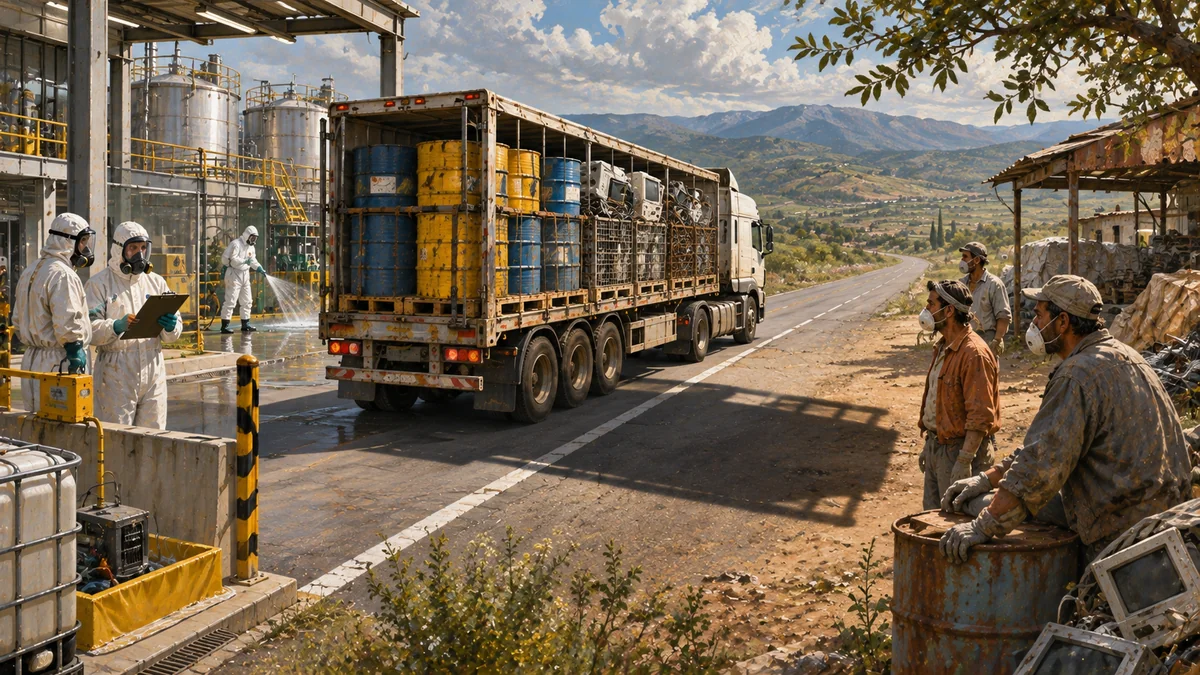
AI-generated symbolic editorial illustration, not a documentary image.
The European Union often speaks of a high level of protection for health and the environment. And it has many substantive reasons for doing so. European rules on chemicals, pesticides, hazardous waste and product safety are among the most extensive in the world. A substance may be restricted or prohibited if risks to people, animals or the environment exceed an acceptable level. Hazardous waste is subject to strict rules on transboundary movements. Ships flying an EU member-state flag must, at the end of their lives, be recycled in approved facilities. Electronic waste is subject to an increasingly strict international control regime. But this is where the question of this article begins.
What happens to risk when it crosses a border?
If a particular use is unacceptable for a European worker, consumer, bee population, soil or groundwater, under what conditions does it become acceptable in Brazil, Morocco, Malaysia, Bangladesh or India? If ship dismantling under certain conditions does not meet European environmental and social standards, is the problem solved when the ship changes flag a few months before scrapping? If the European Union generates more waste than it wants or is able to process domestically, is “recycling in a third country” always an environmental solution — or can it sometimes be merely the geographical transfer of a burden?
These are not the same legal questions. A pesticide is not waste. Waste is not a ship. A ship is not a medical experiment. But the same moral test runs through all of them:
do we protect people and the environment because they are worth protecting — or mainly because they are located inside our legal space?
“Banned in the EU” is not a single legal category
An important correction is necessary first. The phrase “banned in the EU” can be misleadingly broad. An active substance in a pesticide may be non-approved because an assessment identified an unacceptable risk. Its approval may expire. A manufacturer may withdraw an application for renewal. Its use may be restricted to particular methods, crops or environments. Some hazards are global.
Others depend heavily on the manner of use, exposure, local ecosystems, protective equipment, climate and the actual capacity to enforce rules.
Therefore, from the statement: “the EU does not permit this substance” it does not automatically follow that: “every use of this substance anywhere in the world is demonstrably unacceptable.” That distinction has to remain. But the opposite claim is too broad as well.
If a regulator concludes, after scientific assessment, that a serious hazard exists, it is not enough simply to answer:
“conditions are different elsewhere.”
The question becomes what actually changed in the risk — and what changed only in the location where the risk is borne.
The EU itself acknowledged the double-standard problem
In 2020, the European Commission’s Chemicals Strategy for Sustainability announced that the Union would “lead by example” and ensure that hazardous chemicals banned in the EU would not be produced for export.
In 2023, the Commission launched a public consultation on an initiative to prohibit the production for export of hazardous chemicals banned in the EU. Its own explanation was unusually direct.
The Commission said that the EU could not be consistent in pursuing a toxic-free environment if hazardous chemicals whose use is not allowed in the Union could still be manufactured in the EU and exported. It also stressed that the same chemicals can harm health and the environment regardless of where they are used. [1]
This matters. The criticism of a double standard is not an external accusation here.
The European Commission itself framed the problem as one of internal and external consistency.
Yet the current regime is still not a general export ban
International trade in certain hazardous chemicals has long been regulated. The EU implements the Rotterdam Convention through the Prior Informed Consent — PIC — Regulation.
The Commission explains that this regime governs trade in certain hazardous chemicals that are banned or severely restricted in the EU. For chemicals listed in Annex III of the Rotterdam Convention, the basic logic is that export should not occur without the importing country’s prior informed consent. [2]
PIC is a procedural safeguard, not an answer to the entire double-standard question. The importing state is not necessarily a passive victim and has its own regulatory authority. It may face different agricultural conditions, different pests and a different assessment of risk.
But PIC is not the same thing as a ban, and state consent does not establish that workers, local communities and the environment receive materially comparable protection.
Its logic is: the country should know what it is importing and have an opportunity to decide. The logic of a general ban would be: if the hazard is serious enough that we do not permit the product to be manufactured or used for our own market, we will not produce it for export regardless of the recipient’s consent. These are two different ethical models.
Importing-state sovereignty does not resolve material protection
Pesticide manufacturers and their industry associations emphasise that the importing state has the right to make its own regulatory assessment.
The mere fact that a pesticide is not approved in the EU does not, in their view, prove that it cannot be used safely and lawfully elsewhere. The United States, Canada, Japan and other countries have their own sophisticated regulatory systems and may approve substances that the EU does not.
Companies repeated this argument in response to investigations by Public Eye and Unearthed into European exports of non-approved or banned pesticides. [3]
That fact has to remain in the record: a different regulatory decision is not automatically proof of a lower standard.
But the industry argument does not answer the central question where recipient countries have significantly less oversight infrastructure, fewer resources for inspection, poorer worker access to protective equipment or weaker health systems. Formal state consent and the actual capacity for safe use are not the same thing.
Importing-state sovereignty matters. So does asymmetry in power and regulatory capacity.
How much of these pesticides actually leaves the EU?
Here the data require particular precision. In 2025, Public Eye and Unearthed analysed export notifications obtained from the European Chemicals Agency and national authorities.
According to their analysis, companies filed plans for 2024 to export nearly 122,000 tonnes of pesticide products containing 75 active substances banned for use as plant-protection products in the EU.
According to the joint Unearthed/Public Eye analysis, 58 percent of the notified total mass was destined for low- and middle-income countries. [3]
But the 122,000-tonne figure requires a major qualifier. These are not customs data showing completed exports and they are not official statistics of quantities actually shipped.
They are quantities from advance export notifications filed by companies, obtained by the investigative organisations from ECHA and national authorities.
The authors themselves note that these are estimates made before the first annual export and may differ from final exported quantities. In mixtures, the figure often represents the mass of the entire product rather than only the banned active substance. That means: 122,000 tonnes should not be described as the precisely measured mass of banned chemicals that actually left the EU.
It can, however, be described as a substantial publicly available research dataset on the planned export of pesticide products containing such substances, with the authors themselves warning that notified quantities may differ from final exports.
And the trend was significant enough for members of the European Parliament to refer to it in a written question to the Commission in 2025. [4]

The problem is sharper because the Commission had already promised change
In 2023, the Commission did not merely say that it would study the issue. It described the public consultation as part of an initiative to prohibit production for export of hazardous chemicals banned in the EU.
As of 8 October 2026, the Commission’s current page on international agreements still presents the PIC Regulation as the EU’s general framework for trade in hazardous chemicals that are banned or severely restricted in the Union. The 2023 export-ban initiative is therefore treated in this article as an announced policy or unfinished legislative project, not as an already adopted general EU prohibition. [2]
That does not mean the EU failed to tighten specific rules in the meantime. It did. In the case of mercury, for example, it prohibited the manufacture and export of additional mercury-added products. [5]
But the general logic for hazardous chemicals banned or severely restricted domestically remains different from the newer approach the EU has already adopted for some categories of waste. That difference is worth noticing.
Imports back into Europe expose another oddity in the system
The double standard has another layer. The EU may prohibit or decline to approve the use of a particular active substance on its own fields, allow its export under PIC conditions, and then still have to decide what residues of that substance are permissible in imported food.
This does not mean that all food produced with a non-approved pesticide automatically returns to the EU. Imports must comply with European maximum residue levels. But the political tension is obvious.
In September 2024, the European Parliament rejected Commission proposals that would have allowed certain import tolerances for several pesticides whose use is banned in the EU. MEPs demanded equivalent standards for imported crops and European production. [6]
That European Parliament decision shows that the problem was recognised inside European institutions as well. The later correction does not change the basic question:
if the environmental hazard of a substance is serious enough that we want to prevent its use on European fields and even its residues in imported food, why is production of the same substance for agricultural fields elsewhere so much easier to defend?
On waste, the European legal framework is stricter than the slogan suggests
A second important boundary is necessary here. It would not be fair to say: “Europe simply sends its hazardous waste to poor countries.” The law is much stricter than that.
The EU has a general ban on exports of waste for disposal and a ban on exports of hazardous waste for recovery to countries outside the OECD system. The Commission states this explicitly in its current rules on waste shipments. [7]
At the international level, the Basel Ban Amendment is also important. It entered into force on 5 December 2019. An important legal limitation is that it does not automatically bind every Party to the Basel Convention, but those Parties that expressed consent to be bound. For bound Annex VII countries, it requires a ban on certain transboundary movements of hazardous waste to non-Annex VII countries, both for final disposal and for specified recovery operations. [8]
The tightening emerged precisely because the older model allowed economic advantage to be gained by having someone cheaper elsewhere process a dangerous burden.
Since 2025, electronic waste has been under even broader control
The international regime for e-waste has tightened as well. Amendments to the Basel Convention that took effect for most Parties on 1 January 2025 brought all transboundary movements of electrical and electronic waste — hazardous and non-hazardous — under the prior informed consent procedure. The Basel Secretariat explains that the amendments apply to Parties that did not notify non-acceptance within the required period. [9] [10]
That matters because, in electronics, the boundary between: “used equipment for reuse” and “waste sent elsewhere for dismantling” can carry major economic consequences.
The Convention now addresses that distinction explicitly and recognises that countries may differ in deciding when used electrical equipment already constitutes waste.
This is not a complete solution. But it is a substantially stricter traceability system than existed decades ago.

The global e-waste problem is still growing faster than formal recycling
Rules do not solve the problem if the volume of waste grows faster than infrastructure. The Global E-waste Monitor 2024 estimates that the world generated a record 62 million tonnes of electronic waste in 2022. Only 22.3 percent was documented as formally collected and environmentally soundly recycled. [11]
Europe has the highest documented collection and recycling rate among regions. But because consumption is also high, it generates a very large amount of e-waste per capita. That perspective matters. The problem does not begin only at the point of export.
It begins with a production-and-consumption model that creates a material stream for which we then search for the cheapest environmental and economic route.
The new European waste regulation is an unusually direct acknowledgement of the earlier problem
Regulation (EU) 2024/1157 on shipments of waste entered into force in May 2024. Most of its new procedural provisions have applied since 21 May 2026, while many of the new export rules begin later, especially in 2027.
The Commission explicitly describes the aim of the new regime as preventing the Union from exporting its “waste challenges” to third countries and ensuring environmentally sound management of waste. [12] [7]
That is a very important formulation. It does not come from an environmental NGO. It is part of the EU’s own legal and policy framework.
The EU therefore acknowledges that export of material formally destined for recycling can also become an export of an environmental problem.
In 2026, the system is actually becoming stricter
Since 21 May 2026, all exports of plastic waste to third countries require a prior-notification and consent procedure.
On 21 November 2026 — only weeks after the date of this article — a ban on plastic-waste exports to non-OECD countries takes effect; for non-hazardous B3011 plastic waste, a possible route to resumed exports under a special procedure is envisaged only from May 2029. [13]
From 21 May 2027, the general logic for other non-hazardous or “green-listed” waste becomes stricter as well.
Exports to non-OECD countries will generally be prohibited, with exceptions possible for countries on a Commission list that have expressly requested continued imports and demonstrated the capacity for environmentally sound waste management.
On 18 September 2026, the Commission published a draft of the first such list. Thirty-two countries had applied. [14]
The tightening of the rules is an institutional acknowledgement that the previous regime did not provide sufficient protection.
The EU is changing the rules because the label “recyclable” did not by itself guarantee environmentally sound treatment after export.
Yet in 2025 the EU still exported 32 million tonnes of waste
The scale is large. On 18 September 2026, the Commission stated that the EU had exported about 32 million tonnes of waste in 2025, around 40 percent of it to non-OECD countries. For plastic waste, the EU exported about 1.4 million tonnes in 2025.
The largest OECD recipient was Türkiye, with roughly 510,000 tonnes. The Commission also listed Malaysia, Indonesia and Vietnam among the major destinations. [14]
Again, precision matters. “Waste” is not the same as “hazardous waste”. Much of these flows is trade in materials intended for recovery. Proper recycling of secondary raw materials can be environmentally beneficial.
The problem begins when a lower processing price also reflects lower environmental protection, weaker oversight and a transfer of the consequences of poor handling.
In its 2026 assessment of plastic-waste exports to Türkiye, the Commission itself raised concerns about transparency, enforcement and the impact of imported waste on domestic waste management.
That is not evidence that every export to Türkiye is harmful. It is evidence that the labels “OECD” or “recovery” do not by themselves end the oversight question.
A ship can change flag faster than it changes owner
The most vivid example of geographical risk transfer is not a container. It is a ship. The EU Ship Recycling Regulation requires large ships flying an EU member-state flag to be recycled at the end of their lives in facilities on the European list that meet specified health and environmental standards. That is a strict system on paper.
The difficulty is that the obligation is tied primarily to the flag of the ship — a legal status that can be changed before recycling.
In its first major evaluation of the Regulation in February 2025, the European Commission found that shipowners had significantly reduced its effectiveness by reflagging vessels to third-country flags shortly before recycling. [15]
Once a ship loses a member-state flag and becomes waste outside the EU, it can move outside the core of the European recycling regime. In many such cases, it is then dismantled in South Asia.
The Commission itself measured how strong the pattern is
The figures from the evaluation are revealing. In 2023, ships under EU/EEA flags represented about 13 percent of the world fleet over 500 GT by number of ships.
Among end-of-life vessels, only 6.7 percent of ships recycled worldwide were still flying an EU/EEA flag at the time of recycling.
More strikingly, between 2016 and 2023 the total LDT tonnage of ships that changed away from an EU flag less than one year before recycling was greater than the LDT tonnage of ships that retained an EU flag until recycling. [16]
That does not mean every reflagging proves deliberate evasion of the law. Ships change flags for various commercial reasons.
But the Commission itself describes the practice as an important form of circumvention of ship-recycling rules.
The double standard becomes highly material here. The standard does not necessarily change by decree. It changes with the flag on the stern.
Why is dismantling in South Asia financially more attractive?
The reason is not mysterious. The Commission’s supporting staff working document states that prices offered by ship-recycling facilities in South Asia in 2023 were consistently above €500 per light displacement tonne — LDT. For Türkiye it cites roughly €300 per LDT, and for the EU around €100 per LDT.
For an average vessel falling within the Regulation’s scope, the Commission estimates a revenue difference of around €1.5 million in favour of recycling in South Asia rather than in an EU facility. [16]
The Commission explicitly identifies among the reasons the fact that environmental and social costs of ship dismantling are not fully internalised in some South Asian facilities. This is close to a textbook case of externalities.
If safer handling of asbestos, oils, heavy metals and other hazardous materials is more expensive, whoever can transfer part of that cost to workers, local communities or the environment gains a competitive advantage. The market then rewards the lower standard.
But the global ship-recycling regime has also moved
Later global reforms are part of the response to the problem, not a reason to reduce its weight. The Hong Kong International Convention for the Safe and Environmentally Sound Recycling of Ships entered into force on 26 June 2025.
It established global obligations concerning ships, inventories of hazardous materials, authorisation of recycling facilities, certification, control and reporting. [17]
That was a major step. At entry into force, several major ship-recycling states were Parties as well — Bangladesh, India, Pakistan and Türkiye — so the framework was not confined to flag or ship-owning states. The IMO reported 24 Parties representing 57.15 percent of world merchant-shipping tonnage.
The European Commission also emphasises that the EU Ship Recycling Regulation remains stricter than the Hong Kong Convention in some areas. [18]
In January 2026, the EU also harmonised certain certificate formats so that shipowners could use a single document to meet both the European regime and the Convention without formally lowering EU requirements. [19]
These are later institutional tightenings. They still do not solve the basic problem of reflagging.

A safety standard can be universal only if it does not disappear with registration
The European argument is: our ships must go to safer facilities. But if “our ship” in practice means only: “a ship that still flies our flag on the final day,” then the universality of the standard is limited. Ownership may remain European. Capital may remain European. Profit from sale for scrapping may remain European. The ship itself remains the same. What changes is the registration jurisdiction. If that change also sharply reduces the environmental and social obligation, the risk has not disappeared.
It has merely moved outside legal sight.
Guatemala: a historical contrast, not a direct analogy
It is useful here to take a historical step away from chemicals and waste. Not because pesticides or ship recycling are equivalent to medical experimentation. They are not. But the history of research ethics shows why geographical transfer of risk is morally sensitive.
Between 1946 and 1948, the U.S. Public Health Service, the Pan American Sanitary Bureau and Guatemalan institutions participated in sexually transmitted infection research in Guatemala.
The U.S. National Archives states that the research included deliberate exposure of people to bacteria that cause sexually transmitted diseases.
The populations involved included prisoners, soldiers, sex workers and patients in a psychiatric hospital. [20]
An official 2011 report by the U.S. Presidential Commission for the Study of Bioethical Issues documented 1,308 people in intentional-exposure experiments involving gonorrhoea, syphilis or chancroid. The Commission found an absence of valid informed consent and serious ethical violations. [21]
This is not an example of “exporting a banned product”. It is a far more serious and different category. But its moral structure contains a warning: when a group is politically weaker, poorer, institutionalised or outside the researcher’s domestic political space, it can become easier to accept a risk that would be politically or ethically much harder to impose at home.
Later rules were built after abuses
The history of such abuses forced the system toward stronger protections. The U.S. Belmont Report of 1979 identified respect for persons, beneficence and justice as basic principles of research.
Under justice, it explicitly warns that vulnerable or already burdened groups should not become convenient pools for risky research merely because they are easier to recruit while the benefits of research accrue to more privileged groups. [22]
That logic is strikingly useful beyond medicine. Who bears the risk? Who receives the benefit? Who has the ability to say no? Who has enough information? And who has enough political power to demand a stricter standard?
Even during Covid, the criterion was not “necessity permits everything”
The Covid-19 pandemic showed that society may accept research involving greater risk when an extraordinary public-health rationale exists.
But when the WHO discussed deliberate infection of volunteers with SARS-CoV-2, it did not say: “a crisis justifies the risk.”
In 2020, it published eight criteria for ethical acceptability of such human challenge studies, including strong scientific justification, a favourable risk-benefit profile, careful participant selection, independent review and informed consent. WHO later broadened this approach with guidance for controlled human-infection studies during public-health emergencies. [23] [24]
That example sets a clear boundary for the broader theme of this article.
The problem is not that different circumstances can justify different levels of risk.
The problem is when the difference in acceptable risk rests mainly on the fact that somebody else bears the consequences.
Not every difference is a double standard
This needs to be stated explicitly. Countries are not identical. Climates are not identical. Agriculture is not identical. Regulatory systems are not identical. Recycling capacity is not identical. The economic benefit of importing secondary raw materials can be real.
A country in the Global South may rationally want to import waste material because it has an efficient recycling industry and needs the raw material.
It may want to use a pesticide because the balance between the threat posed by a particular pest and the hazard of the substance is different.
A shipyard or recycling facility in India or Bangladesh is not unsafe by definition simply because it is outside Europe.
Nor is it morally correct to place wealthy countries in a paternalistic role in which they alone decide what poorer countries may buy.
Those distinctions have to be preserved so the criticism does not become indiscriminate. But they do not mean that every trade flow is therefore ethically neutral.
The key test is material equivalence of protection
A better standard is concrete. If we export a product because we believe it can be used safely elsewhere: does the recipient really have the capacity to enforce the necessary safety measures? Are workers informed? Do they have protective equipment? Is there health surveillance? Does the regulator understand the hazards? Can the product be refused without economic or political pressure? If we export waste for recycling: is the facility supervised? Are emissions and labour standards comparable? Are hazardous residues actually disposed of appropriately? Is traceability complete? Would we accept the same method of handling in the country of origin? If a ship is sold for dismantling: is the higher price the result of more efficient recycling — or of part of the health and environmental cost being left to somebody else? Those questions tell us more than the label: “the export is legal.”
Prior informed consent is not the same thing as equal bargaining power
PIC improves traceability and the formal ability of a state to decide whether to accept an import. But “informed consent of a state” is not a magic formula and does not equalise bargaining power or the actual protection of the people who bear the risk.
There are major differences between states in expertise, administrative capacity, corruption risk, dependence on foreign investment and ability to monitor use after import.
The same is true of private actors. A plantation worker is not the same person as the ministry that authorised a pesticide import.
A resident living near a shipbreaking yard did not necessarily participate in the decision made by a shipowner and the facility owner.
A child living beside informal electronics recycling is not a party to an international contract. That is the moral limit of the sovereignty counterargument. The state may consent.
But concrete people bear the risk.
European reforms are evidence that the criticism is not baseless
If the problem were merely a rhetorical invention of EU critics, the direction of European reforms would be hard to explain.
The Commission itself proposed ending the production of banned hazardous chemicals for export. The EU already prohibits hazardous-waste exports to many countries. The Basel system expanded controls over e-waste. The new EU waste-shipment regime explicitly speaks of preventing exports of European “waste challenges”. A ban on plastic-waste exports to non-OECD countries is about to take effect in November 2026. A significantly stricter system for other non-hazardous waste follows in May 2027.
The EU created an approved list of ship-recycling facilities and itself found that reflagging undermines its effectiveness.
The Hong Kong Convention globalised part of the safety framework. These are not minor adjustments. They mean the standard is moving toward the principle that:
risk does not become less important merely because it crossed a border.
But the transition period reveals the double standard
The problem is that the principle often arrives later than the economic flow. The Commission announced in 2020 that it wanted to end production of banned hazardous chemicals for export. In 2023 it held a public consultation.
In 2025, export notifications still showed very large planned quantities of pesticide products containing non-approved or banned active substances.
In 2026, the current European regime for chemicals still rests primarily on information and consent, not on a general ban.
For plastic waste, however, the EU has already adopted the next step: a ban on exports to non-OECD countries will apply from 21 November 2026. This means the Union itself already accepts, in one field, the principle that:
some material flows should be stopped even when another state is willing to receive them.
Why the same ethical threshold is being reached more slowly for chemicals is an unavoidable political question.
The most uncomfortable case is when the rule exists — and can be bypassed
For ships, the problem is even clearer. The European standard exists. Approved facilities exist. Capacity, according to the Commission, exists. But the economic incentive to dismantle elsewhere is large. And the legal link to the European standard can disappear through reflagging. That is a more dangerous form of double standard than a public declaration that: “one rule applies to us, another to you.” Nothing needs to be said.
It is enough to design a rule so that responsibility depends on a legal status that can be changed just before the cost arises.
What would the West say if another state acted the same way?
This is the standard test of this series. Imagine a country that prohibits the domestic use of a hazardous pesticide because of health or environmental risks, then allows its manufacture for export to states with weaker oversight capacity.
Would Western NGOs and European institutions ask whether that was a double standard? Almost certainly.
Imagine a country that requires its domestic companies to handle dangerous material safely and expensively, but allows the obligation to disappear if, shortly before the end of an asset’s life, the company changes its registration jurisdiction. Would we call that robust environmental regulation? Hardly.
Imagine a country that exports large volumes of recyclable waste to poorer countries and is satisfied with the label “recovery” even though it lacks sufficient data on actual treatment conditions.
Those are precisely the kinds of cases the West criticises elsewhere. It therefore has to apply the same standard at home.
Later corrections do not erase the earlier transfer of risk
The rules have become stricter. But tightening the rules is not an excuse for the regime that previously allowed more risk to be transferred across borders.
The Basel regime became stricter. E-waste is under broader control. EU waste-shipment rules became substantially stricter in 2026. The ban on plastic-waste exports to non-OECD countries is close to taking effect. The European Commission publicly acknowledged the reflagging problem in ship recycling. The Hong Kong Convention entered into force. The European Parliament opposed higher import tolerances for some pesticides no longer permitted in the EU. Modern research-ethics systems created far stronger protections after historical abuses. These are real regulatory changes. But they do not erase the question of why the original difference was acceptable.
A later correction does not cancel the earlier double standard; it often confirms it by showing that change was necessary.
When risk crosses the border
The greatest mistake would be to say that every hazardous chemical is the same, every waste export is harmful and every South Asian recycling yard is worse than a European one. The evidence does not support that.
The second greatest mistake would be to believe that a change of jurisdiction changes the biology, chemistry or physics of risk.
Asbestos does not become less dangerous because a ship changed flag. A heavy metal does not become less toxic because it is in another port. A pesticide does not change its toxicological properties at a customs border.
Plastic waste does not become environmentally neutral when statistics reclassify it from a domestic problem into an export for recovery.
Circumstances can genuinely change. The method of use. Exposure. Processing technology. Oversight. Local benefit. Regulatory judgment. But those differences have to be demonstrated. Not simply assumed.
If the West presents human rights, health and environmental protection as universal values, then the basic criterion cannot be:
“does the risk arise inside our border?” The criterion has to be:
who bears the risk, who receives the benefit, whether protection is materially comparable, and whether we would accept the same standard if the exposed worker, community or environment were our own.
A border can change the law. It can change jurisdiction. It can change the price of labour. It can change the flag of a ship. It should not, by itself, become a reason why danger to another person counts for less.
Sources and further reading
- European Commission — consultation on production and export of hazardous chemicals banned in the EU Source
- European Commission — international agreements on chemicals Source
- Greenpeace Unearthed — trade in pesticides banned in the EU (23 September 2025) Source
- European Parliament — parliamentary question E-10-2025-003973 on pesticide exports Source
- European Commission — mercury regulation and policy Source
- European Parliament — residues of banned pesticides in imported food Source
- European Commission — waste shipment policy Source
- Basel Convention — questions and answers on the Ban Amendment Source
- Basel Convention — text of the Convention Source
- Basel Convention — amendments on electrical and electronic waste Source
- ITU and UNITAR — Global E-waste Monitor 2024 Source
- EU — Regulation (EU) 2024/1157 on shipments of waste Source
- European Commission — plastic waste shipments Source
- European Commission — draft list of countries authorised to import EU waste (18 September 2026) Source
- European Commission — evaluation of the Ship Recycling Regulation, COM(2025) 52 Source
- European Commission — accompanying staff working document on ship recycling, SWD(2025) 40 Source
- IMO — entry into force of the Hong Kong Convention on ship recycling Source
- European Commission — ship recycling regulation evaluation and list update (19 February 2025) Source
- European Commission — new ship recycling certificate formats (19 January 2026) Source
- US National Archives — records on human experiments in Guatemala Source
- US Presidential Commission for Bioethics — report on the Guatemala experiments (2011) Source
- US Department of Health and Human Services — Belmont Report, ethical principles for human research Source
- WHO — ethical criteria for SARS-CoV-2 human challenge studies (2020) Source
- WHO — guidance on ethics of controlled human infection studies Source