Free Market for Whom? — Subsidies, Industrial Policy and WTO Rules
Who can subsidise domestic industry while defending free markets? We compare WTO rules, US industrial policy, and international economic competition.
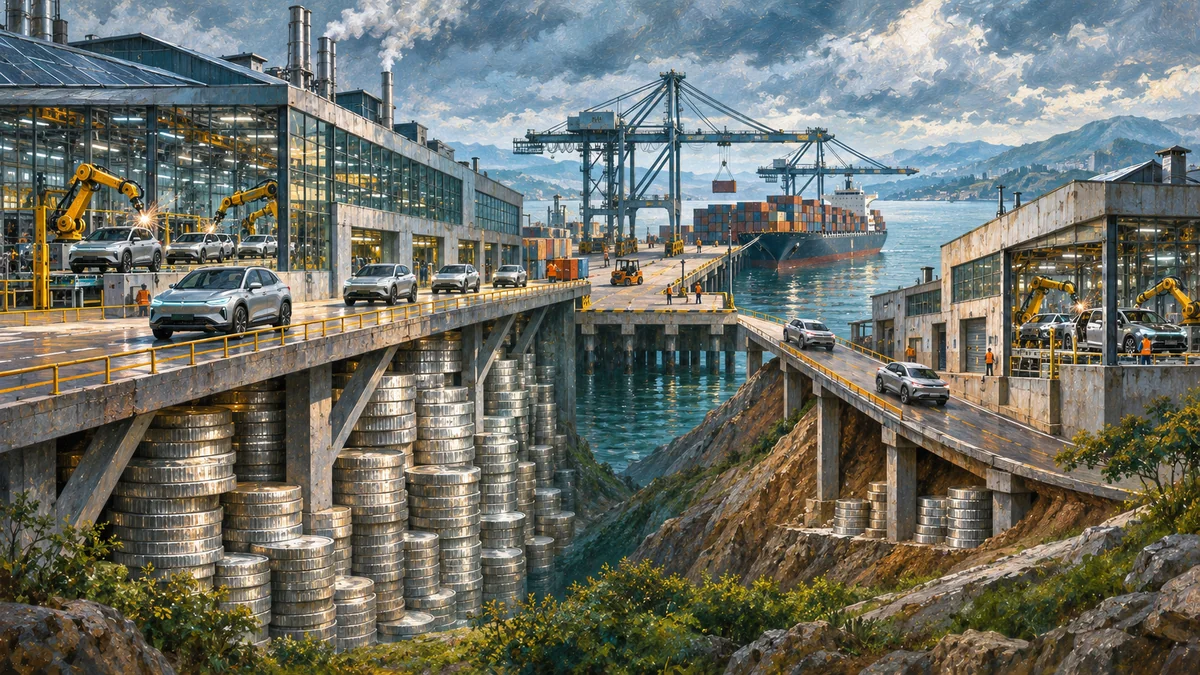
AI-generated symbolic editorial illustration, not a documentary image.
For decades, Western states built a large part of their economic legitimacy around the language of the free market. Competition was supposed to reward more efficient producers. State subsidies were supposed to distort prices. Local-content requirements were supposed to discriminate against imports. State-owned enterprises, cheap credit, selective tax breaks and politically directed capital were supposed to be signs of an economy in which the market no longer decided on its own. That criticism is not invented.
Subsidies can genuinely distort trade, displace competitors, create excess capacity and force other states into subsidy races of their own. China’s industrial-policy model has characteristics that cannot fairly be reduced to an ordinary Western tax incentive. But something changed.
When the United States and the European Union began treating the same strategic sectors as matters of national security, climate policy and supply-chain resilience, state intervention acquired a different vocabulary. It was no longer necessarily “market distortion”. It became strategic industrial policy.
That is not merely a semantic game. Western governments use supply-chain security, the climate transition and technological dependence as justifications for wider state intervention. Even where those arguments refer to real vulnerabilities, they do not create an automatic exemption from rules the same governments invoke against others. The question is whether the same standard applies when a competitor justifies its own industrial policy in the language of resilience, technological sovereignty, employment or national security. The central question of this article is therefore not:
are subsidies good or bad?
The question is: when does state support become legitimate industrial policy — and who has the political power to call its own support “resilience” while calling a rival’s support a “non-market practice”?
The WTO does not prohibit all subsidies
The most common oversimplification has to be removed first. World Trade Organization rules do not say that governments may not subsidise their economies.
The WTO Agreement on Subsidies and Countervailing Measures — the SCM Agreement — first defines what counts as a subsidy. There must be a financial contribution by a government or public body that confers a benefit; possible forms include direct transfers, loans, equity infusions, guarantees, tax incentives, provision of goods or services and government purchases.
Specificity also matters: the rules focus on assistance directed at a particular enterprise, industry, group of enterprises or region. [1]
The Agreement then distinguishes between two key categories. Some subsidies are prohibited. These include, in particular, subsidies contingent on export performance and subsidies whose receipt is conditional on the use of domestic over imported goods.
Others are actionable. They are not prohibited as such, but another member can challenge them if they cause specified adverse effects, such as serious prejudice to its interests. [2]
That distinction is essential. Saying “China subsidises industry” does not by itself prove a WTO violation. Saying “the United States subsidises industry” does not either. We need a specific measure, a legal category, eligibility conditions and trade effects. That is where the more interesting story begins.

Industrial policy has returned — in the West too
In the 1990s and early 2000s, Western economic policy often favoured the language of horizontal rules: the state should provide stability, competition, education, infrastructure and research, while the market should choose firms and technologies. That ideal was never fully realised.
Agriculture, defence, energy, aviation, banking and many other sectors remained closely intertwined with government.
But after the global financial crisis, the pandemic, supply-chain disruptions and intensifying U.S.-China technological rivalry, industrial policy became much more explicit.
In 2025, the IMF observed that advanced and emerging economies were increasingly using direct assistance and subsidised finance for targeted sectors, with supply-chain resilience, national security, the climate transition and technological competitiveness increasingly prominent as justifications. [3]
That means the dispute is no longer simply between a world of “free markets” and a world of “state economies”. Increasingly, it is a dispute between different forms of industrial policy.
The IRA: climate policy that was also domestic-production policy
The U.S. Inflation Reduction Act became one of the clearest symbols of that shift. The Act used tax incentives and other forms of support to accelerate the energy transition, while tying part of that support to production, components or supply chains in the United States or North America.
For the consumer tax credit for new clean vehicles, cars sold after 2022 had to meet, among other requirements, final-assembly rules in North America. Full eligibility also depended on requirements concerning the sourcing of critical minerals and battery components. [4]
The U.S. government openly presented these rules as a way to reduce emissions while strengthening domestic manufacturing, jobs, energy security and supply-chain resilience. [5]
That was industrial policy, not neutral free-market operation. The U.S. government linked public support to the development of domestic productive capacity.
That is precisely the kind of intervention international trade rules constrain when an additional benefit is made conditional on the domestic origin of goods.
In 2026, a WTO panel actually found the United States in violation
China challenged several U.S. IRA tax incentives at the WTO in 2024. By 2026, the dispute had narrowed.
China withdrew its claims against the Clean Vehicle Credit after that measure was terminated in July 2025 by the One Big Beautiful Bill Act.
But the dispute over the so-called ITC/PTC Domestic Content Bonus Credits for renewable and clean energy remained. On 30 January 2026, a WTO panel circulated its report.
It found that the domestic-content bonus tax credits were inconsistent with the national-treatment obligation under the GATT, with the TRIMs Agreement and — most importantly for this article — with Articles 3.1(b) and 3.2 of the SCM Agreement because the additional subsidy was contingent on the use of U.S. rather than imported goods. [6]
The panel also rejected the United States’ reliance on the public-morals exception in Article XX(a) of the GATT, but it is important to state precisely why. It found that the United States had not established the required relationship between the specific domestic-content bonuses and the asserted objective of protecting U.S. public morals from non-market practices, unfair competition and forced labour. Because that threshold element was not met, the panel did not need to complete every remaining step of the “necessity” analysis. [7]
The panel then recommended, under Article 4.7 of the SCM Agreement, that the prohibited subsidies be withdrawn without delay, and specified that they should be withdrawn no later than 1 October 2026. [8]
This was an important moment. Not because it proved that U.S. climate policy as a whole was unlawful. The panel did not decide that. It decided on specific domestic-content bonus credits. But for those measures, the result was fairly clear:
an institution of the rules-based system that the United States often invokes when criticising others found that a U.S. subsidy design violated the very non-discrimination and local-content rules presented as universal.
Then the United States appealed into a system that cannot hear appeals
On 23 February 2026, the United States notified the WTO that it was appealing certain legal findings of the panel.
That created another institutional problem. The WTO Appellate Body has lacked enough members to hear new appeals since December 2019. [9]
When a member appeals into such a non-operational body, the panel report cannot proceed through the normal route to become an adopted final report of the Dispute Settlement Body. In its 2026 World Trade Report, the WTO uses the expression “appeal into the void” for situations in which an appeal prevents adoption of a panel report. [10]
In DS623, the DSB chair removed adoption of the panel report from the February 2026 agenda precisely because the United States had appealed. [11]
So legal precision matters.
The panel found a violation, but because of the appeal the report was not adopted as a final DSB decision.
As a consequence, 1 October 2026 did not become a binding compliance deadline flowing from an adopted DSB recommendation. It was the date set by the panel in a report whose adoption was subsequently blocked by the appeal.
As of 8 October 2026, the position remains unresolved. USTR lists DS623 as Pending, while current IRS guidance still describes the Domestic Content Bonus Credit as available for projects meeting U.S.-content requirements for iron, steel and manufactured products. [12] [13]
That means something concrete: the panel’s date has passed, but because the appeal process was never completed, the usual legal obligation that follows an adopted report did not arise. At the same time, the disputed mechanism has not disappeared from the U.S. tax system.
That distinction has to be preserved. But it does not make the political problem smaller. It makes it larger.
U.S. criticism of the WTO does not create a U.S. exemption
The U.S. government does not justify its position only by dissatisfaction with one adverse dispute. For years, the United States has argued that the WTO system is not sufficiently capable of dealing with features of China’s economic model: large-scale subsidisation, state-owned enterprises, opaque support, industrial direction, market-access restrictions and other practices the U.S. government describes as non-market.
After the DS623 report, USTR stressed that, in its view, the panel had failed to grapple adequately with Chinese non-market policies and excess capacity, and that current rules do not provide an adequate response to such competition. [14]
Some of those concerns are documented, and the modern trading system has serious difficulty measuring support that may operate through public banks, local governments, state land, state-owned enterprises, regulation, public procurement and political targets.
But that does not mean Washington can decide for itself when a rule it invokes against others has become obsolete or inapplicable to the United States. This is where the problem of selective universalism appears.
If the rules apply only as long as they can discipline a rival, but become suddenly obsolete once they constrain our own industrial policy, then the issue is no longer merely reform of the rules. It becomes an asymmetry of power in deciding when an existing rule is still legitimate.
Particularly awkward is who helped create the appellate vacuum
The Appellate Body crisis did not appear from nowhere. The WTO’s own institutional material notes that in August 2017 the United States said it would not agree to launching selection processes to fill vacant seats until its systemic concerns were addressed. In December 2019, the Appellate Body ceased to be capable of hearing appeals because too few members remained. WTO material in 2026 continued to confirm that a functioning body had not been restored because members failed to reach consensus, with U.S. objections central to the blockage of appointments. [15] [16]
U.S. concerns about overreach, deadlines and judicial activism by the Appellate Body are not content-free. But the institutional consequence is concrete.
A country that played the central role in preventing the appellate body from being replenished can then appeal an adverse panel ruling to a body that cannot decide the appeal because of that blockage. That is exactly what happened in DS623. It does not prove that the U.S. appeal lacks legal merit.
But it is difficult to reconcile with rhetoric about others violating a “rules-based trading order” when one of its most powerful members can temporarily neutralise an adverse ruling by using the institutional vacuum.
The CHIPS Act: the state is not merely subsidising the market — it is directing the geography of technology
The IRA is not an isolated case. The U.S. CHIPS and Science Act is an even more direct example of strategic industrial policy.
The Department of Commerce oversees roughly $50 billion under CHIPS for America, including about $39 billion in manufacturing incentives. [17]
Individual projects received multibillion-dollar packages. TSMC Arizona, for example, received a final award of up to $6.6 billion in direct funding and up to $5 billion in proposed loans. [18]
That is state policy selecting a strategic sector. The government identifies the technology it wants on its territory, offers financial support, imposes conditions and uses public money to redirect private investment. That is close to a textbook definition of industrial policy.

With CHIPS, the question is not only who gets money — but also where the recipient may not invest
The law contains an even stronger geopolitical layer. Recipients of support face restrictions on expanding certain semiconductor manufacturing capacity in “foreign countries of concern”, including China, Russia, Iran and North Korea.
Final Commerce rules, among other things, restrict material expansion of advanced manufacturing capacity in such countries for ten years after an award and limit certain joint research and technology-licensing arrangements with foreign entities of concern. [19]
That is not merely assistance to domestic industry. It is an attempt to shape the geography of global technology production. The U.S. argument is clear: advanced semiconductors are not ordinary goods because they are connected to military capability, artificial intelligence, communications infrastructure and economic security. That argument carries considerable weight. But again, the same test has to be used.
When China restricts exports, directs capital or subsidises domestic capacity in the name of “technological sovereignty” and “national security”, Western governments ask whether the security rationale is genuine or merely a protectionist pretext.
The same question has to apply to Washington — without a presumption that an American security justification is more credible merely because it is American.
Chinese industrial policy is nevertheless different in scale and structure
An important boundary has to be drawn here. Criticising Western double standards does not require claiming that the U.S. CHIPS Act is simply the same thing as China’s economic system. It is not.
In an IMF Working Paper from August 2025, researchers estimated the equivalent fiscal cost of key Chinese industrial-policy instruments — cash subsidies, tax incentives, subsidised credit and subsidised land — at roughly 4 percent of GDP per year over the period they analysed. [20]
That is a research estimate by the paper’s authors, not a legal finding and not an official WTO measure of subsidy size. The same analysis estimates that some instruments are associated with excess production and that the combination of industrial policies also creates domestic misallocation of productive factors.
An IMF Working Paper from 2024 additionally found that Chinese subsidies tended on average to increase exports of subsidised products and reduce imports, with effects spreading through supply chains into other sectors. [21]
Beyond the amount of support itself, USTR accuses China of opaque subsidies, privileged treatment of certain state-owned and favoured firms, market-access restrictions, regulatory discrimination and other non-market practices. [22]
Those differences are material. They should not be erased. But neither should differences become a magical exception under which every American intervention is “market-based” merely because it operates through a tax credit, while every Chinese intervention is “non-market” merely because China does it.
The same standard requires measurement, not labels
A fair comparison would be much more boring — and much more honest. How large is the support? How specifically is it targeted? Is it tied to domestic goods? Does it discriminate against foreign suppliers? How transparent is it? Are the conditions published? Are there audits, judicial review and time limits? Does the support generate excess capacity? Does it lower export prices in ways that harm producers elsewhere?
Is the security objective narrowly defined, or so broad that it can justify almost any protection of domestic industry?
Those are questions that can be asked of Washington, Beijing, Brussels, Tokyo or any other capital. If we replace them with the phrases “our resilience” and “their distortion”, we are no longer dealing with a universal rule. We have arrived at geopolitical language for comparable instruments.
U.S. cotton: the double standard did not begin with China
To show that the subsidy dispute is not merely a reaction to the modern Chinese model, we have to go back before the IRA and CHIPS.
In 2002, Brazil challenged U.S. cotton subsidies at the WTO in United States — Subsidies on Upland Cotton (DS267). The dispute was broad and legally complex. But the central result is clear.
The WTO found problems with certain prohibited export subsidies as well as domestic support that caused serious prejudice to Brazilian interests. In 2007, a compliance panel found that the United States still had not removed the adverse effects of certain programmes, and arbitrators later authorised Brazil to take trade countermeasures. [23]
For fiscal year 2006, the arbitration calculation for the two components came to about $294.7 million, with the authorised level of countermeasures capable of varying from year to year. [24]
This was not China. It was not a country that could simply be dismissed with the phrase “state capitalism”.
It was Brazil using the rules of the trading system against one of the world’s most powerful states over U.S. agricultural support.

The United States adjusted only after a long dispute
The case is not a reason to excuse U.S. policy. It shows that change required years of litigation, findings of non-compliance, authorised countermeasures and negotiation.
The United States changed parts of its programmes, reached interim arrangements with Brazil and concluded a final memorandum in 2014 that ended the dispute. Among the terms was a final one-time contribution of $300 million to the Brazilian Cotton Institute. [25]
That shows that multilateral rules can constrain a major power — but often only after a long and costly process that a smaller state is less able to sustain.
The timeline is instructive precisely for that reason. Brazil initiated the dispute in 2002. Key reports were adopted in 2005. Non-compliance was found later. Countermeasures were authorised. A final settlement came only in 2014.
A powerful country has time, lawyers, fiscal space and bargaining leverage to litigate for more than a decade. A smaller or poorer country often has nothing close to the same room for manoeuvre.
A “free market” is easier when you are rich enough to subsidise
This is the second, more structural level of the double standard. Even if the formal rules are the same, the capacity to exploit permitted forms of support is not. A rich state can afford tens of billions of dollars for semiconductors. It can offer tax credits for domestic clean-energy production. It can provide large loans or guarantees. It can fund research, public procurement and infrastructure around a chosen sector.
A smaller or poorer state may instead be advised to improve the business environment, reduce fiscal risk and avoid “picking winners” — even while its competitors do exactly that.
In 2024, the IMF warned that new industrial policies were concentrated mainly in large economies and could create adverse cross-border spillovers and retaliatory measures. [26]
That is not necessarily formal legal discrimination. But it is structural privilege. A rule that allows everyone to participate in a certain kind of fiscal race gives greater real freedom to whoever has the deeper budget.
That is why “everyone subsidises” is not enough either
The opposite oversimplification would be: “Because everyone uses industrial policy, nobody has the right to criticise China.” That does not hold either. Scale, form and effects matter.
If a state supports production at a level that creates persistent excess capacity and displaces producers elsewhere, that is a different problem from a limited research subsidy. If support is nearly impossible to measure because financing is opaque, oversight becomes harder.
If a state-owned enterprise receives credit on terms a private competitor could never obtain, the market is altered.
If regulation, procurement, land and finance all push in the same direction, the effect is not comparable to a single openly published tax credit.
An IMF Working Paper from July 2026, using model-based estimates, finds that subsidies increase net exports in strategic sectors especially in China. The authors estimate that U.S. and EU subsidies have qualitatively similar but smaller trade effects, partly because their subsidy structures are distributed differently across sectors. [27]
Again, these are research-model estimates by the authors of a Working Paper, not a legal WTO finding. But as a comparative economic test, they are far more useful than an ideological slogan. The instruments are not identical. The effects are not identical.
But the logic of state direction of strategic production is now present across all three major economic poles.
National security has become an economic category
The deepest shift is not only in the amount of subsidies. The boundary between economics and security has changed. Semiconductors are security. Batteries are security. Critical minerals are security. Energy technology is security. Supply chains are security. Data are security. That shift has a rational core.
The pandemic and geopolitical crises showed that the cheapest supply chain is not always the most resilient. Advanced chips have direct military uses. Excessive dependence on a single supplier can create strategic vulnerability.
But the more economic sectors we place inside national security, the less remains of the old rule that markets should decide without political direction.
If a major power can protect almost any strategic sector with a security argument, the free-market system begins to turn into a system of managed interdependence. That may be the new reality.
But it is not fair to insist that others continue living by the old ideal while we reserve the new exception for ourselves.
Material differences do not create an automatic U.S. exemption
The U.S. government argues that: the Chinese system is larger, less transparent and more deeply intertwined with the state; Chinese subsidies have generated major trade effects in some sectors; advanced semiconductors have security implications; the climate transition requires rapid investment; WTO rules were not designed for today’s system of state capitalism. Some material differences between the systems are documented.
But they do not mean that every U.S. measure is therefore automatically consistent with universal rules, or that Washington may exempt its own instruments from the test it applies to others. DS623 shows the opposite. The panel did not say: “the American objective is bad.” It said:
the way a particular additional benefit was tied to the use of domestic goods was inconsistent with specific WTO rules.
That is the essential difference between an objective and an instrument. If a rules-based system is supposed to be universal, even a politically desired or security-framed objective has to survive the legal test applied to the instrument chosen.
When a Chinese subsidy is “distortion”, but an American one is “reindustrialisation”
Language reveals a great deal. In January 2026, USTR described the panel decision as a report punishing U.S. efforts to “reindustrialize” the economy. [14]
When the same office discusses Chinese measures, it uses phrases such as “non-market policies and practices”, “excess capacity” and attempts to dominate strategic industries.
In some cases, there are material differences that have to be demonstrated. But part of the difference is also perspective. Every major power sees its industrial policy through domestic goals: jobs, resilience, national security, technological progress, the climate transition, regional development. Its competitors see the external effects: lost market share, lower prices for subsidised goods, redirected investment, dependency, discrimination. Both perspectives can be true at the same time. That is precisely why a universal rule cannot depend on who is speaking.
What would the West say if China did the same thing?
The question has to be asked carefully, not rhetorically. Imagine a measure under which China offered an additional tax benefit to an energy project only if the project used a specified amount of Chinese iron, steel or manufactured equipment. Would Washington describe that as neutral climate policy? Probably not.
It would ask whether the measure was a local-content requirement, discrimination against imports and a subsidy distorting competition.
Those are exactly the questions the WTO panel asked of the U.S. measure in DS623. The reverse is true as well.
If the United States restricts CHIPS recipients from investing in advanced manufacturing in China for national-security reasons, China cannot automatically present every similar restriction of its own as entirely normal sovereignty. It too should have to explain scope, necessity and proportionality.
Universalism does not require all systems to be identical. It requires that differences be demonstrated using the same criteria.
The problem is not industrial policy itself
Sometimes the state has to intervene. Markets may underinvest in basic research. A supply chain may become dangerously concentrated. Climate costs are not fully reflected in market prices. An emerging industry may generate learning effects that no individual firm can capture. Military-sensitive technology is not an ordinary consumer good.
The IMF’s 2025 World Economic Outlook did not reject industrial policy as such. It found that targeted support can, in some circumstances, raise output and productivity in the targeted sector, but that effects are often modest and accompanied by fiscal costs, higher prices, misallocation and cross-border consequences. [28]
So the question is not whether we should return to an imaginary world without government. The question is whether we have rules that consistently distinguish between actual correction of market failures and political protection of domestic interests. And more importantly: whether we accept the same distinction when we dislike the result.
The WTO has a problem — but the stronger member cannot become its own judge
The American critique of the WTO is persuasive in one respect. Current rules have difficulty capturing every form of modern industrial policy, especially where support is opaque or state direction operates through banks, land, regulation and firms with varying degrees of state control. The appellate system also needs reform. But the solution to imperfect rules cannot be:
the rules are binding when they constrain others, and politically obsolete when they constrain us.
If the United States believes the SCM Agreement, the GATT or the current dispute-settlement system no longer fits the world, it can demand reform.
But it cannot insist that others respect the existing system while treating an adverse result against itself as something that can be left suspended in an institutional void.
DS623 therefore matters beyond one tax bonus. It shows what happens when a rule collides with the industrial policy of the system’s most powerful member.
Free market for whom?
In the modern economy, almost nobody advocates a pure free market in every strategic sector anymore. China has long used extensive industrial policy. The United States has explicitly returned it to the centre of economic and security strategy. The EU speaks of strategic autonomy and supports its own industrial capacity. That is not hypocrisy by itself. The world changed.
Climate, pandemics, wars, technology and concentrated supply chains created problems that older prescriptions did not handle well. Hypocrisy begins elsewhere. When we describe our own subsidies by their intended purpose — jobs, resilience, climate, security, reindustrialisation — while describing a rival’s subsidies only by their effects — distortion, excess capacity, non-market behaviour, unfair competition.
A fair standard must examine both for everyone. Intent and effect. Scale and transparency. Security justification and trade discrimination. Legal rule and material difference.
The West has every right to criticise Chinese subsidies when they are opaque, discriminatory or create serious cross-border effects.
But that right is persuasive only if the West is prepared to accept that its own industrial policy can cross the same line.
And in 2026, a WTO panel said exactly that to the United States. The problem was not that the United States wanted green energy or domestic industry. The problem was that a particular bonus was tied to domestic goods.
The panel called for withdrawal by 1 October 2026, but the U.S. appeal prevented adoption of the report; a week after that panel date, the IRS still lists the bonus as an available mechanism. Legally, that is not the same as failing to comply with an adopted DSB ruling. Politically, however, it is a very clear illustration of a system in which an adverse panel result can remain suspended in the appellate void.
When a rule becomes inconvenient, we can demand that it be reformed. But we cannot fairly call it universal —
if it applies only to others.
Sources and further reading
- WTO — overview of subsidies and countervailing measures Source
- WTO — Agreement on Subsidies and Countervailing Measures Source
- IMF — productivity benefits, risks and trade-offs of industrial policy (25 November 2025) Source
- IRS — tax credits for new clean vehicles purchased from 2023 Source
- US Treasury — release on IRA clean vehicle rules Source
- WTO — dispute DS623, US tax credits under the Inflation Reduction Act Source
- WTO — panel report in dispute DS623 Source
- WTO — findings and recommendations in DS623 Source
- WTO — Appellate Body Source
- WTO — World Trade Report 2026, executive summary Source
- WTO — Dispute Settlement Body meeting (24 February 2026) Source
- USTR — dispute DS623 record Source
- IRS — domestic content bonus credit Source
- USTR — response to WTO report on US reindustrialisation (January 2026) Source
- WTO — WTO reform briefing for the 12th Ministerial Conference Source
- WTO — WTO reform briefing for the 14th Ministerial Conference Source
- US Department of Commerce — launch of CHIPS for America funding Source
- US Department of Commerce — CHIPS incentives award to TSMC Source
- US Department of Commerce — final national-security rules for CHIPS incentives Source
- IMF — quantification of China’s industrial policy and its impact on misallocation Source
- IMF — trade implications of China’s subsidies Source
- USTR — 2024 report to Congress on China’s WTO compliance Source
- WTO — dispute DS267, US upland cotton subsidies Source
- USTR — statement on awards in the Brazil cotton dispute (2009) Source
- USTR — US–Brazil agreement to end the WTO cotton dispute (2014) Source
- IMF — conditions for effective industrial policy (12 April 2024) Source
- IMF — industrial policy and trade tensions in strategic sectors (2026) Source
- IMF — World Economic Outlook 2025, chapter on industrial policy Source