Who Will Pay for the Green Transition? — Climate Justice Between History and the Future
How should the cost of climate transition be shared? We explore historical emissions, climate finance, just-transition policies, and trade measures.
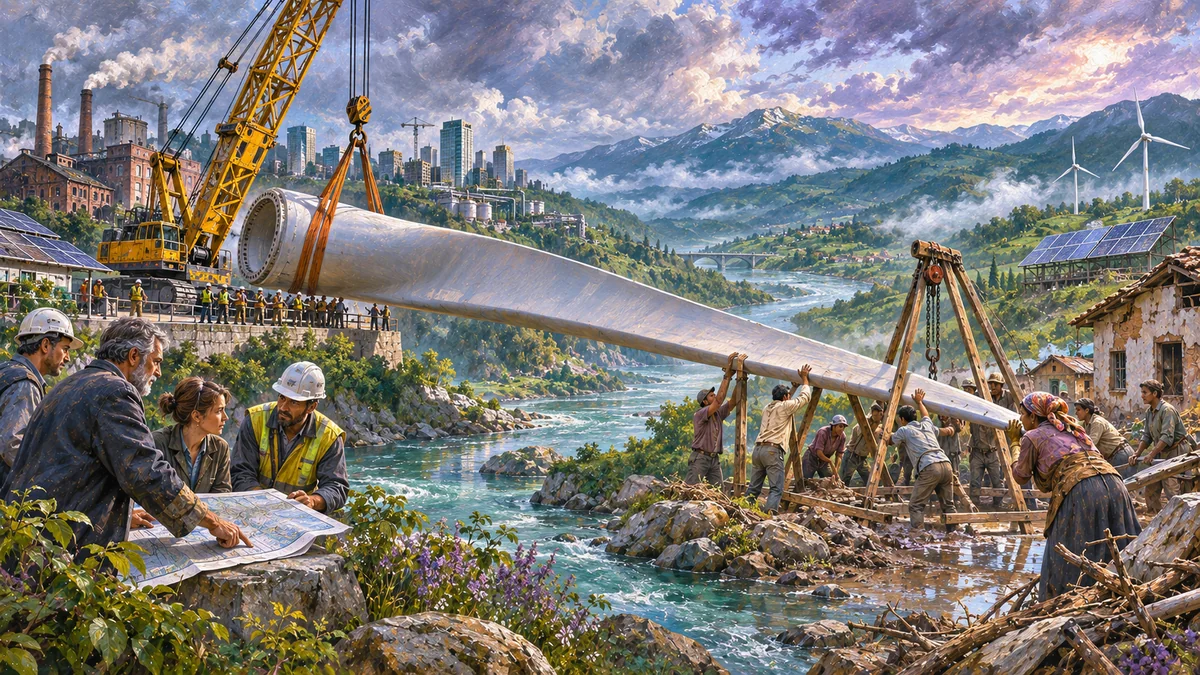
AI-generated symbolic editorial illustration, not a documentary image.
The climate transition is not merely a matter of new power plants, cleaner technologies and reducing emissions. It is also a question of who can finance such a transformation and who will bear the costs when promised support takes the form of a loan, a new trade obligation or pressure on public finances. Countries are expected to respond collectively to a global problem, but they do not enter that transition with equal wealth, infrastructure or histories of industrialisation.
This is why the international climate framework adopted the principle of common but differentiated responsibilities and respective capabilities (CBDR-RC). The Paris Agreement retains that principle because shared responsibility does not mean an identical financial or developmental burden. In its 2025 advisory opinion, the International Court of Justice highlighted, among other considerations relevant to climate obligations, countries' historical and current contributions to cumulative emissions, their capabilities and their national circumstances. This is not an automatic formula for compensation, but an important consideration in understanding how burdens can be fairly distributed. [1]
The question posed by this article, then, is not whether today's major emitters—including China, India and other rapidly growing economies—must act. They must. The question is whether countries that industrialised earlier and command greater financial resources are willing to shoulder a proportionate share of the costs and risks of the transition they expect others to undertake.
Who Polluted Yesterday, and Who Is Emitting Today?
The climate does not respond only to how much a country emitted over the past year. Warming also depends on the CO₂ that has accumulated through human activity over a much longer period. The IPCC estimates cumulative net anthropogenic CO₂ emissions from 1850 to 2019 at approximately 2,400 ± 240 gigatonnes. In its regional breakdown, North America accounted for about 23%, Europe 16%, and East Asia, which includes China, 12% of those emissions. [2]
These figures matter historically, but they are not a simple list of countries to blame. Regional groupings are not individual states; estimates of land-use emissions carry uncertainties; populations and economic relationships have changed; and production and consumption have often taken place in different parts of the world. None of these qualifications, however, makes history irrelevant: much of the capital and infrastructure of today's wealthy economies was built during an era of intensive fossil-fuel use.
It would be equally misleading to disregard the present. According to the Global Carbon Budget 2025, the shares of global fossil CO₂ emissions in 2024—not all greenhouse gases—were approximately 32% for China, 13% for the United States, 8% for India and 6% for the EU-27. The same source reports per-capita fossil emissions for 2024 in tonnes of carbon (tC). Converting its rounded values into tonnes of CO₂ gives approximately 14.3 tonnes for the United States, 8.8 for China, 5.5 for the EU-27 and 2.2 for India. These are approximate conversions, not independently more precise measurements. [3]
Historical emissions, present annual emissions, per-capita emissions, consumption-based emissions and the capacity to pay answer different questions. No single indicator can determine on its own who should finance the transition. If we consider only present emissions, part of the historical benefit disappears from the debate; if we consider only history, we overlook the present and future effects of major economies. A fair debate must be able to hold both perspectives at once.

Why Does International Law Differentiate Responsibilities?
The principle of common but differentiated responsibilities and respective capabilities (CBDR-RC) was not designed to divide the world into innocent and guilty states. It reflects a basic reality: climate impacts are shared, but economic and historical starting points are not. The United Nations Framework Convention on Climate Change incorporated this distinction into international cooperation, while Article 2(2) of the Paris Agreement expressly requires its implementation to reflect equity and different national circumstances. Article 9 requires developed countries to provide financial resources to assist developing countries with mitigation and adaptation, and encourages other parties to provide support voluntarily. These obligations do not give every country a predetermined, identical monetary share. [4]
The International Court of Justice's advisory opinion of 23 July 2025 further illuminated this relationship in legal terms. In explaining differentiation, the Court highlighted countries' historical and current contributions to cumulative emissions, their capacities and their national circumstances. It thereby rejected the idea that the historical dimension was merely a political invention, without establishing any automatic formula converting past emissions into a compulsory payment by a particular state. [1]
The legal distinction matters. An advisory opinion is not a judgment awarding compensation in a particular dispute. For the purposes of these proceedings, the Court did not treat the “polluter pays” principle as an independently applicable rule of law determining obligations on its own. It did, however, interpret the climate treaties and other relevant rules of international law. The legal position is therefore neither “wealthy countries must automatically pay for everything” nor “history is irrelevant”, but a more demanding assessment of specific obligations and the proportionality of burdens. [5]
If we take this distinction seriously, we must move from the language of agreements to the question of how obligations are actually financed. Equity can be recognised on paper; budgets, loan agreements and trade conditions reveal how much of it a state is prepared to recognise in practice.
One Hundred Billion Dollars: A Promise, a Delay and the Cost of Loans
In 2009, developed countries politically committed themselves to the goal of collectively mobilising USD 100 billion a year by 2020 for climate action in developing countries. This was not an estimate of total needs, but a public commitment with a deadline. According to the OECD, the target was first exceeded only in 2022, when USD 115.9 billion was provided and mobilised. The OECD reports USD 132.8 billion for 2023 and USD 136.7 billion for 2024. The target was thus exceeded eventually, but two years later than the original deadline. [6] [7]
More important than the aggregate figure is what it contains. The OECD category climate finance provided and mobilised is not synonymous with grants: it includes attributable public flows, officially supported export credits and private finance mobilised through public interventions. Of the total USD 136.7 billion in 2024, approximately USD 101.6 billion was public finance. Within that public-finance subset, loans accounted for roughly 67%, or USD 68.5 billion, while grants represented 29%, or USD 29.7 billion; the remainder was primarily equity. These percentages must not be applied to the entire USD 136.7 billion total. [7] [8]
A loan offered on more favourable terms is not the same as commercial debt, and it can be an important source of development finance. But the recipient generally has to repay it. Assessing fairness therefore also requires asking who bears interest costs, exchange-rate risk, repayment obligations and the consequences of possible debt distress. If reducing emissions is presented as a shared responsibility, finance cannot be judged solely by how much is recorded on the provider's side. What matters as well is how much of the cost remains with the country the support was supposed to help.
South Africa: Who Gets to Decide the Course of the Energy Transition?
South Africa's Just Energy Transition Partnership (JETP) is a particularly revealing example because it brings together climate goals, the need for reliable electricity, jobs in the coal industry and the terms of finance. The initial framework announced in 2021 and detailed a year later amounted to approximately USD 8.456 billion. Under the original breakdown, grants and technical assistance accounted for USD 329.7 million, concessional loans for USD 5.325 billion, commercial loans for USD 1.5 billion, and guarantees for USD 1.3 billion. A guarantee is not a direct disbursement, and a loan is not a grant. [9]
South Africa's JET Investment Plan for 2023–2027 estimated requirements at around 1.48 trillion rand. The partners' initial offer was not intended to cover the whole amount. An official 2022 report described it as a catalytic contribution and also stated that it represented around 12% of needs. Yet the ratio between the two amounts cited in that same report—approximately 128 billion rand and 1.5 trillion rand—is only about 8.5%. Without an explanation of the different calculation bases, the stated 12% cannot be presented as a directly verified calculation from those two figures. [10] This does not prove that the terms of all offered loans were poor. It does mean that the label “just transition” must be tested against the actual distribution of debt, risk and democratic decision-making.
President Cyril Ramaphosa emphasised as early as November 2021 that the USD 8.5 billion offer did not commit South Africa to accepting conditions that would undermine its public finances, and he insisted on respect for domestic development priorities. [11] This raises a fundamental question of self-determination: does outside capital support the decisions of a country familiar with its own economic and social circumstances, or does decision-making gradually pass to the financier? The partnership must also be judged by how much scope local communities and elected institutions have to choose the pace, technology and social safeguards of the transition.
Figures available up to 31 March 2026 show that the partnership's scope had changed. The JET register recorded around USD 13.159 billion in planned international-partner funding and approximately USD 6.115 billion in allocations at instrument level. The broader figure of USD 14.364 billion also includes separately recorded indicative contributions from the private sector and domestic development finance institutions, so it must not be described as a new pledge by foreign governments. Approximately USD 4.32 billion was recorded for specific projects. A pledge, an allocation and a disbursement represent different stages of financing. [12] [13]
In the broader register, as of March 2026 there were approximately USD 989 million in grant commitments and USD 862 million in allocated grant funding. This marks a significant change from the initial package, but does not conclusively demonstrate that financial justice has been achieved. The cost of capital, contractual terms, actual disbursements and consequences for the population tell us more about fairness than the headline total at a press conference. A transition that claims to be just must also be measurable in the lives of people whose work, electricity bills and local environment are changing.

Adaptation, Loss and Damage, and New Financial Promises
When discussing emissions reductions, we can expect action from all major current emitters. With adaptation, however, inequality is even more apparent: a country may contribute very little to global emissions and still face expensive investments in coastal protection, irrigation, flood defences, urban cooling or early-warning systems. Such expenditure is not a reward for successful industrial policy, but a response to changes that have already occurred.
The UNEP Adaptation Gap Report 2025 estimated developing countries' adaptation needs by 2035 at approximately USD 310 billion annually based on modelling, or USD 365 billion annually by extrapolating national plans. International public adaptation-finance flows in 2023 were around USD 26 billion, leading UNEP to describe needs as approximately 12 to 14 times greater. These are not the same accounting categories as the OECD's overall climate-finance statistics, so the numbers cannot simply be added or subtracted. Nevertheless, the gap reveals the scale of the problem: needs are rising much faster than specifically designated public funding. [14]
Adaptation does not always have the final word. Where consequences cannot be prevented or remedied, we speak of loss and damage. The Fund for Responding to Loss and Damage (FRLD), agreed at COP27 and operationalised at COP28, is intended to assist responses to such consequences. [15] As of 15 March 2026, the official overview listed approximately USD 822.06 million in pledges from 27 contributors. A pledge is not yet a signed agreement, an approved application or a payment. [16]
For the initial Barbados Implementation Modalities (BIM), USD 250 million was first earmarked; at the Board's ninth meeting in 2026, that allocation was increased by USD 92 million to USD 342 million. By 29 June 2026, the secretariat had registered 176 requests involving 119 countries, totalling approximately USD 2.8 billion. Those are requests, not approved or disbursed funds. The Board was expected to consider the first initial package in December 2026, which, at the date of this edition, was still in the future. [17] International support for loss and damage does not automatically constitute a particular state's legal liability to pay compensation; these are different mechanisms with different legal foundations.
At COP29 in Baku in 2024, a new collective quantified goal for climate finance was adopted. Developed countries are to take the lead in raising climate finance for developing countries to at least USD 300 billion a year by 2035, alongside a broader mobilisation goal of at least USD 1.3 trillion annually by 2035 from various public and private sources. [18] These amounts are not the same pledge: the higher one is not a commitment by developed countries to pay USD 1.3 trillion in public money each year on their own. The stated goal matters, but its fairness in practice will depend on instruments, accessibility, timing and actual financial flows.
This brings the finance debate back to its core. The purpose of a fund or an agreement is not merely to display political will, but to ensure that communities already bearing the consequences receive resources when they actually need them. Otherwise, the word solidarity becomes a statistical category, while the risk remains where resources are most limited.


The EU's CBAM: An Environmental Measure or a New Development Burden?
With the Carbon Border Adjustment Mechanism (CBAM), the European Union has linked its climate requirements to the conditions governing imports of certain goods. The European Commission describes its aims as preventing the relocation of emissions-intensive production and making the carbon burden on producers inside and outside the EU more comparable. That regulatory rationale is understandable, but it does not yet answer the question of how costs should be fairly divided between economies with vastly different capacities to invest in cleaner production. [19]
The definitive CBAM regime has applied since 1 January 2026. For cement, iron and steel, aluminium and fertilisers, a general threshold of 50 tonnes of net mass per importer per calendar year applies; the exemption does not extend to electricity and hydrogen. Other rules, including exemptions based on origin, must be assessed separately. The sale of certificates relating to 2026 imports begins in February 2027, while the Commission publishes quarterly prices for 2026. It would therefore be incorrect to suggest that an importer was already purchasing certificates for January 2026 shipments at that time. [19] [20] [21]
CBAM addresses the emissions intensity of covered imports, not how many centuries a country needed to accumulate capital or its historical contribution to cumulative emissions. That does not in itself mean newer exporters should be permanently exempt from all climate requirements. But it does raise a legitimate question: does the same border price impose a comparable burden where access to technology and finance is profoundly unequal?
In 2021, UNCTAD used a general-equilibrium model to assess the possible effects of the EU's then-proposed CBAM. Among its scenarios, the study indicated possible trade diversion away from some developing countries towards more efficient producers and considered the option of using revenues to support cleaner technologies. These were modelled scenarios from 2021, not measured impacts of the definitive regime introduced in 2026. [22]
Similarly, a 2026 study associated with the UNFCCC modelled hypothetical simultaneous carbon-border measures across several developed markets affecting India, including Canada, Japan, the United Kingdom and the United States. Its possible negative sectoral effects are therefore not evidence of damage already caused by the EU's CBAM alone. The study also suggested that earlier domestic investment in cleaner production could reduce exposure to such risks. [23]
The Commission states that it supports developing countries in decarbonisation and CBAM implementation. A fair assessment must acknowledge that support. But its existence alone is not enough: its scale, access conditions and availability of technology must be compared with the actual cost of adjustment. Without such evidence, neither complete fairness nor inevitable economic damage can be declared in advance. [19]
Rules of this kind expose the heart of a democratic and developmental question. The EU can set conditions for its market, while exporting countries must decide how to respond to a standard whose rules they did not shape on equal terms. If cleaner production requires more capital than they can access, even a formally uniform standard can produce unequal consequences. Equal rules do not necessarily mean equal opportunities to comply.

Common Rules and Unequal Economic Power
Two oversimplifications readily emerge in debates about climate justice. The first holds that wealthy countries should pay for everything because they industrialised first; the second insists that history no longer matters because a large share of fossil emissions now comes from China, India and other economies. Both overlook the relationship between the physical problem and the economic capacity to address it. Today's major emitters must reduce emissions, while historical benefits and the ability to pay remain relevant to the distribution of burdens.
CBDR-RC is not permission to pollute without limits. The Paris Agreement requires its parties to prepare and maintain nationally determined contributions, while the precise obligations must be interpreted under the relevant treaty provisions and other rules. In 2025, the International Court of Justice specifically considered standards of due diligence in preventing significant environmental harm. Differentiation between countries therefore does not mean that some have no obligations at all. [5]
The difficulty arises when internationally determined requirements are presented as a shared discipline while their implementation costs are largely shifted onto national budgets, domestic borrowing and households' capacity to pay for higher upfront investment. Such arrangements are not automatically evidence of deliberate exploitation. They can, however, expose a verifiable asymmetry between the power to set rules and the burden of complying with them. We must therefore ask who had a voice in making the rules, who controls finance, who sets its terms and who carries the risk when the expected benefits are delayed.
More private capital is not inherently bad, and government subsidies are not automatically more equitable. Both must be judged by actual costs, ownership of infrastructure, people's access to energy and control over decisions. If a new arrangement increases communities' dependence on financial intermediaries while reducing their ability to decide for themselves, REALKO must investigate it. But that conclusion has to be demonstrated through specific contracts and institutions, not attributed to every climate project in advance.
The US Withdrawal and the Question of International Responsibility
Western countries do not act as a single bloc on climate policy. While the European Union was developing CBAM and continuing its regulatory framework, the United States withdrew from the Paris Agreement once again. The US presidential order was issued on 20 January 2025, and the UN depositary received formal notification on 27 January 2025; the withdrawal took effect on 27 January 2026. From that date, the United States ceased to be a party to the Paris Agreement. [24] [25]
The White House explained the decision in terms of economic interests, energy and jobs. This should be reported as the administration's stated argument, not as independently established proof that withdrawal was necessary. The political tension is evident: a country with a large historical share of emissions was able to leave the treaty framework, while numerous countries with far fewer financial resources are expected to adapt rapidly to climate and trade requirements. That is a well-founded question of consistency, not proof that all Western governments made the same choice.
Withdrawal has legal consequences. After 27 January 2026, it would be incorrect to treat the United States as though new obligations under the Paris Agreement continued to arise from its ongoing membership. Yet withdrawal does not change historical emissions, nor does it automatically exclude all obligations under customary international law. In 2025, the International Court of Justice considered, among other matters, duties to prevent significant environmental harm and to cooperate; the application of any particular obligation depends on its legal basis, timing and specific circumstances. [5]
The advisory opinion also clarified the general rules of state responsibility for a breach of an international obligation. Consequences may include cessation of the breach, assurances of non-repetition and reparation. The Court did not, however, award compensation to an individual country, establish a uniform historical emissions tax or declare all past emissions unlawful. A specific compensation claim requires examination of whether an obligation was breached, whether the conduct is attributable to the state, and whether there is a sufficiently direct and certain causal link to the harm. The cumulative nature of emissions does not rule out that inquiry in advance, nor does it resolve it by itself. [5]
Legal responsibility, political finance targets and the FRLD must therefore be treated separately. When these categories are collapsed into one slogan, the debate loses precision. And when a country invokes universal discipline but chooses to withdraw from the framework itself, comparing its conduct with its declared principles is both legitimate and necessary.
What If the History of Industrialisation Had Been Reversed?
Imagine that history had unfolded differently. Europe and North America remained predominantly agricultural and poorer through much of the nineteenth and twentieth centuries, while Asian and African economies built industry, railways, universities and capital through prolonged use of cheap coal, oil and gas. When the West sought to industrialise, wealthy partners would tell it that the remaining global carbon budget was small, that it must use costlier and cleaner technology, that its steel would be subject to a charge at a foreign border, and that much of the financial assistance offered for adjustment would be in the form of loans. This thought experiment is not historical evidence; it is a test of the consistency of our moral standards.
Would countries on the poorer side accept such rules without objection? We cannot know how they would behave. It is reasonable, however, to expect them to invoke history, development needs and unequal capacities to pay. Those very questions are already embedded in the international climate framework—not to allow anyone to repeat the old development path without limits, but because pursuing the same objective does not necessarily require everyone to carry the same burden.
The example leads us to a more practical question than assigning moral guilt to nations: how much development space does each country have? Earlier industrialised countries often built infrastructure before today's carbon prices existed, while more recently industrialising economies face different environmental constraints and higher upfront capital requirements. The atmosphere does not allow limitless repetition of past emissions. But fairness requires that unequal financial starting points not be erased from negotiations over common goals.
When Does the Climate Transition Become a Development Double Standard?
Cleaner technologies can reduce dependence on imported fuels, improve air quality and create new opportunities for energy supply. These are significant benefits. Yet future benefits do not automatically finance today's investment: electricity grids must be built, equipment purchased, workers trained and any debt repaid. So the question of whether a transition brings benefits is not the same as the question of who can secure those benefits and who bears the initial risk.
A double standard does not arise simply because countries are asked to reduce emissions. It can emerge through a combination of actions: when wealthy economies acknowledge differentiated historical responsibilities in treaties while expecting poorer ones to follow a faster and more capital-intensive development path; when major financial promises arrive late or fall far short of assessed needs; when a large share of support remains debt; and when trade rules create additional costs without comparable access to the capital needed to comply. To judge a particular policy, we must examine the whole arrangement rather than select only its most outrageous feature.
The evidence also shows improvements. Developed countries ultimately exceeded the original USD 100 billion target, the FRLD secured initial funding, and South Africa's finance register grew. Fair criticism must acknowledge these facts. Yet subsequent progress does not undo an earlier delay, nor does it prove that burdens or decision-making were fairly distributed. Outcomes must be examined through the timeliness of disbursements, the types of instruments used, access to capital, financial consequences and the opportunity for local communities to participate in decisions.
This is also a question of individual and community freedom. If the pace of economic transformation is decided far from the people paying for it, democratic oversight must be considered alongside emissions and efficiency. But opposing outside authority is not enough: we must show how an arrangement could be environmentally effective, economically feasible and more accountable to the people it affects.
Who Ultimately Pays the Climate Bill?
A fair answer is neither “the West alone” nor “everyone should pay according to their current share of emissions”. The first overlooks today's substantial emissions from large, rapidly growing economies. The second ignores historical contributions, wealth inequality and the fact that many countries built essential infrastructure before today's carbon rules existed. The international climate regime has therefore adopted a more demanding principle: responsibility is shared, but not equally distributed.
If developed countries with greater financial capacity want to advocate common limits credibly, they must seriously shoulder part of the cost of the transition rather than merely define its rules. This may include timely and transparent public finance, more grants and genuinely concessional funding where debt constrains development, technology transfer, and support for adaptation and responses to loss and damage. Today's major emitters must likewise accept their own share of responsibility. Neither side gains credibility by loudly listing the other's duties while calling its own an exception.
The deepest question thus goes beyond accounting. Who has the power to determine other people's development paths, and who bears the consequences if those paths prove more expensive than promised? Freedom of choice is hollow if a society has no viable alternative. And fairness is not achieved simply by prescribing equal rules to everyone when only the wealthiest can afford to meet them. If the atmosphere is shared when limits are set, responsibility for the costs cannot disappear when the bill comes due.
Sources and further reading
- International Court of Justice — Summary of the advisory opinion on the obligations of states in respect of climate change (23 July 2025) Source
- IPCC — AR6 WGIII, Figure SPM.2 on emissions Source
- Global Carbon Budget 2025 — Publication in Earth System Science Data (2026) Source
- UNFCCC — Paris Agreement Source
- International Court of Justice — Advisory opinion on the obligations of states in respect of climate change (23 July 2025) Source
- OECD — The USD 100 billion climate-finance goal reached in 2022 Source
- OECD — Climate finance provided and mobilised by developed countries, 2013–2024, Part 2 Source
- OECD — Climate finance provided and mobilised by developed countries, 2013–2024, Part 3 Source
- UK Government — Twelve-month progress update on South Africa's Just Energy Transition Partnership Source
- SAnews — Estimated financing needs for South Africa's just energy transition Source
- Presidency of South Africa — President Ramaphosa's position on conditions attached to the energy-transition partnership Source
- Just Energy Transition — South Africa's investment register dashboard Source
- Just Energy Transition — Progress report for the first quarter of 2026 Source
- UNEP — Adaptation Gap Report 2025 Source
- UNFCCC — Fund for Responding to Loss and Damage Source
- Fund for Responding to Loss and Damage — Pledges and financing Source
- Fund for Responding to Loss and Damage — Barbados Implementation Modalities Source
- UNFCCC — COP29 climate conference in Baku Source
- European Commission — Definitive regime of the Carbon Border Adjustment Mechanism Source
- European Union — Regulation (EU) 2025/2083 amending CBAM Source
- European Commission — First CBAM certificate price (7 April 2026) Source
- UNCTAD — Implications of the EU's Carbon Border Adjustment Mechanism for developing countries Source
- UNFCCC — Study on early climate action and exposure to carbon-border pricing risks Source
- United Nations Treaty Collection — Status of the Paris Agreement Source
- White House — Executive order on international environmental agreements (2025) Source