What Should I Do If Home Isn't Safe?
If home is unsafe, your safety comes first. Recognize threats and abuse and find safer ways to seek help in Slovenia.
Sometimes you hear a key turn in the front door and already know it could be a difficult evening. Some days are peaceful. On others, someone shouts, threatens people, or smashes things. Perhaps someone has hit you. Or perhaps nobody hits you, but someone humiliates you, frightens you, or makes you keep secrets that leave you ashamed and afraid. By morning, everyone may act as if nothing happened. You are left wondering what tonight will bring.
When is this more than a family argument? Who can you turn to when the person meant to protect you is the person you fear? And what if someone refuses to believe you?
If there is violence at home or you fear for your safety, you do not have to face it alone. The violence is not your fault. If you are in danger right now, try to reach a safe person or place, but only if doing so will not put you in greater danger. In Slovenia, call 113 for urgent police help or 112 for emergency medical or other rescue services. If the danger happens repeatedly but is not immediate, tell a trusted, safe adult, the police, or a centre for social work (center za socialno delo, CSD) as soon as you can. You do not need proof or an injury before asking for help.
How can I tell whether this is more than an argument?
Families disagree. A parent may make a rule you think is too strict. You may argue, then talk it through later. That alone does not mean there is violence. The important thing is neither to call every disagreement abuse nor to dismiss real danger as an ordinary argument.
It is different when someone uses their power to threaten, frighten, humiliate, force, or hurt another person. A hit does not become acceptable because it leaves no bruise. Smashing things to scare you, or threatening you if you tell someone, is not just having a “bad day.” Emotional and psychological abuse can be serious without a visible injury. You do not need to work out the legal definition yourself. The authorities make that assessment; you can ask for help when you feel threatened.
Sexual abuse can also happen at home, not only at the hands of a stranger. If someone forces you into sexual touching or acts you do not want and tells you to keep quiet, try to tell someone safe. You do not have to explain everything at once. You could begin: “Someone is doing things to me that I don't want. I'm scared to talk about it.”
Serious neglect can also put a child at risk: for example, being left without essential care, needed medication, or proper protection. A family having little money is not, by itself, proof of abuse. But when a child's basic needs cannot be met, the family may need support—and the child has a right to help.
Perhaps someone is hurting your mother, father, brother, or sister, and you see or hear it happen. Even if nobody strikes you, living with violence can be frightening and dangerous. You are not responsible for stepping between people and physically stopping the violence. Tell someone who can help arrange protection.
“But they're not always like that ...”
You can love someone and still be afraid of them. You remember when they cared for you, laughed with you, or helped you. Perhaps they apologise after an outburst. Of course you want the good days back. But an apology or a happy memory does not make you safe if the harm continues.
Someone might say, “I hit you because you didn't listen,” or “My parents treated me that way.” What you did does not excuse violence against you. Physical punishment of children is prohibited in Slovenia. Parents can set rules and reasonable consequences. They cannot use those rules as permission to frighten or hurt a child.
If an adult has problems with alcohol, drugs, or mental health, you may want to help. But an illness or an addiction does not automatically make someone violent. What matters here is their behaviour and the danger it creates. Nor is it your job to treat that adult or prevent their outbursts by being perfectly obedient.
Asking for protection is not betraying your family. You do not have to keep violence secret, even when you love the person involved.
If you are in danger right now
When you are frightened, a long list of instructions is not much help. What matters most is getting help safely, not winning an argument.
If you can safely get to a neighbour, a school, a shop, or another trusted adult, ask for help. But if leaving, arguing back, or using your phone would put you at greater risk, do not feel you must do it because an article suggests it. No single safety plan works in every home.
In Slovenia, call 113 when you urgently need the police and 112 for emergency medical, fire, or other rescue services. If you can call, first tell the operator where you are, what is happening, and whether anyone is hurt. For example: “I'm fifteen. Someone at home is threatening me. I'm at [address or location]. I need help.” Say if a younger child is in danger too. You do not have to get every word right.
If using a phone is unsafe, ask a safe adult to call on your behalf if you can. In an immediate emergency, an email, online form, or counselling chat is no substitute for urgent help. Do not try to organise a dangerous escape to an unknown place, or put yourself at risk trying to rescue someone else. The appropriate services can help plan a safer way to leave and get protection.
What should I say to someone who can help?
The following scene is fictional. It illustrates one possible first step, not a real testimony or a promise that every case will unfold in the same way.
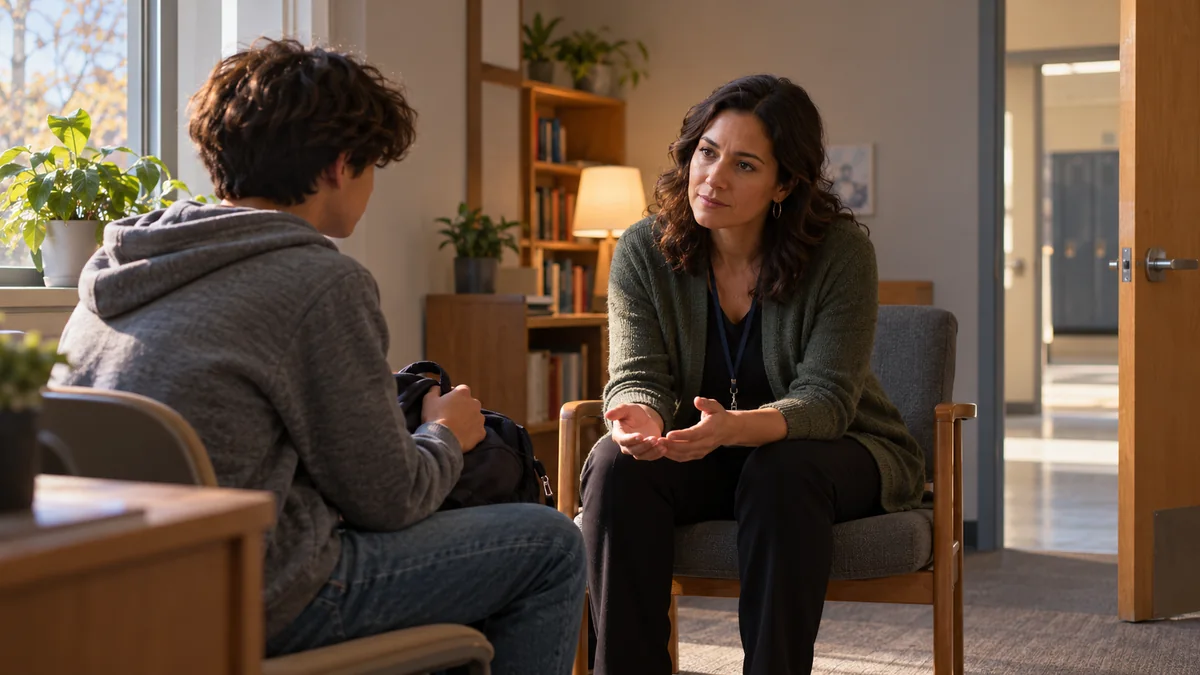
Fifteen-year-old Ema comes to school on Monday exhausted. The night before, an adult at home shouted, made threats, and smashed things. Ema spent the evening listening for footsteps near her younger brother's room. When the school counsellor asks if she is all right, Ema says, “It's only arguments.”
Then she finds the words: “Someone at home is threatening us. I'm scared for my brother and me. And I'm afraid of what will happen if they find out I told you. Can we talk about how to keep us safe first?”
Ema does not know what comes next. But she has said three important things: what is happening, who is in danger, and what she fears may happen if the adult finds out. She does not have to explain the family's entire history or find the right legal term for every act.
In a similar situation, you could say: “I'm frightened at home. I need help, but I'm worried things will get worse if you call home immediately.” The adults helping you need to take that fear seriously when planning protection. A school that learns of domestic violence against a child cannot promise to keep it completely secret: it must notify the relevant services. How those adults respond is their responsibility, not yours.
What if there is nobody at home I can trust?
The person putting you in danger may be your only caregiver. So telling every young person to speak to a parent first would be bad advice. Look for someone safe outside your home: a teacher, school counsellor, doctor, relative, coach, or a friend's parent. The important thing is not just finding an adult, but finding someone who can listen safely and help you get protection.
You can report violence to the police yourself or contact a CSD. You do not need permission from the person threatening you. If the first adult tells you it is “just a private family matter,” try another safe adult or contact the appropriate service directly. If you are in immediate danger, do not wait for your next appointment.
Someone may check your phone, read your messages, or threaten you for contacting others. If so, talking in person or using a safe adult's phone may be safer, provided it does not increase the risk. Deleting a conversation does not necessarily remove every trace. Tell the person helping you about threats or control over your communications too.
What if I am afraid to disobey?
This shorter scene is fictional as well. It is not an instruction for every situation involving alcohol.
Sixteen-year-old Gal sees that his caregiver has been drinking and is about to drive. The caregiver insists that Gal get in the car. Gal is afraid to refuse. But this is not a disagreement about a family outing. It is about the danger of driving after drinking.
If Gal can stay somewhere safe without making the situation more dangerous, he should avoid getting into the car. He can ask another safe adult for help. If his caregiver poses an immediate danger, he can call the police on 113. If speaking up would put him at risk of violence, he does not need to confront the caregiver to prove he is brave.
Adults are responsible for raising and protecting children. But being allowed to set rules does not give an adult the right to endanger a child. In a moment like this, safe help matters more than appearing obedient.
What might happen after I ask for help?
This may be the part that worries you most. Will someone contact home? Will the adult be angry? Will you have to leave? Nobody can promise exactly what will happen. What you should know is that adults and public services have responsibilities to protect children; those responsibilities are not yours to carry.
Police can take a report and look into what happened. A CSD assesses the danger and helps coordinate protective steps when needed. In some cases, this may include a temporary safe place to stay at a crisis centre. No particular measure is guaranteed or automatic after one conversation. You do not need to know where you will sleep next week before you ask for help today.
If someone is violent, you are not responsible for arranging a family meeting or persuading everyone to make peace. In Slovenia, mediation between the parties is not used when domestic violence is suspected. You can hope someone will change and still ask for protection now.
You do not need photographs of injuries, secret recordings, or witnesses before reporting violence. If recording something would be safe and useful later, a safe adult can help you decide how. You do not have to prove your case before someone will listen to your safety concerns. Never put yourself in greater danger to gather evidence.
Where can I get help in Slovenia?
If you are in immediate danger, remember 113 for the police and 112 for emergency services. For advice, support, and help with the next step, you can also contact:
- TOM telephone — 116 111: a free helpline for children and young people, open every day, including holidays, from noon to 8 p.m. Its online chat has separate hours that may change. TOM offers confidential advice, but when someone is in danger or their life is at risk, anonymity cannot always be guaranteed: emergency services, police, or a CSD may need to become involved. TOM is not an emergency response service.
- SOS telephone — 080 11 55: advice and support concerning violence, 24 hours a day, every day of the year.
- Centre for social work (CSD): help assessing danger and arranging further protection, including crisis accommodation when appropriate.
These details apply to Slovenia and were checked when the Slovene source was prepared. If you live elsewhere, look up the emergency services and child protection support where you are. If you are in danger now, do not wait for a counselling line to open or for a reply to an email.
One sentence can be a beginning
When home does not feel safe, you may struggle to find the words. You can start with just one sentence: “I'm scared at home, and I need help.” You do not have to tell your whole story perfectly. Asking for help is worthwhile even if you are not sure how serious things are.
If you are safe for now, tell a safe person or service outside the violence what is happening as soon as you can. If you are in danger, try to reach emergency help without putting yourself at greater risk. If the first person cannot help, try another safe adult or the relevant service. And if fear, someone monitoring you, or dependence on your caregiver stops you from following every suggestion, that is not your fault.
Families can be complicated, but this is clear: you do not have to fix your family before asking for protection.
Sources and Further Reading
- ** GOV.SI**, Preprečevanje nasilja v družini [Preventing Domestic Violence], forms of violence and the prohibition of corporal punishment of children: https://www.gov.si/podrocja/druzina-otroci-in-zakonska-zveza/preprecevanje-nasilja-v-druzini/
- ** GOV.SI**, Pomoč žrtvi v primeru nasilja [Help for Victims of Violence] and Ukrepi za zagotovitev varnosti ob nasilju v družini [Measures to Ensure Safety in Domestic Violence], CSD, protective measures, crisis centres, and SOS: https://www.gov.si/teme/pomoc-v-primeru-nasilja/ ; https://www.gov.si/teme/ukrepi-za-zagotovitev-varnosti-ob-nasilju-v-druzini/
- V04 — Slovenian Police, Prijava nasilja v družini [Reporting Domestic Violence], reports by minors and 113: https://www.policija.si/svetujemo-ozavescamo/oosebna-varnost/nasilje-v-druzini/prijava-nasilja-v-druzini
- V06 — GOV.SI, Klici v sili [Emergency Calls], 112 and 113: https://www.gov.si/teme/klic-v-sili/
- V07 — TOM telephone, Stopi v stik [Get in Touch], 116 111, opening hours, and the limits of anonymity: https://www.e-tom.si/stopi-v-stik/
- V09 — GOV.SI and Društvo SOS telefon, 080 11 55 and 24/7 availability: https://www.gov.si/teme/pomoc-v-primeru-nasilja/ ; https://drustvo-sos.si/nasilje/
- V10 — GOV.SI, Mediacija v družinskih sporih [Mediation in Family Disputes], mediation excluded when domestic violence is suspected: https://www.gov.si/teme/mediacija-v-druzinskih-sporih/
- V11 — GOV.SI, action when violence against a child is identified and crisis centres: https://www.gov.si/teme/pomoc-v-primeru-nasilja/
- V13 — WHO and UNICEF, Child maltreatment and Convention on the Rights of the Child (Article 19): https://www.who.int/news-room/fact-sheets/detail/child-maltreatment ; https://www.unicef.org/child-rights-convention/convention-text