Tutankhamun's Trumpets: An Ancient Sound, a Curse, and a Mystery That Still Echoes
Five minutes until the radio broadcast. The lights in the Cairo Museum reportedly went out.
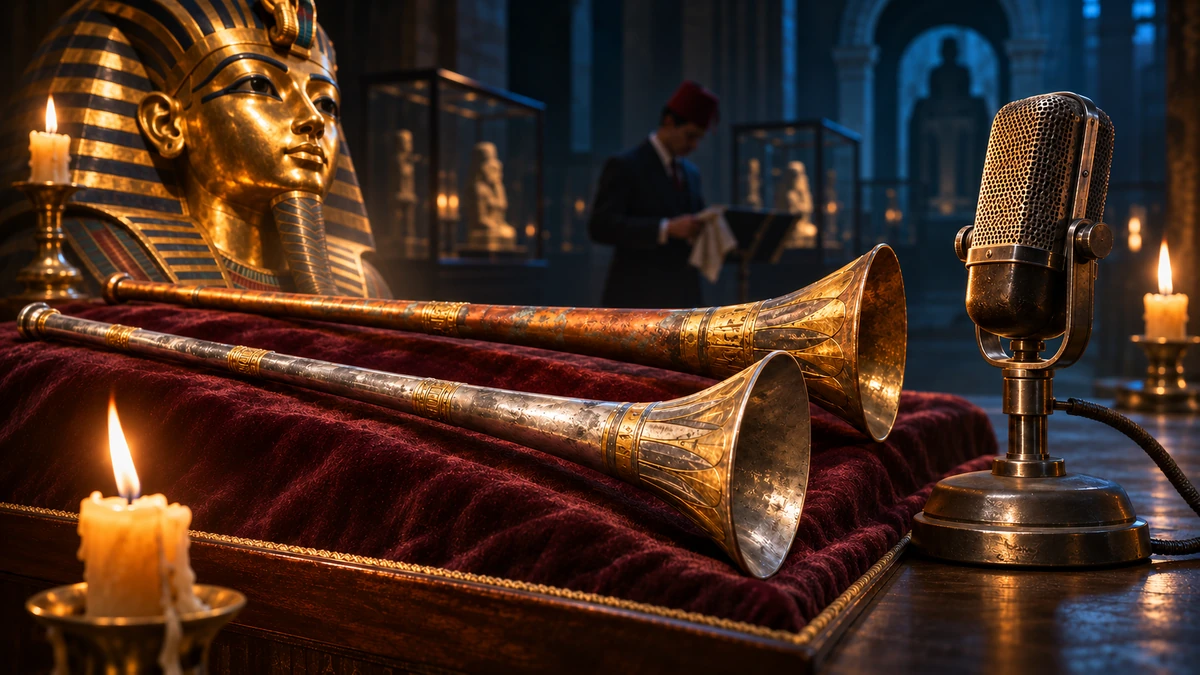
An artistic interpretation linking Tutankhamun's trumpets to the 1939 radio broadcast; not a historical photograph.
Five minutes until the radio broadcast. The lights in the Cairo Museum reportedly went out. Soon afterward, the guards' torches failed as well. Among the display cases and objects from the pharaohs' tombs, only candlelight remained. It was a scene that radio producer Rex Keating later recalled as one of the strangest moments of his career. His account was published as early as 1955, long before the age of social media. [3] [4]
On Sunday, 16 April 1939, the BBC was preparing to introduce the world, in a major radio broadcast, to the sound of two trumpets from the tomb of Pharaoh Tutankhamun. The instruments were more than three thousand years old. One was made of silver; the other was fashioned from a copper alloy and partly gilded. Their journey from tomb to microphone was extraordinary in itself. But the evening was accompanied by difficulties that would later acquire an almost supernatural interpretation. [1] [2] [3]
Just a few months later, the Second World War began. Since then, a story has grown around the trumpets: that their sound foretells wars, brings misfortune, or awakens an ancient curse. Online versions venture even further, invoking the failure of every power station in Cairo, mass panic, and even a lost weapon supposedly known to the ancient Egyptians. What is supported by documents, what comes from eyewitness accounts, and what arose only in the telling?
The answer begins in the tomb, not in front of a radio microphone.
Two Trumpets from the Same Tomb, but Not the Same Room
When Howard Carter discovered Tutankhamun's tomb in the Valley of the Kings in November 1922, its contents offered an exceptionally rare view into life, authority, and funerary customs during ancient Egypt's Eighteenth Dynasty. Among them were two short metal trumpets without valves. Their authenticity is not in question: both survive in archaeological and museum records with specific inventory numbers. [1] [2] [8]

The gilded copper-alloy trumpet was found in the antechamber and is recorded as 50gg in Carter's inventory and JE 62008 in the museum's. The silver trumpet, embellished with gold, was documented in the burial chamber during the 1923–1924 excavation season. Its designations are Carter 175 and JE 62007. The findspots were therefore different. That distinction is intriguing, but by itself it does not prove that the two instruments had strictly separate military and ritual functions. [1] [8]
In one photograph frequently shared with the story, it looks as though two trumpets have been placed side by side. In fact, the photograph shows the silver trumpet and its painted wooden insert. The museum description suggests that the insert may have protected the thin metal from deformation or helped clean the interior. The bronze trumpet also had a wooden insert. Its precise purpose has not been fully established. [2] [13]
Images of Egyptian deities appear on the flared bells of both trumpets, evoking the royal and religious world of the pharaohs. That raises a question which the simple label “military instrument” cannot settle: why were these particular objects placed in a royal tomb? Were they used for ordinary signalling, processions, ceremonies, or several different practices? The evidence supports the importance of trumpets in military and ceremonial settings, but the details of their funerary role remain open. [2] [5] [13]
The Crack of Silver Before the Famous Performance
Before the radio broadcast of 1939, the trumpets had already been the subject of experiments in sound. Music researcher Percival Kirby tested their capabilities during the 1930s. The BBC programme was therefore not literally the first time anyone had played them in three thousand years. It was, however, the great public presentation that carried their sound over the airwaves. [5]
Historical photograph of the trumpet radio broadcast (BBC, 1939)
The BBC broadcast was arranged with the involvement of Rex Keating and the Egyptian Antiquities Service. Alfred Lucas, a conservator who had worked with Carter's excavation team, took part, while the trumpets were played by James Tappern, a British military musician. An audience of 150 million is often cited. That figure is a widely repeated historical estimate of reach, not a precisely measured audience count. [3] [6]
The most dramatic complication occurred before the performance. According to Keating's account, the silver trumpet was so badly damaged during an attempt to play it with a modern mouthpiece that it had to be repaired. Specialist accounts of the incident also point to differences among later retellings: it is not certain that Tappern himself caused the damage, still less that the instrument broke apart during the completed broadcast. The safer historical description is that it was damaged during preparations and repaired before the programme. [3] [5]
Then, according to Keating, the museum lighting failed. The New Zealand Listener recounted this very episode on 27 May 1955: with approximately five minutes remaining before the broadcast, even the guards' torches reportedly went out, and the programme proceeded by candlelight. That does not establish that every power station in Cairo failed. No independent electricity-grid record has been found to support such a citywide blackout. Nor can the sound of the trumpets be said to have caused it: in the sequence that has survived, the difficulties occurred before the instruments were played on air. [3] [4]
Despite everything, the broadcast succeeded. The instruments sounded before radio microphones, leaving a recording that is an exceptional witness both to Egyptian archaeology and to the early age of radio. But what did the listeners actually hear?
Was This Really the Sound Tutankhamun Heard?
Here begins another mystery, much more tangible than a curse. The trumpets are authentic, but the ancient Egyptian method of playing them has not survived in instructions or recordings. Tappern used a modern mouthpiece. With it, he could produce a fanfare closer to the performance tradition of more recent European brass instruments than to any reliably reconstructed music of the pharaoh's court. [3] [5] [11]
Instrument historian Jeremy Montagu has noted that the original instruments offered a fairly limited range of sounds. Discussions of the trumpets refer principally to a small number of natural notes, with a strong middle note likely to have been the most practical for signalling. The museum description of the silver trumpet envisages a signalling system based chiefly on the rhythm of a single note. That is a very different picture from the multi-note fanfare played in 1939. [2] [5] [11]
Interestingly, a BBC historical overview also mentions another performance on the bronze trumpet in 1941, this time without an added modern mouthpiece. The detail matters to the history of the experiments, not to the alleged curse. Above all, it shows that the radio event in 1939 was not the only later reported occasion on which an original instrument was sounded. [6]
So what kinds of signals did the trumpets convey? Might they have been used separately or alternately? Did their different lengths imply a different range of sound or symbolic significance? The physical objects survived. The original conventions governing their use did not. That lost layer of ancient knowledge is one of the most legitimate mysteries we can investigate without appealing to the supernatural.
A Curse Older Than the Radio Recording
The story of Tutankhamun's curse did not begin in April 1939. It was already spreading after the death of Lord Carnarvon in 1923, only a few months after the discovery of the tomb. His death became the occasion for claims that the pharaoh's tomb endangered anyone who disturbed his rest. Historian Roger Luckhurst, however, has pointed out that similar tales about mummies and cursed antiquities were circulating in Victorian times. Tutankhamun's story did not arise in a vacuum; it drew its power from an existing cultural imagination. [9] [10]
We cannot understand such legends merely by asking whether they are true. It also matters why they emerged and why people were so eager to pass them on. A tomb, the death of a young king, sudden illnesses, inaccessible chambers, and mysterious symbols all provided fertile ground for a story in which each new strange occurrence became linked to those before it.
A study published in the British Medical Journal in 2002 compared the lifespans of people potentially exposed to the supposed curse at the opening of the tomb with those of a comparison group. It found no statistically significant association. The study has methodological limitations and says nothing about the sonic power of the trumpets; it is worth mentioning because it actually tested one measurable implication of the wider curse narrative. [14]
By the time the trumpets sounded in 1939, then, the legend was ready. A damaged instrument, extinguished lights, and a later war gave it another chapter.
The Trumpets Said to Foretell Wars
The sequence of events in 1939 is striking: on 16 April, the world heard Tutankhamun's trumpets; on 1 September, Germany invaded Poland. But a gap of five months does not establish a causal link. The instruments could become a symbol or omen in a later narrative without having caused any historical upheaval.
The legend does not end with that year. According to some versions, someone also played a trumpet before the Six-Day War in 1967, the Gulf War in 1991, and the Egyptian revolution of 2011. Interestingly, at least part of the story can be traced beyond anonymous internet posts. On 12 April 2011, Egyptian curator Hala Hassan told Al-Ahram that she attributed magical properties to the trumpet and associated it with those wars. According to her account, a museum employee had also played the instrument about a week before the revolution began. [7]
This is a verifiable account of a belief, not proof that the belief was true. To establish the reported performances before 1967 and 1991, we would need independently dated records, reliable accounts of the circumstances, and comparisons with other periods. Nor do we know every occasion on which the trumpets sounded without a war following. The association remains part of a historically interesting legend, not an established property of the object.
Making that distinction does not destroy the mystery. It shows how genuine testimony, selected coincidences, and the human search for patterns can gradually combine into a narrative that seems to grow ever stronger even while its central conclusions remain unverified.
Forgotten Acoustics or an Ancient Weapon?
Did ancient Egyptian craftspeople understand special effects of sound? They certainly knew how to make thin, carefully shaped metal tubes that could produce a penetrating tone when played correctly. Physics explains how a tube's length, its mouthpiece, the air column, and resonance determine a trumpet's acoustic properties. Investigating ancient instruments is therefore also an investigation into the practical technological knowledge of ancient Egypt. [11] [12]
None of that, however, establishes the existence of a “weapon of mass destruction.” We have no credible historical source, measurement, or repeatable experiment showing that these two trumpets could shut down power stations, cause mass psychological disturbance, or bring down buildings. The claim that people and animals experienced mass panic during the 1939 broadcast is not corroborated by the credible historical reports reviewed.
Accounts of the supposed power of sound also invoke the trumpets at Jericho or the silver trumpets described in the Bible. These are interesting cultural parallels, illustrating the symbolic meanings of sound, warfare, and divine presence. They are not technical documentation for Tutankhamun's instruments. Similar motifs do not demonstrate identical technology.
Being open to future discoveries does not mean declaring every hypothesis equally likely. It means specifying what would have to be discovered or measured for our present assessment to change. In the case of the trumpets, the strongest avenues for research lie in materials, reconstructions, acoustic models, and comparisons with ancient Egyptian depictions.
Theft, Return, and the Legend of Frightened Thieves
During the Egyptian revolution, the story suddenly returned to the headlines. Following the break-in at the Cairo Museum on 28 January 2011, the bronze, partly gilded trumpet JE 62008 was among the missing objects. The silver trumpet JE 62007 was not stolen: it was on exhibition outside the museum at the time. The official museum inventory records the disappearance of the bronze object specifically. [3] [8]
On 12 April, Al-Ahram reported the return of the bronze trumpet along with several other objects. That rules out the popular version in which both trumpets were stolen and quietly returned after exactly two weeks. Approximately two and a half months passed between the disappearance and the public announcement. [7]
There is a separate question surrounding the black bag at Shubra metro station. Al-Ahram described a man who found a statuette of Tutankhamun inside the bag. A later BBC report stated that the trumpet had reportedly also been found in a bag with other antiquities on the Cairo metro. These accounts are related but not entirely identical; without an additional official inventory, we cannot reconstruct the route of every object in minute detail. [3] [7]
A still bolder embellishment claims that the thieves were frightened by the supposed curse and returned the objects for that reason. The reports reviewed contain no verifiable statement from the thieves or other reliable evidence for such a motive. It is a legend that transformed a historical theft into yet another story about the power of the pharaoh's trumpet.
The Recording Remains. But What of the Original Sound?
According to a CNN report published in August 2026, both trumpets are now held at the Grand Egyptian Museum in Giza. They are displayed in controlled conditions, together with their wooden inserts. The fragility of the originals is one reason specialists discourage playing them again. We cannot summon the sound of the past at any cost: an object that has survived three thousand years might be irreparably damaged in the next experiment. [13]
Tutankhamun's trumpets are extraordinary even without supernatural explanations. They bring together ancient Egyptian craftsmanship, royal authority, the development of acoustic knowledge, the history of radio, and the modern culture of legends. From two small metal instruments grew a story that has endured far longer than the broadcast itself. Their greatest mystery may not be whether they once “summoned” a war, but how, when, and why they sounded in the world from which they came.
The failure of the lights is part of the broadcast's history as recounted in surviving testimony. The connection to wars belongs to later lore. The theft in 2011 is documented, but the thieves' alleged fear is not. Between these claims lies room for genuine open questions worthy of research. A mystery loses none of its appeal when we are honest about the limits of the evidence.
Sources and further reading
- Griffith Institute, University of Oxford, Silver trumpet embellished with gold, Carter 175, JE 62007: source Source
- The Global Egyptian Museum, The Silver Trumpet of Tutankhamun, JE 62007: source Source
- Christine Finn, BBC News, Recreating the sound of Tutankhamun's trumpets, 18 April 2011 (available mirror of the BBC page): source Source
- New Zealand Listener, A Flourish of Trumpets, 27 May 1955, p. 4: source Source
- Society of Antiquaries of London, Salon 254: More on Tut's trumpet, 14 February 2020 (specialist interpretations and Keating's account): source Source
- BBC History Revealed, Tutankhamun facts, 5 May 2022: source Source
- Nevine El-Aref, Al-Ahram Online, Missing artifacts from the Egyptian Museum retrieved, 12 April 2011: source Source
- Egyptian Museum / Museums Association, Egypt looted objects, JE 62008, Cairo Museum inventory, 2011: source Source
- University of Manchester / Joyce Tyldesley, 90th anniversary of the curse of Tutankhamen – how a modern myth was born, 5 April 2013: source Source
- Roger Luckhurst, The mummy's curse: a study in rumour, Critical Quarterly 52(3), 2010, DOI 10.1111/j.1467-8705.2010.01948.x: source Source
- Jeremy Montagu, Why Mouthpieces: source Source
- University of New South Wales, Brass instrument (lip reed) acoustics: an introduction: source Source
- Sheena McKenzie, CNN Style, The Egyptian trumpets that lay silent for over 3,000 years, 10 August 2026 (KEYT syndication): source Source
- Mark R. Nelson, The mummy's curse: historical cohort study, BMJ 325, 2002, DOI 10.1136/bmj.325.7378.1482: source Source