The Oldest Musical Instrument in the World
The Neanderthal flute from Divje Babe raises the question of whether Neanderthals made music some 60,000 years ago.
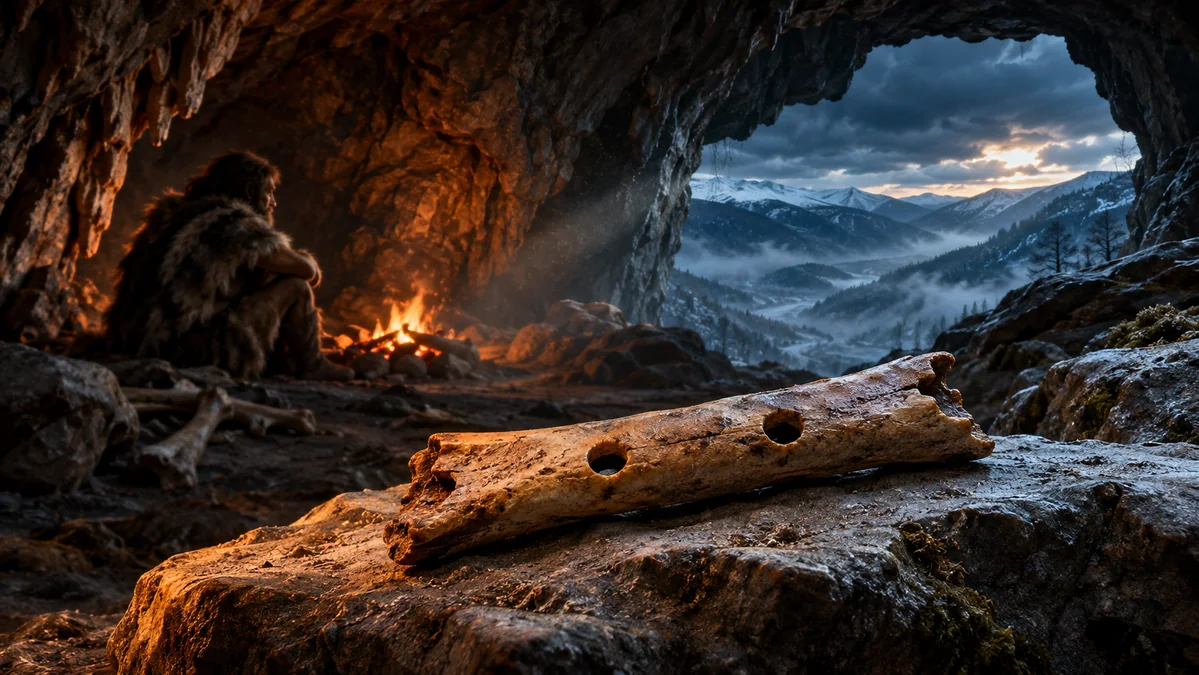
Artistic interpretation of prehistory, not a documentary photograph of the discovery or an exact reconstruction of the bone.
The Neanderthal flute from Divje Babe: a 60,000-year-old discovery that raises one of prehistory's most fascinating questions — were our ancient relatives already making music?
Around 60,000 years ago, the region we now know as Slovenia was very different from the world we inhabit today. Cave bears, large predators, and other Ice Age animals roamed its forests and valleys. Neanderthals, our extinct human relatives, also lived in this environment. They knew how to make tools, use fire, hunt, and cooperate. But could they also create music?
Imagine a Neanderthal sitting beside a fire, holding a hollow animal bone. Rather than discarding it, they make holes in it, raise it to their lips, and attempt to produce different notes. Perhaps the sound draws the attention of others. Perhaps it becomes part of a shared evening around the fire. This is an imagined scene, not a historically documented event.
Yet a genuine archaeological discovery makes such a possibility more than mere fantasy. In 1995, archaeologists discovered a perforated bone from a young cave bear in the Divje Babe cave in western Slovenia, dating back approximately 50,000 to 60,000 years. The National Museum of Slovenia presents it as the Neanderthal flute and the oldest known musical instrument in the world.
If this interpretation is correct, the discovery suggests that musical creativity was not exclusive to anatomically modern humans. It may have been part of Neanderthal life much earlier than previously believed. But behind this extraordinary claim lies a difficult question: were the holes in the bone really made by human hands?
A Cave That Preserved a Mystery for Almost 60,000 Years
The Divje Babe I cave lies beneath the northern edge of the Šebrelje Plateau, approximately 230 metres above the Idrijca River valley. During the last Ice Age, it served primarily as a den for cave bears. Over thousands of years, their remains accumulated inside the cave, mixed with sediments, stone artefacts, and traces of occasional human visits.

Archaeological excavations uncovered a sequence of sediment layers more than twelve metres deep, offering researchers a glimpse into the cave's long history. During excavations led by Slovenian archaeologist Ivan Turk, an unusual bone was uncovered on 18 July 1995. The object was found in a Middle Palaeolithic, or Mousterian, layer associated with Neanderthals, close to the remains of a hearth.
It was an 11.4-centimetre-long fragment of the left femur of a young cave bear, approximately one to two years old. Two complete holes were preserved in the bone. Additional traces led researchers to conclude that two more holes had originally been present, although they now survive only partially. This distinctive feature was crucial.
What appeared to be an ordinary animal bone began to look like something more than a chance remnant of life in the cave. It resembled an object that could have been used to produce sound. But resemblance is not proof.
How Was Its Age Determined?
The discovery does not carry a date, and nobody can simply count the years it has spent buried in the ground. Archaeologists establish its age by examining the layer in which it was found and applying different dating methods to associated material. At Divje Babe, researchers used radiometric dating techniques, including electron spin resonance analysis of cave bear teeth.
According to more recent findings, the layer containing the famous bone was deposited approximately 50,000 to 60,000 years ago. This places the object within the period when Neanderthals inhabited the region. It is also significant that stone tools characteristic of Neanderthal culture were discovered in the same archaeological layer.
The archaeological context therefore securely associates the bone with the period of Neanderthal occupation. By itself, however, it does not establish that Neanderthals made the holes. Reaching that conclusion requires an investigation into how the damage originated.
Were the Holes Made by Neanderthals or Animal Teeth?
This is the central question surrounding the entire discovery. Soon after the find, researchers developed two main explanations. According to the first, Neanderthals deliberately perforated the bone using stone and bone tools. According to the second, the holes resulted from the bites of large carnivores feeding on cave bear remains.
In 1998, Francesco d'Errico, Paola Villa, and their colleagues published a comparative study of damage to cave bear bones. They pointed out that the teeth of predators can produce openings resembling those found on the Divje Babe specimen. In 2015, Cajus Diedrich proposed a further explanation suggesting that perforated bones could have resulted from the feeding activities of prehistoric hyenas.
However, researchers supporting a Neanderthal origin identified problems with such comparisons. Among other approaches, they examined how bone responds to impacts from pointed stone tools and bone punches, and whether these implements could produce holes of comparable shape. Experiments demonstrated that this was possible. Other investigations attempted to establish whether animal teeth could account for all the observed damage without causing the bone to crack or fracture in other ways.
Yet three important distinctions must be maintained. Demonstrating that a particular hole can be made with a stone tool does not establish that it was actually produced in that way. Showing that an animal tooth can cause similar damage does not prove that it created this particular opening. And even if the holes were shown to be the result of deliberate modification, the original purpose of the object would still need to be explained separately.
The scientific question, therefore, is not which interpretation is more appealing, but which one best accounts for the full body of surviving evidence.
What Did Computed Microtomography Reveal?
An important step forward came with a study published in the scientific journal Archaeometry in 2012. Claudio Tuniz, Federico Bernardini, Ivan Turk, Ljuben Dimkaroski, and their colleagues examined the object using X-ray computed microtomography. This technology makes it possible to construct a three-dimensional view of the bone's internal structure without physically damaging the valuable artefact.
The analysis supported the conclusion that four holes had originally been present. It also indicated that some surface modifications previously associated with carnivore bites could have occurred after the bone had been deposited in sediment. Researchers additionally observed a surface modification near one of the holes that might have been related to preparing the bone for perforation.
Their conclusion was important, but cautious: the possibility that Neanderthals manufactured the object could not be excluded. In 2020, Matija Turk, Ivan Turk, and Marcel Otte published a comprehensive review of the research conducted up to that point in the journal Applied Sciences. They defended the interpretation of the object as a deliberately manufactured musical instrument, highlighting experimental, archaeological, and musical arguments in its favour.
Nevertheless, the alternative explanation involving animal-inflicted damage remains part of the scientific literature. It is therefore essential to distinguish between the position of the National Museum of Slovenia, which identifies the object as a Neanderthal musical instrument, and the broader scientific debate, in which that conclusion is not universally accepted.
An Instrument That Can Still Be Played Today
One of the most fascinating aspects of the research began with the creation of replicas. If the perforated bone really was a musical instrument, the next question is what sounds it might have produced. Early acoustic experiments were conducted by Drago Kunej and Mira Omerzel - Mirit. Another important step was taken by musician Ljuben Dimkaroski, who, in collaboration with Ivan Turk, experimented with reconstructions featuring four holes.
The orientation of the instrument proved particularly important. In this reconstruction, three holes are operated with the fingers, while a fourth, on the opposite side of the bone, can be opened and closed with the palm. The reconstruction also incorporates a mouthpiece shaped according to an interpretation of the bone's surviving edge.
The results of the musical experiments were surprising. The reconstructed instrument could produce a variety of notes, transitions, and playing techniques also familiar from modern wind instruments. Dimkaroski achieved a tonal range of approximately three and a half octaves on the reconstructed object. That is a remarkable capability for such a small wind instrument.
Research was later continued by musician Boštjan Gombač. On 8 February 2025, he played a replica created with the aid of a precise three-dimensional model at the opening of the European Capital of Culture Nova Gorica–Gorizia, and subsequently performed on it again at the opening of the museum exhibition that June. But an essential limitation remains.
The reconstructed instrument is the result of a modern research process. Missing sections have been recreated according to assumptions about the object's original shape and use. Demonstrating that a replica can be played is not direct evidence that someone played the original bone in the same way 60,000 years ago. Nor do acoustic experiments reveal what melodies, rhythms, or musical traditions its possible prehistoric users might have known.
They tell us something different: the object's shape is compatible with musical use and allows a surprisingly wide variety of sounds to be produced. This constitutes an important argument in the debate over its purpose, but not a definitive resolution.
Are the Other Oldest Musical Instruments Really Much Younger?
Among the most convincingly established prehistoric flutes are discoveries from caves in the Swabian Jura region of present-day Germany. One particularly well-known example is the flute from Hohle Fels cave, made from the bone of a large bird. Instruments made from bird bones and mammoth ivory have also been discovered in nearby caves.
These instruments date back approximately 35,000 to 40,000 years, while some studies of the associated archaeological layers suggest somewhat earlier dates. Unlike the Divje Babe object, these instruments are much more widely accepted within the scientific community as deliberately manufactured musical instruments. They are associated with early anatomically modern humans.
If the Divje Babe flute really is a musical instrument, it represents substantially earlier evidence of musical creativity. However, we must not confuse the age of surviving instruments with the age of music itself. Humans, or their relatives, may have sung, clapped, struck objects, or created rhythmic patterns long before these instruments were made.
Such activities generally leave no archaeological traces that can be identified unambiguously. We therefore do not know when the first music emerged. We know only how far back in time the material traces of its existence discovered and interpreted so far extend.
Neanderthals Were Not Devoid of Creativity
Our understanding of Neanderthals has changed considerably over recent decades. In the past, they were often depicted in popular culture as crude, clumsy, and intellectually limited beings. We now know that this image was deeply oversimplified. Neanderthals manufactured specialised tools, understood different materials, used fire, and cooperated in demanding everyday activities.
Certain archaeological discoveries also point to behaviour that may be associated with symbolic thought and cultural expression. But our understanding of their abilities is not changing because we would like them to resemble us more closely. It is changing because of new evidence. The discovery from Divje Babe belongs to this very story of scientific investigation.
If Neanderthals really did deliberately manufacture musical instruments, it would mean that they knew how to shape materials to produce controlled sounds. Such an activity might have required knowledge, creative planning, and experience passed between individuals. Whether music served entertainment, community bonding, communication, or ritual purposes among them remains unknown.
Another important distinction is necessary here. Musical creativity may form part of cultural and symbolic life, but it does not, by itself, prove the existence of religious beliefs or a particular spiritual understanding of the world. We cannot reconstruct the inner world of Neanderthals from a single bone. But we can use it to investigate whether their world was more creative and culturally rich than we long assumed.
This question deserves serious investigation, regardless of what the final answer about the origin of the holes may be.
A Slovenian Discovery of Global Importance
The Neanderthal flute is now one of the most recognisable objects of Slovenia's archaeological heritage. It is held by the National Museum of Slovenia in Ljubljana, where it is presented as an artefact of global significance. In 2025, to mark the thirtieth anniversary of its discovery, the museum organised the exhibition The Neanderthal Flute – 60,000 Years of Music, presenting archaeological evidence, technological research, reconstructions, and musical experiments.
The exhibition ran from 26 June 2025 to 8 February 2026. The significance of the discovery extends beyond the possibility of it holding the record as the world's oldest musical instrument. It also lies in the fact that a small object from a Slovenian cave sparked an international scientific debate spanning archaeology, the study of animal remains, acoustics, experimental instrument-making, and research into the development of human culture.
Discoveries like this remind us how few direct traces remain of the lives of our ancient relatives. And how much a single bone can reveal when we ask the right questions.
Did Music Echo Through Divje Babe 60,000 Years Ago?
Let us return to the imagined scene from the beginning. A Neanderthal sits beside a fire, holding a perforated bone. They raise it to their lips, and sound spreads through the cave. Did this really happen? We do not know.
Perhaps the holes were deliberately manufactured, and the bone truly was a musical instrument. Perhaps they were the result of damage that occurred without human intervention. Supporters of both explanations have presented scientific arguments, and the research has grown increasingly precise over the decades. But even if the bone is eventually established as a genuine musical instrument, we will not know what melodies Neanderthals played, when they played them, or what music meant to them.
Their voices have fallen silent. Their stories were never written down. Most of their everyday and cultural lives have disappeared without direct traces. What remains are stone tools, hearths, animal bones, and a handful of objects whose meaning we are still trying to understand. Among them is the small, perforated bone from Divje Babe.
At first glance, it seems modest, almost insignificant. But viewed through the lens of archaeological research, it becomes an extraordinary reminder of the limits of our knowledge of the past. If it was a flute, it may be among the oldest surviving evidence of Neanderthal musical creativity. If it was not, it remains an important example of how difficult it can be to distinguish natural damage from traces of deliberate manufacture.
Either way, it teaches us something important. We should not underestimate the past simply because so little of it has survived. The absence of surviving songs does not mean that prehistoric life was without music. And the absence of a definitive answer does not mean that a question is not worth asking.
Perhaps that is precisely why the Divje Babe discovery speaks so powerfully to our imagination. After almost 60,000 years, it still invites us to listen to a world from which not a single direct record of a melody has survived.
Sources and further reading
- National Museum of Slovenia. Neanderthal Flute – The Oldest Musical Instrument in the World. Official museum presentation of the discovery, its origin, age, and interpretation. Source 1 Source 2
- National Museum of Slovenia (2025). The Neanderthal Flute – 60,000 Years of Music. Documentation of the exhibition marking the thirtieth anniversary of the discovery. Source 1 Source 2
- Turk, M., Turk, I., Otte, M. (2020). The Neanderthal Musical Instrument from Divje Babe I Cave (Slovenia): A Critical Review of the Discussion. Applied Sciences, 10(4), 1226. Source
- Tuniz, C. et al. (2012). Did Neanderthals Play Music? X-ray Computed Micro-tomography of the Divje Babe ‘Flute’. Archaeometry, 54(3), 581–590. Source
- D'Errico, F., Villa, P., Pinto Llona, A. C., Ruiz Idarraga, R. (1998). A Middle Palaeolithic Origin of Music? Using Cave-bear Bone Accumulations to Assess the Divje Babe I Bone ‘Flute’. Antiquity, 72(275), 65–79. Source
- Diedrich, C. G. (2015). ‘Neanderthal Bone Flutes’: Simply Products of Ice Age Spotted Hyena Scavenging Activities on Cave Bear Cubs in European Cave Bear Dens. Royal Society Open Science, 2(4), 140022. Source
- Conard, N. J., Malina, M., Münzel, S. C. (2009). New Flutes Document the Earliest Musical Tradition in Southwestern Germany. Nature, 460, 737–740. Source
- Turk, M., Bastiani, G. (2020). Experimental Research on the Neanderthal Musical Instrument from Divje Babe I Cave (Slovenia). EXARC Journal, Issue 2020/3. Experimental research into hole-making techniques and the instrument's musical capabilities. Source