The Book of Veles — Lost Slavic Heritage or a Modern Myth?
The story of mysterious wooden tablets, Slavic gods, forgotten ancestors, and one of the most controversial texts in Slavic cultural history.
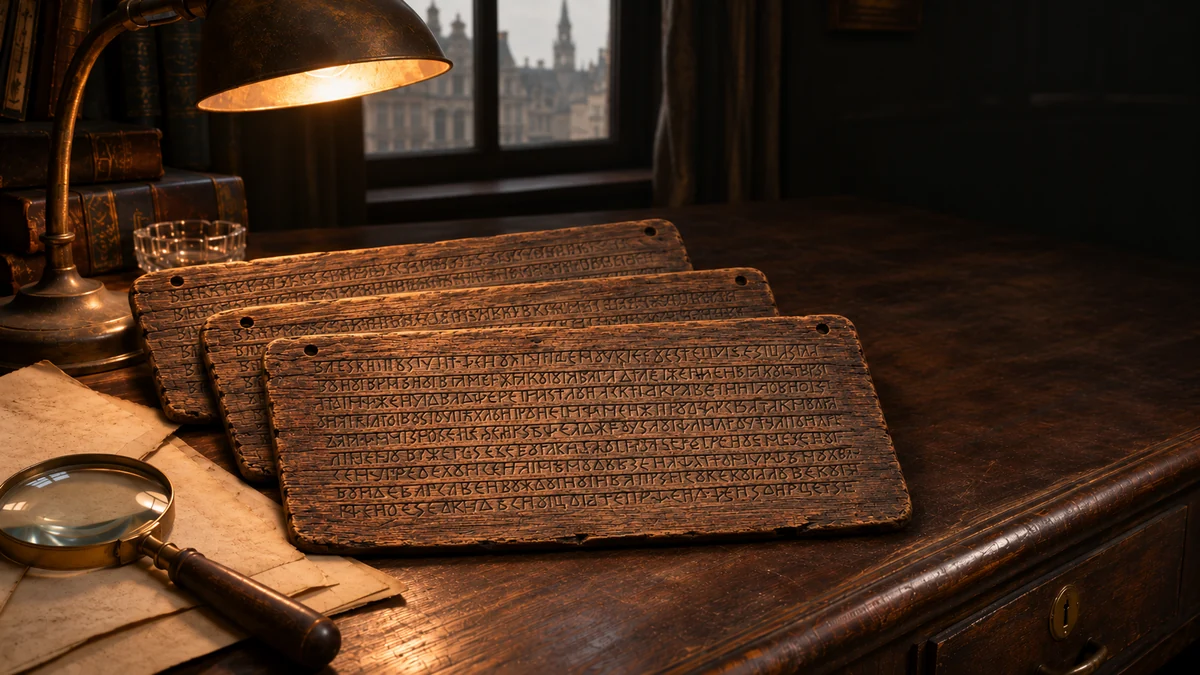
Artistic reconstruction of the alleged wooden tablets of the Book of Veles. The originals have not survived.
The Mystery of the Wooden Tablets
Imagine a discovery that could transform our understanding of Slavic history. A collection of wooden tablets inscribed with unusual Slavic characters. A text describing gods, ancestors, migrations, and wars centuries before the Christianization of the Slavs. A testimony seemingly preserving the voices of people whose ancient religious traditions are now known only through scattered written accounts, archaeological discoveries, and folk narratives. This is precisely the kind of discovery the Book of Veles was claimed to represent.
According to the account later presented by its supporters, Fyodor Izenbek, a colonel in the Russian White Army, supposedly discovered a collection of wooden tablets bearing unusual characters on a devastated noble estate in 1919. He allegedly took them abroad while fleeing revolutionary Russia. The tablets eventually reached Brussels, where a Russian émigré named Yuri Mirolyubov became acquainted with them. Mirolyubov claimed to have spent approximately fifteen years transcribing their contents. The tablets supposedly contained accounts of Slavic history, religious beliefs, migrations, and struggles for survival. After Izenbek's death in 1941, the tablets reportedly disappeared. Only the transcriptions were said to have survived.
If the text were genuinely more than a thousand years old, it would represent an extraordinary historical source. No extensive collection of original pre-Christian Slavic religious texts comparable to certain ancient Indian or classical literary monuments has survived. But serious problems arise at the very beginning of the discovery story. None of the alleged wooden tablets is available for scientific examination today. There is no reliably documented findspot, no independent material analysis, and no continuous chain of evidence connecting the supposed discovery with the surviving transcriptions. The earliest verifiable public references to the text date only to the 1950s.
In November 1953, the Russian émigré magazine Zhar-ptitsa (The Firebird), published in San Francisco, reported the alleged existence of the tablets. Over the following years, individual passages, commentaries, and a reproduction presented as an image of one of the tablets appeared. More extensive publication of the transcriptions began in 1957. More than thirty years therefore passed between the alleged discovery and the text's public introduction. Is this the story of a lost ancient document whose original disappeared amid the upheavals of war? Or is it the story of a more recent work presented as a testimony from the distant past? The answer cannot be found merely in the appeal of its contents. We must examine the evidence.

What Does the Book of Veles Actually Say?
The Book of Veles is not a conventional historical chronicle. Nor is it a consistently organized collection of prayers or a systematically written religious doctrine. Its contents combine mythology, ancestral narratives, supposed history, moral teachings, political messages, and descriptions of rituals. Modern editions generally organize the surviving textual corpus into numbered groups from 1 to 38, with many passages divided into additional sections and fragments. This numbering reflects the history of the transcriptions and their subsequent editorial arrangement. It does not prove that exactly 38 complete wooden tablets once existed.
The text describes legendary ancestors, particularly Bogumir and Oriy. Their descendants are associated with the emergence of Slavic tribes, migrations, and the founding of settlements. The narratives range across distant lands, the Carpathians, the Dnieper basin, and the territory of the future Kyivan Rus’. They mention Goths, Huns, Khazars, Avars, Greeks, and Varangians, along with numerous conflicts in which the alleged ancestors defended their land. Yet history is only one layer of the narrative. Another is religion.
The gods help people in their work, protect livestock, bring rain, accompany the Sun, and safeguard warriors. Ancestors remain connected with their descendants, while death is not presented as the final end of existence. A third layer is moral. The Book of Veles repeatedly emphasizes communal unity. Discord, greed, and unjust rule are portrayed as dangers capable of destroying even a powerful people. The land is more than territory. It is a place of life and an inheritance from the ancestors, for which the community bears a special responsibility. These messages give the text its distinctive character.
However, readers must distinguish between two questions: what the narrator says and whether the events described actually happened. A story may be culturally or philosophically interesting without being a reliable historical record.
Veles, Perun, and the Forgotten Slavic Gods
Among the most fascinating aspects of the Book of Veles are its accounts of deities. These include Veles, Perun, Svarog, Dazhbog, Triglav, Svetovid, and numerous other names. Some of these deities are independently attested in historical sources. Veles, also known as Volos, appears in the medieval East Slavic tradition, particularly in connection with livestock, wealth, and oaths. Perun is associated with thunder and divine power. His name also appears in early chronicle accounts of political treaties between the Rus’ and the Byzantines. Both are important to the study of pre-Christian religious beliefs among the Eastern Slavs.
Dazhbog appears in the medieval literary tradition, while Triglav is historically documented primarily among certain Western Slavic communities, especially in Pomerania. These names, therefore, did not originate with the Book of Veles. However, their historically attested characteristics do not always correspond to the roles assigned to them in its narrative. In the Book of Veles, Veles is also portrayed as a teacher of agriculture, Svarog as a divine ancestor, Perun as the protector of warriors, and Dazhbog as a source of life, light, and fertility. Numerous deities are incorporated into a relatively elaborate religious system. This is precisely where caution is necessary.
The pre-Christian Slavs did not form a politically and religiously uniform community. Different regions had different cults, customs, and local traditions. The surviving historical sources do not allow us to reconstruct a single pantheon that operated identically throughout all Slavic lands without significant qualifications. Consequently, the historical existence of Perun or Veles does not validate every narrative in which they appear. A later author could also have learned their names from medieval chronicles, folk traditions, or published historical research. The authenticity of an individual ancient motif is not proof of the authenticity of an entire text.
This is one of the most important principles in studying the Book of Veles.
Prav, Yav, and Nav — Three Worlds?
One of the most recognizable concepts in the Book of Veles is the triad of Prav, Yav, and Nav. In modern interpretations, it is frequently presented as the foundation of an ancient Slavic understanding of the universe. Prav is said to represent divine order and the laws governing creation. Yav is understood as the manifest world in which human beings live. Nav is associated with the dead and the afterlife. This division offers a relatively structured picture of existence in which divine order, earthly life, and the realm of the departed are interconnected. But how ancient is this system? The individual terms have older Slavic linguistic roots. Nav is particularly interesting.
In Slovenian, the word navje denotes a mythological dwelling place of the dead and, in older usage, a cemetery, according to the Dictionary of the Slovenian Standard Language. Pleteršnik's historical dictionary also points to the Old Church Slavonic navь, associated with the deceased. This is a genuine linguistic trace of older Slavic conceptions of death. However, the history of an individual word is not the same as the history of an entire religious system. At present, there is no reliable medieval source independently describing Prav, Yav, and Nav as three precisely defined levels of a unified pre-Christian Slavic cosmology.
Older ideas about heaven, earth, and the afterlife are a separate matter. They have foundations in folklore, linguistics, and comparative mythology. Yet these ideas cannot automatically be equated with the Prav–Yav–Nav system. In the form commonly encountered today, that system is closely associated with the Book of Veles and modern interpretations of Slavic spirituality. Resemblances to older concepts are interesting, but they do not establish direct continuity.
Bogumir, Oriy, and the Supposed History of the Slavic Ancestors
The Book of Veles also attempts to answer the question of where the Slavic peoples originated. Bogumir and Oriy occupy particularly important places in its ancestral narratives. Bogumir is presented as a legendary ancestor whose descendants supposedly gave rise to various Slavic tribes. The names of his daughters and sons are associated with peoples such as the Polans, Drevlians, Severians, and Rus’. Many cultures preserve similar narratives. These are known as etiological myths: stories that attempt to explain the origin of a place, people, name, or custom. But a resemblance between the name of an alleged ancestor and the name of a people does not prove that such a person actually lived.
Another important figure is Oriy, who supposedly led his descendants during migrations toward the Carpathians and the Dnieper. His story is also associated with Kyi, Shchek, and Khoryv, who appear in the medieval chronicle tradition concerning the foundation of Kyiv. This raises the question of textual dependence. Does the Book of Veles independently preserve an older version of the story? Or did its compiler know the account in the Primary Chronicle and reshape it? Without reliable evidence for the age of the Book of Veles, its narrative cannot be used as independent confirmation of these events. The same problem applies to references to historical peoples.
The Goths, Huns, Khazars, and Avars genuinely existed. They are known from various written, archaeological, and linguistic sources. But this does not mean that all the battles and migrations described in the Book of Veles actually took place. An author can incorporate real names and places into a historical narrative without making its events verifiable. Further difficulties arise from unusual chronological statements, interpreted differently by translators, and narratives that are difficult to reconcile chronologically. The Book of Veles is therefore interesting as a text presenting a particular vision of Slavic history, but it is not a reliable chronicle of the earliest Slavic periods.
Rituals, Sacrifices, and Life After Death
The religious passages of the Book of Veles contain numerous descriptions of everyday life. People praise the gods at sunrise, cultivate fields, tend their herds, offer agricultural produce, and preserve the memory of their ancestors. Some passages mention a ritual drink called suritsa, associated with honey, herbs, and sunlight. Other passages contain prayer-like texts that modern editors associate with Perun, Dazhbog, and Ognebog, a deity associated with fire. However, their exact wording and division cannot always be reliably reconstructed. Some transcriptions are difficult to interpret, and word boundaries were established only by later editors.
The Realm of the Ancestors
A particularly important theme is the conception of life after death. The text describes heavenly meadows where the deceased are reunited with their ancestors. There are pastures, herds, green landscapes, and an existence free from earthly suffering. Veles also appears as a guardian of herds. Such imagery can be compared with numerous religious and mythological visions of a blessed afterlife. There are also various historical accounts of funerary rituals, ancestor veneration, and beliefs concerning the dead among Slavic communities. However, there is no reliable independent early medieval confirmation of the particular image of Svarog's heavenly meadows.
We can therefore examine it as part of the religious world of the Book of Veles, but not as a directly verified description of ancient Slavic beliefs.
Did the Slavs Practice Human Sacrifice?
In some passages, the Book of Veles rejects human sacrifice, while elsewhere it also rejects animal sacrifice. Instead, it emphasizes offerings of agricultural produce, milk, honey, and ritual drinks. This presents a community whose religion supposedly found expression primarily through nonviolent offerings. However, independent historical accounts paint a more complicated picture. The Byzantine historian Procopius reported in the sixth century that the Slavs and Antes sacrificed cattle and other animals. The Primary Chronicle, under the year 983, contains an account of human sacrifice in Kyiv, associated with the fate of a Christian Varangian and his son.
It must be remembered, however, that this chronicle narrative is also structured as an account of Christian martyrdom. It is not a direct, impartial description of ritual practice. Other medieval authors also report human sacrifices among certain Western Slavic communities. Individual accounts cannot legitimately be generalized to all Slavs. Nor can they simply be dismissed on the basis of statements in the Book of Veles. An accurate historical assessment is therefore more demanding than either of two extreme claims: that all Slavs practiced human sacrifice or that no Slavic community ever practiced it. In this respect, the Book of Veles primarily presents a moral image of its own people.
That self-representation deserves study, but it must not be confused with established historical fact.
Why Do Scholars Reject the Authenticity of the Book of Veles?
The question of authenticity cannot be resolved by considering whether the narratives seem attractive, convincing, or similar to older traditions. It requires an examination of provenance, material evidence, language, and the surviving textual versions. These are precisely the areas where researchers have identified the most serious problems.
The Original Tablets Are Missing
None of the alleged wooden originals is available for direct examination. It is therefore impossible to determine the age of the wood, study how the characters were inscribed, or examine potential traces of aging and use. The loss of an original does not, by itself, prove forgery. History contains many works preserved only through later copies. But the absence of the originals is not the only problem with the Book of Veles.
The Disputed Photograph of Tablet 16
In 1960, the palaeographer and linguist Lidia Zhukovskaya analyzed a reproduction presented as a photograph of one of the wooden tablets. She identified characteristics of the writing that, in her assessment, were more consistent with a paper transcription or drawn copy than with a direct photograph of characters carved into wood. This did not prove that the wooden tablets had never existed. Her research did, however, demonstrate that the published reproduction could not be considered reliable material evidence of their authenticity.
Linguistic Irregularities
Linguistics provides one of the strongest arguments against the text's claimed antiquity. The Book of Veles combines forms characteristic of different Slavic languages, historical periods, and orthographic traditions. The problem is not simply that its language is unusual. A genuinely ancient and otherwise unknown dialect could contain features absent from other surviving sources. But we would still expect its phonological and grammatical system to be relatively consistent. Oleg Tvorogov documented numerous irregularities in declension, verb forms, the representation of sounds, and the use of different linguistic features. These difficulties are not limited to a handful of selected words.
They occur throughout much of the corpus and are difficult to explain as the consistent historical development of a single Slavic language. This strongly supports the interpretation of an artificially archaized language.
The Different Versions Do Not Agree
Tvorogov compared Mirolyubov's typescripts, the publications in Zhar-ptitsa, and later editions. He identified differences in word division, spelling, line boundaries, and, in some places, the actual content. Particularly problematic are passages presented as damaged or illegible in one version but as readable text in another. Such differences can also arise when an authentic text is copied. However, their frequency, character, and relationship to the alleged arrangement of characters on wooden tablets demand a convincing explanation. Since the originals are missing, it is impossible to verify which version is correct.
Similarities to Earlier Literary Works
The Book of Veles also uses expressions and motifs familiar from other published historical and literary texts. Particularly interesting are parallels with the medieval Tale of Igor's Campaign, including the motif of Dazhbog's descendants and the mention of the Kayala River. Individual similarities may derive from a broader tradition. But when several rare and distinctive expressions appear together, the possibility of direct literary borrowing must also be investigated. These difficulties reinforce one another. The absence of originals alone is not proof of fabrication. Nor is an individual unusual word.
But the history of the text's public appearance, its linguistic irregularities, the discrepancies between transcriptions, and its literary parallels together form a strong pattern of evidence. For these reasons, most scholars regard the Book of Veles as a modern forgery presented as an ancient document.
Who Might Have Written the Book of Veles?
The central figure in the history of the text's transmission is Yuri Mirolyubov. According to his own account, he transcribed the alleged wooden tablets in Brussels. His material later became the basis for numerous publications and translations. But Mirolyubov was not merely a copyist. He also explored Slavic mythology, the supposed prehistoric origins of the Rus’, and comparisons with the ancient Indian Vedic tradition. Researchers have observed that some unusual names of deities and religious concepts found in his other works also appear in the Book of Veles. This raises the possibility that he was directly involved in composing the text. Tvorogov argued for precisely this interpretation.
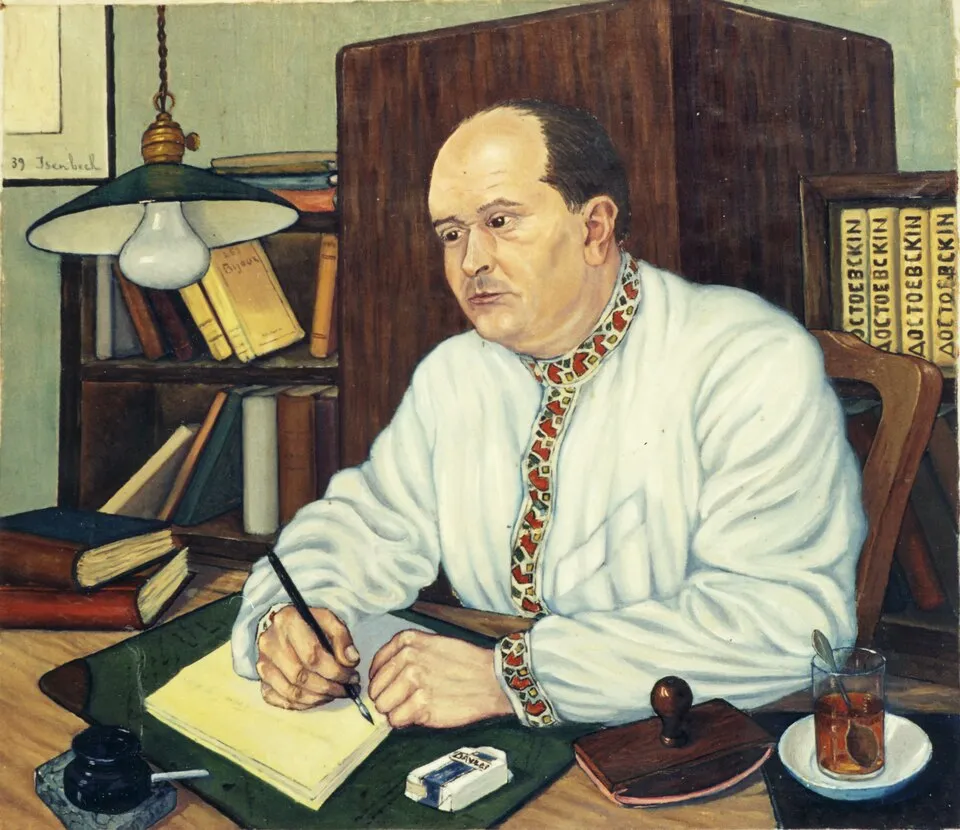
However, the exact history of the entire corpus cannot be fully reconstructed. It would therefore be unjustified to claim without qualification that the author of every line has been conclusively identified.
What Do Supporters of Authenticity Argue?
Some authors propose alternative explanations. The Ukrainian linguist Valentyn Taranets, for example, suggested that the linguistic diversity of the text reflects different dialectal and chronological layers of an older oral tradition. Such a hypothesis can be investigated. However, it must explain not only individual linguistic forms but also the broader grammatical structure, the history of the transcriptions, the disappearance of the alleged originals, and the circumstances of the first publications. The possibility of an older oral tradition is not, by itself, proof that the surviving written version was composed in the Middle Ages. Alternative explanations have not satisfactorily resolved these problems.
Why Would Someone Create Such a Text?
It is possible that the Book of Veles is connected with a search for historical roots and cultural identity within Russian émigré circles. Following the revolution, civil war, and loss of their homeland, questions of shared history acquired particular significance for many emigrants. The Book of Veles repeatedly emphasizes remembrance of ancestors, the threat of foreign domination, the loss of the homeland, and the need for unity. This correspondence is interesting as a historical and literary interpretation. But it does not allow us to draw reliable conclusions about the personal motives of the possible author. It remains a hypothesis, not an established fact.
The Book of Veles and Slovenian Mythological Heritage
The Book of Veles is also a subject of interest for Slovenian readers. Some of its narrative motifs can be compared with Slovenian folk traditions. However, these connections carry different levels of evidential value.
Kresnik and the Battle with the Dragon
Slovenian tradition includes Kresnik, a supernatural hero associated with fire, storms, fertility, and conflict with a dangerous adversary. In some narratives, he fights a dragon or serpent-like creature. The Book of Veles likewise contains a story about a dragon and the divine forces that defeat it. The Slovenian researcher Zmago Šmitek demonstrated that the Kresnik tradition has significant parallels with broader Indo-European mythological motifs. Yet a resemblance between narrative patterns does not prove the authenticity of the specific story in the Book of Veles. It merely shows that similar motifs can be independently studied across different traditions.
Navje and the World of the Dead
The Slovenian word navje is a particularly important linguistic parallel. Its historical attestation confirms that certain words resembling expressions in the Book of Veles have older Slavic roots. However, it does not confirm the complete doctrine of Prav, Yav, and Nav.
Triglav — Mountain and Deity
Triglav is the name of Slovenia's highest mountain and also that of a historically attested Western Slavic deity. But the identical name does not prove that the Slovenian mountain was dedicated to this god. Such an interpretation would require independent historical or archaeological evidence. The name alone is not enough.
Mythological Landscapes
Slovenian folk traditions contain stories about sacred mountains, springs, trees, special places, and boundaries between the worlds of the living and the dead. Comparable motifs are found in the Book of Veles. But Slovenian traditions have their own documented history of recording and research. Similar caution is necessary when considering material concerning traditional beliefs reported from the Soča Valley, whose historical interpretation remains the subject of scholarly debate. Superficial similarities between different traditions do not establish that they are identical. This is precisely why independent Slovenian sources are valuable.
They allow us to investigate older Slavic motifs without having to accept the historically disputed Book of Veles as evidence of their existence.
Lost Heritage or a Modern Myth?
The Book of Veles is compelling primarily because it promises something that the surviving historical sources do not provide: an extensive account of Slavic life, gods, and religious beliefs before Christianization. Its stories concern ancestors, freedom, land, communal unity, and humanity's place in nature. These themes can still resonate with readers today. But the question of historical authenticity requires different standards from the question of personal or spiritual significance. The available evidence does not support the claim that we possess an authentic surviving book from the ninth century.
The alleged wooden tablets are not available for examination. The history of their discovery has not been independently verified. The earliest verifiable public references to the text date from the twentieth century, while linguistic and textual research strongly supports a modern origin. In this respect, the prevailing scholarly assessment is clear. Yet this does not mean that the book lacks cultural significance. It contains historically attested Slavic deities, real peoples, and motifs with parallels in older traditions. The Book of Veles has also influenced modern ideas about Slavic history, religion, and identity.
For some communities associated with Slavic Native Faith, or Rodnovery, it has become an important spiritual text. This influence can be studied independently of whether the alleged wooden tablets ever existed. Its lack of historical authenticity does not erase the personal significance it may hold for individual readers. But personal significance is not evidence of a text's age. The most important task of research is therefore not to choose between completely accepting and completely rejecting everything the book contains.
It is more important to understand which elements have an older historical background, which derive from folk traditions, and which most likely emerged through more recent reinterpretations of the past. Authentic Slavic heritage is rich enough that it does not need to be supported by unproven claims. It survives in languages, archaeological discoveries, medieval records, place names, customs, and folk narratives. This is the heritage that deserves careful and responsible investigation. Respecting our ancestors does not mean accepting every story about them as historical truth. It also means respecting their past enough to try to understand it as it actually was — rather than only as we might wish it to have been.
Sources and further reading
- Tvorogov, Oleg V. (1990). Влесова книга (The Book of Veles). Trudy Otdela drevnerusskoy literatury, vol. 43, pp. 170–254. Critical study and text edition. Source
- Zhukovskaya, Lidia P. (1960). Поддельная докириллическая рукопись (К вопросу о методе определения подделок) (A Forged Pre-Cyrillic Manuscript: On the Method of Identifying Forgeries). Voprosy yazykoznaniya, no. 2, pp. 142–144.
- Alberti, Alberto (2023). Księga Welesa (The Book of Veles). In Marcello Garzaniti (ed.), Słowianie. Historia, kultury i języki. Łódź: Wydawnictwo Uniwersytetu Łódzkiego, p. 71. University record. Source
- Kotlyar, Mykola F. (2003). Велесова книга (The Book of Veles). In Енциклопедія історії України (Encyclopedia of the History of Ukraine), vol. 1. Kyiv: Naukova Dumka. Ukrainian historical encyclopedia. Source
- Taranets, Valentyn H. (2015). Велесова книга (історико-лінгвістичне дослідження) (The Book of Veles: A Historical and Linguistic Study). Odesa: KP OMD. An alternative linguistic interpretation. University repository. Source
- Gnatyuk, Valentin and Yulia (translation and commentary, 2011). Велесова книга (The Book of Veles). 5th edition. Moscow: Amrita. ISBN 978-5-413-00262-9. A modern comparative edition, not independent evidence of the alleged original text's antiquity.
- The Russian Primary Chronicle (Povest' vremennykh let). Translated by Samuel Hazzard Cross and Olgerd P. Sherbowitz-Wetzor.
- Procopius of Caesarea. The Gothic War, Book III. An early Byzantine account concerning the Slavs and Antes.
- Kalik, Judith, and Uchitel, Alexander (2019). Slavic Gods and Heroes. London and New York: Routledge.
- Šmitek, Zmago (1998). Kresnik: An Attempt at a Mythological Reconstruction. Studia Mythologica Slavica, vol. 1, pp. 93–118. ZRC SAZU. Source
- Fran Ramovš Institute of the Slovenian Language, ZRC SAZU. Entry navje. Dictionary of the Slovenian Standard Language, Slovenian Etymological Dictionary, and Pleteršnik's Dictionary. Fran dictionary portal. Source
- Luján, Eugenio R. (2008). Procopius, De bello Gothico III 38.17–23: A Description of Ritual Pagan Slavic Slayings? Studia Mythologica Slavica, vol. 11, pp. 105–111. ZRC SAZU. Source