Propaganda: The Art of Shaping Reality
In 1917, the American government's propaganda apparatus could address citizens during an ordinary visit to the cinema. During the break to change a film reel, a speaker would step before the audience with a few minutes to deliver a message about the war and citizens' duties.
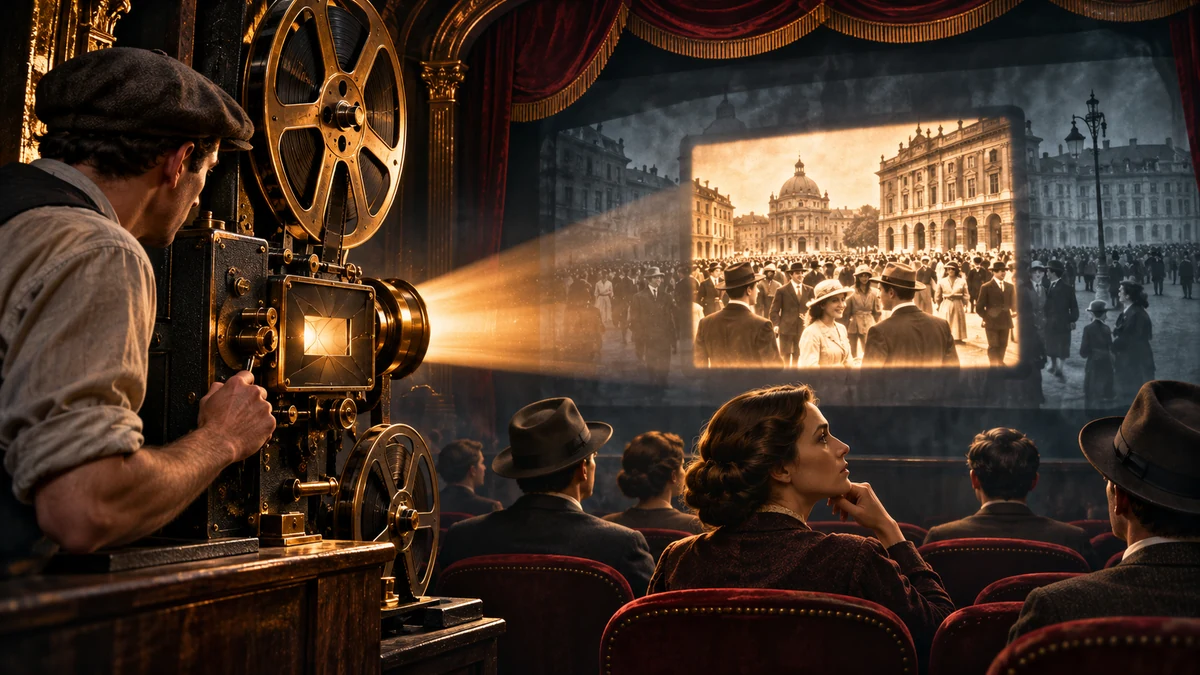
Artistic illustration of selective framing; not an archival depiction of CPI activities.
In 1917, the American government's propaganda apparatus could address citizens during an ordinary visit to the cinema. During the break to change a film reel, a speaker would step before the audience with a few minutes to deliver a message about the war and citizens' duties. The speech was not spontaneous: it formed part of a wider program organized by the Committee on Public Information. Surviving posters and archival materials show how government institutions treated public support as something that could be deliberately cultivated. [1] [2]
These documents raise a question that reaches far beyond the First World War. Who selects the information from which we construct our picture of reality? Who decides which event becomes news, which remains at the margins, and what words will guide our understanding of it? Propaganda does not always depend on someone telling an obvious lie. Sometimes it is enough to emphasize one aspect of a real event, attach a symbol to it, or place it within a story that serves a sponsor's interests. Yet the possibility of influence does not establish the existence of all-encompassing control: intention, execution, and actual effects must be demonstrated separately.
When Public Opinion Became a Government Task
In April 1917, the United States established the Committee on Public Information (CPI) by Executive Order 2594. According to the US National Archives, the committee disseminated government information, supported morale at home, and represented the United States abroad. Its domestic operations ended after the armistice in November 1918, while its overseas activities continued until June 1919. The institution's existence, remit, and period of operation are not conjecture; they are part of the archival record. [1]
One of its more tangible programs was the Four Minute Men. At cinemas and other public venues, local volunteers delivered carefully prepared short messages. The Library of Congress also holds an original 1917 poster and displays material intended for the speakers. Audiences heard these messages somewhere other than a conventional government press conference: in an everyday social setting, just before entertainment. That was precisely the advantage of the format — an official message reached the public through a familiar local voice it might trust. [2]
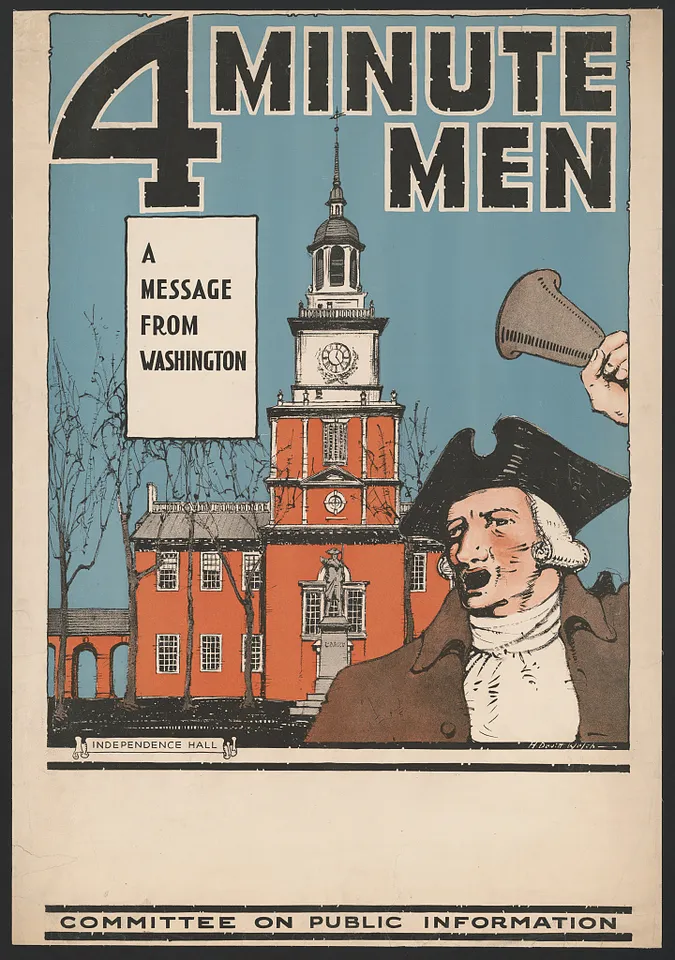
Surviving instructions to speakers offer a closer look at the program. The Four Minute Men bulletin of May 22, 1917, gave strikingly practical directions: speakers were to keep strictly to the time limit, plan their introduction, explanation, and closing appeal in advance, rehearse their delivery, and draw more effective turns of phrase from newspapers. Bulletin No. 17, dated October 8, 1917, also published a model speech that confronted listeners with the possibility that a German spy might be watching their conduct and urged them to support a war loan. This is evidence of planned rhetoric, not proof that listeners believed the threat or that the approach necessarily worked. The available online transcription of these early bulletins draws on a later historical publication, a distinction that remains part of its provenance. [10]
This is the documented history of state-organized persuasion. But it does not tell us, on its own, how many individuals changed their minds because of a speech, whether they responded enthusiastically, or whether they remained skeptical. The archive describes the program's scale, yet organizational reach is not evidence of every listener's internal response. Even here, an essential distinction emerges between a message's reach and its power to persuade.
Bernays: When Influence Does Not Pretend to Be Accidental
In 1928, Edward L. Bernays published Propaganda. In its opening chapter, Organizing Chaos, he presented, with little attempt at euphemism, the idea that organizing mass habits and opinions was not a side effect of modern democracy but an important part of its operation. For those who know how to organize and direct such processes, he used the expression invisible government. [3]
Today, that expression can readily sound like a description of one secret group issuing orders to everyone else from the shadows. But Bernays's text is more complicated. He discusses political parties, business interests, associations, social leaders, and people who use their positions to transmit ideas. He even explicitly notes that these supposed invisible directors often do not know one another. His metaphor describes the dispersed power to shape attention and perceptions; it is not documentation of a single global command structure. [3]
Bernays also worked with the CPI during the First World War. Drawing on archival research, historian Joseph Malherek describes him primarily as a skilled organizer of events that attracted media attention, rather than as an accomplished interpreter of psychoanalysis. Although he was Sigmund Freud's nephew, neither that family connection nor his use of psychological language establishes that the effectiveness of his campaigns was scientifically tested according to Freud's theories. [5]
Nor would it be fair to deny the far-reaching implications of his political proposal. Bernays defended the organized management of public opinion as a way to cope with the complexity of mass society. In his view, individuals cannot personally verify all the information they need to make political and consumer decisions. Someone therefore selects, sorts, and simplifies. The central question is not merely whether this is technically possible, but who is entitled to make those choices on behalf of others.
Here two levels of evidence must be distinguished. The book unambiguously establishes what Bernays advocated. It does not establish that his account of society as a whole was correct, or that every attempt at persuasion he proposed actually succeeded. The original text is an exceptional source for the history of ideas and public-relations methods, not an irrefutable blueprint demonstrating their effectiveness.
A World We Cannot See Directly
Bernays did not start from nothing. As early as 1922, Walter Lippmann, in Public Opinion, reflected on the difference between the world we inhabit and the pictures of that world on which we act. Because we cannot personally observe most political and distant events, we rely on reports, words, selected scenes, and simplified explanations. Lippmann used the term pseudo-environment for this mediated mental setting. [4]
We must not turn that concept into a claim that everything we hear through the media is fabricated. A map is not the landscape, but it may be an excellent map. A report is not the event itself, but it may be accurate and responsible. The problem arises when we stop noticing the difference between a verified event and the interpretation surrounding it; when a selection of presented facts quietly becomes a restriction on what we are even allowed to consider.
Complete independence from intermediaries is therefore not a realistic solution. No one can personally verify everything happening in the world. We need journalists, researchers, archives, witnesses, and institutions that make information available. But we also need ways to compare, criticize, and verify them. The freedom to examine evidence is precisely what separates help in understanding the world from a demand that we understand it only through one permitted frame.
“Torches of Freedom”: When a Commercial Interest Adopts the Language of Emancipation
One of Bernays's best-known projects was a 1929 event that became known as Torches of Freedom. The client was American Tobacco, which wanted to expand the market for cigarettes among women. Bernays linked women's public smoking to ideas of freedom and social equality. The staged scene during Easter festivities in New York was designed so that newspapers might report it as a news story, rather than merely an advertisement. [5] [6]
The example is revealing precisely because it combines a genuine social issue with a specific commercial interest. The restrictions women faced in public existed independently of the tobacco company. But the client wanted their struggle for equality to become associated with the purchase of its product. Freedom became the language of marketing. This is how manipulation can become possible without a complete fabrication: a genuine ideal is used as a means to pursue a different objective.
Bernays is often credited with almost single-handedly transforming American culture through this one event. Historical research published by Vanessa Murphree in 2015 corrected that story. Comparing newspaper coverage at the time, she found that the event did attract notice, but the attention was neither as uniformly favorable nor as persuasively powerful as Bernays later portrayed it. Women were smoking in some public places even before 1929. [6] [7]
In an accompanying methodological account, Murphree explains that she reviewed more than 250 newspaper articles alongside Bernays's archival clippings. Media attention was real, but some editors recognized the event's promotional staging and did not simply reproduce it as an independent, spontaneous protest. Once again, it is not enough to ask whether the story was published: we must examine how it was published and how much distance the coverage maintained from the client's interpretation. [11]
This is crucial: Bernays planned to attract attention, but it has not been demonstrated that a single event fully achieved the effects he attributed to his campaign. The story of a man who could almost magically direct the masses may itself have formed part of his professional self-promotion. The history of propaganda is therefore more revealing when we examine archival responses instead of repeating legends about all-powerful propagandists.
The Media Can Set the Agenda Without Dictating All Our Conclusions
In the second half of the twentieth century, researchers tried to describe and measure the mechanisms of media influence more precisely. In 1972, Maxwell McCombs and Donald Shaw published a study of agenda-setting — the shaping of the public agenda of attention. Their central idea was that the media, through the selection, frequency, and placement of news, influence which political issues people consider important. [8]
That is not proof that they successfully prescribe what audiences must think about every issue. If a newspaper devotes extensive coverage to housing, housing policy may become more visible, while readers can still disagree about causes and solutions. Nor does research into agenda-setting justify the conclusion that every news report produces a particular political outcome.
Another useful concept is framing. The same event can be reported as an economic issue, a moral dilemma, a security threat, or a dispute over human rights. Within each frame, certain facts move into the foreground while others recede. In a 1993 article, Robert M. Entman helped to define this field of research more precisely. A frame is not automatically a falsehood, but it is a choice that can be investigated and challenged. [9]
Here, too, we must distinguish an identifiable communication method from an alleged hidden intention. A journalist may frame a story in a particular way because they believe it makes the issue easier to understand. An editorial team may emphasize it because it serves the public interest. A campaign sponsor, meanwhile, may pay for that very emphasis, conceal the payment, and then try to present the result as entirely independent public sentiment. The mechanism of selection may be similar; the question of responsibility is not.
When Does Persuasion Become Manipulation?
In a pluralistic society, persuasion cannot be prohibited without infringing on freedom of expression. A trade union wants to persuade an employer and the public; an environmental organization warns of dangers; a political party presents its platform; a journalist explains the grounds for an investigation; a scientist defends a conclusion based on evidence. All are attempts to influence others' opinions. Such efforts are not, in themselves, evidence of abuse.
The problem begins when the relationship between speaker and audience is deliberately concealed. If a paid campaign passes itself off as independent testimony, if known counterarguments are systematically excluded, or if true facts are selected to create a misleading overall impression, people's ability to judge freely is weakened. A closer examination therefore asks not only whether a message is emotional or forceful. It asks who commissioned it, who paid for it, what evidence it uses, which relevant facts were omitted, and whether audiences can obtain and challenge the information.
Even that is not always straightforward. Every news report is shorter than the event it describes. Every editorial choice leaves something out. Manipulation must therefore be established through specific actions and circumstances, not inferred from dissatisfaction with somebody else's conclusion. Two competing explanations can also differ substantially in the strength of their evidence. Critical thinking does not mean assigning them equal weight.
Where Does Hidden Power Enter the Picture?
The CPI story concerns an official institution with formal leadership, a defined period of operation, and surviving archival traces. The American Tobacco story concerns a private client, a public-relations professional, and an attempt to generate favorable media coverage. Bernays's book openly advocates the expert management of public attention. These are three different kinds of evidence — organizational, commercial-historical, and intellectual. [1] [3] [5]
The hidden element appears when audiences do not know the sponsor, the payment, the selection of material, or the deliberate creation of an apparently spontaneous news event. Yet even then we must establish which actors were connected, what they did, and what consequences can be verified. Similar advertising methods used in two unrelated campaigns are not proof of a shared political command. The expression “invisible government” can serve as a cautionary metaphor for informal power — it is not, by itself, evidence of a global conspiracy.
That distinction will be decisive in the articles that follow in this series. A covert intelligence operation, an experiment on an individual, obedience to authority, and digital profiling may all affect human freedom, but they are not the same phenomenon. Each calls for different documents, different methods, and different standards for establishing consequences.
Independent Judgment Does Not Mean Living Without Information
Propaganda comes closest to gaining power over a person when it is no longer content to present an argument, but tries to narrow the very range of questions that can be asked. Our view of the world will always be mediated in part. But that is no reason to despair or to assume that every account is a lie. It is a reason to demand comparable standards from all intermediaries — governmental, private, mainstream, and alternative: the ability to check claims, disclosure of significant interests, and a willingness to correct mistakes.
Inner freedom does not mean confidently declaring that no one can mislead us. It means being capable of asking an uncomfortable question even of our own favorite interpretation. Who is the source? What does it actually demonstrate? What might prove the opposite? Is there still an unresolved gap between an intended effect and its actual consequences?
If we can answer these questions without fearing scrutiny, propaganda does not lose all its influence. But it does lose part of its most important advantage: the ability to have selected, in advance, the only acceptable picture of reality for us.
Sources and further reading
- National Archives and Records Administration. Records of the Committee on Public Information (RG 63). Official description of the archival collection and the CPI's establishment; consulted November 18, 2026. source Source
- Library of Congress. Four Minute Men. Exhibition Echoes of the Great War: American Experiences of World War I; description of the program and a surviving 1917 poster. source Source
- Bernays, Edward L. Propaganda. New York: Horace Liveright, 1928. Chapters I (Organizing Chaos), IV, V, VI, and XI. Examined transcription of the first edition: source Source
- Lippmann, Walter. Public Opinion. New York: Harcourt, Brace and Company, 1922. Chapter I (The World Outside and the Pictures in Our Heads). source Source
- Malherek, Joseph. “Creating Circumstances: Edward Bernays, Psychoanalysis, and the Making of American Consumer Culture.” Perspectives on History, American Historical Association, March 23, 2017. source Source
- The Museum of Public Relations. Pioneer — Edward Bernays. Institutional historical overview; supplementary account, not independent proof of campaign effectiveness. source Source
- Murphree, Vanessa. “Edward Bernays’s 1929 ‘Torches of Freedom’ March: Myths and Historical Significance.” American Journalism 32, no. 3 (2015): 258–281. DOI: 10.1080/08821127.2015.1064681. Bibliographic record and publicly available abstract examined; full study not yet reviewed. source Source
- McCombs, Maxwell E., and Donald L. Shaw. “The Agenda-Setting Function of Mass Media.” Public Opinion Quarterly 36, no. 2 (1972): 176–187. DOI: 10.1086/267990. Bibliographic details and public abstract examined: source Source
- Entman, Robert M. “Framing: Toward Clarification of a Fractured Paradigm.” Journal of Communication 43, no. 4 (1993): 51–58. DOI: 10.1111/j.1460-2466.1993.tb01304.x. Bibliographic details and public ERIC abstract examined: source Source
- Committee on Public Information. Four Minute Men Bulletin, no. 1 (May 22, 1917), and no. 17 (October 8, 1917); excerpts reproduced in History Matters: Four Minute Men: Volunteer Speeches During World War I, George Mason University. The online collection cites Alfred Cornbise, War As Advertised: The Four Minute Men and America's Crusade, 1917–1918 (1984), as its source. The reproduced transcription was reviewed, not the physical archival originals. source Source
- Murphree, Vanessa. “Teaching Our Journal: Edward Bernays’s 1929 ‘Torches of Freedom’ March.” American Journalism (accompanying methodological and teaching text on research [7]). The publicly available text was examined; it is not a substitute for the full article [7]. source Source