Secret Rituals and the Initiation of Elites
Belonging sometimes begins with a signed application; at other times, it begins with a ceremony, a promise, or a trial whose full meaning is understood only by those present.
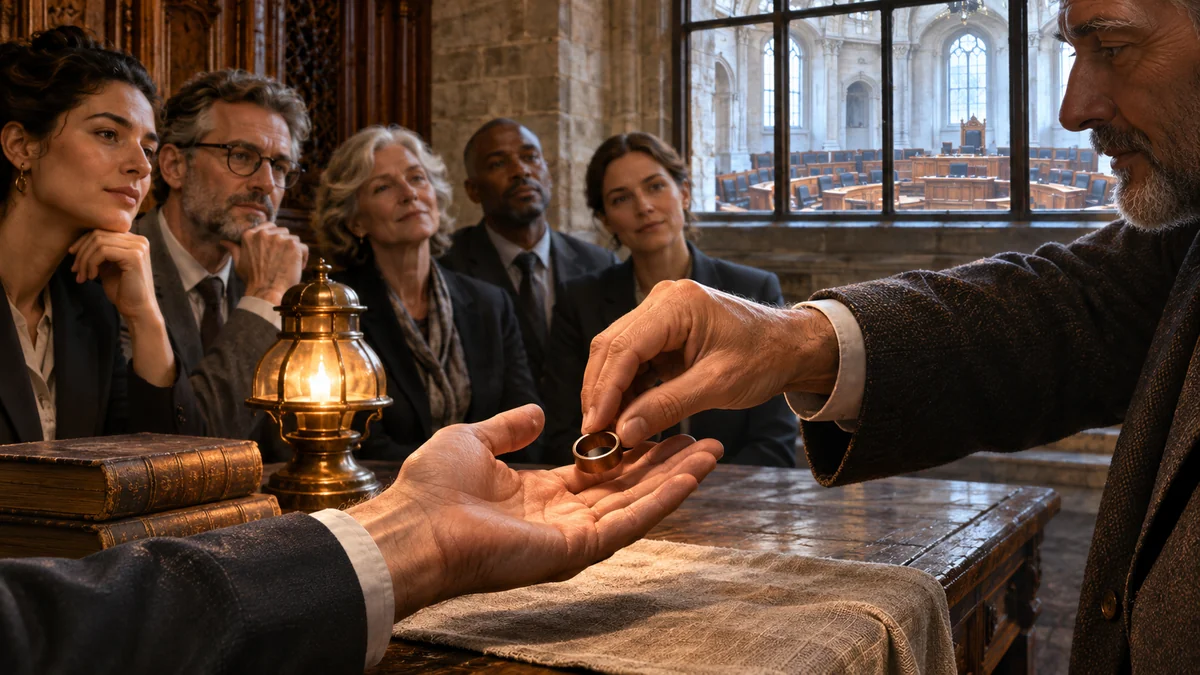
An artistic illustration of symbolic belonging and public accountability; it does not depict a documented ceremony.
Belonging sometimes begins with a signed application; at other times, it begins with a ceremony, a promise, or a trial whose full meaning is understood only by those present. Entering a circle of members does not necessarily change a person's legal powers. It may, however, change how they see themselves, how others see them, and whom they are prepared to trust. That is the social power of initiation. The most important questions it raises concern not only the secrecy of a ritual, but what belonging means beyond the room in which the ritual took place.
Elite communities may take the form of orders of chivalry, exclusive clubs, fraternities, or organizations with their own degrees of membership. Some present their ceremonies publicly; others keep them private. Their histories and areas of authority differ. We must therefore separate three things that discussions of hidden power too often merge: symbolic initiation, social connectedness, and demonstrable influence over public decisions. The links between them can be investigated, but we cannot fairly declare them a chain of cause and effect before examining the documents.
When a Person Crosses the Threshold
In 1909, the French ethnologist Arnold van Gennep described rites of passage as a sequence of separation from a previous position, a transitional period, and reincorporation into a community with a new status. Victor Turner later paid particular attention to the intervening state in which a person is no longer what they were, but has not yet fully become what they will be. This perspective helps explain why a ceremony may change someone's experience of belonging even when almost nothing visibly changes outside it. It is an anthropological model, not proof that every organization follows the same procedure or has the same purpose behind it. [1]
A transition can be entirely public: a student receives a diploma, a public official takes an oath, or a new member of an order receives an emblem of belonging. In a private fraternity, by contrast, the process may involve a particular sequence of words, symbols, garments, and promises. What these cases share is the act of marking a boundary between “before” and “after.” What differs is who draws that boundary, what obligations it imposes, who has access to the proceedings, and whether outsiders can assess their consequences.
Ritual secrecy therefore has at least two distinct sides. One is people's right to a private communal life, shared symbols, and spiritual experiences. The other is the possibility that closed rules may generate expectations of mutual loyalty unknown to people outside the group. The latter is a legitimate research question; it is not yet a finding that such expectations have been used to exert improper influence over the state.
Why a Group Remembers a Ritual
A shared ritual is more than a sequence of movements. Participants learn its language together, endure the tension of anticipation, remember the same event, and often come to feel that they belong to a story older than themselves. In their discussion of ritual, identification, and social cohesion, researchers Harvey Whitehouse and Jonathan Lanman distinguish ordinary identification with a group from pronounced identity fusion, in which people experience the group as especially closely bound to their own sense of self. This is a theoretical and empirically testable explanation of some forms of bonding, not a measure of every member's obedience. [2]
An intense shared experience may strengthen trust and a sense of closeness. But its effects depend on the circumstances, relationships, and how a person experiences the event. A 2026 study by Pierre Bouchat and colleagues examines the relationship between perceived emotional synchrony and subsequent feelings of cohesion in university initiation rituals. Its findings do not establish that the same mechanism operates among political or economic elites. [3]
The counterevidence is even more important. In a longitudinal study of a single American college fraternity, Aldo Cimino and Benjamin J. Thomas investigated whether more severe initiation practices increased solidarity. The results did not provide firm support for the simple notion that harsher initiation necessarily produces a more closely knit group. Liesbeth Mann and colleagues found across several studies that experiencing humiliation may even be associated with a weaker sense of belonging, particularly when the humiliation is experienced alone rather than together with others. [4] [5]
This does not mean that humiliating rituals can never create dependence or that their organizers cannot abuse their position. It means we cannot justifiably infer lasting loyalty from the mere presence of an ordeal. The belief that “anyone who has undergone the ritual will always obey” may be attractive in a story about invisible power, but the available psychological research does not support it as a general rule. Influence must be observed in actual relationships and actions, not calculated from the presumed power of symbols.
The Masonic Lodge: What Its Own Rules Reveal
One of the best-known examples of organized initiation is Freemasonry. The United Grand Lodge of England (UGLE) publicly explains that lodge meetings combine administrative business with ritual proceedings. Administrative business includes proposing candidates and voting on their admission, as well as discussing charitable activities; ceremonies include admitting new members and installing officers. The basic progression, as the institution describes it, comprises three degrees: Entered Apprentice, Fellowcraft, and Master Mason. [6]

Even this official account shows that “secret” is not a sufficiently precise word. The organization publicly describes its existence, structure, and aims, while keeping parts of its symbolic tradition within the circle of participants. That distinction may reflect tradition, group identity, or a desire for candidates to experience a ceremony without having its details revealed in advance. None of these reasons, by itself, settles whether inappropriate links between private obligations and public offices might arise in particular circumstances.
When reading institutional rules, we must also ask whose rules they are. UGLE's explanations describe its understanding of its own tradition; they are not a legal account of every Masonic tradition worldwide, nor an independent assessment of every member's conduct. A researcher can use them to establish what an organization officially prescribes and publicly acknowledges. A claim that members acted differently in a particular case, however, requires other types of sources: records of the event, testimony, correspondence, investigative findings, or court files.

The distinction matters equally for hierarchy. A ritual degree may define a member's position within a lodge; it does not follow that the degree confers legislative, judicial, or executive authority outside it. Organizational authority and state power are different things. Combining them merely because the same person appears in both settings skips the central question: what did that person actually do because of the relationship?
Elite Recognition That Is Not Secret
Britain's Order of the Garter offers a useful comparison. The Royal Family describes it as a high order of chivalry with limited membership and public ceremonies. New members receive insignia, take part in a procession, and are admitted to the ceremonial life of St George's Chapel at Windsor. Selection is prestigious and exclusive, yet the principal features of the ceremony are known, and members of the public can witness part of the occasion. [7]
Why does this example matter in an article about secret rituals? Because it demonstrates that ritual, strict selection, and proximity to the upper reaches of society can exist without invoking a secret organization. An honor recognizes standing and membership in a particular institution; it does not, by itself, show that its recipient subsequently makes decisions in place of the government or the courts. To investigate the social power of such recognition, we need to examine whom it gives access to, which relationships it strengthens, and whether there is an evidenced connection with particular decisions.
Here the idea of symbolic capital becomes useful: reputation, recognition, and a sense of being chosen may direct attention and open doors even without taking the form of an official command. Yet prestige alone cannot tell us how much influence was exerted over a particular decision. A ceremony may mark the beginning of an investigation into a network of relationships, not its conclusion.
When Private Loyalty Meets Public Duty
The British Parliament examined Masonic links with public service far more concretely than general stories about secret societies might suggest. In a 1999 report, the House of Commons Home Affairs Committee considered allegations about Masonic connections in the police and judiciary, alongside questions about disclosure of membership. Its conclusions were not uniform across the cases considered: regarding some police investigations, the committee concluded that Freemasonry was not a significant factor, or that a decisive role had not been proven, while in some specific relationships it did not entirely rule out the possibility of a contribution. [8]
Paragraph 27 of the report is particularly revealing. The committee recorded two cases in which a local ombudsman had admonished councillors for failing to disclose Masonic membership in connection with planning applications. This is a specific and significant finding: private affiliation became a question of public accountability in actual administrative proceedings. But the parliamentary report is not the complete original ombudsman's case file; it does not establish that any particular planning decision was actually altered because of membership. [8]
Precisely the difference between such claims determines the quality of investigative writing. An undisclosed interest may be a documented procedural issue. An abuse of office requires additional evidence. Coordinated, concealed control of a system requires a much broader chain of proof. Presenting all three as one can obscure the irregularities that really have been established by drowning them in an untestable general accusation.
Figures showing overlap between membership and public office also deserve careful treatment. In the same report, the committee stated that among 39 independent councillors in the Welsh county of Pembrokeshire for whom it had information, 16 were current or former Freemasons (approximately 41 percent). The figure describes an overlap between membership and local political office in a particular period and group; it is not the proportion of all British councillors and is not, in itself, evidence of improper voting or collusion. That is precisely why we must examine individuals' roles, contacts, and decision records rather than mistake a history of membership for a history of actions. [8]
The Right to Privacy and the Limits of Scrutiny
British policy on the disclosure of Masonic membership did not develop in a single direction. On 5 November 2009, the then Justice Secretary, Jack Straw, announced in a parliamentary statement that the special requirement for candidates for judicial office to disclose their membership would end. He explained that a review of the policy had found no evidence of judicial impropriety resulting from Masonic membership and that continuing to collect such information would be disproportionate. He also pointed to other existing safeguards protecting judicial independence and integrity. [9]
The decision does not mean that Masonic membership in every occupation is always an entirely private matter with no possible conflict of interest. Nor can a rule concerning judicial candidates automatically be extended to police officers or other countries. Its implication is more demanding: a democratic authority must explain why it collects particular information, what harm it seeks to prevent, and whether a less intrusive way of protecting the public interest is available.
The European Court of Human Rights also brought this tension into focus in 2026. On 7 July 2026, the Grand Chamber, in Grande Oriente d’Italia v. Italy (no. 29550/17), examined a search of the premises of a Masonic association and the seizure of numerous documents, including personal data relating to more than six thousand members, during a parliamentary inquiry into possible influence by mafia organizations. By sixteen votes to one, it found a violation of Article 8 of the European Convention on Human Rights, which in this case also encompassed respect for the association's premises, because of insufficient procedural safeguards and the disproportionate scope of the interference. [10]
The judgment does not mean Parliament may not investigate infiltration by organized crime, or that closed associations are exempt from investigation. Nor does it decide whether particular allegations of political influence were true. The decisive legal question was how far the state may intrude upon the rights of an association and its members, and what scrutiny must accompany that intrusion. In defending public accountability, we must not abandon the principle that even people belonging to unpopular or suspicion-arousing organizations are entitled to legal protection.
When Does Belonging Become a Conflict of Interest?
For a reasoned assessment, it helps to change the question slightly. Instead of asking, “Is this official a member of some group?”, we should ask, “Does this official have a private relationship that might improperly influence a particular public duty?” The OECD's 2003 guidelines on managing conflicts of interest in the public service distinguish actual, apparent, and potential conflicts. An actual conflict concerns a situation in which a private interest could improperly influence the performance of official duties; an apparent conflict concerns a situation that creates such an appearance, even if this is not in fact the case; and a potential conflict concerns circumstances in which a conflict could arise later. [11]
A private interest need not be financial. It may involve a relationship with a friend, relative, former business partner, or fellow member of an association. Yet membership alone is not corruption, and disclosure of membership does not, in itself, eliminate every risk. Responsible safeguards may include confidential or otherwise appropriate disclosure, recusal from a particular proceeding, controls on access to information, or other proportionate measures, depending on the law, the office, and the specific relationship. [11]
Consider a hypothetical example. A municipal decision-maker handles an application from an organization in which they hold a significant private role. Whether that group performs secret rituals is not the decisive question. What matters is the substance of the decision, the official's authority, the nature of the connection, any benefits involved, and whether the conflict was properly disclosed and the official recused themselves if necessary. The same standards would apply to a religious association, a business club, a sports organization, or a family connection. Such consistency is what separates concern for integrity from the stigmatization of a selected group.
The question becomes sharper when a private promise, access to information, and public power intersect. At that point, appeals to personal honor, charitable aims, or centuries of tradition are not sufficient. But suspicion alone is not an investigation either. We need documented communications, a record of decision-making, relevant interests, possible benefits, and an assessment of alternative explanations. Only then can we distinguish legitimate friendship from the misuse of a relationship, and a social network from covert coordination.
From Shared Ritual to Actual Influence: The Missing Steps
Historical narratives about elites often skip the hardest part of the journey. They present a ceremony, a list of attendees, or a symbol of belonging, and then infer that a political decision was made there. This leap is appealing because it offers a simple answer to the complicated question of who governs. At the same time, it weakens the inquiry: it prevents us from checking when the alleged influence actually occurred and who bears responsibility for it.
A verifiable investigation should establish at least five steps. First, identify the individual, their office, and the period concerned. Next, demonstrate the relevant relationship or contact. Then find a record of an action, instruction, agreement, or decision. Only after that should we test whether a reasonable causal link between the private relationship and the outcome can be established, and assess alternative explanations. Proof of some steps does not constitute proof of them all.
This approach is not designed to shield elites from scrutiny. Quite the opposite: it keeps real structures of influence from disappearing behind a haze of symbols. If improper intervention occurred, we should be able to ask who contacted whom, when, in pursuit of what interest, what decision followed, and which document supports the account. If the information is missing, the honest course is to leave the hypothesis open and explain which evidence is lacking. If the evidence contradicts the hypothesis, the investigation must acknowledge that too.
Nor can we conclude from the cases examined that all closed circles are harmless. Privacy can protect human freedom; it can also make outside scrutiny more difficult where it overlaps with public office. What matters is not the mystique of the setting but the substance of actions, the relationship between power and accountability, and whether those affected can seek an independent assessment.
To Whom Is the Highest Loyalty Owed?
Initiation may give a person a language of dignity, service, friendship, and personal growth. It may also foster the sense that those “inside” deserve more trust or protection than those “outside.” No ritual determines by itself which path will prevail. That becomes clear only through rules, relationships, actions, and a group's willingness to hold its members accountable.
Private affiliation is part of human freedom. Public authority, however, is not the private property of those who wield it. Anyone who makes decisions on behalf of others must be able to explain those decisions to people outside their own circle as well. This is a moral boundary that applies to a Masonic lodge, a professional network, a political party, a business association, and any other community that comes close to the power of the state.
We thus arrive at a less spectacular but more important conclusion: rituals can create belonging and prestige, but their actual political significance must be established through people's actions. The material reviewed contains documented ceremonies, studies of group psychology, parliamentary warnings, and legal safeguards. It does not, however, provide a completed chain of evidence deriving systematic, covert direction of political decisions from initiation itself. That is not a reason to end the investigation. It is a reason to ask the next question more precisely: When does loyalty to a private circle become an action for which its members must also answer to those outside it?
Documentary sources and archive links
These links lead to documents, archival records or photographs hosted by their original source institutions.
Sources and further reading
- Jennifer Hasty, David G. Lewis, and Marjorie M. Snipes (2022), OpenStax, Introduction to Anthropology, “13.4 Rituals of Transition and Conformity,” discussion of van Gennep's model and Turner's concept of liminality. source Source
- Harvey Whitehouse and Jonathan A. Lanman (2014), “The Ties That Bind Us: Ritual, Fusion, and Identification,” Current Anthropology 55(6), DOI: 10.1086/678698. source Source
- Pierre Bouchat, José J. Pizarro, Jon Zabala, Darío Páez, and Bernard Rimé (2026), “Emotional synchrony predicts social cohesion effects following costly rituals,” British Journal of Social Psychology 65(2), e70064, DOI: 10.1111/bjso.70064. source Source
- Aldo Cimino and Benjamin J. Thomas (2022), “Does hazing actually increase group solidarity? Re-examining a classic theory with a modern fraternity,” Evolution and Human Behavior 43, 408–417, DOI: 10.1016/j.evolhumbehav.2022.07.001. source Source
- Liesbeth Mann, Allard R. Feddes, Bertjan Doosje, and Agneta H. Fischer (2016), “Withdraw or affiliate? The role of humiliation during initiation rituals,” Cognition and Emotion 30(1), 80–100, DOI: 10.1080/02699931.2015.1050358. source Source
- United Grand Lodge of England, “What is Freemasonry?”, sections “What happens at a Lodge meeting?” and “The Three Degrees of Freemasonry”; the institution's official description of its rules and practices. source Source
- The Royal Family, “The Order of the Garter,” official account of member selection, insignia, and ceremonies at Windsor. source Source
- House of Commons, Home Affairs Committee (1999), Freemasonry in Public Life, Second Report, HC 467, especially paragraphs 14–27; parliamentary report. source Source
- UK Parliament, Hansard, 5 November 2009, written ministerial statement by Jack Straw on disclosure of Masonic membership by candidates for judicial office. source Source
- European Court of Human Rights, Grand Chamber, Grande Oriente d’Italia v. Italy, no. 29550/17, 7 July 2026; official summary ECHR 182 (2026): source ; judgment in HUDOC: source ; official Italian publication: source Source 1 Source 2 Source 3
- OECD (2003), Recommendation of the Council on OECD Guidelines for Managing Conflict of Interest in the Public Service, OECD/LEGAL/0316, annex — definitions of actual, apparent, and potential conflicts and principles for managing them. source Source