The Hidden Language of Symbols
An unfinished pyramid topped by a hovering eye appears on the American one-dollar bill. In an Egyptian collection, we may encounter another eye, fashioned as an amulet.
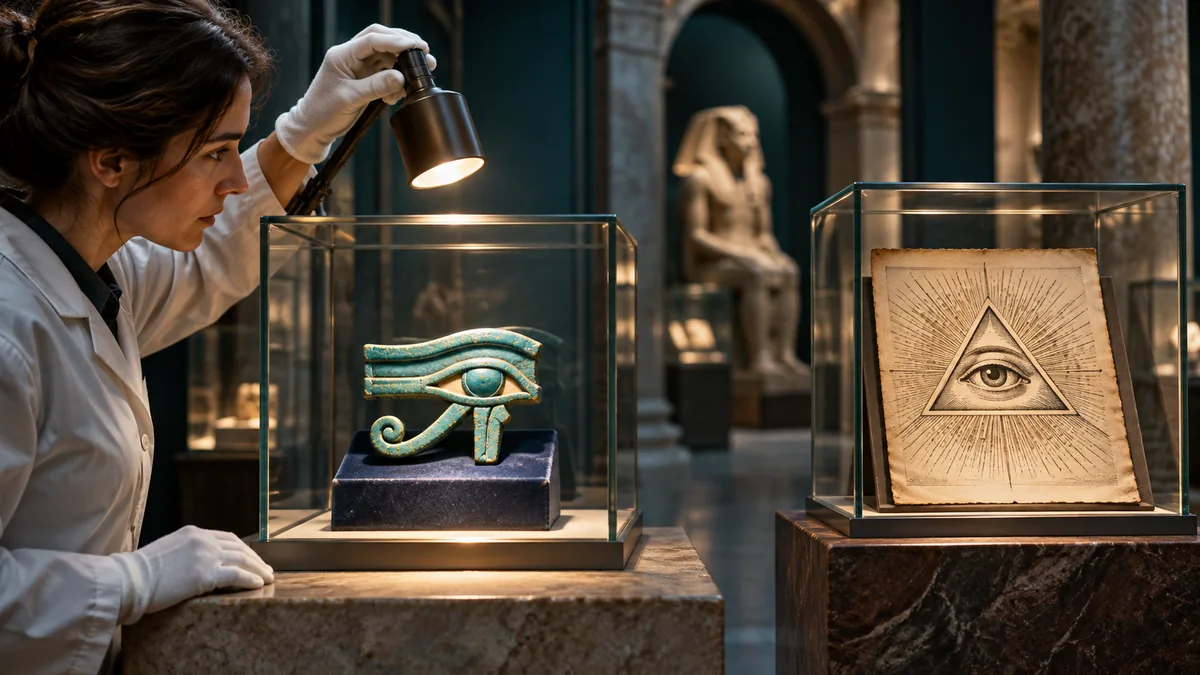
An artistic comparison of symbols from different contexts; the depicted objects are not identifiable museum exhibits.
An unfinished pyramid topped by a hovering eye appears on the American one-dollar bill. In an Egyptian collection, we may encounter another eye, fashioned as an amulet. Other eyes and geometric signs appear in Masonic settings. Anyone who places these images side by side will quickly notice their similarities; it is harder to answer whether they actually tell the same story. A similar line may point to a shared inheritance, a direct borrowing, a new meaning, or simply an image used by different people for different purposes. [1] [4] [7]
A symbol can inspire hope, warn of danger, bring people together, or impose an identity upon them. Some symbols belong to spiritual traditions, others appear on official documents and currency, and still others on clothing that people are forced to wear. Studying symbols is therefore not a game of hunting for hidden shapes. It is a question of historical context, the right to one's own interpretation, and the power of those who can decide what a sign should mean to others. In this account, we will examine both genuine links between traditions and the point at which resemblance ceases to be evidence.
When an Image Leaves Its Original Setting
Let us begin with a distinction that is easy to overlook. An eye is a recognizable motif, but not every depicted gaze is the Eye of Horus, the Eye of Providence, or a Masonic sign. The human eye offers only so many simple visual forms, yet it provides cultures with an obvious source of metaphor: seeing, watching, knowing, protecting, or controlling. To argue that one particular image derives from another, we need a historical trail—a creator, a text, an object, a date, a route of transmission, or a documented borrowing. Resemblance alone poses a question; it does not answer it. [1] [4] [7]
An object usually tells us both less and more than we would like. More, because we may know its material, date, place of discovery, and manner of use. Less, because without a relevant text or context we cannot always know what it meant to every person who saw it. Even when a historical author explains the purpose of a sign, that explanation does not encompass all its later meanings. We must therefore distinguish what a source explicitly says from what a later observer projects onto an image.
Meaning does not travel only through the making of copies. It can pass through trade, books, religious contact, colonial encounters, political propaganda, or personal inspiration. A borrowing can be documented yet quite freely reinterpreted: a group adopts an old form but gives it a different message. In studying secret societies, it is therefore especially important to ask whether we have a document recording the adoption of a symbol and its function within a particular organization. Only further evidence could show whether the resemblance also corresponded to a shared political decision.
How to Read a Symbol Without Reading Our Answer Into It
A useful starting point consists of six straightforward checks. First, describe what has actually been drawn or made; then establish which object or document bears the image. The third step is dating, and the fourth is the meaning given by the original or nearest available source. Fifth comes the history of subsequent uses and changes. The sixth step is the most demanding: if someone infers political power from a symbol, they must also show who made a decision, under what authority, and with what consequence. This is not a definitive formula for every work of art, but a way to avoid leaping from an image to an accusation.
We must also pay attention to whose voice a source represents. A museum can provide a scholarly description of a dated object without thereby becoming a witness to every historical use of the same form. A religious or initiatory association may credibly explain what its emblem means to its members; such self-description is not independent proof that the same interpretation prevailed thousands of years ago. A historian may offer a plausible reading without replacing a primary document that has not been consulted. Maintaining these distinctions also protects legitimate religious experience: one need not belittle spiritual meaning in order to reject an unsupported claim about organizational power.
There is another uncomfortable but necessary question: who has the right to explain a symbol? An institution may set out its teaching, a researcher may examine its historical claims, and an individual may find a personal message in the same image. These interpretations can coexist, but they are not interchangeable. When someone moves from a personal experience to the conclusion that another organization must be following a shared secret plan, they have crossed from meaning into an evidentiary claim. Such a claim requires stricter standards than philosophical reflection.
The Eye of Horus, the Ankh, and the Cobra: Three Egyptian Stories
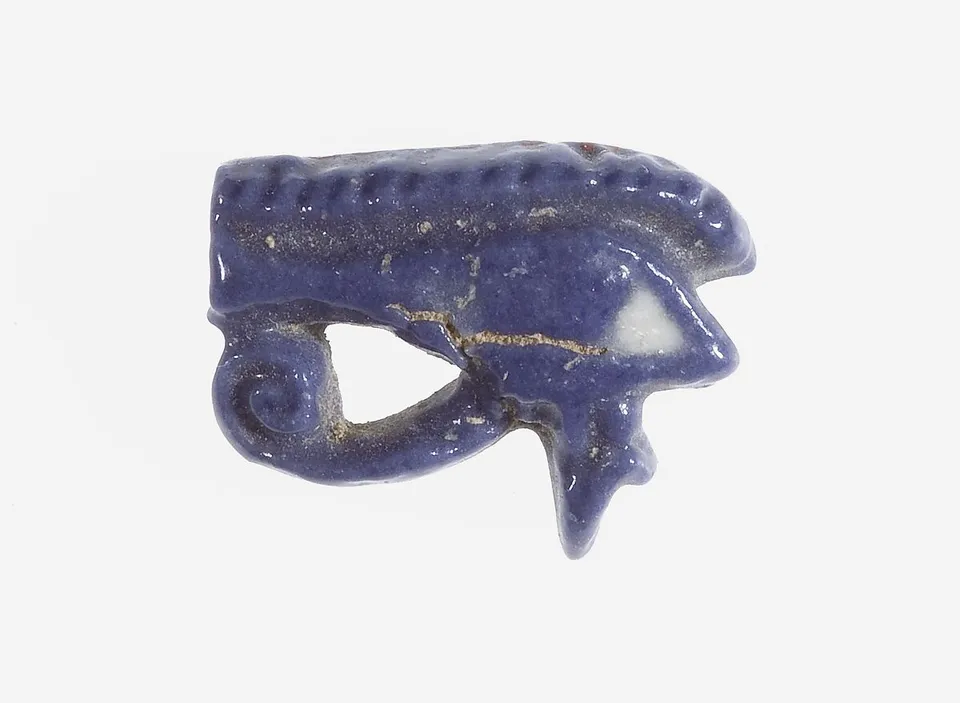
The Metropolitan Museum of Art in New York holds a Wedjat Eye Amulet dated to approximately 1850–1700 BCE. In its interpretation, the wedjat, or Eye of Horus, is associated with wholeness, restoration, and protection. This meaning belongs to a particular Egyptian religious and material context. We do not need to posit a modern secret order to understand why someone would wear an amulet believed to protect its wearer. Nor does the object prove that every later eye within a triangle derives directly from the same cult. [4]
The ankh, a sign with a loop above a crossbar, tells another story. On a museum object dated to approximately 1396–1386 BCE, it is associated with life; its shape also appears in later representations and composite emblems. But the ankh is not a variant of the eye, nor does it establish the same teaching as any given serpent. Even two images from one civilization may serve different purposes. Material proximity does not guarantee identical meaning. [5]
The third example is the upright Egyptian cobra, the uraeus. The museum holds a plaque from a string of amulets, dated to approximately 1080–945 BCE, and places it within protective symbolism. This cobra is not a serpent biting its own tail. To call it an ouroboros without distinction would overlook the very characteristic that matters for the particular object. The first lesson of the history of symbols is therefore somewhat paradoxical: before searching for hidden connections, we must learn to notice obvious differences. [6]
The Pyramid and the Eye: What Does 1782 Really Tell Us?
The adopted design for the reverse of the Great Seal of the United States depicts an unfinished pyramid, an eye above it, and Latin mottos around it. The design was adopted on June 20, 1782, after several earlier proposals and discussions. A transcript of the explanation by Charles Thomson, secretary of the Continental Congress, is also available. It associates the pyramid with strength and duration, and the eye and inscription with divine providence in the story of American independence. This was a documented meaning articulated when the emblem was adopted—not an official defense invented later in response to modern suspicions. [1] [2]
Trenchard engraving of the Great Seal reverse (1786)
Below the pyramid is the motto Novus Ordo Seclorum. In its historical context, it refers to a new order of the ages or eras, associated with the founding of the American republic. Its meaning cannot legitimately be translated automatically into a claim about a present-day world government. Language can acquire various later associations, but the Latin phrase alone does not establish a political plan that would have to be demonstrated by other documents. If evidence existed of a different, concealed program pursued by identifiable people, we would need to examine it; the inscription itself cannot stand in for missing correspondence. [1] [2]
A second date matters here: 1935. That was when both sides of the Great Seal first appeared together on the American one-dollar bill. The emblem was adopted in 1782, while its image appeared on this widely circulated medium in 1935. Conflating these events can lead someone to attribute an intention to the later monetary object without a chronological trail to support it. The official account of 1935 certainly does not settle every question about the new meanings the symbol acquired in public life, but it establishes an essential boundary for interpretation. [2] [3]
The pyramid and the eye are frequently discussed in connection with Freemasonry. The all-seeing eye has its own history within Masonic traditions, but this does not make the entire state emblem the creation of any particular lodge. Even if an individual creator's membership in a fraternity were documented, we would still need separate evidence that the fraternity shaped the decision and did so under some political authority of its own. Research into power makes little progress when it substitutes a similar sign on an entirely different object for the transcribed report of 1782. [1] [7] [8]
The Square and Compasses: Ritual Teaching Is Not a Government Organization Chart
The square and compasses are among the most recognizable signs of Freemasonry. The Grand Lodge of Pennsylvania and the Scottish Rite's Northern Masonic Jurisdiction describe them as tools from which moral lessons about conduct, judgment, and one's relationship with others are drawn. Some depictions include the letter G, while others do not. This difference matters because even related institutions offer a variety of designs and interpretations. An organization's own account therefore tells us a great deal about how its members understand their sign; it does not, by itself, settle the history of every depicted square in building guilds, churches, or secular art. [7] [8]
Here we can see a symbol's genuine institutional function. A sign can help identify membership, reinforce a teaching, preserve ritual memory, and distinguish an organization's public appearance from its members' everyday lives. We need not deny this power in order to reject a hasty conclusion. When the same pair of tools appears in architecture or on a coat of arms, we still do not know whether it represents ritual borrowing, a professional emblem, a later renovation, or coincidence. The answer must come from a specific date, creator, and history of the object.
We must also distinguish membership from authority. If we can show that someone belongs to a lodge, we have evidence of an association. To understand political power, however, we need actions: did that person have access to a decision, issue an instruction, take part in a vote, arrange a favor, or influence a particular appointment? A sign may open a line of inquiry, but it cannot pursue that inquiry for us. This is precisely what separates a grounded investigation of informal networks from the story that every geometric resemblance proves the existence of a single secret command.
Pentagram, Pentacle, and Baphomet: When Names Mislead
A pentagram is a geometric five-pointed star. In some historical magical texts, however, a pentacle does not refer exclusively to that shape but to a talismanic object or diagram containing different figures and inscriptions. The British Library catalogs Harley MS 2267, a manuscript associated with ritual magic around the year 1600; its description includes pentacles, circles, and other signs. Yet a catalog entry is not a facsimile of every folio and does not authorize us to draw every recorded pentacle as a five-pointed star. The principle is simple: when interpreting an old text, first establish what its authors meant by a term, rather than what a modern online dictionary suggests to us today. [9]
A Tufts University exhibition shows the variety of pentacles in specific books of magic. An even clearer example is a later English edition of The Key of Solomon, edited by S. L. MacGregor Mathers. Its Second Pentacle of Jupiter is described as a figure containing a hexagram, or six-pointed star. This is significant evidence that the term in this printed witness is not limited to five-pointed geometry. It does not prove that every older manuscript was identical to Mathers's edition, however, or that every six-pointed star in the world expressed the same magical doctrine. [10] [11]
The picture is equally varied outside European grimoires. In his study of Arabic magical manuscripts, Giovanni Maria Martini describes five-pointed Seals of Solomon in MS ARA 244 and a six-pointed form in MS ARA 72. The Metropolitan Museum of Art holds an eleventh-century talismanic scroll on which it likewise interprets a six-pointed star in the context of the Seal of Solomon. These are documented examples of different uses and names; they establish neither a unified medieval organization nor an unchanging meaning for every hexagram. Some original manuscript illustrations have not yet been examined directly, so we rely here on the scholar's and museum's descriptions. [12] [13]
The story of Baphomet offers a different warning. The now familiar goat-headed image, laden with multiple meanings and associated with Éliphas Lévi, belongs historically to the mid-nineteenth century: Julian Strube's research documents its publication in 1854 and its use as a frontispiece in the 1855–1856 edition. Strube interprets it in the context of Lévi's religious, political, and magnetic thought, not as direct evidence of a secret medieval Templar idol. Later associations with Satanic imagery and the inverted pentagram must be examined as subsequent chapters in the motif's history, rather than uncritically attributed to its original creation. [14]
The nature of our evidence matters in Lévi's case as well. The accessible scholarly study reproduces an early image, but this does not mean that we have directly examined the original 1854 printing. Still less does it allow us to conclude that all the groups that later adopted the image were organizationally connected. Symbols can travel through books, art, and mass culture much faster than authority, money, or orders. We must therefore trace the history of the image separately from the history of the institutions that used it. [14]
The Ouroboros and the Theosophical Emblem: The Same Figure, New Questions
The serpent biting its own tail is among the most recognizable images in European esoteric culture. It is often described as the ouroboros, a sign of endless cycles, eternity, or renewal. Yet the Egyptologist Dana Michael Reemes warns in his dissertation The Egyptian Ouroboros that this interpretation does not automatically fit every ancient Egyptian depiction of encircling serpents. In his reading, some images serve protective and boundary-marking functions; interpreting every such depiction as a sign of eternal time requires further historical support. This is the argument of a particular scholarly study, not a final verdict on every Egyptian drawing. [15]
Moving to modern Theosophy, we encounter a different kind of source. In its public explanation of its emblem, the Theosophical Society in Australia explicitly interprets the serpent biting its own tail, the interlaced triangles, the ankh, the swastika, and other elements as expressions of philosophical and spiritual ideas. The society can reliably explain what it intends its own composite sign to communicate. That explanation alone, however, cannot prove that every element has carried the same message since antiquity or that an unbroken organization secretly passed the symbols down through the centuries. [16]
This very distinction is of interest to researchers: the Theosophical emblem is a genuine example of the deliberate combination and reinterpretation of traditions. We need not choose between accepting every esoteric historical claim unconditionally and ridiculing spiritual experience. We can establish what a modern association expressly teaches and then investigate the historical age, paths of transmission, and meaning of each component in turn. The Theosophical interpretation is a valuable cultural source precisely because we attribute it to its actual proponents, not to an unnamed ancient "secret school." [15] [16]
For comparison, consider the serpent on a staff in the emblem of the World Health Organization, adopted in 1948. The WHO officially associates it with Asclepius and healing. Once again, we have a real organization, a specific date, and a documented explanation. The fact that a serpent also appears in certain esoteric signs does not establish that the WHO is subordinate to the same hidden group; its symbolism has a documented medical context. Such a comparison does not deny every historical borrowing. It reminds us that each alleged connection must be demonstrated separately. [17]
The Hexagram, the Swastika, and the Yellow Star: Different Uses, Unequal Power
The six-pointed star appears in different traditions. In certain Jewish settings it became established as the Star of David and an important marker of collective identity, while in other contexts we encounter a geometrically related shape in talismanic texts. The history of its Jewish use does not begin at a single identifiable moment: earlier examples exist, while broader public identification with Judaism developed over time, particularly in more recent centuries. The same shape in a Seal of Solomon and in a Jewish symbol does not, by itself, tell us that the different communities shared an institution, ritual, or political goal. [12] [13] [21]
When we turn to Nazi persecution, the question is no longer merely who attached a meaning to a motif. Nazi authorities used the Jewish star in parts of occupied Europe as a compulsory marking for people they discriminated against and persecuted. Museum records of yellow badges attest to the material form of this policy. A sign that could express voluntary belonging became, in the hands of perpetrators, a means of public labeling, exclusion, and control. Responsibility for the coercion rests with the authorities who imposed it, not with the people forced to wear the mark. The details of the regulations varied by place and period. [21] [22]
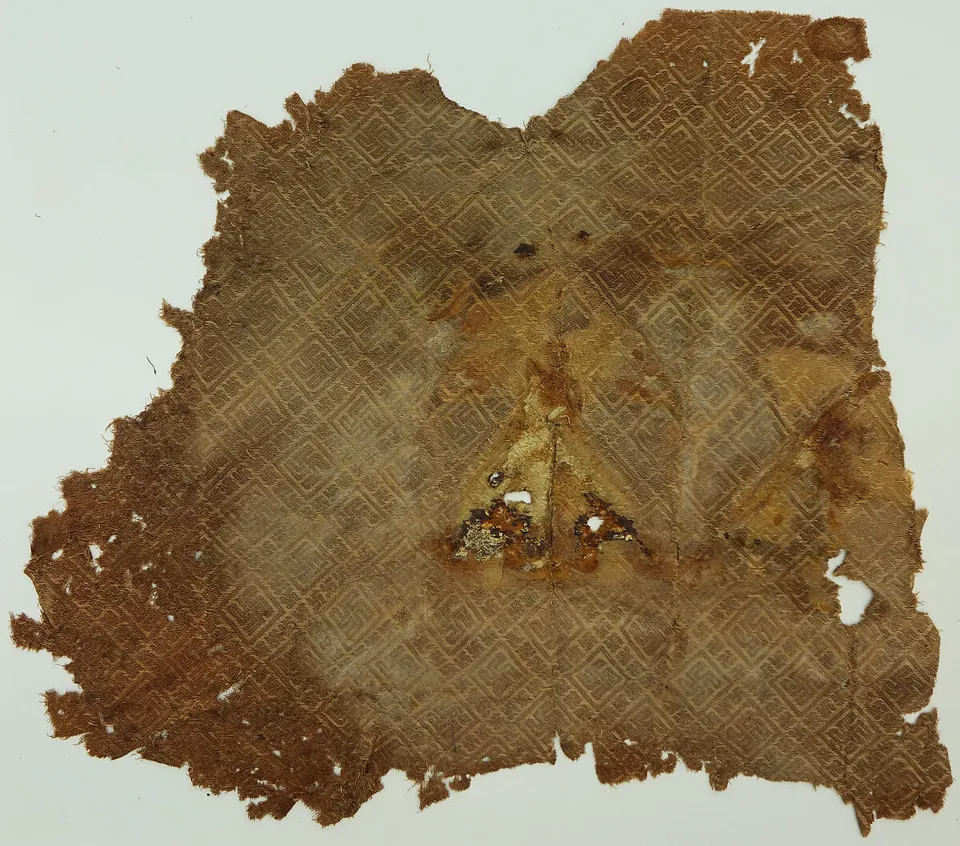
The swastika provides a different example. The Metropolitan Museum of Art holds a fourteenth-century Chinese textile bearing a swastika pattern and an eighteenth-century Japanese Buddhist priest's robe on which a similar sign is associated with the Buddhist concept of infinity. We cannot construct a complete dictionary of all Asian religions from two objects, but they are concrete enough to refute the claim that the motif originated with European National Socialism. [18] [19]
The National Socialist Party adopted the sign in its political imagery in 1920 and tied it to a racist ideology. This was a historically documented act of political appropriation. An old geometric form became the emblem of an organization that later carried out mass violence and persecution. Comparison with Asian objects does not diminish the Nazi regime's responsibility. On the contrary, it helps us identify precisely who used the motif for a particular political purpose and what consequences followed. [20]
The yellow star and the Nazi swastika are therefore not symmetrical examples of "two sides of the same symbolic war." Nazi authorities imposed the former upon their victims, while using the latter as the emblem of their own movement and power. Historical analysis must not lose sight of that distinction amid discussions of shapes, numbers of points, or supposed occult codes. When a symbol becomes an instrument of coercion, responsibility is first and foremost a matter of the documented actions of people and institutions. [20] [21] [22]
From Institutional Meaning to Modern Claims of Hidden Power
We can now return to the opening question about the eye above the pyramid. On one side stands the preserved transcript of Thomson's report from 1782; on the other, Masonic explanations of their own emblems. Both deserve to be read. But a record concerning a state emblem is not a Masonic rule, just as a fraternity's description of itself is not a document ordering the American Congress to act. Such a political claim would require another kind of evidence: documented communication, authority, a decision, and a traceable connection between an action and the alleged influence. [1] [2] [7] [8]
The Theosophical emblem provides a similar lesson. The society publicly explains why it combines the ouroboros, the ankh, and geometric elements. This is a case of documented adoption and reinterpretation of symbols. Without further evidence, however, it does not establish that every culture in which the individual motifs were used belonged to a single secret chain of power. If we found correspondence, founding documents, or an independently confirmed route by which a particular sign was transmitted, that would be a genuine historical link worthy of analysis. Its scope would still be determined by the evidence, not by visual resemblance. [15] [16]
The distinction between symbolic and political influence is crucial to investigating hidden power. An institution can genuinely shape its members' thinking, connect influential people, or teach a moral or religious doctrine. It does not follow that it directs ministries, corporations, or courts. Influence has degrees: from visibility and belonging, through personal connections, to actual decision-making. Each degree demands its own kind of evidence. The history of symbols may provide an initial map for an investigation, but it is not a final judgment on the hidden mechanisms of power.
Researchers must not make the opposite mistake of declaring symbols unimportant. Consider compulsory badges and propaganda flags: images can help organize social exclusion, encourage hatred, and reinforce power relations. Yet what mattered was not any supernatural property of their colors or geometry; it was laws, organizations, speakers, orders, and the people who carried them out. When we follow those actions, we do not diminish the symbols. We return them to the history in which they actually operated. [20] [21] [22]
Who Has the Power to Define Meaning?
A sign does not speak for itself. People speak when they create, wear, interpret, transmit, or impose it. Sometimes meaning grows from religious tradition and personal experience; at other times, from a publicly adopted state document, family memory, or political propaganda. An old form can become a modern expression of belonging, while a new ruler may use it in an entirely different setting. There is therefore no universal key that would automatically reveal the secret master of history through an eye, a serpent, or a six-pointed star.
On the other hand, the ability to determine what others must see in a sign can become a form of real power. There is a fundamental moral distinction between voluntary use and compulsory marking. One person chooses a symbol to tell others who they are; another has a sign imposed on them by an authority so that they may be singled out. We can describe both objects precisely, but only the question of freedom reveals how unequal the situations are. The history of the Jewish star during Nazi persecution shows why ethical meaning must not be erased for the sake of a seemingly neutral comparison of geometric forms. [21] [22]
If we want to remain independent in studying the history of power, we must accept a more demanding task than recognizing hidden signs. We need the patience to distinguish an object from its interpretation, an interpretation from documented transmission, and transmission from an actual political decision. Where a connection exists, let a traceable source demonstrate it. Where it cannot be established, let suspicion remain a question rather than a condemnation. Symbols matter precisely because human beings live with them and act through them—and because our actions can bring others either dignity or humiliation.
Next in the Series
In subsequent installments of the Hidden Power series, we will apply the same standard to other institutions and explanations of authority: we will not draw conclusions from similarities between symbols alone, but will seek identifiable people, documents, powers, and consequences. We understand history more deeply when we can acknowledge the different meanings of the same image while also naming clearly the actions for which we have evidence.
Sources and further reading
- Charles Thomson / U.S. National Archives, DocsTeach. Report on the Seal of the United States, June 20, 1782; publicly accessible archival transcript and explanation of the reverse. source Source
- U.S. National Archives. Original Design of the Great Seal of the United States (1782); historical description and confirmation of the adoption date. source Source
- U.S. Bureau of Engraving and Printing. Frequently Asked Questions; discussion of the meaning of the Great Seal and its use on the banknote in 1935. source Source
- The Metropolitan Museum of Art. Wedjat Eye Amulet, accession no. 22.1.128, Egypt, approximately 1850–1700 BCE; museum object record. source Source
- The Metropolitan Museum of Art. Ceremonial Implement in the Shape of an Ankh, accession no. 30.8.30, approximately 1396–1386 BCE; object record. source Source
- The Metropolitan Museum of Art. Uraeus Plaque from a String of Amulets, accession no. 25.3.169g, approximately 1080–945 BCE; object record. source Source
- Grand Lodge of Pennsylvania (2016). The Square and Compass; institutional interpretation of a Masonic sign. source Source
- Scottish Rite, Northern Masonic Jurisdiction. The Origins of the Square and Compasses; institutional account of the sign's history and interpretations. source Source
- British Library. Harley MS 2267 — A Manual of Ritual Magic, catalog record for a manuscript dated to 1600; catalog description, not a direct visual examination of every folio. source Source
- Tufts University, Tisch Library. The Grimoires’ Pentacles; university exhibition presenting and interpreting specific historical books. source Source
- S. L. MacGregor Mathers (ed.). The Key of Solomon the King, a late-nineteenth-century English printed edition, "Second Pentacle of Jupiter"; digital copy at Wellcome Collection. source Source
- Giovanni Maria Martini. Arabic Manuscripts on Magic at L’Orientale; academic study of particular Arabic manuscripts and variants of the Seal of Solomon; university PDF. source Source
- The Metropolitan Museum of Art. Talismanic Scroll, eleventh century; museum object record and interpretation of the Seal of Solomon. source Source
- Julian Strube (2016). "The ‘Baphomet’ of Eliphas Lévi: Its Meaning and Historical Context." Correspondences, 4, pp. 1–43 (online edition cited); academic historical study including a reproduction, not a direct examination of the original 1854 printing. source Source
- Dana Michael Reemes (2015). The Egyptian Ouroboros: An Iconological and Theological Study. Doctoral dissertation, University of California, Los Angeles; bibliographic abstract and relevant online sections consulted, not all illustrations. source Source
- The Theosophical Society in Australia. The Emblem of the Theosophical Society; institutional self-description and explanations of the emblem's elements. source Source
- World Health Organization. Logo; official explanation of the emblem showing a staff and serpent. source Source
- The Metropolitan Museum of Art. Textile Fragment with Swastika Pattern, China, Yuan dynasty, fourteenth century; museum object record. source Source
- The Metropolitan Museum of Art. Buddhist Priest’s Robe (Kesa) with Pattern of Swallows among Willow Branches, Japan, eighteenth century; museum object record. source Source
- United States Holocaust Memorial Museum. History of the Swastika; historical survey of earlier uses and Nazi political appropriation of the sign. source Source
- Yedida Kanfer, JFCS Holocaust Center. What Is a Symbol? The Corruption and Reclaiming of the Jewish Star; historical discussion of the Jewish star, compulsory marking, and reclamation. source Source
- The Jewish Museum. Yellow Badge, accession no. U 8667; museum object record. source Source