The Order of Malta: From Knighthood to Diplomacy
The Order of Malta is an unusual historical example of an institution that lost the territory it once ruled yet retained its own leadership, diplomatic representations, and a distinctive position in international relations.
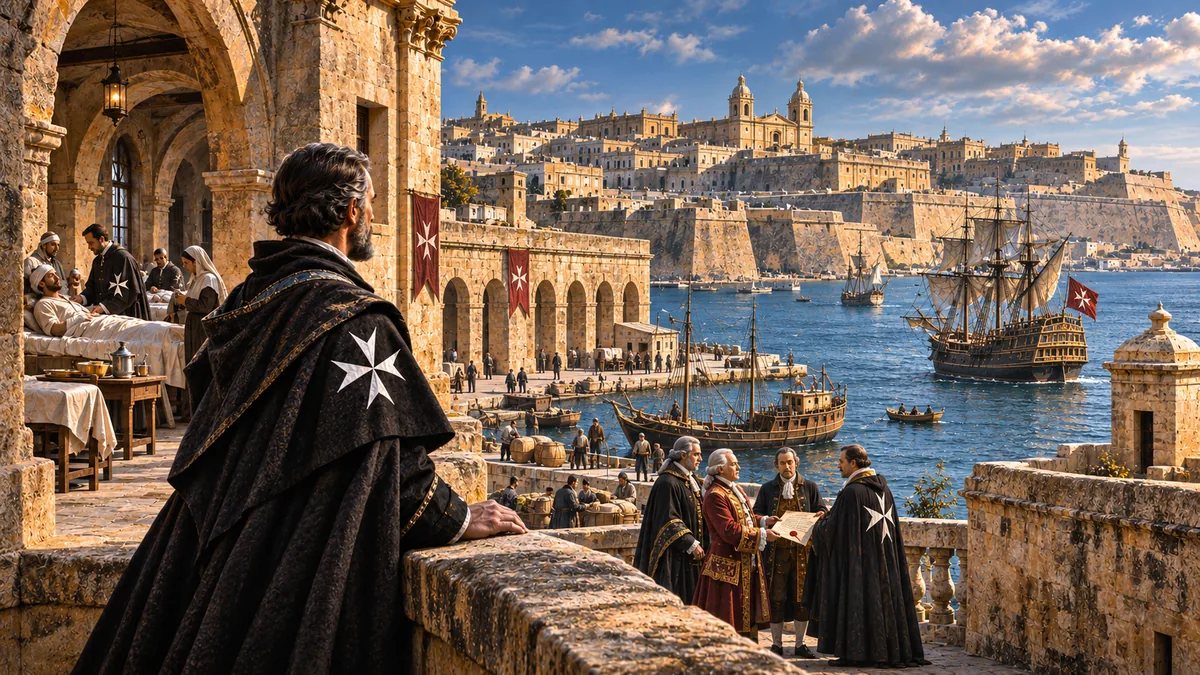
Historical artistic interpretation; not an archival photograph or evidence of one event.
The Order of Malta is an unusual historical example of an institution that lost the territory it once ruled yet retained its own leadership, diplomatic representations, and a distinctive position in international relations. To some, it is primarily a symbol of chivalric tradition and care for the sick; to others, it poses a puzzle: how can an organization without ordinary state territory operate in the world of diplomacy? Its history contains both elements: a genuine humanitarian mission and periods of armed rule during which people also lived in slavery under its administration. [1] [2] [6] [14]
The question, then, is not whether the Order is “influential” in the abstract. It has documented legal powers, a leadership hierarchy, and channels of contact with representatives of states; none of this needs to be guessed at. The harder task is to establish what any particular connection actually permits, who could make decisions at a given historical moment, and where the boundary lies between demonstrated influence and conjecture about covert control. Neither reverence for the eight-pointed cross nor the assumption that anything other than an ordinary state must be a hidden authority is sufficient for that assessment. [3] [4] [7]
The Jerusalem Hospital and the Beginnings of the Order’s Autonomy
The origins of today's Sovereign Military Order of Malta must be sought in the hospital and pilgrim community in Jerusalem associated with Saint John. The institutional history uses approximately the year 1048 for its early beginnings, but this should not be confused with a precisely established date for the founding of the modern institution. Tradition speaks of Blessed Gerard, who led the community when pilgrims, the sick, and city residents depended on organized care. Even here, the source of power was unusual: trust earned by serving people could bring a community resources, protection, and institutional autonomy. [1] [2]
An important milestone came on 15 February 1113, when Pope Paschal II recognized the Hospitallers in the bull Pie Postulatio Voluntatis and established significant rules governing their status, including the ability to choose a successor to their superior from within the community. Such recognition strengthened the Order's position in the Church, but its medieval significance must not be translated directly into modern constitutional law: papal protection and the right to choose internal leadership were not yet equivalent to statehood or unlimited sovereignty. Here we know the bull's wording and significance through the official historical account; we have not directly examined the original Latin archival document for this article. [1]
Over time, alongside care, the Hospitallers also developed armed protection and military activity. This was not a simple transition from “good” medicine to “bad” warfare, but a consequence of the specific crusading and Mediterranean environment in which pilgrimage routes, sieges, landed possessions, and armed security were closely interwoven. Yet when an institution can make decisions both about a hospital and about armed people, accountability becomes an essential question: whom does force serve, who controls its use, and who bears its consequences? [2]
Rhodes and Malta: The Period of Actual Territorial Rule
After the loss of its last major strongholds in the Holy Land, the Order established a new base on Rhodes. Its takeover of the island took place in the early fourteenth century; sources give the years 1309 and 1310, so the historical transition matters more than an appearance of precision attached to a single year. There, the Order developed fortifications, port and maritime infrastructure, and a form of political power that was far from merely symbolic. It lost Rhodes following the Ottoman siege in 1522. [2]
In 1530 it received Malta under feudal conditions and held it until the French occupation in 1798. During this period, its leadership possessed real instruments of power: fortifications, armed vessels, public responsibilities, maritime commerce, and a system of captivity. In light of this history, “knightly order” is an inadequate description if it suggests only a ceremonial brotherhood. The Order also governed territory, took part in international conflicts, and helped shape the daily lives of people under its rule. [2] [15]

The development of its military organization also depended on European political and noble connections. Yet a knightly title or membership held by a particular noble family does not, by itself, tell us whether that family governed the Order, what authority it possessed, or whether its influence extended to decisions made by other states. Malta's history provides sufficiently solid examples of real power that undocumented family connections need not be substituted for identifiable chains of command, administrative acts, and the consequences of decisions. [2] [18]
Galleys, Captives, and the Less Visible History of Chivalry
We would distort the history of the Maltese period if we told only of coastal defense, hospitals, and magnificent ceremonies. Academic research documents that the Order's galleys also depended on the forced labor of captives, including enslaved people, convicts, and debtors. Writing in Antiquity, Russell Palmer examined both historical and material traces of this labor. A galley rower was not merely an invisible source of propulsion behind maritime glory; he was a person whose movements, time, and body were subjected to the authority of others. [14]
Michel Fontenay studied the Maltese slave market between 1530 and 1798, while a university doctoral study of the Hospitallers indicates that enslavement neither began nor ended on the island of Malta: the issue also encompasses earlier Mediterranean relationships between the Order, captives, and forced labor. A study of privateering in the Levant illuminates the links between maritime violence, private commercial interests, licenses granted to operate, and the division of spoils. At this stage, we do not use aggregate figures that we have not verified, nor do we invent individual captives' life stories; not all the key academic works were fully accessible, and we have not directly examined the original galley registers. [15] [16] [17]
Captivity in the Mediterranean was part of a wider, multilateral system of warfare, ransom, and the trafficking of human beings. This context must not be erased, but neither may it become an excuse for minimizing the responsibility of an institution that used and benefited from enslavement. Equally, it would be historically and morally unfair to attribute the responsibility of former leaders to every present-day member. The same standards apply to everyone: we judge actions by evidence, not people by their symbols, religion, or ancestry. [14] [15]
This history places a fundamental question about power at the forefront: can an organization sincerely help some people while exploiting others? History shows that it can; a humanitarian purpose does not guarantee that every other area of activity is just. Nor does this make later care for the sick worthless. Honest research must hold both facts in view rather than using one to erase the other. [2] [14]
After 1798: Sovereignty Without an Ordinary State?
When Napoleon took Malta in 1798, the Order lost actual control of the island. Its leadership subsequently settled in Rome. This rupture is decisive for our subject: an organization that once governed territory preserved a recognizable legal and ceremonial identity, but its present arrangements are not an unchanged continuation of its former territorial rule over Malta. [2] [7]

In Article 4, the current Constitutional Charter describes the Order of Malta as a subject of international law exercising certain sovereign functions in keeping with its mission, while Article 5 governs its status within the Catholic Church and its relationship with the Holy See. These are two related but distinct legal dimensions. International legal personality entails a capacity for certain actions in international relations, not automatically all the characteristics of a territorial state; conversely, a canonical relationship does not in itself negate diplomatic dealings with states. This article cites the official English translations of the Constitutional Charter and Code from 2022 and 2023, while recognizing that the official Italian original is authoritative for legal interpretation. [3] [21]
In a memorandum dated 3 February 1994, the United Nations Legal Office considered the possibility of observer status for entities that are not states. On 24 August 1994, the General Assembly granted the Order of Malta observer status through resolution 48/265. This was a documented achievement in the Order's international presence, but it was neither admission as a UN member state nor legal proof that the Order was an ordinary state. Legal scholars Emma Allen and Mario Prost accordingly discuss its distinctive, sui generis, position and the limits of “statehood without territory.” At this stage, we know their full academic article only through publicly available metadata and abstracts, not through a complete reading of the text. [5] [6] [7]
Likewise, diplomatic accreditation or a special legal personality does not mean that every member of the Order is exempt from the laws of the country where they live. The scope of any privileges depends on specific rules and agreements. To investigate the Order of Malta's influence in a particular country, the relevant questions are which representation communicated with whom, what document resulted, and whether we can demonstrate an effect on a public decision. A photograph of a head of state meeting the Grand Master is evidence of a meeting, not of a secret command. [5] [6] [12]
Aristocratic Tradition and Three Classes of Membership
The name, coats of arms, and ceremonial dress recall centuries when nobility and knighthood opened paths to positions of command and social prestige. The Order of Malta therefore matters in research into European aristocratic networks. Yet the historical importance of noble ties must not be projected onto its present structure without verification. In its official explanations, the Order states that most modern members do not come from old noble families; this is an institutional self-assessment, not an independent census-based analysis of its membership. [18]
The constitutional framework of 2022 distinguishes a First Class of professed members, a Second Class of members who have made a promise of obedience, and a Third Class of other members. They cannot all be described simply as one circle of aristocrats. Membership entails different religious obligations and opportunities to participate in governance. The Code also regulates admission procedures, including preparation of candidates for the Third Class. These rules are publicly available. That does not settle questions about actual practice, but it allows us to verify what the organization formally requires. [3] [18]
The reform removed the former requirement of noble descent for election as Grand Master, a change the Order itself emphasized before the elections of 2023. That did not, however, abolish every historical noble category, title, or genealogical verification in other parts of the Order. Changing a formal qualification at the top is significant, but it does not by itself reveal how the social composition of the membership is evolving or who actually gains access to informal circles of acquaintance. Such research would require specific, verifiable records, not simply recognizable surnames. [3] [19]
Leadership, Confidential Deliberations, and the Limits of Authority
The Order's leadership comprises the Grand Master, the Sovereign Council, and other constitutionally established bodies. The Constitutional Charter and Code specify who may decide matters of membership, elections, administration, and external relations. The Grand Master is not merely the decorative holder of a historical title, but neither is he an unrestricted individual unbound by rules. His powers operate alongside collegial bodies and the Order's special canonical position. [3] [4]
A noteworthy provision is Article 143 of the Code, under which the deliberations and minutes of meetings of the Sovereign Council and the Council of the Professed are confidential, while adopted decisions are exempt from this duty of secrecy. It does not follow that all such decisions must automatically be made public. The provision directly documents a distinction between confidentiality of internal deliberations and the status of adopted resolutions. But such institutional confidentiality is not evidence that members of the Council coordinate the decisions of foreign governments. Inferring external political direction from an internal rule would require further sources concerning specific measures, individuals, and outcomes. [3]
Under the reformed procedure, Fra’ John T. Dunlap was elected Grand Master on 3 May 2023. His election is a documented historical act, distinguishable from the former noble-descent requirement and from broader questions of diplomacy. Discussions of “invisible power” often overlook the fact that influence operates at several levels: an Order may reliably direct its own members and programs without thereby possessing authority over state ministries. [11] [19]
Conflict with the Holy See and the 2022 Reform
Relations with the pope have not always been free of tension. In late 2016, a dispute concerning the removal of Grand Chancellor Albrecht von Boeselager led to a public conflict between the Order's leadership and the Vatican. In January 2017, Reuters reported the Vatican's demand for cooperation with an inquiry, while the Order's official chronology records the resignation of Grand Master Fra’ Matthew Festing and the subsequent reversal of certain exclusion decisions. Media reports also mention a dispute about contraception in some humanitarian programs. These accounts require us to distinguish allegations, institutional conflict, and a legally established finding of an individual's wrongdoing. [9] [10]
On 3 September 2022, Pope Francis promulgated a new Constitutional Charter and Code, relieved the existing senior officeholders of their positions, and appointed a provisional Sovereign Council. The Vatican's account of the intervention matters because it demonstrates very real influence by the Holy See over the Order's internal canonical arrangements. It also referred to a 1953 decision of a tribunal of cardinals that restricted treating the Order's sovereign prerogatives as equivalent to full state sovereignty. We have not directly examined the original text of that decision in this research. Our account therefore relies on the Vatican's published summary, not on any claim to have conducted our own legal analysis of the original ruling. [8] [21]
This public reform is more revealing than fanciful scenarios about an all-powerful Order. If the independence of its leadership were absolute, such direct Vatican intervention would be difficult to explain. Conversely, if the Order's international autonomy were merely an empty label, its continued diplomatic contacts and separate humanitarian structures would be difficult to account for. Research must therefore retain the tension between canonical oversight, special external powers, and actual political effects, rather than collapsing them all into a single word—sovereignty. [3] [7] [8]
Diplomacy in Practice and the Scope of Humanitarian Work
Two events in 2026 illustrate the kind of public international activity the Order actually conducts. According to its official announcement, the leadership attended an audience with Pope Leo XIV in June; in July, the Grand Master visited Croatia and met its representatives. The Order also reported a visit to South America in October and diplomatic relations with Argentina which it itself dates to 1948. These are verifiable connections through which an organization gains recognition and opportunities for dialogue, not evidence of the content of any unpublished agreements or secret orders to governments. [12] [20] [22]
For 2025, Malteser International reports that its programs reached more than eight million people in 33 countries. In the same report, it states that it provided healthcare assistance to more than 700,000 refugees and internally displaced people. These are significant figures for understanding the scale of humanitarian activity, but they come from the organization's own reporting; this article does not present them as the result of an independent audit. They also refer specifically to Malteser International and must not automatically be treated as measures of all members, all diplomatic contacts, or the Order of Malta's total political influence. [13]
Humanitarian action can create a legitimate form of social influence: an institution that supports hospitals, assists displaced people, or organizes disaster responses becomes a partner for public authorities. But its effects must be evaluated at the level of programs, people, and decisions. When the Order participates in an evacuation or provides healthcare, that is a specific undertaking that can be assessed. A claim that the same network secretly determines appointments in governments requires an entirely different kind of evidence—correspondence, instructions, decisions, and a demonstrable connection among them. [12] [13]
From Documented Power to an Unverified Hypothesis
The Order of Malta is not a “secret society” merely because it preserves a religious tradition, has an internal hierarchy, or keeps certain meeting minutes confidential. Much of its history, constitution, diplomacy, and leadership conflicts is publicly documented. Nor must the organization be idealized: its former rule in Malta participated in systems of enslavement and forced labor, while its present aristocratic traditions deserve careful investigation of social access and privilege. [3] [14] [15]
When we speak of covert political power, the evidentiary threshold becomes higher. We would need an identifiable person, date, authorization or communication, a specific decision, and an explanation of why that decision resulted from the claimed influence rather than mere membership or a chance meeting. The absence of such a traceable chain does not prove that no confidential agreement has ever existed anywhere. It does mean that we cannot responsibly claim, on this basis, that the Order of Malta as a whole controls governments, banks, or other religious organizations. Those questions require separate evidence, and financial structures also call for a separate inquiry into ownership. [5] [7] [18]
The philosophical conclusion is less comfortable, but more useful, than a simple division of institutions into benevolent and malevolent. Power must be judged by actions, rules, and consequences, not by prestige or the suspicion aroused by a symbol. Genuine aid does not erase historical violence, and historical violence does not make every present-day charitable act false. If people are to understand the less visible layers of power, they must learn to look at what is easiest to overlook: not only who bears a title, but who can make decisions about another person—and who has the power to hold the decision-maker accountable.
Next in the Series
The next article, SM-29 – Occultism and the Rise of National Socialism, will examine a different historical field in which symbols, ideology, propaganda mythology, and actual political institutions intersect. Moving to that subject does not, in itself, imply that the Order of Malta was institutionally linked to National Socialist occultism; any alleged connection would require separate evidence.
Sources and further reading
- Sovereign Military Order of Malta. “1113 – The Bull ‘Pie Postulatio Voluntatis’” (historical explanation of the bull of Paschal II, 15 February 1113). source. Source
- Sovereign Military Order of Malta. “From the 11th century to the present day” (official historical chronology). source. Source
- Sovereign Military Order of Malta (2023). Constitutional Charter and Code (official English translation; Constitutional Charter promulgated in 2022; examples include Articles 4–5 and Article 143 of the Code). source. Source
- Sovereign Military Order of Malta. “Governance” (official description of governing bodies). source. Source
- United Nations General Assembly (24 August 1994). Observer status for the Sovereign Military Order of Malta in the General Assembly, resolution A/RES/48/265. source. Source
- United Nations Office of Legal Affairs (3 February 1994). Memorandum on observer status for entities other than states, in United Nations Juridical Yearbook 1994, Chapter VI, No. 34, pp. 463–464. source. Source
- Emma Allen and Mario Prost (2022). “Ceci n’est pas un État: The Order of Malta and the Holy See as precedents for deterritorialized statehood?” Review of European, Comparative & International Environmental Law, 31, 171–181. source. Source
- Vatican News (3 September 2022). “Pope promulgates new Constitution of the Order of Malta” (official summary of the papal intervention and mention of a 1953 legal ruling). source. Source
- Sovereign Military Order of Malta (28 January 2017). “The Grand Master Fra’ Matthew Festing resigns from office” (institutional report on the crisis). source. Source
- Reuters (17 January 2017). “Vatican orders Knights of Malta to cooperate with papal inquiry” (contemporaneous news report). source. Source
- Sovereign Military Order of Malta. “Grand Master: Fra’ John T. Dunlap” (official biography and election date, 3 May 2023). source. Source
- Sovereign Military Order of Malta (3 July 2026). “Order of Malta’s Grand Master in Official Visit to Croatia” (report on meetings, 2–3 July). source. Source
- Malteser International (published 2026). Annual Report 2025 (the organization's reporting on programs and aid provided). source. Source
- Russell Palmer (2021). “Slavery, captivity and galley rowing in early modern Malta.” Antiquity, 95 (383), 1280–1297. source. Source
- Michel Fontenay (2001). “Il mercato maltese degli schiavi al tempo dei Cavalieri di San Giovanni (1530–1798).” Quaderni storici, 36 (107). source. Source
- Nicholas McDermott (2022). Hospitaller interactions with servile and enslaved peoples at sea and on land, from the fourteenth to the seventeenth century. Doctoral dissertation, Cardiff University, ORCA repository (metadata and abstract reviewed; the full text was not subjected to a critical reading). source. Source
- Joan Abela (2016). “Per omnes partes barbarie orientis: Maltese corsairing in the Levant during the sixteenth and seventeenth centuries.” In G. Harlaftis, D. Dimitropoulos and D. J. Starkey (eds.), Corsairs and Pirates in the Eastern Mediterranean, Fifteenth–Nineteenth Centuries, pp. 109–125. AdVenture SA. University of Malta repository (metadata and abstract reviewed; the full text was not read). source. Source
- Sovereign Military Order of Malta. “Frequently Asked Questions” (official explanations of membership and aristocratic traditions). source. Source
- Sovereign Military Order of Malta (2023). “The election of the Grand Master taking place on 3 May 2023” (electoral framework and removal of the noble-descent requirement). source. Source
- Sovereign Military Order of Malta (25 June 2026). “Pope Leo XIV receives in audience Order of Malta Grand Master Fra’ John T. Dunlap” (official account of the audience). source. Source
- Sovereign Military Order of Malta (2022; English PDF published in 2023). Constitutional Charter and Code (second official English edition for comparison of provisions). source. Source
- Sovereign Military Order of Malta (27 October 2026). “The Grand Master visits South America” (official report on the visit and relations with Argentina; publication date and updated official URL verified). source. Source