Opus Dei: Faith, Belonging and Influence
Opus Dei is an organization whose name frequently appears in discussions of Catholic faith, political elites, demanding personal ways of life, and concealed networks of influence.
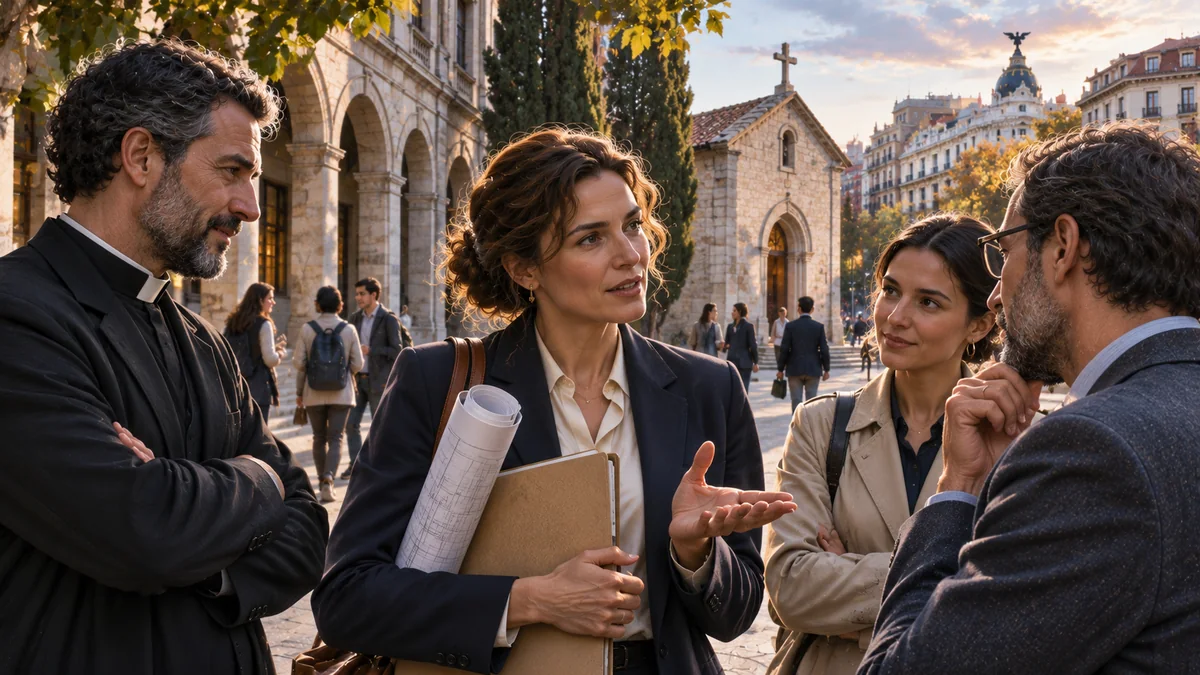
Editorial illustration of the relationship between faith, professional life, and public institutions; it does not depict a documented meeting of Opus Dei members.
Opus Dei is an organization whose name frequently appears in discussions of Catholic faith, political elites, demanding personal ways of life, and concealed networks of influence. Yet the first question already reveals an important distinction: are we talking about an institution with published statutes and a recognized place in the Catholic Church, about the personal connections of its members, or about an alleged leadership that supposedly dictates government decisions from behind the scenes? These are not three versions of the same claim, but three separate research questions. [2] [3] [9]
Its history offers enough documented examples of actual power that there is no need to supplement it with invented chains of command. Members of Opus Dei have held important political offices; the institution has developed an extensive environment of spiritual formation and education; and its internal rules reach into the daily lives of those who belong to it. At the same time, some people have left the organization with experiences that differ substantially from its public self-description. Responsible research must allow all these accounts to be examined, without assigning them equal evidentiary weight in advance. [3] [10] [14] [15]
From Its Beginnings in Madrid to a Recognized Church Institution
Josemaría Escrivá founded Opus Dei in Madrid on 2 October 1928. His central religious idea was not withdrawal from the world but the sanctification of ordinary work: professional effort, family life, and everyday responsibilities were to become a setting for Christian life. The assertion that Escrivá was following divine inspiration belongs to his religious testimony; the date of the foundation and subsequent institutional development, however, are historical matters. The institution's own chronology records the beginning of work with women in 1930, diocesan approval in 1941, and the foundation of the Priestly Society of the Holy Cross in 1943. [1]
Opus Dei developed through various canonical forms before John Paul II granted it the status of a personal prelature through the apostolic constitution Ut sit of 28 November 1982. This is a particular framework within Church law, not a state, a Masonic lodge, or an autonomous parallel church. The prelate and other competent bodies have defined internal responsibilities and duties. To understand their actual reach, we must examine the legal act and the statutes and take later changes into account, rather than deducing unlimited authority over members in every aspect of life from the title “prelate” alone. [2] [3] [20]
Unlike the initiatory orders examined in earlier parts of this series, Opus Dei does not conceal its basic doctrine or institutional existence: it publishes a chronology, legal documents, and accounts of its mission. But making an organization’s name public does not tell us everything about private conversations, who decides on admission, or how an individual experienced obedience. The research question lies precisely in the space between a rule as described in law and an actual relationship of power. [1] [3]

Sanctifying Work: A Spiritual Idea and Its Social Consequences
The idea that a person's faith should be lived through work is not, in itself, a political program. For many members, it may offer a way of connecting professional integrity, religious conviction, and responsibility toward others. On this understanding, personal success is not necessarily a mark of election, and an important position does not automatically confer a right to command. Assessing the spiritual idea must be distinguished from examining whether particular institutions or members have lived by it consistently. [1] [20]
This is also where its social dimension emerges. When religious formation is connected to ordinary professions, it creates an environment in which people encounter one another as students, academics, businesspeople, officials, and friends. Such ties do not necessarily constitute a clandestine organization, but they may create trust, access to information, and opportunities to exercise influence. The path from a shared conviction to a government decision must be demonstrated separately, through an identifiable person, competence, agreement, and outcome. The same standard should apply to a Church group, a political party, a business club, or an alumni association. [12] [13]
Who Belongs to Opus Dei, and What Is Expected of Them?
The publicly available English translation of the 1982 statutes describes different forms of membership. Numeraries live in celibacy and are generally especially available for the prelature's activities, often including residence in its centers. Associates also live in celibacy, but their living circumstances and responsibilities differ from those of numeraries. Supernumeraries may be married or unmarried and ordinarily pursue the organization's mission within family and professional life. These forms are not a ladder of occult degrees; they are distinct ways of life and organizational positions, as described in the statutes. [3]
The statutes also provide specifically for assistant numeraries, women whose work is primarily associated with the domestic and organizational running of the centers. This provision matters because work performed in those centers later became the subject of disputes and allegations by former members. A description of a vocation or religious way of life does not, by itself, establish whether particular women worked voluntarily, enjoyed appropriate protections, or were free to leave without pressure. Establishing that requires evidence about actual working conditions, payments, insurance, free consent, and possible restrictions. [3] [14] [15]
The institution emphasizes the gradual nature of the decision to join and the personal freedom of its members. But voluntariness is not merely the moment someone gives consent. It also involves the ability to reconsider, refuse a demand, seek independent advice, and leave without improper punishment. This is a general ethical standard for reading the statutes alongside personal accounts, not a judgment made in advance about everyone in the organization. [3] [15]
Rules, Internal Authority, and the Right to Leave
The 1982 statutes address more than spirituality. They regulate the authority of the prelate and regional leaders, the admission of members, obligations, and the termination of ties with the institution. Under no. 29, a member wishing to leave during temporary incorporation or after definitive incorporation must obtain a dispensation granted by the prelate following the prescribed consultation. No. 34 states that a person who leaves cannot demand compensation from the prelature for services rendered or contributions made to it. These are concrete written provisions that merit serious scrutiny. [3]
But it would be unjustified to infer directly from them that every such restriction is also valid under civil employment law in every jurisdiction. The canonical regulation of membership, a possible employment relationship, and entitlements to social-security contributions are different matters. What is decisive is whether a person actually worked under conditions that give rise to labor-law or social-protection rights in the country concerned. Nor can the 1982 text replace an examination of any subsequent amendments. [3] [6]
Alongside its hierarchical provisions, the statutes explicitly defend personal freedom, dignity, and independence in social decisions. No. 89 rejects characterizing its activities as secret or clandestine, while encouraging discretion rather than public display; provisions around nos. 118–123 address free initiative and professional life. This is important counterevidence to any claim that the statutes simply demand total political obedience. At the same time, a written commitment to freedom does not prove that pressure has never occurred in any community. [3]
In an organization regulated in this way, an obligation to a shared religious purpose must be distinguished from potentially unlawful coercion in personal or professional life. The issue is not whether an organization may have rules at all; every community does. It is whether the rules are comprehensible, rights are enforceable, authority is subject to scrutiny, and the path out of the community is genuinely accessible. It is here that historical analysis meets the question of a person's inner freedom.
Who Oversees the Prelature? Changes from 1982 to 2026
Opus Dei's legal position has not remained unchanged. On 14 July 2022, Pope Francis issued Ad charisma tuendum, transferring the competent oversight to the Dicastery for the Clergy, providing for regular reporting to the Holy See, requiring an adaptation of the statutes, and amending certain provisions concerning the prelate's position. On 8 August 2023, the Holy See also amended canons 295 and 296 governing personal prelatures. These are published legal acts whose existence is not a matter of rumor or religious belief. [4] [5]
Their precise consequences are matters of canon-law interpretation. In 2024, Dawid Pietras offered an analysis of the changes to the prelature's position and its relationship with laypeople; this is a scholarly contribution, not new legislation or the only accepted interpretation. The essential point is that an account of authority in 2026 cannot simply reproduce the entire 1982 legal model as if nothing had happened since. [6]
According to published reports, Opus Dei submitted a proposal for revised statutes to the Holy See on 11 June 2025. In February 2026, reporting on a meeting with Pope Leo XIV indicated that the process was still under way. When this article was prepared, no subsequently published, definitively approved text had been independently established. We therefore refer to the confirmed legal acts of 1982, 2022 and 2023, and to later reports on the progress of reform, rather than inventing a definitive set of statutes for 2026. [7] [8] [19]
Franco's Spain: When Members Reach the Highest Levels of Government
The best-known historical example of Opus Dei members' political presence is Spain under Francisco Franco's dictatorship. During the government reshuffle of 1957, Alberto Ullastres became minister responsible for trade and Mariano Navarro-Rubio became minister responsible for finance. Historical studies examine their connections with Opus Dei and the role of economic technocrats. These were real individuals in positions of actual power, not fictional figures in a mysterious narrative. [9] [10] [11]
But what does their membership prove about the institution? It proves that certain members reached the highest levels of an authoritarian regime and helped shape economic policy there. On its own, it does not prove that religious leaders ordered a particular government measure or that the cabinet operated as a unified organizational branch of Opus Dei. Historian Anna Catharina Hofmann warns that treating the “Opus Dei technocrats” as a single, uniform circle obscures their internal disputes and the different intellectual origins of their policies. That criticism does not diminish their responsibility for what they did within Franco's state; it demands precision in assigning that responsibility. [10] [11]
In its response about Franco's Spain, Opus Dei emphasized that its members make political decisions as individuals and that the institution did not have a common party-political program. That position is important to include, but it is the response of the institution under examination, not an automatic verdict on every influential connection. Nor should we accept the opposite conclusion merely because two ministers share a religious affiliation. Proof of specific institutional orders would require dated correspondence, identified recipients, testimonies, minutes, and a traceable chain of decisions. [12]
The wider significance of the example is that political influence does not begin only with a secret document. It can develop through personal recommendations, educational circles, ideological proximity, and habits of cooperation. Yet when we move from the finding that networks existed to the claim that a direct order was issued, we must show evidence for that additional step. Without it, an investigation can quickly replace personal accountability with a presumption of collective guilt.
Universities, Business Schools, and Long-Term Social Power
Opus Dei's influence has not been confined to politics. The University of Navarra and IESE Business School appear in studies of Spanish elites as important institutions associated with the Opus Dei milieu. Education creates acquaintances, professional vocabularies, recommendations, and career paths. When former students become executives, professors, or government officials, such communities can influence social decisions over the long term, even without a single secret commander directing them. [13]
Precision is essential here: a university's spiritual association is not the same as legal ownership. Its professors are not automatically members of the prelature, and diplomats or entrepreneurs do not simply execute instructions from their former educational environment. What matters is who actually founded an institution, which governing bodies and legal entities control it, who finances it, and what roles individuals hold. The extent of ownership and financial relationships is a separate research subject belonging to the Who Owns the World? series; here our main concern is how belonging and informal influence take shape through institutions. [3] [13]
A list of famous graduates would not be sufficient to establish abuse of such a network. We would need evidence that a particular recommendation, membership connection, or financial dependency affected a specific decision in conflict with public duties. The distinction between access and the abuse of access matters precisely because it enables us to recognize genuine abuses when they occur.
Argentina: Testimonies About Work That Demand Investigation
The question of inner freedom takes on a different weight in the accounts of former assistant numeraries in Argentina. These women have made allegations of labor exploitation, human trafficking, and forced labor; the Argentine justice system has also taken up the case. Associated Press reported on the investigation in 2024 and, on 9 November 2026, reported on 43 women whose representatives wanted to draw attention to their allegations during the pope's visit to Argentina. The figures 44 and 43 appear in earlier agency reporting and official responses; without the complete court record, they must not be arbitrarily reconciled. [14] [15] [16] [21]
In a response dated 28 July 2025, Opus Dei denied allegations of human trafficking and labor exploitation, stressing the voluntary nature of the choice to pursue this religious way of life. It also described the dispute's development from claims concerning social-security contributions into a criminal investigation. On the other side, former members' accounts raise questions about the relationship between religious belonging, work, supervision, and the possibility of leaving. Each set of claims matters evidentially, but an institutional denial is not an acquittal, just as a testimony or prosecutorial allegation does not, by itself, establish that a crime has occurred. [14] [15] [16]
The chronology matters. In July 2025, the institution described the proceedings as they stood at that time; later reporting from November 2026 describes further developments and allegations concerning certain responsible individuals. Those dates must not be compressed into a single statement as though nothing had changed between them. This article has not included direct examination of all original Argentine court files, individual employment contracts, or any final judgments that may exist. The defensible conclusion is therefore that there are serious, documented allegations and legal proceedings, not that the criminal liability of particular people has already been proved. [15] [21]
Even when courts determine criminal liability, a broader question of responsibility remains: how is free consent ensured, what social protection does someone actually have after years of work for a religious institution, and can a person who leaves exercise their rights and obtain independent assistance? These matters can be discussed reasonably without prematurely condemning anyone. They test whether elevated spiritual principles are reflected in everyday conduct.
Contemporary Allegations, the Institution's Response, and Vatican Oversight
In 2024, journalist Gareth Gore published Opus, a book setting out extensive allegations concerning Opus Dei's political, economic, and personal influence. The organization publicly rejected several significant claims, including the depiction of unified political action and improper financial connections. The book can provide starting points for checking individual documents, and the official response is a necessary part of the counterevidence; neither automatically substitutes for an independent examination of the evidence. [18]
According to Reuters, Pope Leo XIV received Gore on 16 March 2026, when Gore was calling for an investigation. The meeting confirms that these questions reached the highest level of Church authority, but receiving an author is not an endorsement of his book. The same caution applies to new regulations: legal reform does not by itself prove past abuse, although it may indicate that the competent authorities are redefining oversight and the boundaries of responsibility. [4] [17]
Three kinds of power thus intersect in the history of Opus Dei: formal ecclesiastical authority, the social influence of its members, and the power of personal relationships within the community. The first can be examined through legal acts; the second requires historical analysis of particular networks and actions; the third must also be explored through personal experiences, working conditions, and rules on leaving. These distinctions mean that a serious investigation cannot stop at the word “secrecy,” but neither can it stop at an organization's assurance that everything is voluntary. [3] [10] [15]
Free Belonging or Authority Beyond Scrutiny?
A religious community may have an identity, spiritual discipline, and internal obligations. A person may freely choose a demanding way of life. But when a relationship of power emerges in which someone determines another person's work, living environment, disclosure of personal circumstances, or conditions for leaving, the decisive question becomes whether that person has a genuine opportunity to choose freely. This standard does not arise from hostility to religion, but from respect for human dignity and the responsibility of every institution, religious or secular.
Opus Dei does not become a clandestine ruling organization merely because some of its members occupy influential positions; nor can it be exempt from public scrutiny simply because it grounds its mission in religion. Evidence of political careers is not the same as evidence of organizational commands; a written rule is not the same as lived practice; and a serious allegation is not the same as a final court judgment. These distinctions are not an obstacle to researching hidden power, but a condition for doing so responsibly.
The investigation therefore does not end with the question of who belongs to Opus Dei. It continues by asking: who had the authority, who actually made a decision, who bore the consequences, and did people have independent ways to object? Where the documents provide answers, they should be stated plainly. Where they do not, room remains for honest investigation—without collective blame, but also without automatic trust in authority.
Next in the Series
The next article, SM-28 – The Order of Malta: From Knighthood to Diplomacy, examines a different institution whose history spans medieval knighthood and modern international activities. A shared Catholic setting or contact between individuals is not evidence that Opus Dei and the Order of Malta are institutionally subordinate to one another; here too, we will examine relationships through specific documents and events.
Sources and further reading
- Opus Dei (2006). “Historical Overview” — institutional chronology (institutional source). source. Source
- John Paul II (28 November 1982). Ut sit, apostolic constitution on the personal prelature Opus Dei (original Latin legal act). source. Source
- Opus Dei. Statutes of Opus Dei (1982; unofficial English translation published in 2022), especially nos. 6–13, 28–34, 89, 118–125 and 181. source. Source
- Francis (14 July 2022). Ad charisma tuendum, apostolic letter issued motu proprio. source. Source
- Francis (8 August 2023). Apostolic letter amending canons 295–296 concerning personal prelatures. source. Source
- Dawid Pietras (2024). Study of the legal position of a personal prelature after the changes of 2022–2023, Kościół i Prawo, 13(2), 25–46 (academic abstract accessible). source. Source
- Opus Dei (16 February 2026). “Pope Leo XIV Receives the Prelate of Opus Dei in Audience” (institutional report). source. Source
- Victoria Cardiel, EWTN News (16 February 2026). Report on the continuing consideration of proposed statutes. source. Source
- Leslie Mackenzie (1973). “The Political Ideas of the Opus Dei in Spain”, Government and Opposition, 8 (abstract accessible). source. Source
- Andrés Villena-Oliver and Alejandro Romero-Reche (2024). “A Formula to Save Us (From Ourselves): Continuity and Change in the Spanish Legal Domination System (1959–2024)”. Sociology Lens, 37(2), 240–255 (sociological analysis of Spanish elites and the legitimacy of authority). source. Source
- Anna Catharina Hofmann (2023). “Autoritarismo administrativo, sociedad desmovilizada: Laureano López Rodó y los orígenes del desarrollismo franquista”. Historia y Política, 50, 277–309 (study of ideological differences and internal conflicts among Franco-era technocrats). source. Source
- Opus Dei (2008). “Opus Dei and Franco” (official institutional response). source. Source
- Antonio Martín-Cabello, Eva Matarín Rodríguez-Peral and Rubén J. Pérez Redondo (2025). “Spanish Elites From the Late 19th Century to the Present”. Sociology Lens, 38, 154–167 (review of Spanish elites, including the University of Navarra and IESE). source. Source
- Associated Press (2024). Report on criminal allegations and an investigation in Argentina. source. Source
- Opus Dei (28 July 2025). “Questions and Answers About a Legal Investigation in Argentina” (statement by the institution concerned). source. Source
- Associated Press (November 2026). “Pope Leo XIV’s Argentina visit brings renewed scrutiny of clergy abuse scandals” (agency report referring to 43 former assistant numeraries and their request for a meeting). source. Source
- Joshua McElwee, Reuters (16 March 2026). “Pope meets author urging investigation of Catholic group Opus Dei”. source. Source
- Opus Dei (1 October 2024). “Response to Gareth Gore’s book Opus” (institutional response to the book). source. Source
- Opus Dei (2025). “Questions & Answers about the Ordinary General Congress” (institutional explanation of the statutes procedure). source. Source
- Opus Dei. “Personal Prelature” (institutional explanation of canonical status). source. Source
- Associated Press (9 November 2026). “Pope meets with survivors of clergy abuse in Argentina as it reckons with legacy and ongoing cases” (agency report, separate from any judicial determination). source. Source