Golden Dawn, Aleister Crowley and the O.T.O.
In London at the end of the nineteenth century, people studied secret rituals, adopted new names and progressed through degrees whose meanings were known only to initiates.
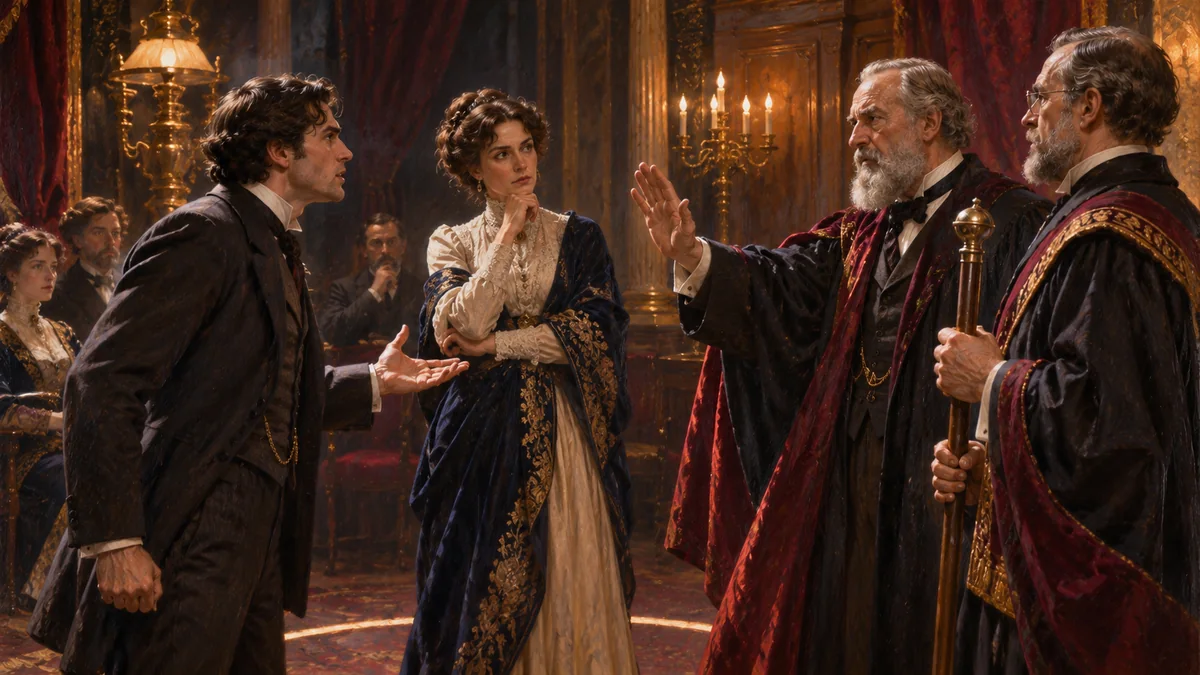
Editorial illustration; not a depiction of a documented historical meeting.
In London at the end of the nineteenth century, people studied secret rituals, adopted new names and progressed through degrees whose meanings were known only to initiates. Among them were poets, actresses, physicians and students of esotericism. Some leaders invoked invisible “Secret Chiefs” as the source of their internal authority; yet when disputes erupted, power also depended on thoroughly earthly things: letters, warrants, rules, personal loyalties and the right to use ritual premises. This duality runs through the history of the Hermetic Order of the Golden Dawn and the later Ordo Templi Orientis. [1] [3] [4]
Aleister Crowley moved between such organizations, altered their teachings and devised new forms of ritual practice. His life therefore provides an important trail of connections, not proof that all these orders formed a single hidden authority. To understand how their power worked, we must distinguish a historically attested organization, its own account of itself, and claims to supernatural or political leadership. [1] [2] [7]
Golden Dawn: an order born of cipher manuscripts
The Hermetic Order of the Golden Dawn took shape in 1888 within a British milieu of Freemasons and students of Western esotericism. Its founders included William Wynn Westcott, Samuel Liddell MacGregor Mathers and William Robert Woodman. Westcott and Mathers were associated with the Societas Rosicruciana in Anglia (SRIA), discussed in our article on the Rosicrucians. But the Golden Dawn was an independent organizational initiative, with its own rituals and membership, not simply another name for the SRIA. [1] [2]
An important part of the story concerns the so-called Cipher Manuscripts, on which the drafts of the early initiation rituals were based. Westcott said he had received the material through a Masonic intermediary, Adolphus Frederick Alexander Woodford. The tradition also features a German adept, Anna Sprengel, who allegedly authorized the founding of the order. The existence of manuscript material and its use by the emerging organization are historical matters supported by documents; however, Sprengel's alleged identity and authority to grant a warrant must not be presented as independently established facts. [2] [5]
The cipher drafts were only the beginning. Westcott and Mathers developed a system of rituals, instruction and advancement combining Kabbalah, tarot, alchemy, astrology and Western Hermetic themes. Such a synthesis does not prove an unbroken institutional lineage from ancient Egypt or medieval secret brotherhoods. It does, however, demonstrate genuine cultural creation: older symbols and texts were newly organized into a program that admitted people to actual groups, assigned them duties and conferred ranks. [1] [2]
Who could join, and who could decide?
Unlike parts of the Masonic world of the time, the Golden Dawn admitted both men and women. Its well-known members included the poet William Butler Yeats, the actress Florence Farr, Maud Gonne and the artist Moina Mathers, born Mina Bergson. Women were not merely spectators or passive companions. Some held prominent organizational and ritual roles, an important consideration when assessing the order's social character in Victorian Britain. That does not mean all its internal hierarchies were entirely egalitarian. [1] [6]
The rituals defined degrees of membership, while knowledge was distributed so that members did not receive all of it at once. This arrangement could provide demanding study, group discipline and a distinctive symbolic experience. At the same time, it allowed leaders to control who could advance, who could be entrusted with manuscripts and who could affirm the validity of a ritual. The question of power therefore does not begin with whether magic worked supernaturally, but with the verifiable fact that certain individuals possessed the authority to judge other individuals. [1] [6]
Ideas about the Secret Chiefs further complicated the question of legitimacy. Invoking a higher authority inaccessible to ordinary members could strengthen a leadership's position, yet those claims were themselves disputed. Historian Christopher Coome therefore examines how assertions about Secret Chiefs intertwined with visible rivalries among members during the order's disintegration. Investigating their role in the language and practice of authority is not the same as proving that supernatural chiefs actually existed. [3]
The year 1900: when a schism exposed internal power
Crowley entered the Golden Dawn on 18 November 1898. He advanced rapidly through the preliminary degrees and sought admission to the Inner Order. When London members opposed this, he turned to Mathers in France early in 1900. His dispute with the London leadership, including Yeats, became part of a wider organizational crisis. Historian Nevill Drury also records Crowley's ambition to displace Yeats from the leadership of the English branch of the order. [7]
The dispute was not merely a clash of personalities. It concerned the validity of warrants, who had the right to confer degrees, and whether a distant leader could overturn decisions taken by the London group. The Yorke Collection at the Warburg Institute catalogs material relating to this crisis, including rules, letters and publications from 1900. Its catalog, together with the archival inventory at the Harry Ransom Center in Texas, confirms that such documentary traces exist. Not all the original sheets or the complete correspondence were examined directly for this research, so we do not infer details beyond what the catalog descriptions establish. [3] [4] [5] [8]
The consequences of the schism are historically significant. If a single, all-powerful and uninterrupted hidden center had been demonstrated for the Golden Dawn, it would also have to account for the order's inability to retain its own leaders within one institution. Instead, historical sources show mutual accusations, refusals of obedience and later competing lines of succession. The schism does not prove that there was no concealment or no ambitious leadership within the order; it does limit the claim that all its members always acted within a single chain of command. [1] [3] [8]
Crowley, Cairo and the emergence of Thelema
Crowley grounded his own religious and ritual path in Liber AL vel Legis (The Book of the Law), a text which, by his account, he received in Cairo on 8–10 April 1904. It became the central text of his teachings, later known as Thelema. Surviving manuscripts, editions and Crowley's accounts allow us to study how his religious interpretation arose and spread. They cannot, however, independently establish that the text was actually dictated by a separate supernatural entity named Aiwass, as Crowley claimed. [9] [10]
Historian Caroline Tully draws attention to Egypt's importance as a source of symbolic authority in the Hermetic milieu and in Crowley's account of his experience. This is therefore not only a question of a private mystical event. When someone presents a new authority as a revelation from a place already associated by the audience with ancient wisdom, that shapes how others perceive the person's right to teach. This is a historical and cultural explanation of the making of legitimacy, not a final verdict on someone's inner experience. [10]
In 1907 Crowley, together with George Cecil Jones, developed A∴A∴, a separate initiatory system associated with study, discipline and Thelema. He later also played an important role in the O.T.O., but the two were not the same institution. Their leadership structures and routes to membership differed, although some individuals and teachings overlapped. The O.T.O.'s public manifesto of 1919 expressly states that A∴A∴ is not part of the O.T.O. but is its ally. [11] [14]
O.T.O.: from Reuss's warrants to Crowley's British branch
The Ordo Templi Orientis (O.T.O.) arose in German-speaking esoteric and ritual-Masonic circles around the turn of the twentieth century. Carl Kellner and Theodor Reuss, and later Franz Hartmann and others, are associated with its early history. The official history of today's American branch of the O.T.O. describes Kellner's idea for an Academia Masonica and Reuss's acquisition of ritual warrants early in the century. This is a valuable institutional record, but the self-account of one successor organization is not a definitive independent judgment on the precise origins or uninterrupted validity of every historical warrant. [12]
A more reliable chronological marker for Crowley's specific role is his association with Reuss. According to the O.T.O.'s official history, Reuss admitted him to three degrees in 1910 and, on 21 April 1912, issued him a warrant to lead the British and Irish branch known as Mysteria Mystica Maxima (M∴M∴M∴). Academic research confirms that Crowley held a significant leadership position in this organizational connection in 1912. A regional warrant is not, in itself, proof that he had already succeeded Reuss as the undisputed worldwide head. [11] [12]
A published transcription of a contract between Reuss and Rudolf Steiner dated 3 January 1906, concerning ritual powers within Mystica Aeterna and the Memphis–Misraim systems, also confirms connections with a broader esoteric milieu. That document was discussed in SM-24. Its importance here is limited but clear: powers were sometimes regulated by specific terms, not merely by mutual recognition of symbols. We did not examine the original archival sheet for this article; nor does the agreement establish that the O.T.O. directed all of Steiner's activities. [13]
What did the leaders of the O.T.O. actually write in 1919?
An important source is the journal The Equinox, Volume III, Number 1, published on 21 March 1919. Among other works it contains Liber LII (the O.T.O. manifesto), Liber CI (an open letter to prospective members) and Liber CXCIV (an account of the order's constitution). Unlike later stories about the supposed omnipotence of secret societies, these are publicly issued rules and promises that can be read and compared. Bibliographic records confirm their inclusion in the issue; available online transcriptions permit examination of the individual texts. [14] [15] [16] [17]

Liber LII lists numerous historical and spiritual traditions, including the Templars, Rosicrucians, Illuminati and several Masonic rites. It states that the heads of these orders decided to reunite their activities. This is literally the organization's claim about its own mission, not independent evidence that all the historical orders named actually accepted a common head. The same document lays claim to extraordinary secrets, including some that cannot be treated as scientifically demonstrated effects. What makes it valuable for a history of power is precisely how sweeping claims about knowledge and antiquity accompanied highly concrete rules for admitting members. [15]
The manifesto describes degrees 0°–X°, the position of the supreme head (Outer Head of the Order, O.H.O.), a regional Grand Master, a Treasurer and a Secretary. It states that adult candidates of good repute could advance to the Third Degree, whereas higher degrees were to be conferred only by invitation from the appropriate leadership. It also refers to initiation payments, subscriptions and diploma fees. The result is a clear organizational asymmetry: certain knowledge and higher decisions were reserved for selected positions. The text shows that such rules were proclaimed in 1919; it does not by itself establish actual membership figures, every payment made or the rules followed today. [15]
Liber CI describes the expected duties and promised benefits of membership: paying contributions, answering summonses, mutual assistance and support during business and personal hardship. Its introductory provision says that the listed rules come into force in a district when membership exceeds one thousand people. Without evidence that this threshold was reached in a particular district and that the promises were actually fulfilled, we must not describe the proposed system as an already functioning welfare arrangement or a proven economic network. The promise of mutual support nevertheless matters: it depicts a group seeking to shape its members' everyday relationships. [16]
More striking still is the political program in paragraph 40 of the same document. Members are instructed to try to attract royalty, ministers, senior diplomats, military officers and civil officials, with the explicit long-term aim that a state's temporal power should adopt the principles of Thelema. Other provisions encourage business cooperation among members, giving part of one's property to the order and bringing internal disputes before its own bodies; paragraph 28 expressly denies rights to people outside the order, even while recommending kindness to them and using a degrading comparison with animals. Thus the intention to exert wider influence and to privilege insiders is documented in a primary text, but its actual political effectiveness is not. [16]
Both the historical responsibility for such language and subsequent organizational changes must be considered. In a memorandum issued in April 1999, the American branch of the O.T.O. expressly stated that it does not advocate treating nonmembers as people without rights, aggressively recruiting politically influential individuals or forcibly subordinating personal property to the order. The modern organization's account does not change the meaning of the 1919 source; equally, the old text should not automatically be presented as the operative rulebook of every present-day branch. [20]
Liber CXCIV further describes internal administration, the distribution of responsibilities among degrees and the relationship between leaders and members. The text advances the idea that a person comes to understand the order's wider arrangement by analogy with their own life. Historically interesting is the connection between spiritual instruction and an authority structure: the same system that presents itself as a route to personal transformation also determines who may give instructions and who has the right to decide on admission. This is real organizational power, not automatic evidence of authority over public institutions outside the order. [17]
The same document sharply criticizes general elections as a way of choosing competent leaders. For internal decision-making it envisages an eleven-member council and particular arrangements for appeals and oversight between degrees. Here we can observe a concrete political philosophy of the order—its trust in selected positions and selective checks—without presenting it as evidence that a similar model was imposed on any state. [17]
The Gnostic Mass: the transmission of a ritual as evidence of a real connection
In 1913, Crowley composed the Gnostic Mass (Liber XV), a ritual that became important to the O.T.O. Theodor Reuss prepared a German translation or adaptation around 1917; that version was published in 1918. In a study first published online in 2024, Manon Hedenborg White emphasizes that Reuss's text was not a merely mechanical translation but also contained editorial changes. This is a concrete example of ritual material passing between the two leaders and demonstrates how teachings were reshaped in different settings. [18]
Such collaboration provides stronger evidence of a real connection than similar emblems or retrospectively drawn “family trees” of secret societies. It also shows why we must speak of a particular text, particular people and a particular moment. The intertwining of rituals does not prove that all organizations from which the two men borrowed ideas accepted the same supreme leader. Historical research must distinguish exchange, inspiration, formal authorization and actual institutional subordination. [11] [18]
After Reuss: succession and the limits of the political hypothesis
Reuss died in 1923. Crowley subsequently asserted his position in the international leadership of the O.T.O., but questions of formal succession and the history of later branches are complex. Official organizational chronologies are important sources on how each branch legitimizes itself; documentary research must compare their claims with contemporary records and different paths of succession. We therefore cannot, without further archival verification, state that there was a single chain of authority recognized by everyone during this period. [11] [12] [19]
What evidence is there, then, for influence on society beyond the orders? We have named members, ritual books, organizational agreements, journals and contacts with cultural figures. These support the conclusion that the Golden Dawn and the O.T.O. significantly influenced modern Western esotericism, literature and religious practice. Manon Hedenborg White also notes that A∴A∴ and the O.T.O. had few members during Crowley's lifetime and that his publications generally circulated on a modest scale—an important corrective to impressions of their supposed omnipotence at the time. These facts do not justify a leap to the claim that the orders secretly ran the British government or global financial institutions. Such a conclusion would require identified public decisions, a financial trail, correspondence conveying instructions, those who carried them out and a verifiable causal connection. The material examined here does not establish such a comprehensive chain. [1] [11] [19]
The distinction matters because Liber LII itself made exceptionally sweeping claims about the order's scope. Did its leadership really command the international structure it proclaimed? How many people and resources did it possess? How far did its influence on political decisions extend? These are separate research questions. Missing documents do not prove that connections never existed, but the possibility of such connections is not evidence that the organization ruled the world through them. [12] [15]
Initiation, inner freedom and the question of accountability
The history of these orders is not merely about symbols. It concerns real people who joined ritual communities, sought knowledge, formed alliances, argued over rules and expelled one another. Some saw initiation as self-discipline and a path of personal transformation; others invoked special warrants that ordinary members could not independently verify. These internal relationships can help explain the orders' appeal without attributing identical motives to every member or declaring a collective conspiracy without evidence. [1] [3] [15]
The philosophical question is therefore more precise than a general fear of the “occult.” When does voluntarily accepted discipline develop a person's judgment, and when does it demand that judgment be surrendered to an unverifiable authority? Secrecy alone does not prove abuse, yet how an organization handles dissent, departure and oversight of its leaders is an important ethical measure. We should assess concrete procedures and consequences, not merely beliefs that outsiders find unusual.
The Golden Dawn and the O.T.O. thus reveal two kinds of authority. The first is documented, human and historical: decisions about membership, degrees, money, rituals and leadership. The second is claimed: access to a hidden, ancient or supernatural source of legitimacy. The first can be checked against records and testimony; the second can be studied as belief and a source of influence without uncritically converting it into proven fact. Keeping these two levels separate allows readers to consider hidden power freely, neither as adherents nor as predetermined opponents.
Continuation
The next article, SM-26 – Jesuits: Faith, Knowledge and Political Influence, examines a substantially different historical example: a Catholic religious order with a publicly identifiable institutional history, educational work and documented connections to politics. We will not automatically connect its position to the Golden Dawn or the O.T.O.; the research standard remains the same—specific sources, actual powers and demonstrated effects.
Sources and further reading
- Henrik Bogdan (2016). “The Golden Dawn and the O.T.O.” In: The Cambridge Handbook of Western Mysticism and Esotericism. Cambridge University Press. source. A substantial excerpt is publicly available, not the entire chapter. Source
- The Hermetic Order of the Golden Dawn. “History of the Golden Dawn: An Introduction.” source. The organization's account of its founding and the Cipher Manuscripts, not independent proof of the tradition concerning Sprengel. Source
- Christopher Coome (2025). “The Changing of the Guard, 1889–1903.” In: The Foundations of Re-Enchantment. Oxford University Press. source. The publicly available abstract was used. Source
- Warburg Institute. “The Yorke Collection.” source. Information about the collection and reproduction restrictions. Source
- Warburg Institute. Yorke Collection, NS 1–49 (archival catalog). source. Catalog information, not direct inspection of original documents; visual examination of the PDF was unsuccessful during C0 research. Source
- Nevill Drury (2011). “New Light: The Rise of the Golden Dawn.” In: Stealing Fire from Heaven. Oxford University Press. source. The public chapter description was reviewed. Source
- Nevill Drury (2011). “Aleister Crowley and the Left-Hand Path.” In: Stealing Fire from Heaven. Oxford University Press. source. The publicly available abstract was reviewed. Source
- Harry Ransom Center, University of Texas at Austin. Aleister Crowley: An Inventory of His Collection. source. Archival inventory, not an examination of every original document. Source
- Hermetic Library. “Liber AL vel Legis” (transcription, index and information on the text). source. The text is evidence of the doctrine, not of its claimed supernatural origin. Source
- Caroline J. Tully (2010). “Walk Like an Egyptian: Egypt as Authority in Aleister Crowley’s Reception of The Book of the Law.” The Pomegranate. source. A publicly available academic discussion was used. Source
- Manon Hedenborg White (2021). “Rethinking Aleister Crowley and Thelema: New Perspectives.” Aries: Journal for the Study of Western Esotericism 21(1), 1–11. source. The available academic text discussing A∴A∴, the O.T.O. and membership size was also checked; a visual view of the PDF was unsuccessful during this review. Source
- O.T.O. US Grand Lodge. “History.” source. Institutional history; dates concerning Reuss and Crowley must be distinguished from evidence that all successor branches mutually recognized one another. Source
- Rudolf Steiner Archive. “Contract between Theodor Reuß and Rudolf Steiner,” GA 265, 3 January 1906. source. Published transcription, not a directly examined archival original. Source
- 100th Monkey Press. “The Equinox, Volume III, Number 1” (bibliographic description of the issue dated 21 March 1919). source. Contents and bibliographic documentation. Source
- Aleister Crowley (1919). Liber LII: Manifesto of the O.T.O. In: The Equinox, III/1. Textual transcription, Blazing Star Oasis, O.T.O.: source. A publicly available primary text was used; it describes the order's intentions and rules, not independently established control over all organizations it names. The original C0 register also gives source. Source 1 Source 2
- Aleister Crowley (1919). Liber CI: An Open Letter to Those Who May Wish to Join the Order. In: The Equinox, III/1. source. The complete publicly available transcription was reviewed; it is not evidence that every promised rule was put into practice. The research supplement also gives source. Source 1 Source 2
- Aleister Crowley (1919). Liber CXCIV: An Intimation with Reference to the Constitution of the Order. In: The Equinox, III/1. source. The complete publicly available transcription was reviewed; the research supplement also gives source. Source 1 Source 2
- Manon Hedenborg White (2024, online publication; 2026 journal issue). “Fire-Faith and the Gnostic Neo-Templars: Aleister Crowley’s Gnostic Catholic Mass and Its c. 1917 German Translation by Theodor Reuss.” Aries: Journal for the Study of Western Esotericism 26(1), 58–92. source. The public abstract and publisher's bibliographic details were used; the full article was not examined. Source
- Martin P. Starr (2024). The Unknown God: W. T. Smith and the Thelemites. Oxford University Press. source. A bibliographic and scholarly starting point for further investigation of lines of succession; the full book was not examined. Source
- O.T.O. US Grand Lodge, Sabazius X° (April 1999). “A Memorandum Regarding Liber CI.” source. The organization's account of differences between Crowley's 1919 provisions and the American branch's later practices. Source