Theosophy and the Spiritual Transformation of the World
Can an international association founded to seek wisdom and human fellowship also believe that its work is guided by teachers whose identities cannot be publicly verified?
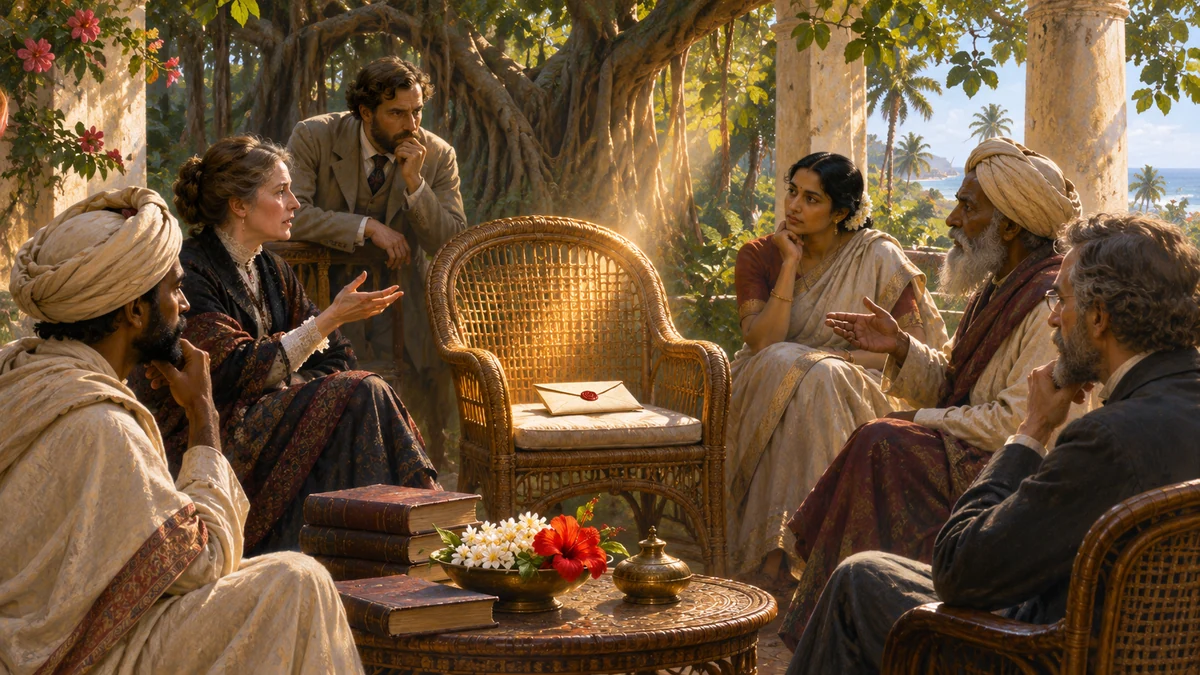
Editorial illustration of Theosophy's question of unseen spiritual leadership; not a documented meeting or an authentic archival letter.
Can an international association founded to seek wisdom and human fellowship also believe that its work is guided by teachers whose identities cannot be publicly verified? This tension runs through the history of the modern Theosophical movement. Its founders spoke openly of universal brotherhood, the comparative study of religions, and spiritual development. At the same time, letters attributed to mysterious “Mahatmas” appeared to some followers as evidence of a higher authority supposedly surpassing ordinary human knowledge. [1] [2] [4]
Theosophy cannot be explained merely as a secret order, nor can it be treated as an innocuous philosophical discussion without social consequences. Its members published books, established branches, and participated in public reform and political movements. The central question for an investigation of hidden power is therefore not whether Theosophy is “behind everything,” but where the claim to spiritual guidance intersects with actual organizational influence—and which documents allow us to establish what really happened.
New York, 1875: A Visible Society and the Promise of Ancient Wisdom
The Theosophical Society was founded in New York in 1875. Its principal founders included Helena Petrovna Blavatsky, Henry Steel Olcott, and William Quan Judge. The organization had identifiable leaders, public activities, and, later, branches in several countries. In 1882 the Society established its international headquarters at Adyar, near Madras, now Chennai. Its existence is therefore not a hypothesis: organizational histories, publications, and records of its activities survive. [1]

The Society’s current official presentation identifies three objectives: forming a nucleus of universal human brotherhood without distinction of race, creed, sex, caste, or color; encouraging the comparative study of religion, philosophy, and science; and investigating unexplained laws of nature and powers latent in humanity. This formulation illustrates the Society’s enduring understanding of its mission. It should not, however, be presented without further verification as the literally unchanged founding constitution of 1875, since the statements of its objects evolved over time. [2]
In Isis Unveiled (1877) and The Secret Doctrine (1888), Blavatsky developed an extensive account of ancient wisdom, spiritual evolution, and hidden connections among religions. These were real and influential historical publications. Reading them does not, however, establish that the cosmic history they describe actually took place, or that all the teachings they present came from a continuous institution operating in secret. [3]
The pursuit of brotherhood had particular significance in a nineteenth-century world shaped by colonial hierarchies, European confidence in its scientific authority, and religious disputes. Europeans, Americans, and Indian thinkers encountered one another in Theosophical circles, but they did not all enter those relationships on socially equal terms. Both the movement’s emancipatory possibilities and the hierarchies that may have persisted within it therefore deserve examination. [16]
The Mahatmas: When Spiritual Authority Took the Form of a Letter
Letters said to have been sent by the spiritual teachers Koot Hoomi and Morya occupy an important place in the early history of Theosophy. This correspondence is particularly associated with Alfred Percy Sinnett and Allan Octavian Hume. It contains discussions of human beings, nature, the development of consciousness, and relations between disciples and masters. To believers, such letters could serve as confirmation that a circle of wiser guides stood above the Society’s visible members. [4] [5]
Here we must distinguish a material object from the explanation given for its origin. The British Library holds material dating approximately from 1880 to 1886 in the collection known as the Mahatma Papers, catalogued as Add MS 45284–45286. The archival description identifies letters purportedly originating with the Mahatmas and expressly records the dispute over authorship. The existence of archived documents and their historical recipients can be verified; that alone does not establish who actually wrote the letters, whether they were transmitted by unusual means, or whether the claimed invisible hierarchy existed. For this article, the archival description and scholarly discussions were reviewed, not every physical document in the collection. [4] [5]
In 1885 Richard Hodgson published an investigative report accusing Blavatsky of producing supposedly supernatural phenomena and letters through deception. His allegations attracted considerable attention. In 1986 the handwriting expert Vernon Harrison criticized, above all, the report’s methods of evaluating manuscript evidence. Subsequent criticism also pointed to Hodgson’s bias and excessive certainty in some conclusions. This matters for a fair account of the investigation, but it does not conversely prove that every letter was an authentic communication from supernatural masters. [6]
The dispute is therefore not satisfactorily resolved either by accepting the letters uncritically because of their religious significance or by appealing to a once-influential investigation while disregarding later criticism. Several distinct questions must be recognized: who composed the text, who physically wrote it, how it reached its recipient, and why particular people recognized spiritual authority in it. Even if some of these questions cannot now be answered conclusively, the actual effects of belief in the Mahatmas on the Society and its members can still be investigated.
India: From Spiritual Encounters to Political Organization
The most tangible wider historical consequences of Theosophical circles emerge in colonial India. Allan Octavian Hume was a British colonial official and one of the principal initiators of the Indian National Congress, founded in 1885. In the early 1880s he became deeply involved in Theosophy and corresponded with people in its circles. Isaac Lubelsky investigates how Hume’s Theosophical worldview influenced his political initiatives, while Mark Bevir describes the broader setting in which educated Indian thinkers, reformers, and liberal Britons developed organizational networks and a new language of political unity. [7] [8]
There is more to this history than simply saying that “Hume was a Theosophist.” Bevir emphasizes that Theosophy offered some Indian participants space for new forms of self-confidence, encounters across regional boundaries, and political reflection. Yet the Congress emerged from the collaboration of numerous Indian actors and concrete political circumstances. Hume’s interest in the Mahatmas therefore does not establish that the Theosophical Society as a whole controlled the Congress, still less that invisible teachers issued its political instructions. [8]
An even clearer example of the intersection between spiritual and public activity is Annie Besant. She joined the Theosophical Society in 1889 and became president of its Adyar-based international organization in 1907. In India she actively supported political self-government; in 1916 she led a Home Rule initiative, and in 1917 she presided over the Indian National Congress. Her public political role, lectures, organizing, and newspaper activities are documented. These visible actions are better evidence of social influence than an inference of secret command based on her spiritual beliefs. [9] [10]

Yet this is not a simple story of Western teachers who “awakened” India. Indian Theosophists, reformers, and nationalists had their own ideas and political goals. Julian Strube’s research emphasizes that Theosophy both retained some colonial assumptions and enabled active participation by people whose voices were often overlooked in older, Europe-centered histories. If we wish to assess who influenced whom, we must also attend to these actors and to existing relations of power. [16]
Steiner, Reuss, and the Question of Actual Initiatory Authority
When Theosophical history intersects with ritual orders, relationships can be investigated much more concretely. In the published transcription of an agreement between Theodor Reuss and Rudolf Steiner, dated 3 January 1906, Steiner is identified as general secretary of the Theosophical Society and leader of the Berlin mystical temple or chapter Mystica Aeterna. As presented in the text, the agreement concerns Reuss’s ritual organization associated with the Memphis and Misraim rites. It specifies whom Steiner may admit to the ritual organization, how degrees and diplomas are to be conferred, where authority lies, and what payments and restrictions apply. [11]
This is an example of the actual formalization of esoteric authority: rather than referring vaguely to hidden masters, we can examine a text laying out rights, conditions, and supervisory relationships. Nevertheless, the published document is not an original manuscript that was directly inspected for this article. Nor does the existence of the agreement justify automatically equating Steiner’s activities with every later form of the O.T.O., or concluding that Theosophy and all ritual orders constituted one institution with a single hierarchy. The details of Reuss’s connections with initiatory systems belong in the following article, SM-25. [11]
Disagreements and limits to control within the Theosophical world are also visible in the split that led to an independent Anthroposophical movement. On 8 December 1912, the German executive committee informed members of the Order of the Star of the East that it regarded their membership as incompatible with belonging to the German Section of the Theosophical Society. The document is a primary source for the committee’s position, not an impartial account of every party to the dispute. [12]
Steiner later explained his own intellectual and organizational path in his autobiography, including why he and his associates left the Theosophical organizational environment. His account helps explain how the future Anthroposophists understood themselves, but it must also be assessed as his personal interpretation of events. In any case, the split of 1912–1913 is a significant counterargument to the notion of a wholly unified, continuous, and disciplined secret organization: genuine tensions, divergent teachings, and conflicting organizational decisions existed. [12] [13]
From Hidden Masters to the Idea of a Plan for the World
In the twentieth century, Alice A. Bailey continued and reshaped some Theosophical ideas about a spiritual hierarchy and a group of people supposedly working to transform the world. In A Treatise on White Magic, she speaks of a future group she calls an “oligarchy of elect souls.” She does not stop at that phrase: she explicitly predicts that the group will one day “govern and guide the world,” and envisages its surpassing the churches and organizations of its time. At the same time, the passage describes a group taking shape without an external ceremonial organization; the wider text emphasizes bringing together people from different backgrounds in service. Bailey’s statement must therefore not be softened into a merely private spiritual metaphor. Equally, the prediction, despite its pronounced ideal of future leadership of the world, is not evidence that such an organization actually acquired political power. [14]
The organizational development of Bailey’s work, by contrast, is historically verifiable. Alice and Foster Bailey founded Lucis Trust in 1922, and the Arcane School began the following year. The official chronology also describes publishing activities. These facts establish the existence of institutions, their publications, and their stated spiritual program. They do not establish that any of those institutions commanded states, directed the United Nations, or determined the policies of all international bodies. Such a claim would require an actual chain of instructions, persons, powers, and decisions carried out. [15]
Particular care is needed here. In esoteric language, “hierarchy” can refer to stages of spiritual development and superhuman teachers; in administrative language it can mean formal jurisdiction and enforceable command. These meanings should not be conflated. When an author speaks of the higher guidance of humanity, that certainly tells us something about her worldview and its potential influence on readers. It does not by itself tell us who signed a particular political decision, which budget paid for it, or who gave orders to whom.
The Dark Side of Universalism: Root Races and Colonial Relationships
Theosophical universalism cannot be assessed without critically examining Blavatsky’s teaching of “root races,” which places humanity within supposed successive stages of spiritual evolution. Julian Strube warns that this language cannot simply be detached from the colonial and racial thinking of its time because Theosophical texts presented it as spiritual. In certain circumstances, these ideas helped sustain notions of hierarchy among human beings. [16]
That does not justify claiming that Theosophy as a whole was identical to later National Socialism, or that all Theosophists supported the same political aims. Historical connections and differences require more precise analysis. For the present, it is enough to recognize the significant tension between a program of universal brotherhood and the simultaneous classification of humanity into supposedly higher and lower stages of development. Research into this tension must also include the responses and active roles of Indian and other non-Western participants. [16]
Spiritual Authority and the Freedom of Independent Judgment
The documented history of Theosophy does not reveal a single covert organization that continuously directed world politics. It reveals something more interesting and verifiable: a real international society; texts concerning alleged masters; disputed letters; connections with political reform; formal ritual agreements; divisions and the foundation of new institutions. In some cases, the effects of ideas on public life are tangible; in others, we can speak only of belief, personal relationships, or unproven hypotheses. [4] [7] [8] [11] [12]
Spiritual seeking can encourage compassion, self-discipline, and a sense of belonging to a wider human community. But when knowledge is attributed to a teacher whom the student cannot independently question or verify, the authority to interpret can also become authority over other people’s lives. This is not an accusation against all Theosophists. It is an ethical question relevant to every spiritual and social movement: does it leave enough room for doubt, freedom to leave, criticism of leaders, and equal human dignity?
Perhaps Theosophy’s most important legacy, then, lies in the tension between the lofty ideal of universal brotherhood and the actual inequalities of the historical world. If spiritual transformation is to include human freedom, it cannot rest merely on a demand to believe in an invisible authority. Belief deserves respectful consideration, while public power demands verifiable evidence, accountability, and the possibility of scrutiny. It is in this distinction that the investigation of external power meets the question of inner independence.
Next in the Series
In the next article, SM-25 – Golden Dawn, Aleister Crowley and the O.T.O., we will turn from Theosophical teachings about spiritual guidance to actual initiatory orders, their ritual rules, individual membership, and documented organizational links. This will allow a more precise inquiry into where formal hierarchies existed and where we are dealing chiefly with later interpretations of their symbols.
Sources and further reading
- Theosophical Society in America. Brief History of the Theosophical Society. Institutional historical overview, undated. source. Supports the Society’s foundation and organizational history, not the supernatural origin of its teachings. Source
- Theosophical Society in America. The Society / Three Objects. Official presentation of the Society’s objects, undated. source. The current wording is not necessarily identical to the founding statement. Source
- Theosophical Society in America. H. P. Blavatsky and Her Writings. Bibliographic presentation, undated. source. Confirms titles and publication years, not the truth of spiritual claims in those works. Source
- British Library, Archives and Manuscripts Catalogue. Mahatma Papers, Add MS 45284–45286, material from 1880–1886. source. The public archival description was reviewed, not the physical manuscripts; authorship is described as disputed. Source
- Joscelyn Godwin (2020). The Mahatma Letters. In Imagining the East: The Early Theosophical Society. Oxford University Press. source. The available academic abstract was used, not the full chapter. Source
- Leslie Price. The Hodgson Report on Theosophy. Psi Encyclopedia / Society for Psychical Research, undated. source. History of the 1885 report and Harrison’s 1986 critique. Source
- Isaac Lubelsky (2020). Allan Octavian Hume, Madame Blavatsky, and the Foundation of the Indian National Congress. In Imagining the East, Oxford University Press, pp. 303–320. source. The academic abstract was used. Source
- Mark Bevir (2003). Theosophy and the Origins of the Indian National Congress. source. The public academic abstract was used; the complete study was not re-examined in detail. Source
- Indian National Congress. Annie Besant. List of former party presidents, undated. source. Institutional biography and political chronology. Source
- Hailey Haffey (2017). Besant, Annie (1847–1933). Routledge Encyclopedia of Modernism. source. Academic encyclopedic overview. Source
- Rudolf Steiner Archive, GA 265. Contract between Theodor Reuß and Rudolf Steiner, 3 January 1906; published English transcription based on Reuss’s manuscript. source. The original archival document was not directly examined. Source
- Rudolf Steiner Archive, GA 37. To the Esteemed Members of “Star of the East”, 8 December 1912. source. A primary document expressing the position of the German leadership, not every party to the dispute. Source
- Rudolf Steiner. The Course of My Life, Chapter XXXI, GA 28. source. Autobiographical testimony, not an independent organizational history. Source
- Alice A. Bailey. A Treatise on White Magic, pp. 399–400; excerpt republished in From the Alice A. Bailey books 2026, Lucis Trust. source. The original passage expressly says “govern and guide the world”; documentary evidence of this wording is not evidence of actual political command. Source
- Lucis Trust. History. Institutional chronology, undated. source. Establishment in 1922 and the Arcane School in 1923; not evidence of global political control. Source
- Julian Strube (2021/published 2022). Theosophy, Race, and the Study of Esotericism. Journal of the American Academy of Religion 89(4), 1180–1189. source. Open-access academic article on racial doctrines, colonial context, and non-Western participants. Source