Who Rules from Behind the Scenes?
When we think about political authority, we usually think of presidents, governments, parliaments and other institutions that make decisions on our behalf.
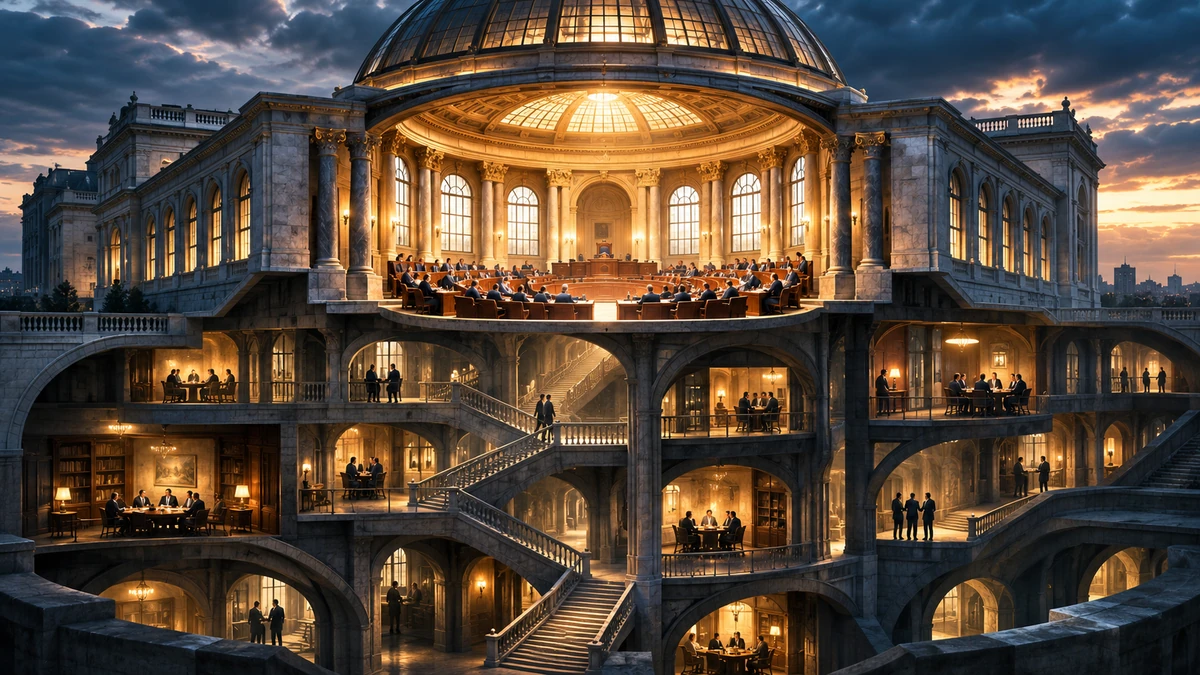
AI-generated editorial illustration; an architectural allegory of visible authority and informal influence, not a depiction of a real institution or event.
When we think about political authority, we usually think of presidents, governments, parliaments and other institutions that make decisions on our behalf. We recognise the faces of politicians, follow elections and listen to public debates. But does looking at the official hierarchy reveal everyone who holds real power? Who shapes decisions before they reach the public, who has access to decision-makers, and who can influence them without holding a senior position themselves?
The study of hidden power begins with precisely this distinction. We are interested not only in who has access to political authority, but also in how individuals and groups can shape decisions without their role being visible to the public.
Power Is Not Always Where Authority Resides
Formal authority derives from an official position and its powers. Actual power, by contrast, lies in the ability to influence the conduct of others and the decisions that shape the life of a community. The two may overlap, but they need not. Someone who holds no public office may have considerable influence over someone who does. Conversely, a person in a senior position may operate within constraints they did not establish.
The Medici offer a revealing historical example. The abstract of historian Nicolai Rubinstein’s monograph on Florence between 1434 and 1494 indicates that the family exercised effective rule within the existing constitutional framework, despite having no special political rights unavailable to other prominent citizens. Rubinstein examines the means by which the Medici consolidated their position and also considers their supporters and the republican opposition. [1]

Florence thus offers a glimpse of circumstances in which formal institutions can coexist with an informal centre of power. To understand a political system, it is therefore not enough to know its constitution. We must also understand the relationships between the people operating within it.
Dynasties and the Inheritance of Influence
Family inheritance is not limited to wealth. Along with wealth, descendants may acquire social standing, personal connections, access to influential institutions and familiarity with the political environment. In such circumstances, a dynasty may enjoy advantages that someone without a comparable background would struggle to acquire in a single lifetime.
Yet a family tree and a political network are not the same thing. A family relationship does not in itself establish a shared political project. Nor does the historical power of a family establish that its descendants still wield the same influence today. When we investigate alleged secret bloodlines, we will ask which relationships can be established genealogically, whether there is organisational continuity, and whether specific decisions can be linked to specific individuals.
When a Secret Society Becomes a Political Issue
One documented case that cannot be overlooked in the study of covert political activity is the Italian Masonic lodge Propaganda Due, known as P2. Article 5 of Italian Law No. 17 of 25 January 1982 expressly dissolved the P2 lodge. Article 1 defines prohibited secret associations through a combination of concealment of their existence, aims and activities or membership, and conduct intended to interfere with the functions of specified state bodies, public institutions and services. [2]
P2 was also the subject of a parliamentary inquiry. On 10 July 1984, the commission adopted its majority report, and minority reports were subsequently submitted. [3] The existence of legislation and investigative records allows us to examine a specific case rather than merely debate whether such an association could exist.

The P2 case cannot automatically be generalised to all Masonic organisations. Although Article 2 of the law provides for penalties for participation in a prohibited secret association, establishing actual participation and determining individual criminal liability are separate matters from the findings of the parliamentary commission. [2] In examining secret organisations, we must therefore distinguish between their structures, aims, actions and individual responsibility.
When Authorities Conceal Their Own Activities
Hidden power does not necessarily operate outside the state apparatus. It can also operate within official institutions whose powers are publicly known but whose individual activities are not. One such example is the US Senate investigation known as the Church Committee. On 27 January 1975, the US Senate adopted a resolution establishing the committee, which published its final report on 29 April 1976. According to the Senate’s official historical overview, the committee investigated, among other matters, the FBI’s COINTELPRO programme, which also targeted the civil rights movement and opponents of the Vietnam War. In its report, the committee found that intelligence agencies had infringed citizens’ constitutional rights. [4]
Intelligence work serves legitimate security purposes for which confidentiality may be necessary. But the need for confidentiality does not in itself justify the abuse of authority. The American inquiry also illustrates another side of the story: oversight institutions can expose the actions of other parts of the same state. A state, therefore, is not necessarily a single, unified actor in which everyone participates in the same covert plan. Within it, there may be disputes, oversight and opposition to abuses.
Behind Closed Doors
The Bilderberg Meetings represent a different form of informal networking. According to the organisers, the meetings have taken place since 1954 and bring together individuals from politics, business, academia and the media. The organisers publish lists of participants and the main topics of the meetings, and say that discussions take place under the Chatham House Rule. They also state that no votes are taken and no resolutions are adopted. [5][6] The Chatham House Rule allows participants to use the information they receive without revealing the identity or affiliation of speakers or other participants in connection with the discussion. [7]

This raises an important question. Is a formal vote even necessary for political influence to occur? An opinion expressed in a private conversation may influence the thinking of someone who will later make decisions in another institution. Participants may form new connections, discover common interests or disagree with one another. These are possible effects of such a setting, not evidence that any of them occurred at a particular meeting.
Confidentiality can encourage frank discussion while making it harder for outsiders to assess the actual influence of these discussions. The organisers’ own account therefore does not provide an independent answer to every question about the consequences of the meetings. Linking a particular conversation to a later political decision requires concrete evidence.
Secret Orders, Occultism and Rituals
The study of hidden power does not end with political connections. We are also interested in closed initiatory orders, their traditions, oaths, symbols, rituals and ways of fostering a sense of belonging. We want to understand how shared beliefs and obligations to an organisation shape the conduct of its members, and when loyalty to the group may conflict with responsibility towards society as a whole.
A ritual may have religious, philosophical, symbolic or social significance. Its secrecy does not in itself establish a harmful purpose. Nor does the similarity of symbols in different settings establish that the same organisation is behind them. On the other hand, allegations of abuse within closed groups demand serious investigation, in which evidence of actual conduct and the dignity of potential victims take precedence. We will neither dismiss questions because they are sensitive nor turn them into accusations without adequate grounds.
Is There a Common Centre of Global Power?
When investigating influential dynasties, secret societies and elite networks, the question inevitably arises as to whether these phenomena are interconnected. Is there a higher hierarchy above individual networks, or are we dealing with multiple centres of power that at times form connections, cooperate and oppose one another?
Intermediate models are also possible: networks may coordinate their activities in some areas while competing in others. Similar interests, personal connections or the existence of secret societies alone do not allow us to choose reliably between these explanations. To establish coordinated action, we must trace the links between the actors, their actions, any instructions that may have been given and the consequences. We must also examine cases in which people alleged to be connected disagreed or failed to achieve their aims.
The absence of available evidence does not necessarily mean that a connection does not exist. But we cannot describe it as established merely because it seems possible. Research means being prepared to accept either the confirmation or the refutation of a hypothesis, or to acknowledge that the answer is not yet known.
Who Are We Really Up Against?
The question of hidden power also has a moral and spiritual dimension. The danger that a person poses to others does not arise simply from their ancestry, wealth, faith or position. What matters is what they do with their power. Do they use it to protect life and human dignity or to subordinate others? Do they respect the truth even when it is uncomfortable for them, or do they use deception as a means of achieving their goals?
From a moral perspective, we are therefore interested in the distinction between power that serves life and force that deprives people of their freedom. From a spiritual perspective, we may also see this as a question of good and evil. This perspective is a philosophical and ethical starting point for the investigation, not evidence of the supernatural origins of a particular political organisation or of its members’ inner motives.
If people resist manipulation by becoming manipulative themselves, or respond to hatred by directing it against others, they risk adopting the very conduct they oppose. The search for truth is therefore inseparable from personal responsibility: the willingness to understand, to verify, to act according to conscience and to retain compassion even in times of conflict.
The Path of Our Investigation
In the series Hidden Power: Dynasties, Secret Societies and the Invisible Mechanisms of Power, we will gradually examine the nature of covert influence, the history of influential dynasties, initiatory societies, occult traditions, contemporary elite networks, covert mechanisms of power and the psychology of control. Finally, we will return to the question of human inner freedom and responsibility.
For now, then, we do not answer the question of who rules from behind the scenes with a single name or a list of dynasties. The examples presented illustrate different ways in which power operates, but provide no evidence of shared leadership. We are interested in the actual structure of power and how we can recognise it, regardless of whether our findings confirm our initial assumptions.
Next: Visible Authority and Invisible Power (SM-02).
Documentary sources and archive links
These links lead to documents, archival records or photographs hosted by their original source institutions.
Sources and further reading
- Nicolai Rubinstein (1997). The Government of Florence Under the Medici (1434 To 1494). Oxford University Press. The publicly accessible abstract of the second edition of the monograph was used. DOI: 10.1093/oso/9780198174189.001.0001. Source Source
- Repubblica Italiana (1982). LEGGE 25 gennaio 1982, n. 17. Law on secret associations and the dissolution of P2, Articles 1, 2 and 5. Gazzetta Ufficiale, no. 27, 28 January 1982, pp. 627–628. Normattiva · Original official gazette Source 1 Source 2
- Camera dei deputati (records from 1984). Commissione parlamentare d'inchiesta sulla loggia massonica P2. Official archive of the commission, description of the majority and minority reports. Archive Source
- U.S. Senate Historical Office. Senate Select Committee to Study Governmental Operations with Respect to Intelligence Activities (The Church Committee). Official historical overview of the 1975–1976 investigation; A History of Notable Senate Investigations, pp. 1, 3. Online overview · Official overview with citations Source 1 Source 2
- Bilderberg Meetings. About Bilderberg Meetings. The organisers’ own account of the purpose and rules of the meetings. Source Source
- Bilderberg Meetings. Frequently Asked Questions. The organisers’ own account of the aims and methods of operation; not an independent source. Source Source
- Chatham House. Chatham House Rule. Original text of the rule and an explanation of its application. Source Source