Saturn: from ancient god of time to modern esoteric symbolism
How did Saturnian symbolism develop from Rome to modern esotericism — and why should links among the Sabbath, sevenfold symbolism, the cube, Kaaba, tefillin and Saturn be treated as an open hypothesis rather than either proven fact or a closed case?
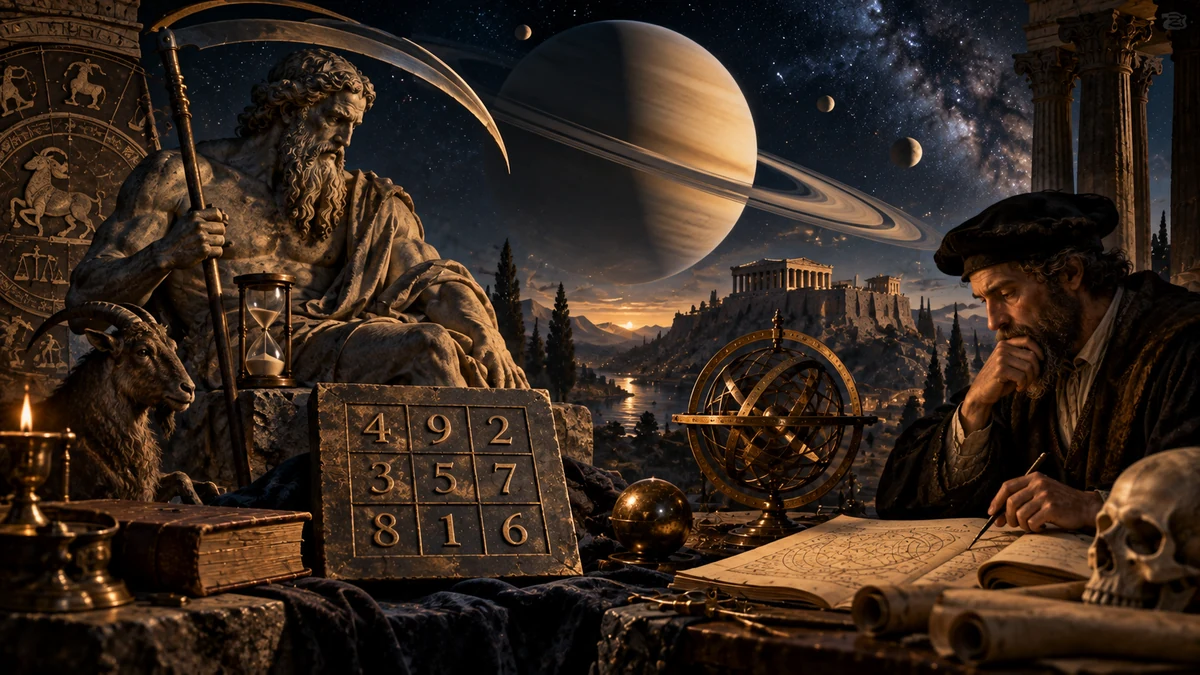
Saturn is one of the clearest examples of how a single symbol can be transformed repeatedly across millennia. The Roman Saturn was above all an old deity of sowing, agriculture and the memory of a Golden Age; through identification with the Greek Cronus he inherited the myth of devouring his children; through the later conflation of Cronus with Chronos he also became an image of time, old age and death.
Astrological tradition added coldness, dryness, melancholy, slowness, boundary and weight. Medieval and Renaissance magic assigned him lead, dark colours and a 3×3 magic square. Only much later did these scattered elements converge into the modern esoteric image of Saturn as lord of limitation, initiation, matter and hidden order.
This is where the question becomes harder. Modern maps connect Saturn with the black cube, the Kaaba, tefillin, the Sabbath/Saturday, Satan, Lucifer, the hexagram and Saturn's polar hexagon. We have not found a direct continuous documentary chain proving a single hidden cult, but that absence does not by itself disprove the hypothesis. Some of the connections are older and more concrete than a purely modern internet construction.
This article therefore does not close the Saturn hypothesis. It separates three levels: what is directly documented, what is symbolically and historically connectable, and what remains an open interpretation without a direct transmission source. This allows the similarities to be taken seriously without presenting them as a proven identity.
From Roman Saturn to Cronus and the Golden Age
The earliest Roman Saturn was not simply a god of time. Roman sources and modern histories of religion connect him above all with sowing, agriculture, abundance and a very old layer of Roman cult. His temple at the foot of the Capitoline became one of the central monuments of Republican Rome and housed the state treasury.
This matters because the modern formula 'Saturn = time = limitation' already contains centuries of later interpretation. Temporal symbolism is real and historically important, but it is not the safest description of the earliest Roman Saturn.
Romans gradually identified Saturn with the Greek Cronus, father of Zeus and the Titan who, according to myth, devoured his children so that they could not displace him from power. Through this identification, the Roman deity acquired a richer mythological biography than his earlier Italic cult layer had possessed.
This identification is one of the first major shifts in the genealogy of the symbol: the same name Saturn can mean an Italic agricultural deity, a Romanized Cronus, or a later planetary archetype. If these layers are merged without labels, an apparent ancient unity is created that the sources do not actually show.
Roman literature associated Saturn's reign with a lost Golden Age, a period of abundance, peace and simple life before later moral decline. This tradition helps explain why Saturn in antiquity was not merely a gloomy or evil figure.
His symbolism is ambivalent from an early stage: he can represent age and lost sovereignty, but also a memory of primordial order, fertility and a time when people supposedly lived without ordinary social burdens. Later esoteric authors greatly expanded this ambivalence.
Saturnalia, Christmas and Santa
Saturnalia was celebrated in December in honour of Saturn. Roman practice included banquets, gambling, gifts and a temporary relaxation of social rules. In some households masters served slaves or at least ate together, creating a ritual reversal of the ordinary order.
That reversal is well documented. There is no need, however, to turn it into a secret rite of death or manipulation. Ancient descriptions speak mainly of festivity, social release, abundance, licensed disorder and symbolic memory of Saturn's Golden Age.
The temporal proximity of Saturnalia, the winter solstice and the later Christian Christmas is real, and similarities in feasting, gifts and festive atmosphere are historically interesting. Some late-antique and medieval practices may have been transmitted, transformed or overlapped.
It goes too far to say that Christmas is simply 'Saturnalia under a new name' or that every Christmas custom is directly Saturnian. The date of 25 December has a complex history, while individual customs come from a mixture of Roman, Christian, Germanic and later European traditions.
The English words Santa and Satan are indeed anagrams, but this is not a historical genealogy. The name Santa Claus derives from Dutch Sinterklaas, a form of Saint Nicholas, whose tradition Dutch immigrants brought to North America.
The word Satan has a completely different history, deriving from a Hebrew term for an adversary or accuser. The similarity of letters in modern English therefore has no evidential value for identifying Santa Claus, Saturn and Satan. Symbolic parallels can be explored literarily; an etymological connection does not exist.
Sabbath, Saturday and Saturn: the ancient association
Here the picture becomes significantly more complicated. In Roman planetary nomenclature Saturday was dies Saturni, Saturn's day. The Jewish Sabbath falls on the same weekly day, although it begins at Friday sunset. The Hebrew name Shabbat derives from a root for rest or cessation and is not etymologically derived from Saturn.
Yet the association between Jews, the Sabbath and Saturn is not a modern internet invention. Tacitus in the first century reports that some interpreted the Sabbath as an observance in honour of Saturn; Cassius Dio in the third century repeatedly calls the Jewish day of rest the 'day of Saturn' and then explains the planetary naming of the days.
This does not prove that the Sabbath originated as a Saturn cult. Tacitus was a hostile non-Jewish observer and Dio was using Greco-Roman planetary nomenclature. It does prove that a Sabbath–Saturn association existed as an ancient interpretive tradition. It is therefore legitimate to ask whether this was merely calendrical overlap or part of a deeper symbolic history — the answer remains open.
The planet Saturn in the ancient astrological system
The visible planet Saturn was the slowest of the seven classical planets in geocentric models and was regarded as the most distant of the planets then known. Its slowness and remoteness became important foundations for astrological meanings of age, coldness and long duration.
A new layer thus emerged: god and planet interpreted one another. Features of the mythological Saturn influenced the reading of the planet, while the planet's apparent motion reinforced images of slowness, weight and delay.
In the Tetrabiblos Ptolemy describes Saturn chiefly as cold and moderately dry because, in his cosmological model, it is furthest removed from the Sun's heat and from moist terrestrial exhalations. Along with Mars he places it among planets associated with more difficult or destructive effects.
This is an important historical source for the later 'heavy' Saturn. But Ptolemy's language belongs to an ancient natural-philosophical and astrological theory of qualities; it is not evidence that the planet physically causes psychological melancholy.
Classical astrology assigns Saturn domicile in Capricorn and Aquarius. Ptolemy explains this through the cold winter signs opposite the houses of the Sun and Moon. Later astrology developed from this a much richer language of structure, law, discipline, age, boundaries and responsibility.
These meanings are historically traceable as an astrological tradition. They can therefore be treated as part of symbolic development, not as universal psychological properties independently confirmed by empirical research.
Cronus, Chronos and the making of Father Time
The Greek Cronus, the Titan and father of Zeus, and Chronos, time, were originally distinct concepts. Their names sounded similar, encouraging ancient and later interpreters to build verbal and allegorical connections between them.
This conflation is crucial to the emergence of Saturn as 'lord of time'. Once Cronus/Saturn merges with Chronos, the sickle, old age and devouring of children acquire new meanings: time reaps, ages and 'devours' everything it produces. This is a historical interpretation, not the original identity of the two Greek figures.
Late-antique, medieval and Renaissance art gradually assembled the figure of Father Time: an old man, a sickle or scythe, later wings and an hourglass. Iconologists such as Erwin Panofsky showed that this was a fusion of elements of Saturn/Cronus with allegories of time and death.
The modern intuition that Saturn has 'always been a god of time with a scythe' therefore conceals a historical process. The symbol is old, but its familiar modern composition was not unchanged from antiquity.
Melancholy, contemplation, lead and blackness
In medieval astrology Saturn acquired a strongly gloomy reputation. Planetary images associate him with poverty, illness, prison, old age, hard labour, isolation and the melancholic temperament. This negative layer strongly influenced European art and medico-astrological imagination.
Yet even here Saturn was not one-dimensional. Slowness could mean stagnation but also endurance; solitude could mean exclusion but also contemplation. That ambivalence later made a Renaissance rehabilitation of Saturn possible.
In the fifteenth century Marsilio Ficino linked the melancholy of scholars with Saturn while also exploring how a difficult Saturnine disposition could be directed toward philosophy and contemplation. Saturn thus moved from being merely an unfortunate planet toward a symbol of depth, seriousness and intellectual concentration.
This Renaissance turn matters for modern esotericism: 'limitation' and 'suffering' can become initiation, discipline and maturation. But this is a later philosophical reinterpretation, not a direct doctrine of the Roman cult of Saturn.
Renaissance correspondence magic explicitly assigns Saturn lead and black, earthy and leaden colours. Agrippa places heavy, dark, slow, solitary and melancholic things under Saturn. Here there is genuine historical grounding for later associations of Saturn with darkness, weight and materiality.
But 'black' is not yet a 'black cube'. Colour, metal and psychological quality are documented correspondences; a geometric doctrine in which the cube is Saturn's universal sacred symbol requires an additional source.

Saturn’s 3×3 square and the beginning of the modern black cube
In the second book of Occult Philosophy Agrippa describes planetary magic squares. Saturn receives the simplest 3×3 square of nine numbers; each row, column and diagonal sums to 15, while the total is 45. The talisman is to be engraved on a plate of lead.
This is one of the best control sources for modern claims about the 'Saturn cube'. Premodern ceremonial tradition really does contain Saturnian geometry, but it is documented as a numerical square and sigil, not as a black three-dimensional cube.
Modern occultism and internet symbolism often construct a chain: Saturn = black colour + materiality + square + hexagon, therefore the black cube must be its hidden universal sign. Individual links have historical precedents, but the complete equation does not appear in the ancient, medieval and Renaissance sources examined here.
The safest formulation is therefore that the 'Black Cube of Saturn' is a modern esoteric synthesis using older Saturnian correspondences. It can be a legitimate modern symbolic construction, but on the current evidence it is not an ancient secret doctrine.
Manly P. Hall and the esoteric network of symbols
Manly P. Hall is useful here as a primary source for modern esoteric interpretation, not as proof of antiquity. In The Secret Teachings of All Ages, discussing the Pythagorean tetractys, he links the cube and six-pointed star with seven used points and adds that the Sabbath, or seventh day, is the central point. This is an explicit connection among geometry, the number seven and the Sabbath in an influential esoteric work from 1928.
Elsewhere Hall compares the seven circuits around Jericho and the seven circuits around the Kaaba with 'seven planetary circulations'. He also symbolically connects the god Pan with Saturn through Capricorn. This shows that a broader planetary reading of Jewish, Islamic and pagan symbolism existed in Western esotericism before today's internet black-cube theory.
In the Hall passages checked here, however, I did not find the statement 'tefillin represents Saturn' or a direct claim that 'the Kaaba is a Saturn temple'. Hall therefore strengthens the provenance of the symbolic network without completing a historical chain of proof. That is precisely why keeping the hypothesis open is methodologically reasonable.
The Kaaba and tefillin: convergences and open hypotheses
The Kaaba in Mecca is a cube-like sacred structure covered by the black kiswa and encircled seven times. When placed beside Saturn's black/dark correspondences, sevenfold symbolism and Hall's planetary reading of seven circumambulations, the resemblance is not trivial and deserves to be recorded.
But there is still a step between noticing convergence and proving a Saturn cult. In the early Islamic and historical sources checked here, we did not find a direct identification of the Kaaba as a Saturn shrine. The article therefore does not say there is no connection; it says the hypothesis remains open and currently lacks a direct transmission source.
Even the etymology of the name Kaaba is under scholarly debate. Geometry, colour, seven circumambulations and later esoteric interpretation can therefore form a cumulative basis for suspicion or hypothesis, not an automatic conclusion.
Tefillin are small leather boxes containing biblical passages, attached to the head and arm during Jewish prayer. Their ritual tradition is more than two thousand years old. In their modern form they are strongly geometric and black, a real visual resemblance to modern Saturnian symbolism.
In the Jewish, archaeological and museum sources checked here, we did not find a direct explanation that they represent Saturn. That is not the same as proving that they cannot. In esoteric or initiatory systems, expecting an explicit statement that 'this object secretly means Saturn' may be unrealistic.
The fair description is therefore that the connection remains an open hypothesis and no direct source for it has yet been found. Similarity of form, colour, placement on the head and the wider seven/Sabbath context can contribute to a cumulative argument; by themselves they do not yet demonstrate historical transmission.
The hexagon, Satan/Lucifer and the “Black Sun”
Saturn's north-polar hexagon is a real and extraordinary atmospheric structure. Voyager detected it in the early 1980s and Cassini later observed it in detail. NASA describes it as a long-lived six-sided jet stream or wave pattern in the atmosphere.
Laboratory experiments with rotating fluids can create polygonal forms, so the geometry itself does not require an artificial or occult explanation. The fact that a hexagon can be geometrically related to a projection of a cube is an interesting symbolic analogy; it is not evidence that ancient Saturn cults knew the hexagon or worshipped a cube.
The name Satan comes from a Hebrew root for adversary or accuser; Saturn comes from the Latin name of the Roman god. Phonetic similarity in English or other modern languages is not an etymological connection. Early Jewish and Christian ideas of Satan have their own historical development.
Lucifer is even clearer: in classical Latin it means 'light-bringer' and names the morning star, Venus. The Christian identification of Lucifer with Satan is a later interpretive history, but it does not make Lucifer an original name for Saturn.
The claim that Saturn was once the physical central sun of Earth's sky is today most recognizably associated with modern catastrophist writers, especially David Talbott and his 1980 book The Saturn Myth. Talbott reads ancient myths as memories of a different planetary configuration.
This is important as the history of a modern idea. It is not a standard conclusion of the history of religions or planetary science. The article can therefore present 'Saturn as primordial sun' as a modern speculative thesis and explain its mythological arguments, but should not move it backward into antiquity as an established fact.

From limitation to initiation: what remains of the Saturn system
Modern psychological and esoteric astrology often translates old Saturnian misfortune into developmental language: boundary becomes discipline, loss becomes trial, delay becomes patience and solitude becomes inner work. Saturn is transformed into a strict teacher rather than only a bringer of adversity.
This interpretation is culturally interesting and may be psychologically useful. Historically it should be labelled as a late transformation of older astrological meanings, not an unchanged teaching from Babylon or Rome to the present.
Once the broad equations are removed, a surprising amount remains: Saturn really is connected with the agricultural cycle, a lost Golden Age, the myth of Cronus, the slow planet, coldness and dryness, melancholy, lead, dark colours, a 3×3 magic square, boundary, old age and the later allegory of time.
The open question is whether recurring forms — the Kaaba, tefillin, the cube, hexagram, Sabbath/Saturday and sevenfold symbolism — arise only through cultural convergence or also through less visible symbolic transmission. We have not found a direct chain proving one hidden cult, but the ancient Sabbath–Saturn association and Hall's esoteric network mean the hypothesis should not simply be closed.
Open hypothesis and Saturn as an archive of transformations
In secret or initiatory traditions, the absence of public acknowledgement is not strong evidence of absence. At the same time, a researcher cannot turn every similarity into a fact. The article therefore uses an intermediate category: open hypothesis.
Where an ancient or esoteric author explicitly records a connection, we state it. Where form, colour, number and ritual converge without a direct transmission source, we write 'it has been proposed', 'a connection is possible', 'several similarities support suspicion', or 'not confirmed'. This preserves the symbolism without manufacturing certainty.
Saturn's story is therefore richer than a simple theory about one secret symbol. A Roman god of sowing merges with a Greek Titan, Cronus blurs into Chronos, the planet acquires melancholic qualities, Renaissance philosophers turn misfortune into contemplation, ceremonial magic adds lead and a square, and modern esotericism reassembles all of this into a language of limitation, materiality and initiation.
The most defensible conclusion is twofold. Documented history shows unusually old and layered Saturnian symbolism; in addition, the ancient Sabbath–Saturn association and Hall's links among sevenfold symbolism, the Sabbath, the cube/star and planetary circumambulation leave open the possibility of deeper continuity. For now this is an open hypothesis, not an established historical verdict — and that is precisely why it deserves further research.
Sources and further reading
- Gorski, Gilbert J. & Packer, James E. 'The Temple of Saturn.' In The Roman Forum. Cambridge University Press, 2015.
- Macrobius. Saturnalia, Book I. Latin text and public-domain English scholarly apparatus via LacusCurtius.
- Ovid. Metamorphoses, Book I — the Four Ages / Golden Age tradition.
- Ptolemy. Tetrabiblos, Book I — planetary qualities, benefic/malefic classification and Saturn's domiciles.
- Klibansky, Raymond; Panofsky, Erwin; Saxl, Fritz. Saturn and Melancholy: Studies in the History of Natural Philosophy, Religion, and Art. Modern reissue overview.
- Banco de España Collection. 'The Triumph of Love and Eternity over Time' — summary of Panofsky on the fusion of Chronos and Cronus/Saturn in Father Time iconography.
- Stanford Encyclopedia of Philosophy. 'Marsilio Ficino' — De vita, melancholy, learned life and celestial sympathies.
- Agrippa, Heinrich Cornelius. Three Books of Occult Philosophy, Book I, ch. 25 and colour correspondences — Saturnine things, lead, black and earthy colours.
- Agrippa, Heinrich Cornelius. Three Books of Occult Philosophy, Book II — Saturn's 3×3 magic square and lead talisman.
- The Warburg Institute Iconographic Database. Medieval and early-modern Saturn imagery and planetary children.
- NASA Science. 'Saturn's Hexagon in Motion' — atmospheric jet stream, Voyager/Cassini observations and laboratory polygon analogues.
- NASA. 'NASA's Cassini Spacecraft Obtains Best Views of Saturn Hexagon.'
- Smithsonian Magazine. 'The Evolving Face of Santa' — Saint Nicholas, Sinterklaas and the development of Santa Claus.
- Encyclopedia.com / Encyclopedia of Religion. 'Satan' — Hebrew root and historical development of the adversary figure.
- Lewis & Short Latin Dictionary via Perseus/Scaife ATLAS. 'lucifer' — classical Latin for the morning star, Venus.
- The Metropolitan Museum of Art. 'Phylactery (tefillin)' — form, Torah texts and archaeological antiquity of tefillin.
- Smarthistory. 'The Kaaba' — architecture, kiswa, history and ritual context.
- Atbuosh, Mohammed A. 'South Arabian etymology for the Meccan Kaʿbah.' Bulletin of the School of Oriental and African Studies 88(1), 2025.
- Talbott, David N. The Saturn Myth (1980) — primary modern source for the primordial-Saturn / Saturn-as-central-sun thesis; cited as history of a modern claim, not as scientific confirmation.
- Tacitus. Histories 5.4 — reports that some Roman explanations interpreted the Jewish seventh-day observance as honouring Saturn; evidence for an ancient association, not for Jewish self-understanding.
- Cassius Dio. Roman History 37.17–18 — calls the Jewish Sabbath the 'day of Saturn' and discusses the planetary naming of weekdays.
- Manly P. Hall. The Secret Teachings of All Ages, 'The Life and Philosophy of Pythagoras' — cube/star symbolism, seven points, and the Sabbath/seventh day as the central point.
- Manly P. Hall. The Secret Teachings of All Ages, 'Isis, the Virgin of the World' — interprets seven circuits around Jericho and seven circuits around the Kaaba as analogues of seven planetary circulations.
- Manly P. Hall. The Secret Teachings of All Ages, 'Atlantis and the Gods of Antiquity' — symbolically identifies Pan with Saturn through Capricorn; used as provenance for modern esoteric Saturn correspondences.