Exit from the Abyss
The system has the greatest power over a person when that person no longer knows how to live without it.
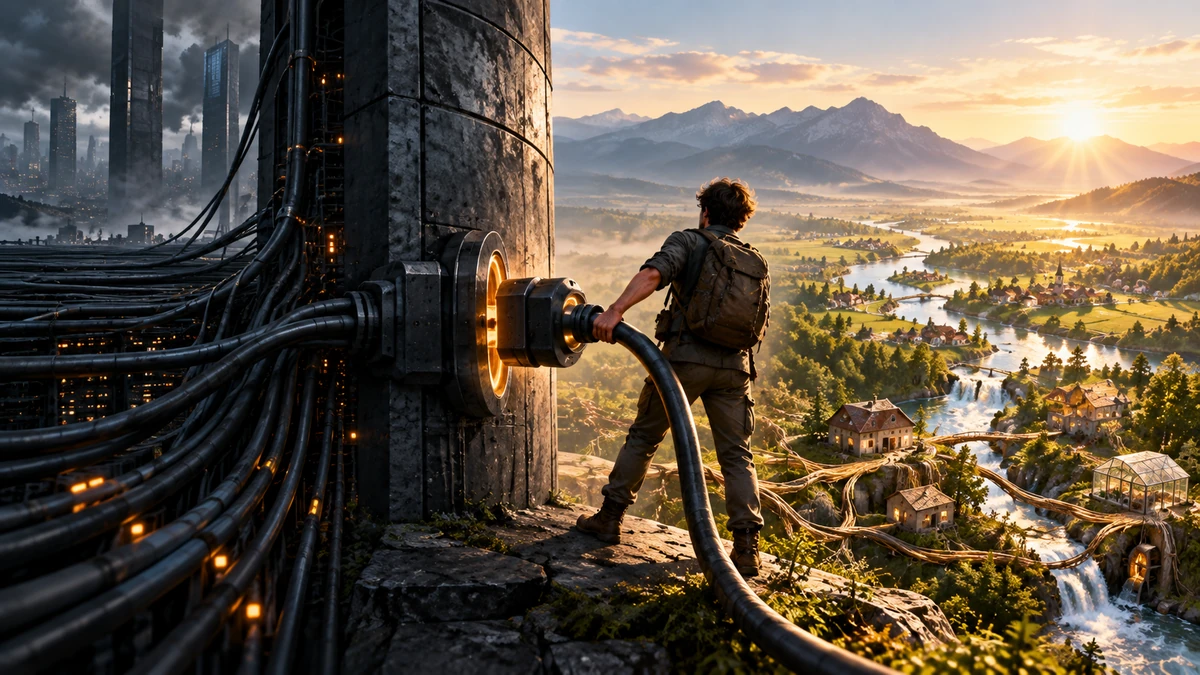
If the entire path into the abyss was made of small surrenders, the way out will not be one magnificent act of rebellion either. One electoral victory will not be enough. One protest will not be enough. One new platform, one new currency, one new politician, one new guru or one person we believe will come and fix everything for us will not be enough. If the problem is deeper, the answer must be deeper too.
The path back begins where a person takes back the things they slowly handed to others over the years. Their attention. Their privacy. Their knowledge. Their relationships. Their ability to survive disruption. Their ability to own, repair and create something. Their ability to say no. And above all, their responsibility. Because perhaps the greatest lie at the end of this path is not that the system is omnipotent. The greatest lie is that the individual is completely powerless.
First, stop looking for a saviour
Every system of power likes two kinds of people. The first obeys. The second waits. Waits for the next election. The next reform. The next revolution. The next leader. The billionaire who will defeat the other billionaires. The new technology that will fix technology. Someone who will finally arrive and set the world right so that they themselves will not have to change anything. But a person waiting for a saviour has already handed over their power.
Perhaps only to a different master. The exit from the abyss begins with an uncomfortable thought: no one owes us the return of a freedom we ourselves stopped exercising. Freedom is not an object you receive once and then store in a drawer. It is an ability. And an ability you do not use disappears.
Freedom needs redundancy
If there is only one route, there is also only one point at which you can be stopped. One method of payment. One identity provider. One communication channel. One source of food. One energy supplier. One cloud holding all your data. One account without which you cannot work. One system without which life does not function. That is efficient. And precisely for that reason it is dangerous. Real resilience is often inefficient. It has a fallback route. An alternative.
An analogue option. A local option. Something that continues to work when the main system fails or turns its back on you. The European Central Bank itself now stresses that cash has properties electronic payments do not: it can be stored and used without a third party, without the internet and even during a power outage. The ECB therefore explicitly links maintaining access to cash with freedom of choice and financial inclusion. This is not nostalgia.[1]
It is redundancy. The same logic applies everywhere. If you can communicate only through one platform, you are not resilient. If all your documents exist only in one account, you are not resilient. If you cannot even open a door without electricity, you are not resilient. If you cannot use something you bought without one company, you are not an owner in the full meaning of the word. A free system is not one that never fails. A free system is one in which the failure of a single point does not mean the failure of the person.

Own something that cannot be switched off remotely
Throughout this series we repeatedly reached the same boundary: ownership and access are not the same thing. If a manufacturer can change the conditions after purchase, disable a function or prevent you from using it, then there is still a switch on the other side of the relationship. That is why the right to repair matters more than it may appear. With Directive 2024/1799 the EU imposed repair obligations on manufacturers for certain products and prohibited contractual, hardware or software techniques that unjustifiably prevent repair.[2]
This is a small example of a larger principle: a person must have the right to use, maintain and repair things they have bought without permanent dependence on the manufacturer’s permission. Knowing how to repair something is not merely a hobby. Having tools is not nostalgia. Knowing how to cook a meal from basic ingredients is not merely tradition. Knowing how to grow, sew, build, repair, store or make something means there are fewer intermediaries between you and a basic need. Fewer intermediaries mean fewer points at which someone else can decide for you.
You defend privacy before you have anything to hide
Perhaps the most destructive sentence of the digital age is: “I have nothing to hide.” Privacy is not a criminal’s privilege. It is the space in which a person can exist before being evaluated. They can read, think, doubt, search, change their mind and make a mistake without every moment becoming a data point in somebody else’s model. European law contains a principle moving in this direction too. The GDPR requires data minimisation: collected data must be adequate, relevant and limited to what is necessary for a specified purpose. It also requires data protection by design and by default.[3]
That principle should become a personal habit. Do not ask only: What does this app allow me to do? Ask also: What does it need to know about me in order to do that? And more importantly: Why should it know anything more? There is no need to live in a cave. No need to reject technology. What is needed is to understand again that every piece of data you do not have to surrender is a piece of data that later cannot be lost, sold, linked, profiled or used against you. The safest database is the one that never received unnecessary data.
Identity should prove the person, not determine their life
Digital identity can be a useful tool. Today’s European EUDI Wallet framework also explicitly says that use is not mandatory and that the user should control which data they share. That is an important safeguard. And precisely for that reason it should be defended. We do not wait until a right disappears before discovering that it mattered. Exiting the abyss does not necessarily mean rejecting digital identity. It means insisting on the principle: identity should prove what is necessary for a particular act — nothing more.[4]
If you need to prove that you are an adult, there is no reason for the merchant to receive your full profile. If you need to sign a document, there is no reason for the signature to become permission to track every other activity. If a system needs one attribute, it does not need to receive the whole person. The boundary has to be drawn before the technology becomes so convenient that no one can be bothered to think about the boundary anymore.
Money must remain a tool of the person, not a leash around their neck
A person without economic space is a politically and socially much weaker person. This does not mean everyone should keep money under a mattress. It means it is dangerous to build a society in which there is only one way to participate in the economy and every route depends on the same digital switch. Cash is one fallback route. Diversifying savings is another. Lower debt is a third. A skill with which you can create something or offer value to another person is a fourth.
The economy is not merely a number in an account. It is the ability to exchange value. The more a person entrusts that ability to a single intermediary, the more power the intermediary has over their life. Financial independence is therefore not greed. It can be a form of civic resilience.
Get to know the people around you again
A completely atomised person is the ideal customer for almost every centralised system. For every problem they need a service. For every piece of advice a platform. For every need an institution. For every loneliness an app. For every crisis someone far away. But much of human resilience throughout history has been local. Family. Neighbour. Friend. Farmer. Craftsperson. A doctor who knows the person, not only the file. Someone you can call without a username and password.
Community is not romantic decoration. It is decentralised infrastructure for human life. If you know the people around you, there are fewer things for which you absolutely need an anonymous system. And a society of people who trust one another directly is harder to divide than a society of profiles that know one another mainly through screens.
Teach children what a world without constant permission looks like
The most dangerous phase of our path was normalisation. The moment a new generation no longer knows that life could work differently. That is why the exit is not only a technical question for adults. It is a question of memory. A child should know that boredom is not an error an algorithm must solve immediately. That friendship is not a follower count. That knowledge is not only an answer printed by artificial intelligence. That a map still exists when the phone has no signal.
That food does not originate in an app. That an object is not broken merely because the manufacturer wants to sell a new one. That privacy is not suspicious. That a human being is not a user account. And above all: that sometimes it is possible to say no even when everyone else says yes. If the next generation does not know this, it cannot later experience it as something taken away. Because you cannot feel the loss of a freedom you never knew existed.
Use technology. Do not let technology use you.
The problem is not the phone. Not artificial intelligence. Not the digital signature. Not a biometric sensor. Not a medical implant. The problem begins when a tool becomes a condition for participating in life and when the person loses the ability to refuse it without disproportionate penalty. So the real boundary is not between technology and nature. It is between tool and master. A tool serves you. A master sets conditions. You can put down a tool. You cannot put down a master. A tool enables something.
A master permits something. We will have to understand that difference in the coming decades better than any generation before us. Because for the first time in history technology is becoming intimate enough to measure our bodies, our behaviour and potentially parts of our nervous system. The closer technology comes to the human being, the stronger the human right must be to remain human without it too.
The most important “no” is the first one
People like to imagine they would resist only when the system became obviously totalitarian. But that is when resistance is most expensive. By then the alternatives have already disappeared. Cash is already rare. The local shop is already closed. Data are already connected. The platform is already indispensable. The system is already the standard. A new generation already experiences it as normal. Freedom is therefore easiest to defend before it has to be heroically rescued. When saying no is still uncomfortable rather than dangerous.
While an alternative still exists. When you can still demand a paper option. Pay in another way. Choose a device that can be repaired. Refuse unnecessary data collection. Keep a human being in a process an algorithm wants to automate completely. Ask: Why is this necessary? Who will have the data? Who can change the rules? What happens if I refuse? Is there a non-digital alternative? These are not the questions of a person afraid of the future. They are the questions of a person who understands the power of infrastructure.
Freedom is not comfortable
Here we reach the greatest difficulty. Many things that increase independence are less convenient. Repair is slower than buying new. Cash is less convenient than tapping a phone. Local food may be more expensive than the global supply chain. Private communication may be less elegant than the platform everyone already uses. Learning a skill is harder than ordering a service. Ownership requires maintenance. Independence requires responsibility. And that is precisely why we have come so far.
Not because people hate freedom. But because convenience is often more pleasant than responsibility. The path into the abyss did not require a person to choose slavery. It was enough for them to choose a little less friction again and again. The exit therefore requires something modern culture finds difficult to sell: voluntarily accepting a certain amount of inconvenience in exchange for greater autonomy. Freedom has a cost. It always has.
Do not leave society. But do not let society become a single point of failure.
Exiting the abyss is not escaping into the forest. It is not living without medicine. Not living without technology. Not rejecting every institution. Not paranoia. It is something considerably more demanding: using the system without handing it every possible exit. Having a digital option and an analogue option. A global network and local relationships. Technology and knowledge without it. Specialists and your own basic capacity for judgement. Institutions and a right to doubt. Convenience and the ability to survive without it.
This is decentralisation at the level of the person. It does not mean you have to do everything yourself. It means no single institution should become so indispensable that its permission is equivalent to your ability to live.
In the end, responsibility remains
The easiest way to end this series would be with one great enemy. A name. A face. An organisation. Someone we could point to and say: they did all of this. That would be comfortable. And precisely for that reason it would miss the point. Large structures of power exist. Interests exist. Abuses exist. Surveillance technologies exist. Institutions can cross boundaries. Companies can pursue profit further than they should. States can demand more in the name of security than we should give them.
But no system becomes everyday life without millions of everyday decisions by people. Every time we say: “It does not matter.” “I have nothing to hide.” “It is only one more app.” “It is not worth making a fuss.” “Someone else will take care of it.” we take a small step. Perhaps a completely reasonable step. But direction is made of steps. And responsibility therefore lies on our side too. Not blame for everything that happens.
Responsibility for what we are willing to normalise. For what we surrender. For what we do not question. For what we do not set a boundary around. For what we teach our children to accept as normal.
The exit begins with one step
At the beginning of this series we said: the abyss does not begin at the bottom. It begins with the first step we told ourselves was not important enough to resist. But the same is true in the other direction. The exit does not begin when the whole world changes. It begins when a person takes back one thing they can still take back. Their time. Their attention. Their data. Their money. Their knowledge. Their relationships. Their body. Their boundaries. Their responsibility. A system of total control needs a person who believes they have no choice. Perhaps the most important act of all is therefore simply this: stop living as though every new stage is inevitable. Convenience will not save us. Technology will not save us. The next person on the screen will not save us. If space for a free human being is to remain, free people will have to preserve it consciously. Every day. In small things. Before they become large. The path into the abyss is made of steps. So is the path out.
Sources and further reading
- ECB: cash as freedom, autonomy and redundancy. European Central Bank, The role of cash and The Eurosystem cash strategy Source
- EU Right to Repair. Directive (EU) 2024/1799 on common rules promoting the repair of goods; European Commission, Directive on repair of goods Source
- GDPR: data minimisation and privacy by design/default. Regulation (EU) 2016/679, Articles 5 and 25 Source
- European Digital Identity Wallet: voluntariness and selective disclosure. European Commission, Q&A Digital Identity Source