Mass Rituals, Sport and Collective Ecstasy: Group Psychology, Symbolism and Belonging
What actually happens when thousands of people sing, move and feel together — and where does measurable crowd psychology end and the open esoteric account of egregores and “energy harvesting” begin?
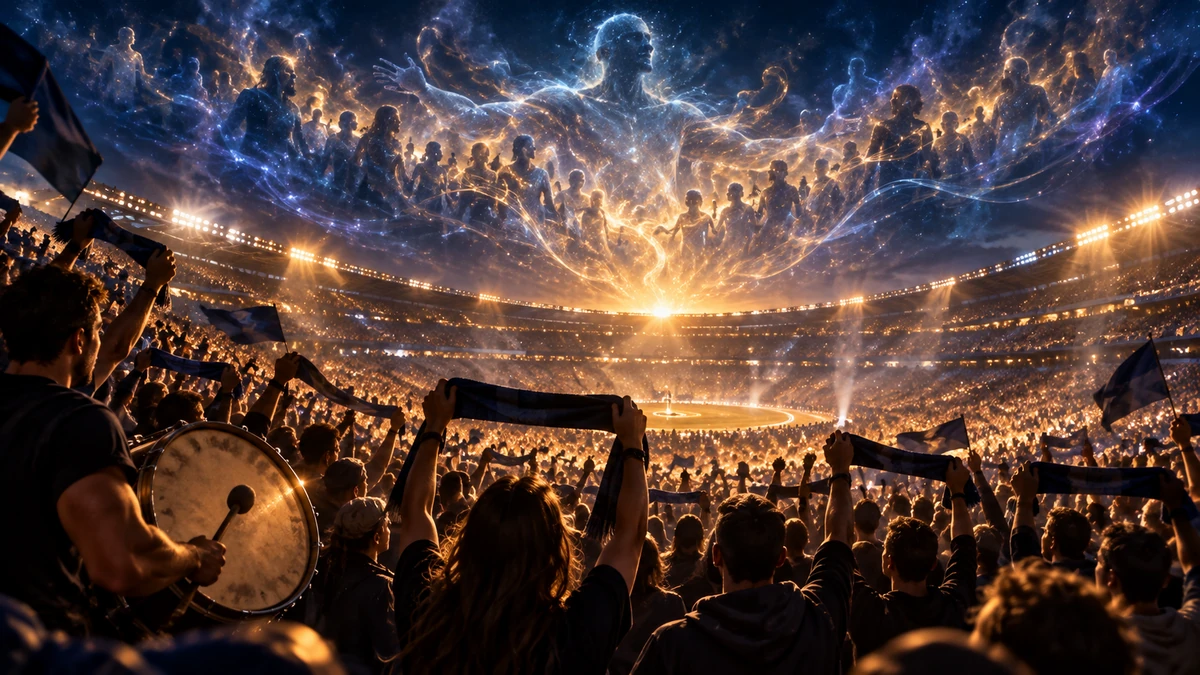
Mass rituals are not psychologically neutral. Shared rhythm, singing, movement, symbols and focused attention can strengthen belonging and produce a sense of “we” that differs from individual experience.
Contemporary research on collective gatherings documents behavioural and emotional synchrony, social bonding, collective efficacy and identity fusion. The sports stadium is an especially clear case because it combines these processes with colours, emblems, songs, flags and dramatic shared anticipation.
Alongside empirically measurable processes there is also an esoteric account: the egregore, a subtle collective field, and the possibility that mass emotional energy can be directed or “harvested.” This article neither reduces that layer to psychology nor presents it as scientifically established.
The key is to keep levels distinct. First establish what research actually measures; then present the esoteric model in its own terms. Whether the two languages describe different layers of the same phenomenon remains an open question.
When a crowd becomes more than a sum of individuals
People do not necessarily become irrational when they enter a crowd, yet shared singing, movement, symbols, anticipation and intense emotion can produce an experience qualitatively different from being alone. A stadium, religious procession, concert, political rally or public mourning ceremony serves different purposes, but many share rhythm, repetition, focused attention and marked symbols.
Émile Durkheim used the term “collective effervescence” for intense shared emotional activation. Contemporary research describes related processes more cautiously as emotional and behavioural synchrony, a sense of unity, strengthened identity and increased subjective energy or collective efficacy. Those are documented psychosocial phenomena. Whether an invisible energetic field also forms in an esoteric sense is a separate question that these studies do not measure.
Rhythm, voice and body: why ritual works
Ritual often coordinates bodies before it coordinates interpretations. People march in step, clap, sing the same melody, repeat phrases, sit or stand together and react collectively to key moments. Experimental work shows that synchronous action can increase social connection and cooperation; meta-analytic evidence finds effects on prosocial behaviour, bonding, social cognition and positive affect.
Field studies also reveal physiological parallels. During a fire-walking ritual, researchers detected coupled heart-rate dynamics between performers and socially related spectators. This does not mean that every crowd’s hearts “mystically synchronize,” but it does show that a shared ritual can link patterns of bodily arousal among emotionally connected participants and observers.

Collective ecstasy, identity and the feeling of “we”
When attention, emotion and behaviour converge on one event, the psychological boundary between “I” and “we” can become less pronounced. Studies of collective gatherings associate perceived emotional synchrony with stronger group identification, identity fusion, social integration, collective efficacy and well-being. This helps explain why people can leave a ceremony or mass gathering feeling unusually strengthened or connected to strangers.
The power of ritual is not automatically morally positive or negative. The same processes that support solidarity, charity and cooperation may, under sharp “us versus them” boundaries, also support conflict. Identity fusion matters because group belonging becomes bound to personal identity and can, in extreme contexts, predict willingness to undertake costly pro-group acts.
The stadium as a modern ritual space
Sport stadiums make ritual structure unusually visible: place, colours, emblems, songs, flags, repeated gestures, shared calendars and emotionally dramatic uncertainty. Sociology of sport therefore treats fandom not merely as watching a game but also as a ritual production of solidarity. A club can become part of a supporter’s biography, family, city or national identity.
In football, behavioural synchrony is direct: thousands sing, raise scarves, jump or fall silent together. Recent research on ultras links synchronized behaviour and emotional intensity with stronger identity fusion. But this does not make sport “nothing but social control.” For many participants it is simultaneously a source of friendship, belonging, ritual time, local identity, memory and joy.

Symbols, attention and the question of directing a crowd
Ritual requires a focus of shared attention. It may be an altar, flag, stage, trophy, player, speaker, symbol, song or moment of silence. A symbol does not operate automatically as a magical command; it gains force because a group loads it with repetition, memory and shared meaning. Sociological ritual theories sometimes speak of “emotional energy,” but the phrase is not a physical unit of measurement.
Those who design an event can shape the sequence of attention: when a crowd waits, sings, looks, falls silent, when lights change, and which symbol appears at peak arousal. That is a documented level of dramaturgy and communication. The stronger claim—that an organizer thereby captures subtle group energy for a hidden purpose—belongs to a metaphysical framework and requires a different kind of evaluation.
Egregore and “energy harvesting”: the esoteric interpretation
Western occultism developed the idea of the egregore: a collective mental or subtle formation said to be created and sustained by shared attention, emotion, symbols and ritual. Some modern esoteric systems go further, proposing that collective emotional arousal can be gathered, directed or used to “feed” unseen entities or structures.
The article does not reduce this account to a psychological metaphor against the tradition’s own intent. It presents it as it is meant: as a possible real subtle or nonhuman level. At the same time, social-psychological studies measure behaviour, identity, reported emotion and physiological signals; they do not measure an egregore or an external recipient of energy. Their findings therefore neither establish nor refute the metaphysical interpretation by themselves.
Are crowds controllable? Between manipulation and human agency
Early crowd psychology often portrayed crowds as irrational, contagious and almost hypnotized masses. Contemporary social-identity approaches revise that picture: people in crowds do not necessarily lose identity but may act more strongly according to the group identity and norms that become salient. A crowd can therefore be disciplined, solidaristic, creative, aggressive or peaceful depending on context and shared norms.
This matters for claims of manipulation. Rhythm, symbolism, speech and staging can shape attention and emotion, but participants are not empty vessels. They arrive with expectations, relationships and meanings of their own, and they can accept, reinterpret or reject a ritual. It is therefore not justified to classify every stadium, concert or religious ceremony automatically as a technology of mass control.
What can be concluded — and what remains open
It is well documented that collective rituals can synchronize behaviour and emotion, increase belonging, reinforce symbols and identity, and under some conditions increase cooperation. Strong identity fusion can also increase willingness to undertake costly action for a group, and sporting events contain many recognizable ritual features. Mass gatherings are therefore not psychologically neutral.
What remains open is whether these processes are accompanied by something current social-psychological instruments do not capture: a subtle collective field, an egregore, or energy that can be directed or “harvested.” The article does not settle that question for the reader. The useful discipline is to separate levels: establish measurable processes first, describe the esoteric model accurately second, and then allow readers to judge whether the two languages describe different layers of one phenomenon or entirely different things.
Sources and further reading
- Pizarro et al. (2022), meta-analytic review of collective effervescence — Frontiers / PMC
- Páez et al. (2015), Psychosocial effects of perceived emotional synchrony in collective gatherings — PubMed
- Wlodarczyk et al. (2020), Perceived Emotional Synchrony scale and collective gatherings — PMC
- Konvalinka et al. (2011), Synchronized arousal in a fire-walking ritual — PNAS / PMC
- Wiltermuth & Heath (2009), Synchrony and Cooperation — Psychological Science
- Mogan, Fischer & Bulbulia (2017), meta-analysis of synchrony effects — Journal of Experimental Social Psychology
- Xygalatas et al. (2013), Extreme rituals promote prosociality — PubMed
- Kavanagh et al. (2019), high-arousal martial-arts rituals, identity fusion and costly pro-group action — PMC
- Swann et al. (2010), Identity fusion and self-sacrifice — PubMed
- Whitehouse et al. (2017), shared dysphoric experiences and extreme cooperation — PMC
- Cottingham (2012), Interaction Ritual Theory and Sports Fans — Sociology of Sport Journal
- Newson (2019), Football, fan violence, and identity fusion — SAGE
- The people’s game: evolutionary perspectives on football fandom (2024) — PMC
- Ultras collective rituals and identity fusion (2025) — Humanities and Social Sciences Communications
- Effects of synchronous chanting among soccer fans (2025) — Evolution and Human Behavior
- Reicher, Spears & Postmes (1995), Social Identity Model of Deindividuation Phenomena
- Thonhauser (2022), critique of classic crowd-psychology contagion models — PMC
- Drury (2026), The Psychology of Crowd Behavior — Annual Review of Psychology
- Tarr, Launay & Dunbar (2014), Music and social bonding — Frontiers
- Bouchat et al. (2024), group identification and emotional synchrony across 13 studies — SAGE
- Theosophical Society in America review: modern occult concept of egregores — tradition-context source
- Llewellyn Encyclopedia: egregore as an occult group thought-form — tradition-context source