When Prisoners Regained Their Faces: The Abolition of Prison Hoods in Portugal in 1913
In February 1913, photographer Joshua Benoliel documented an unusual scene inside a Lisbon penitentiary: hundreds of prisoners gathered in the same room, yet with their faces concealed. The story behind the photograph reveals a prison system that…
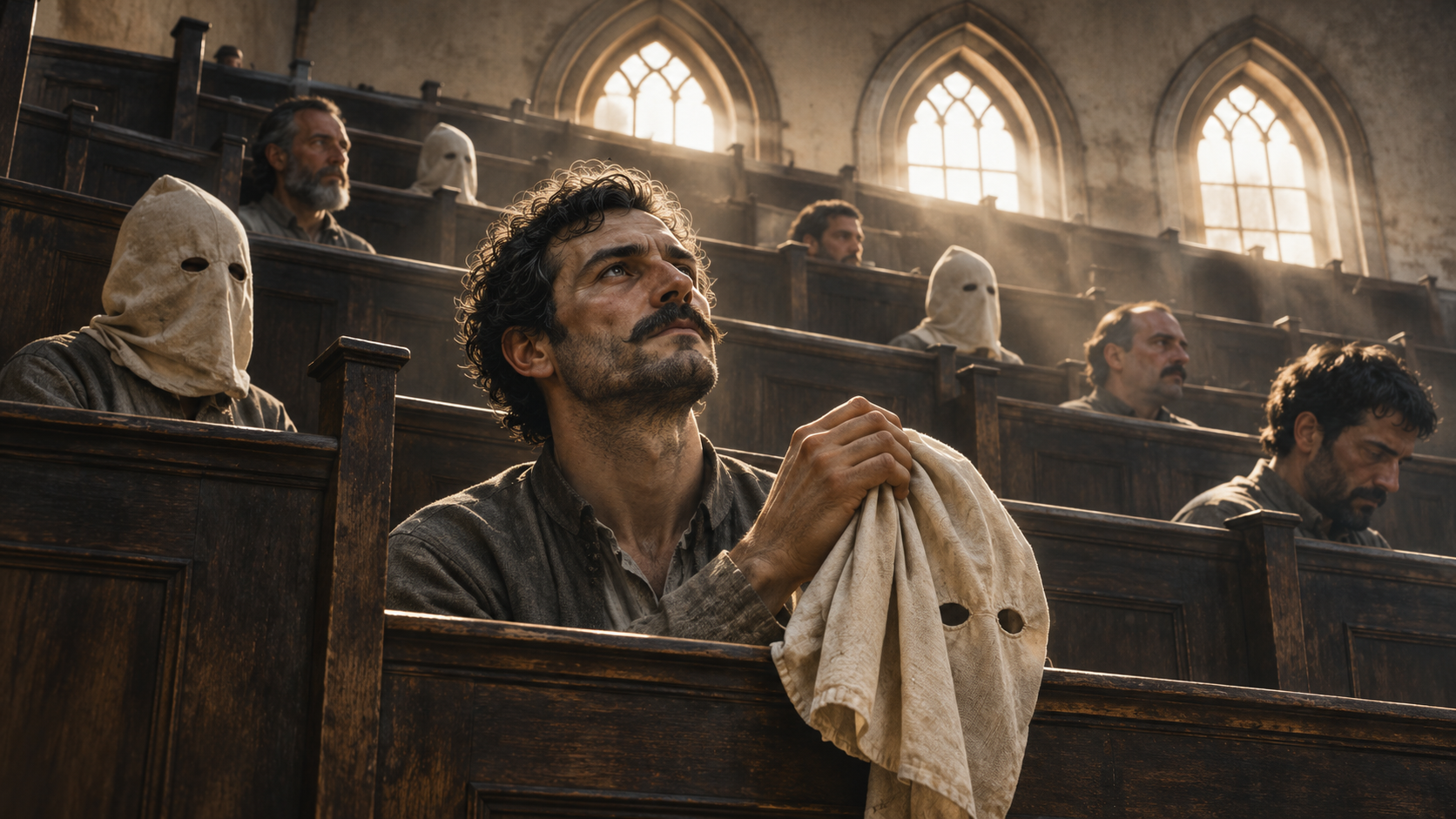
In February 1913, photographer Joshua Benoliel documented an unusual scene inside a Lisbon penitentiary: hundreds of prisoners gathered in the same room, yet with their faces concealed. The story behind the photograph reveals a prison system that sought to reform people through isolation—and a moment when the authorities decided to abandon one of its most visible measures.
Faces Beneath White Hoods
In an old black-and-white photograph, rows of wooden partitions rise towards three tall, arched windows. Heads in pale hoods are visible in many of the compartments. The people are together, yet the partitions keep them apart, while their covered faces prevent them from recognising one another. Light falls into the room, yet their faces remain hidden.
The photograph was taken in the amphitheatre of the Lisbon Central Penitentiary (Penitenciária de Lisboa). Its photographer, photojournalist Joshua Benoliel, documented the abolition in February 1913 of a rule requiring convicted prisoners to wear hoods in certain circumstances. The photograph is associated with archival negative number 22474. [1]
Online, the image often circulates as a striking glimpse of the past. More important than its strangeness, however, is the question it raises: what did society hope to achieve by forbidding prisoners even to recognise one another?
A Punishment That Was Supposed to Transform People Through Solitude
During the nineteenth century, European countries debated new ways for convicted people to serve their sentences. Prison was intended to mean more than a loss of liberty: it was also meant to create conditions that would discourage prisoners from committing further offences. One influential model was the Philadelphia, or Pennsylvania, system: individual cells, strict isolation, controlled movement and restrictions on contact.
Its proponents believed that solitude could foster reflection, discipline and personal change. Yet there was a contradiction at the heart of that idea. How could someone learn to live responsibly among other people if the system almost entirely deprived them of relationships with others? [2]
In 1867, Portugal abolished the death penalty for ordinary criminal offences under civilian law. This was an important historical development, but it did not guarantee that every other form of punishment had become humane. The Lisbon penitentiary, which opened in 1885, was designed for strict supervision and the separation of prisoners. The architecture itself formed part of the penal regime. [3]
What Did the 1884 Prison Regulations Actually Require?
Article 159 of the prison regulations dated 20 November 1884 stipulated that prisoners were neither to see one another nor to communicate—whether in writing, speech or gestures. Outside their cells, convicted prisoners were generally required to wear hoods covering their faces. [4]
Historian J. J. Semedo Moreira describes hoods made of light cloth, with openings for the eyes and mouth. Prisoners were required to wear them when moving through the penitentiary; a bell signalled when they could remove them or had to put them back on. The hood was therefore not intended to make prisoners completely blind, but primarily to prevent them from recognising one another. [12]
The regulations did, however, provide for important exceptions: in exercise yards, chapel amphitheatres and other places where no other prisoners were present. Benoliel's photograph therefore does not prove that prisoners necessarily wore hoods on every occasion in this amphitheatre. It shows them wearing hoods in a documented scene associated with the abolition of the rule. [1][4]
The system sought to prevent prisoners from recognising one another, forming connections or communicating. Security concerns inside prisons are real: institutions must prevent violence, extortion and escape. But security does not automatically justify every measure. Each restriction must be assessed in light of its purpose, necessity and consequences.
Depriving a person of liberty is not a licence to deprive them of human dignity.
Isolation and Its Consequences
Historical accounts of Portuguese prisons describe difficult living conditions and serious health problems, and indicate that certain forms of isolation were associated with significant difficulties for prisoners. Sources concerning the Lisbon penitentiary also mention tuberculosis, mental disorders and transfers of prisoners for medical treatment. [3][5]
We must be precise here. These records do not establish that wearing hoods itself caused particular psychiatric illnesses. Nor do we know the diagnoses or personal experiences of the people shown in the photograph. The historical record does not give us the right to invent their feelings or personal stories.
What we can examine is the principle on which the system was built: people were supposed to be reformed by radically restricting their relationships. Such a practice raises a moral question even when it was lawful in its time and presented as progressive.
6 February 1913: The Ceremonial Removal of the Hoods
Following the proclamation of the First Portuguese Republic in 1910, debates about reforming the penal system intensified. Reform proposals from late 1912 and legislative measures adopted in January 1913 created a framework for change. One of the most visible steps was the abolition of mandatory face coverings for prisoners. [6]
Historian Maria José Moutinho Santos records that on 6 February 1913, a ceremony took place in the amphitheatre of the Lisbon penitentiary, attended by 556 prisoners. Those present included Prime Minister Afonso Costa and Minister of the Interior Rodrigo Rodrigues, who was also director of the penitentiary. Rodrigues announced the abolition of the hoods and the gradual introduction of communal work. [7]
Newspaper reports from the time also support this date: on 7 February 1913, Diário de Notícias reported that the abolition of the hoods had taken place the previous day. That report is cited in a professional journal published by the Portuguese prison administration. [8]
There is, however, an intriguing archival discrepancy. Some later accounts date Benoliel's photograph, and even the ceremony itself, to 5 February 1913. Since the sources differ, we should not claim without evidence that this was simply a separate date on which the photograph was taken. The better-supported date for the ceremony is 6 February; the precise date of the negative remains unresolved. [1][7][8]
In the cited study, the figure of 556 refers to those gathered in the amphitheatre—not necessarily to everyone imprisoned in the institution at the time. Newspapers of the time also used the approximate figure of 600 prisoners. [7][8]
Two Photographs of the Same Change
Benoliel recorded more than a scene of concealed faces. Academic literature identifies two consecutive negatives: 22474, showing prisoners still wearing hoods, and 22475, showing them without hoods. Together, the photographs show the visible difference before and after the hoods were removed. [9]
The photographs cannot tell us how every individual experienced the event. Yet press accounts from the period, as summarised by J. J. Semedo Moreira, describe differing reactions: some prisoners reportedly kept their hoods for political reasons; others reportedly felt uncomfortable revealing their faces; and most were said to have welcomed the change. These accounts are valuable, but they reflect the perspective of reporters at the time, not direct testimony from every participant. [12]
The photographs are therefore not proof of unanimous joy or unanimous opposition. They do, however, clearly document the removal of a measure that had prevented people from freely showing their faces to other prisoners.
The ceremony attracted public attention. On 17 February 1913, Ilustração Portuguesa published a report featuring three photographs by Benoliel. A copy is now documented in the archive of the Fundação Mário Soares e Maria Barroso. [10]
What Actually Changed Inside the Prison?
The abolition of hoods did not mean that prisoners gained their freedom or that they could speak to one another without restriction from then on. An official Portuguese historical overview describes a transition from strict daytime isolation towards a regime based on separation at night and communal work during the day, but in silence. The changes were not implemented all at once; spaces for communal work were also adapted later. [6]
Compared with the earlier system of complete separation, this was a significant shift. But a single ceremony did not turn the penitentiary into an institution without coercion, prohibitions or hierarchy. It would be misleading to portray the event as the sudden liberation of the prisoners.
The event also had a political dimension. The new republic presented the reform as evidence of progress. The monarchist weekly O Correio, meanwhile, criticised the public staging of the ceremony. Its position reflects a political dispute, not an impartial judgement on the reform. [11]
That duality is instructive. Even a beneficial measure can be presented by the authorities in a way that serves their own interests. Whether the reform was genuinely humane depends not only on official speeches, but above all on how prisoners were treated after the ceremony.
A Boundary That Punishment Must Never Cross
The photograph from Lisbon tells us nothing about the innocence or guilt of the individual prisoners. It does not tell us what they had done, how they were sentenced or what awaited each of them. We must therefore resist turning it into a sentimental story in which crimes and their victims disappear from view.
A just punishment may be necessary. That does not make humiliation just. Society must protect people, hold those responsible accountable for the harm they have caused, and prevent further crimes. At the same time, it must respect a moral boundary: a person does not cease to be human when serving a sentence.
In February 1913, the hoods were removed at the Lisbon penitentiary. The camera preserved a visible moment of change. It could not resolve the more difficult question: beyond removing one symbol, was the state capable of changing its treatment of those it kept behind prison walls?
The true measure of justice lies not only in how firmly we punish, but also in the boundaries we refuse to cross when we do so.
Documentary sources and archive links
These links lead to documents, archival records or photographs hosted by their original source institutions.
Sources and further reading
- José Luís Neto, Uma imagem, um negativo, todos os rostos, interpretation of Benoliel's negative and reference to 5 February: source Source
- José Luís Neto, Do isolamento celular, historical background on the Philadelphia system: source Source
- Portuguese Directorate-General for Reintegration and Prison Services, Estabelecimento Prisional de Lisboa, official history of the institution (1867, 1885 and architecture): source ; see also the municipal report (2008): source Source 1 Source 2
- Regulamento provisório da cadeia geral penitenciária do districto da relação de Lisboa (20 November 1884), Article 159, published in Diário do Governo no. 273 (29 November 1884), p. 498; transcription by J. L. Neto: source Source
- Heritage of Hope: The Abolitionist Legacy in Europe, catalogue by the Torre do Tombo Archive and partners, printed p. 33 (isolation, tuberculosis, mental health, Rilhafoles): source Source
- Portuguese Ministry of Justice, 200 anos do Ministério da Justiça, p. 46: source Source
- Maria José Moutinho Santos, A prisão – um lugar dos «outros», Cultura, Espaço & Memória, 6 (2015), printed p. 164, PDF page 166 (counting from 1), account of 6 February 1913 and the 556 prisoners present: source Source
- Direção-Geral de Reinserção e Serviços Prisionais, Sombras e Luzes, nos. 3–4 (2020), article A propósito de uma carruagem celular do século XIX, printed p. 173, notes 27–28; cites O Século and Diário de Notícias of 7 February 1913 and the word ontem ("yesterday"): source Source
- Miguel Novais Jasmins Rodrigues, A Fotografia e a Duração no Trabalho de José Luís Neto, Estúdio 8/19 (2017), pp. 134–135, negatives 22474 and 22475. Repository: source ; open-access reprint of the study in the proceedings O VIII Congresso CSO 2017, pp. 660–661: source Source 1 Source 2
- Ilustração Portuguesa, second series, no. 365, 17 February 1913, A Abolição do Capuz dos Penitenciários, archival reference 09506.013 (Fundação Mário Soares e Maria Barroso): source Source
- O Correio, 15 February 1913, Carta de Lisboa, monarchist commentary: source Source
- J. J. Semedo Moreira, Do isolamento celular, hosted within José Luís Neto's project; summaries of O Século and Diário de Notícias reports dated 7 February 1913: source Source