Lilith: From Ancient Demons to the Legend of Adam’s First Wife
Lilith is not one unchanged figure. From Mesopotamian lilu/lilītu, Isaiah, and Qumran through Talmudic and magical demonology to the medieval first-wife legend and modern feminist icon, her story is repeatedly transformed.
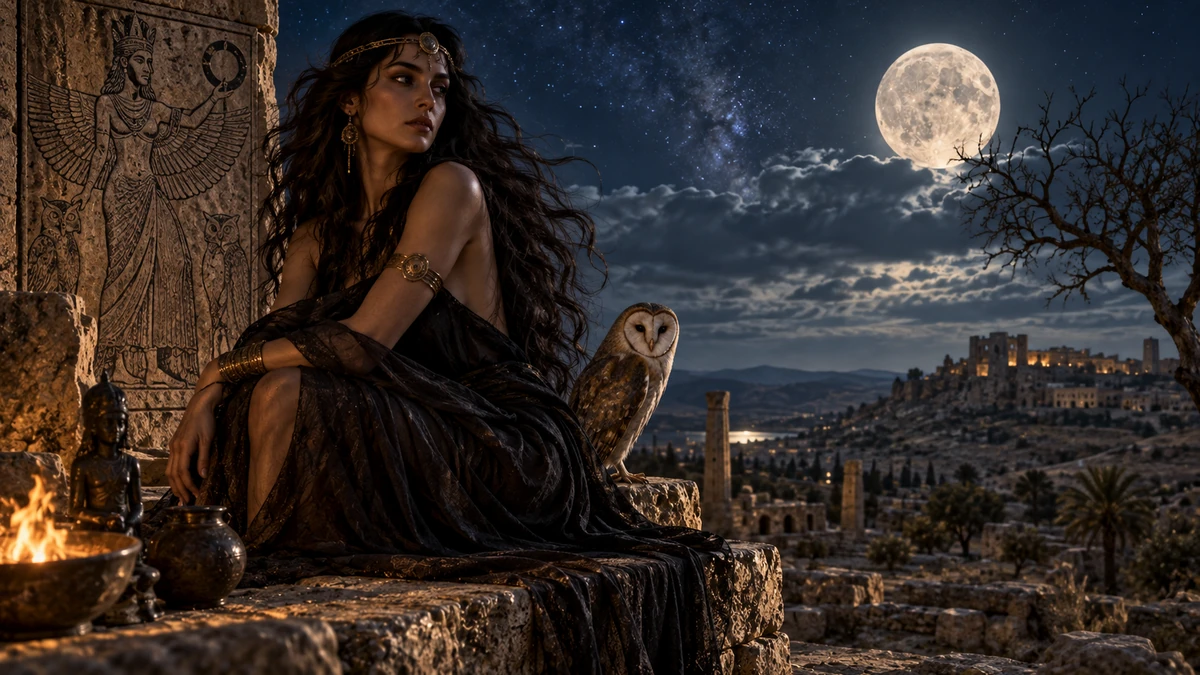
Today Lilith can be a demon, Adam’s supposed first wife, a kabbalistic figure, and a symbol of female independence. These images are connected, but they did not arise at the same time. If they are flattened into one continuous story, it can seem as if the earliest Bible already knew the complete later legend. The sources do not support that.
The earliest comparable layers lead to Mesopotamia, where groups of spirits or demons called lilu, lilītu, and ardat-lilî are attested. Hebrew lilit appears in Isaiah 34:14, but there she is not Adam’s wife; she belongs to a devastated wilderness alongside other dangerous creatures. At Qumran and in late-antique Jewish sources, the demonic profile becomes more elaborate.
Only much later, in the medieval Alphabet of Ben Sira, does Lilith receive the famous biography of Adam’s first wife who demands equality, leaves Adam, and becomes a dangerous demon. That story became enormously influential, but historically it should not be projected backward into Genesis, Isaiah, or ancient Mesopotamian texts.
The article therefore follows one discipline: let each layer remain in its own period. This makes it possible to see how a cluster of nocturnal or harmful spirits gradually becomes a recognizable named figure—and how later generations rewrite her again as a symbol of resistance and autonomy.
First separate the name, the demon, and the legend
The word “Lilith” now covers several historical phenomena. In one source she can be an individual demon, in another a class of female demons, in another the heroine of a pre-Eve story, and in another a symbol of political or spiritual emancipation. The historical question is therefore not only “who is Lilith?” but which Lilith, in which century, and in which genre.
This matters because the later image from the Alphabet of Ben Sira became so famous that it is often read backward into Genesis. Genesis does not name Lilith. The first woman explicitly named alongside Adam in Genesis is Eve. The woman-before-Eve legend is a product of later interpretation, not a direct part of the biblical narrative.
The article therefore does not search for one single “true Lilith.” It reconstructs a genealogy of motifs: related Mesopotamian figures, Isaiah’s lilit, Qumranic and Talmudic demons, late-antique protective magic, the medieval first-wife story, the kabbalistic Lilith–Samael pair, and the modern feminist reversal.
Mesopotamia: related names, not yet Adam’s wife
Akkadian and wider Mesopotamian demonology attests terms such as lilu, lilītu, and ardat-lilî. Different texts associate them with dangerous nocturnal, sexual, or illness-producing forces. This is important background for Hebrew lilit, but it is not one simple biography of a single personality transmitted unchanged for millennia.
Older scholarship often spoke loosely of a direct “Mesopotamian Lilith.” A more careful formulation is better: linguistic and motif-level kinship is real, identity is not automatic. Mesopotamian sources contain several related demonological categories, including Lamashtu, a threat to mothers and infants, but Lamashtu should not simply be renamed Lilith.
The same caution applies to the Sumerian phrase ki-sikil-lil-la-ke in the huluppu-tree story, often rendered as “Lilith” in popular accounts. The philological identification is not secure enough to serve as a biography of the later Jewish figure. The safer conclusion is that later Jewish demonology developed in a cultural world where related nocturnal and female demons had long existed.
The “Queen of the Night”: famous image, uncertain identity
One of the most recognizable online “portraits of Lilith” is the Old Babylonian clay relief in the British Museum known as the Queen of the Night, formerly the Burney Relief. It shows a nude winged woman with bird talons, lions, and owls, and has become a near-visual synonym for Lilith in modern culture.
Yet the museum does not present it as a securely identified portrait of Lilith. Scholarly proposals have included goddesses such as Inanna/Ishtar or Ereshkigal as well as Lilith. It is therefore better to call the Lilith identification a modern and disputed interpretation, not the name inscribed on the object.
This is methodologically useful. Iconography can show what kinds of supernatural female figures Mesopotamians imagined, but without textual evidence it cannot securely assign a personal name. Images and myths may be related; resemblance is not an identification tag.
Isaiah 34:14: the Bible’s single Lilith
In the Hebrew Bible, lilit occurs only in Isaiah 34:14, within an oracle depicting devastated Edom. Around her are wild animals, hyenas or jackals, and goat-like demonic beings; lilit finds a place to rest there. The NRSVUE preserves “Lilith” as a name, while other translations render a “night creature” or related wilderness being.
The context matters more than the later biography. Isaiah does not say that Lilith was created before Eve, that she was Adam’s partner, or that she rebelled and left Eden. The verse places the figure within poetic imagery of a land from which ordered human life has vanished.
Ancient translation traditions already show interpretive diversity. Later Greek and Latin renderings associate the term with demonological female beings such as the lamia. This indicates an early demonic reception, not yet the medieval story of Adam’s first wife.
Qumran: Lilith among spirits of terror
A crucial intermediate stage appears in the Qumran Songs of the Sage (4Q510–511). The composition is apotropaic: through praise of God it seeks to terrify or repel hostile spiritual powers. Lilith appears in a catalogue of harmful beings alongside demons and spirits of destruction.
This matters because it shows that in Second Temple Jewish culture Lilith was recognizable enough as a dangerous supernatural figure to be named among forces from which a community sought ritual protection. At the same time, Qumran still does not know the story of Adam’s first wife.
The chronology therefore sharpens: Isaiah knows lilit in a wilderness of uncanny beings; Qumran lists her among hostile spirits; centuries later texts add increasingly elaborate bodily, sexual, and biographical traits.
The Talmud: wings, long hair, and danger at night
The Babylonian Talmud preserves several brief references to Lilith or lilin. Niddah 24b describes a Lilith-like form as human-looking but winged; Eruvin 100b compares long hair to Lilith; and Shabbat 151b associates sleeping alone in a house with the danger of being seized by Lilith.
Another passage, Eruvin 18b, says that during a period of separation Adam generated spirits, demons, and lilin. This is important background for later associations between Lilith and Adam, but the text does not say that Lilith was his wife. It is a demonological account of offspring, not a first-marriage divorce story.
The Talmud thus supplies several ingredients later legend can combine: a female demon, night, sexual danger, human form, wings, hair, and demons connected with Adam. But ingredients are not yet the same story. Historical method requires us not to leap across the centuries between a motif and a later narrative.
Incantation bowls: Lilith in the house, bedroom, and nursery
Late-antique Mesopotamia has yielded a large corpus of Aramaic incantation bowls and amulets made to protect specific people and households. In these texts liliths often appear in the plural alongside other demons and harmful powers. Spells expel, bind, or even issue ritual “divorce documents” to them.
This material shows that Lilith was not always one literary personality. The term could designate a class of female demons threatening sleep, sexuality, pregnancy, or children. Work by Gideon Bohak, Dan Levene, Shaul Shaked, and others also demonstrates that magical formulas moved among Jewish, Mandaean, Syriac, and broader Mesopotamian environments.
This practice helps explain a major feature of later legend: Lilith as a killer of infants and danger to mothers has deep roots in late-antique protective culture. Yet even here the first-wife story is not required for the demonological function to make sense.

The Alphabet of Ben Sira: here “Adam’s first wife” is born
The decisive narrative turn occurs in the anonymous, satirical Alphabet of Ben Sira, usually dated roughly between the eighth and tenth centuries or around the tenth century. Here Lilith first receives the full biography familiar today: created from earth like Adam, she argues with him over status and equality, utters the divine name, and departs.
The story then explains her demonological role: three angels attempt to bring her back, while Lilith remains linked with danger to children and the angels’ names become part of protective amulet tradition. The text thus fuses two older fields—rabbinic reflection on male and female creation and late-antique Lilith demonology—into a new biographical narrative.
This is the article’s key chronological boundary. The statement “the Jewish Bible teaches that Lilith was Adam’s first wife” is incorrect. A more precise statement is that a medieval Jewish satirical-folkloric work linked older demonological motifs to the exegetical problem of the two creation accounts and produced an extraordinarily influential legend.
Why did the story work so well? Genesis has two creation scenes
The Ben Sira legend gains force from a real literary feature of Genesis. Genesis 1:27 creates male and female together in the divine image, while Genesis 2 narrates a different scene in which the woman is formed after the human. A later interpreter can ask: was the woman in the first scene someone else?
Rabbinic literature knew several ways to reconcile these accounts, including the idea of an originally two-sided human and even a story of a previously created woman, though not yet the full Ben Sira biography of Lilith. The Alphabet chooses a particularly dramatic solution: the first woman is made from the same earth as Adam and therefore claims equal status.
The legend is therefore not random. It is an exegetical innovation using a genuine textual tension plus existing demonology. But that does not make it a hidden lost paragraph of Genesis. It is better evidence for the creative power of reception: an old text can generate new characters across centuries without those characters having been originally written into it.
| Layer | What Lilith means | What we cannot infer from it |
|---|---|---|
| Mesopotamian lilu/lilītu/ardat-lilî | clusters of related harmful/nocturnal spirits | that Adam’s-wife biography already exists |
| Isaiah 34:14 | a being in a devastated demonic wilderness | that Isaiah knows Eden, Adam, or the rebellion story |
| Qumran and Talmud | dangerous demonic figure; night, wings, hair, spirits | that Lilith is already Adam’s former spouse |
| Late-antique magic | liliths as demons from whom households and children need protection | that the term always means one individual Lilith |
| Alphabet of Ben Sira | Adam’s first wife, with equality, departure, and demonization | that the story is biblical or ancient Mesopotamian |
| Medieval Kabbalah and modern reception | cosmic demoness and later a symbol of resistance/autonomy | that all earlier layers carried the same meaning |
Kabbalah: Lilith and Samael become a cosmic pair
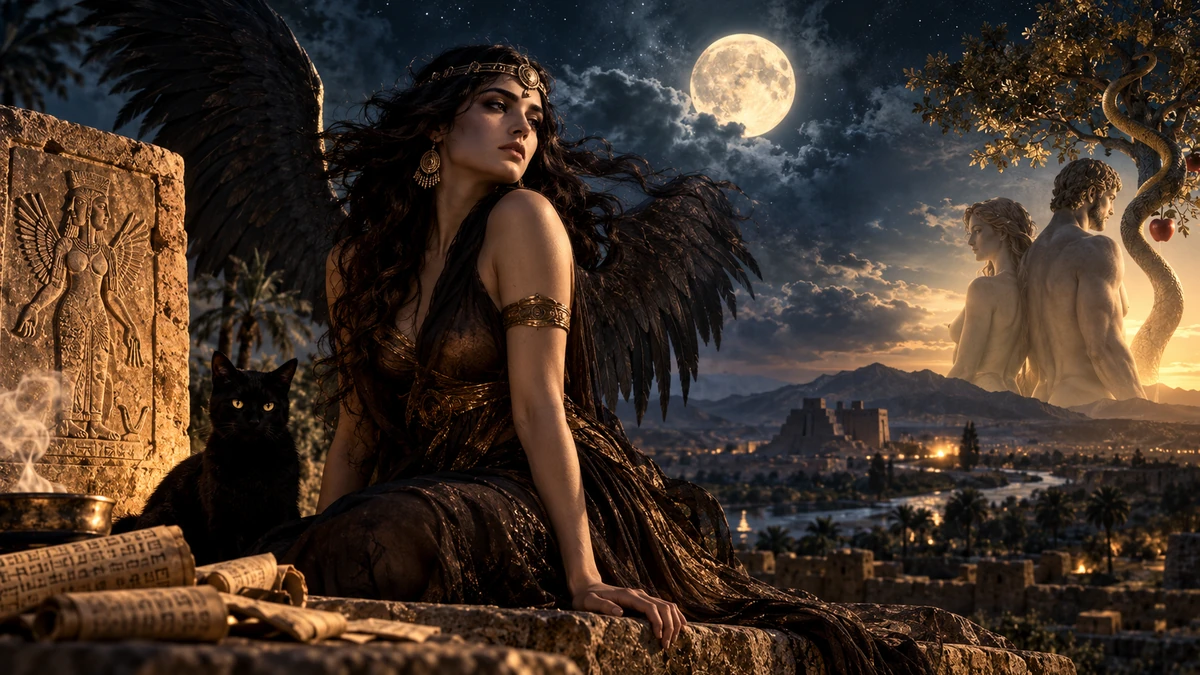
In the thirteenth century Lilith changes again. Joseph Dan has shown that Isaac ha-Kohen’s treatise on the left emanation, followed by Zoharic tradition, makes Lilith and Samael central powers of the demonic realm. The old household and sexual demon becomes part of a much broader cosmic mythology of evil.
This kabbalistic Lilith can appear in multiple forms and relationships; medieval sources are not one uniform encyclopedia. The structural shift, however, is clear: the demonic world mirrors the divine, and Lilith becomes the feminine half of a central pair on the “other side.” This is a very different theological system from Isaiah’s wilderness being or the Talmudic danger of sleeping alone.
Medieval Kabbalah is therefore not evidence that this elaborate cosmology was already present in the Bible. It is the next stage in a history of reception, where an older demonic figure is given a new place in the metaphysical architecture of the world.
From demoness to symbol of independence
In the modern period, the transformation nearly reverses direction. Twentieth-century Jewish feminist writers found in Ben Sira’s rebellious Lilith a figure that could be read against her traditional demonization: if she left Adam because she refused subordination, she could become a symbol of equality and refusal of imposed hierarchy.
This turn is well documented. Lilith magazine, founded in 1976, explicitly took its name from Adam’s legendary first companion and connected the figure with female independence. Feminist midrash repeatedly rewrote her again, just as medieval authors had rewritten her centuries earlier—but with different ethical priorities.
The paradox is one of the most revealing parts of the history. A figure that for centuries embodied dangerous female sexuality, infant death, and nocturnal fear could in a different historical setting become an emblem of autonomy. That does not mean the modern feminist Lilith is “original”; it means reception itself is part of the figure’s history.
The safest conclusion is chronological: Lilith is not one frozen personality from a single lost myth. She is a historically mobile cluster of images repeatedly assembled from ancient demonological categories through the Bible, Qumran, Talmud, magic, medieval narrative, and modern reinterpretation. The open question is: when a later culture turns an old demoness into a heroine, is it correcting an old myth—or creating a new one?
Sources and further reading
- Bible Gateway — Isaiah 34:14 (NRSVUE) — the Hebrew Bible’s single occurrence of *lilit*, preserved in NRSVUE as ‘Lilith’.
- Jessi Knippel, ‘Lilith,’ in The Oxford Handbook of Biblical Monsters (Oxford University Press, 2025), pp. 117–132 — overview of Lilith’s changing figure from the ancient Near East through later religious and modern receptions.
- S. Lackenbacher, ‘Note sur l’ardat-lilî,’ Revue d’Assyriologie et d’archéologie orientale 65.2 (1971), 119–154 — classic Assyriological study of the Mesopotamian *ardat-lilî* tradition.
- British Museum, ‘Queen of the Night’ (Burney Relief), object 2003,0718.1 — museum record and bibliography for the Old Babylonian relief whose identification has been debated.
- L’imaginaire du démoniaque dans la Septante, ch. 3, ‘Les scénarios du démoniaque dans la LXX’ (Brill, 2021) — Isaiah 34:14, later Greek demonological renderings, and Lilith in Qumran’s Songs of the Sage.
- Joseph L. Angel, The Songs of the Sage (4Q510, 4Q511) (Brill, 2022) — critical edition and commentary on the Qumran apotropaic texts naming Lilith among hostile spirits.
- Sefaria — Niddah 24b:10 — primary rabbinic text describing the form of a lilith as human-like and winged.
- Sefaria — Eruvin 100b:26 — primary rabbinic comparison of long hair with Lilith.
- Sefaria — Shabbat 151b — primary rabbinic text associating sleeping alone with danger from Lilith.
- Sefaria source compilation preserving Eruvin 18b — Adam generates spirits, demons, and *lilin* during the period before Seth; contextual background, not a first-wife narrative.
- Michael D. Swartz, ‘Jewish Magic in Late Antiquity,’ in The Cambridge History of Judaism, vol. 4 (Cambridge University Press, 2006/online 2008) — historical context for Jewish amulets, incantations, and bowl magic.
- Christa Müller-Kessler, ‘The Story of Bguzan-Lilit, Daughter of Zanay-Lilit,’ Journal of the American Oriental Society 116.2 (1996), 185–195 — primary philological study of a late-antique Mandaic Lilith tradition.
- Gideon Bohak and Dan Levene, ‘Divorcing Liliths: From the Babylonian Incantation Bowls to the Cairo Genizah,’ Journal of Jewish Studies 63 (2012), 197–217 — study of ritual divorce formulas directed at Liliths and their transmission.
- Wojciech Kosior, ‘A Tale of Two Sisters: The Image of Eve in Early Rabbinic Literature and Its Influence on the Portrayal of Lilith in the Alphabet of Ben Sira,’ Nashim 32 (2018), 112–130 — focused study of the first-wife legend and its exegetical context.
- David Stern, ‘The Alphabet of Ben Sira and the Early History of Parody in Jewish Literature,’ in The Idea of Biblical Interpretation (Brill, 2004) — genre and parody context for Pseudo-Ben Sira.
- Medieval Encounters 31 (2025), discussion of the Alphabet of Ben Sira — dates the anonymous satirical work broadly to the eighth–tenth centuries in the eastern Jewish world and discusses its Lilith narrative.
- Joseph Dan, ‘Samael, Lilith, and the Concept of Evil in Early Kabbalah,’ AJS Review — traces the move from Pseudo-Ben Sira to Isaac ha-Kohen and the Zoharic mythology of Samael and Lilith.
- The Cambridge History of Judaism, ‘Mysticism’ — overview of the thirteenth-century formation and later authority of the Zoharic corpus.
- Joyce Antler, Jewish Radical Feminism: Voices from the Women’s Liberation Movement (NYU Press, 2018) — historical context for Jewish feminism in the 1970s and the launch of Lilith magazine in 1976.
- Lilith Magazine, ‘From the Editor’ (September 1976) and institutional history — primary evidence for the modern feminist reclamation of Lilith as Adam’s legendary equal and the magazine’s namesake.