Jesus in India: The Lost Years, Issa, and Kashmir Under Scrutiny
Does the Gospel silence really point to Jesus studying in India? We examine Notovitch’s Issa manuscript claim, later Himalayan confirmations, Ahmad’s Kashmir thesis, and the history of Roza Bal.
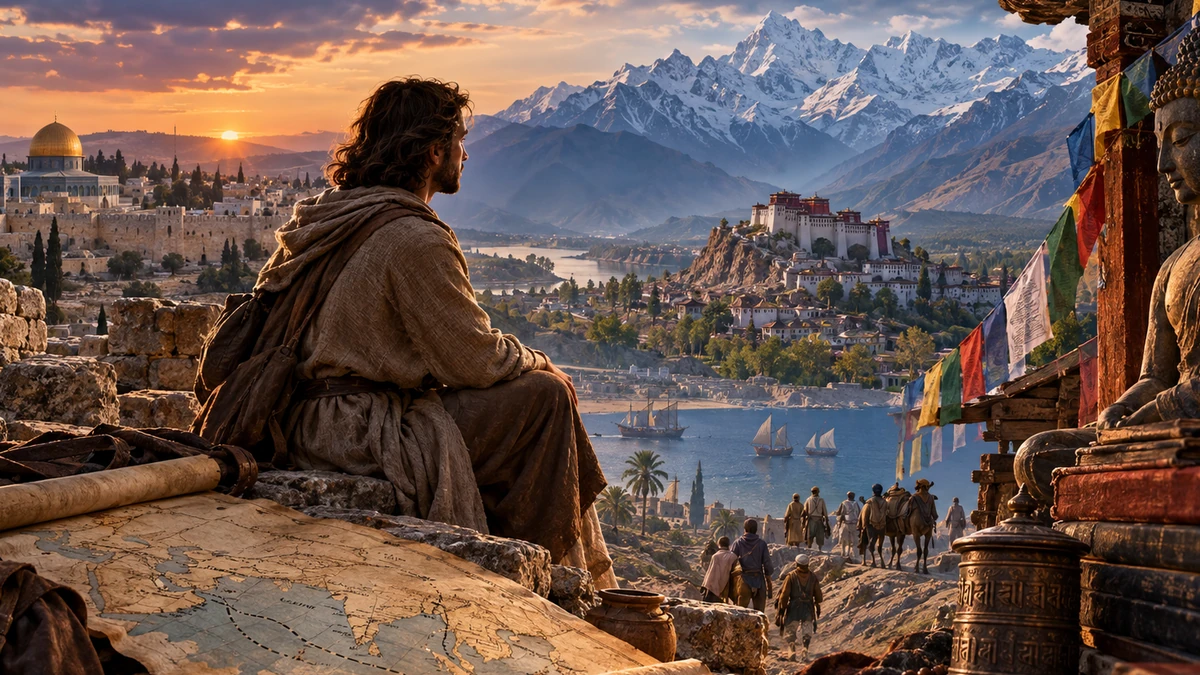
Between Jesus’s visit to the temple at age twelve and the beginning of his public activity at roughly thirty, the canonical Gospels do not provide a detailed biography. That gap later acquired the attractive label “the lost years.” But a gap in a source is not evidence that Jesus spent those years in India — nor is it evidence that such travel was geographically impossible.
From the late nineteenth century onward, several related but historically distinct claims developed around that silence: Nicolas Notovitch reported a Tibetan text about Issa; Swami Abhedananda and Nicholas Roerich later recorded related Himalayan traditions; and Mirza Ghulam Ahmad developed a different thesis in which Jesus survived crucifixion, travelled to Kashmir, and was buried at what is now known as Roza Bal in Srinagar.
This article therefore asks not mainly whether the idea is attractive but how far back each piece of evidence can be traced, whether the source is independent, and what it actually establishes. For a historical claim this large, the distinction between possibility, late tradition, and early testimony is decisive.
What do the Gospels actually leave blank?
Luke is the only canonical evangelist to narrate the story of the twelve-year-old Jesus in the temple. After the episode he explicitly says that Jesus went with his family to Nazareth, was obedient to them, and continued to grow in wisdom and years. When the public story begins, Luke says Jesus was “about thirty years old.” No detailed diary fills the interval.
The word “lost” is therefore slightly misleading. Luke does not say Jesus disappeared or that his whereabouts were unknown to his contemporaries; the biography simply does not follow him in detail during those years. Mark and John do not narrate Jesus’s childhood at all, while Matthew places the family in Nazareth after the return from Egypt and then jumps forward to John the Baptist.
A historically careful starting point is therefore narrow: we know little about Jesus’s life between youth and public ministry. That silence permits hypotheses, but no location — Galilee, Judea, Egypt, India, or anywhere else — becomes established merely because the sources are silent.
Was travel to India in the first century even possible?
Yes — in a geographical and logistical sense, wider contact is not fantasy. The first century had substantial commercial routes linking Roman Egypt, the Red Sea, Arabia, and western India. The Periplus Maris Erythraei, a merchant guide commonly dated around the mid-first century, describes ports, commodities, sailing conditions, and trading routes reaching the western Indian coast.
Modern archaeology and economic history reinforce that picture: Indian merchants reached toward the Red Sea, while ships from Roman Egypt entered the Arabian Sea. A person from the eastern Mediterranean reaching South Asia in stages is therefore not an anachronistic scenario.
But the existence of a route does not identify the traveler. The same networks carried thousands of merchants, sailors, pilgrims, intermediaries, and migrants. “Jesus could have reached India” is therefore a much weaker claim than “Jesus did reach India.” The latter needs a source that actually connects the route to him.
Notovitch and the birth of the modern Issa story
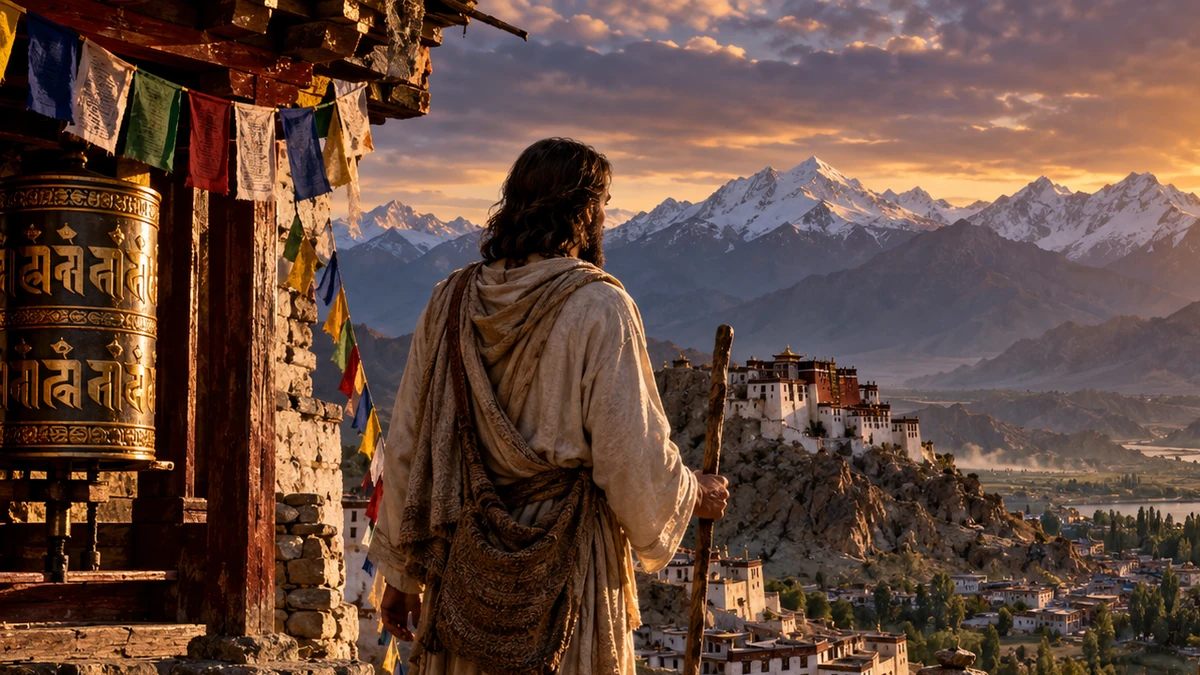
In 1894 Nicolas Notovitch published an account claiming that, after an accident while travelling in Ladakh, he recovered at Hemis monastery. There, he said, lamas read to him from Tibetan books describing Saint Issa, an Israelite-born teacher who had travelled to India as a young man, studied among Brahmins and Buddhists, challenged caste privilege, and later returned west.
Notovitch did not present a manuscript that he himself carried away or photographed. He said portions were orally translated for him and that he later arranged the material into a continuous account. That chain — alleged ancient original, Tibetan copies, oral translation, and authorial arrangement — makes provenance the central problem even before the contents are evaluated.
If such a manuscript were independently verifiable and datable, it would be exceptionally important. The historical weight of the discovery therefore depends on whether the text and the circumstances of its discovery can be confirmed independently of Notovitch’s own narrative.
What happened when the claim was checked?
The Orientalist F. Max Müller raised problems in the same year: a text of such significance was not known from the usual catalogues of Tibetan Buddhist literature, and the story of its transmission contained several unusual steps. Müller did not himself travel to Hemis, so his criticism was not the final word; it did, however, pose a testable question: would the monastery and its lamas confirm Notovitch’s account?
J. Archibald Douglas, a professor in Agra, then visited Hemis in 1895. In his published report he recorded an interview with the head lama, who denied knowing such a manuscript and denied Notovitch’s story of a broken leg and extended stay. Douglas documented the statement with witnesses and the monastery’s seal.
Such an inquiry cannot mathematically prove that no related text ever existed. But it creates a serious historical difficulty: the most concrete elements of Notovitch’s account failed an early attempt at on-site verification. Modern scholarship therefore generally treats his text as a modern apocryphal or pseudo-historical tradition rather than a confirmed ancient source.
Abhedananda and Roerich: independent confirmation or later reception?
The story did not end there. Swami Abhedananda visited Kashmir and Tibet in 1922 and later wrote that material about Issa, similar to Notovitch’s account, had been shown or explained to him at Hemis. Nicholas Roerich likewise recorded stories of Issa circulating in the Himalayan world during the 1920s.
These testimonies matter, but they must be dated correctly. They appear decades after Notovitch’s book had circulated internationally. Similarity to his account therefore does not by itself prove that all of them derive independently from an ancient manuscript; by then the story could already have moved among travelers, monks, missionaries, and local storytellers.
Moreover, none of these later confirmations supplied researchers with an ancient manuscript of documented provenance that could be subjected to palaeographic, linguistic, and textual-critical analysis. Their evidentiary value is therefore greater for the history of the legend’s reception and diffusion than for direct reconstruction of Jesus’s first-century biography.
What do we have — and what do we not have?
| Claim / source | Earliest verifiable layer | What it supports | Main limitation |
|---|---|---|---|
| Gospel gap | first century | detailed biography is sparse between youth and public ministry | silence does not establish a location |
| Mediterranean–India routes | first century | travel was geographically possible | does not identify Jesus as a traveler |
| Notovitch’s Issa | 1894 | detailed story of Jesus studying in India | alleged manuscript was not independently verified; early Hemis checking was negative |
| Abhedananda / Roerich | 1920s | later Himalayan Issa traditions | postdate Notovitch’s circulation; no critically accessible ancient manuscript |
| Ahmad’s post-crucifixion journey | 1890s / publication 1908 | coherent theological-historical reconstruction of a journey to Kashmir | not an early source for Jesus; depends on late identifications and reinterpretations |
| Roza Bal / Yuz Asaf | local Persian sources mainly 18th–19th c. | an older local shrine and Yuz Asaf tradition | earlier sources do not uniformly identify Yuz Asaf with Jesus |
A second theory: Jesus came to India only after the crucifixion
Notovitch’s story is mainly about Jesus’s youth. Mirza Ghulam Ahmad, founder of the Ahmadiyya movement, developed a different reconstruction in the late nineteenth century: Jesus survived crucifixion, travelled through regions corresponding to modern Iran and Afghanistan, reached Kashmir, continued a mission among supposed lost tribes of Israel, and eventually died a natural death there.
According to the movement’s official publishing history, Ahmad’s Masih Hindustan Mein was written in 1896 and published in 1908. The argument also served an important theological purpose: if Jesus died a natural death, he is not physically alive in heaven awaiting a bodily return. The historical reconstruction was thus embedded from the start in a larger religious controversy.
That fact alone does not disqualify a historical claim; many historians have religious motives. It does mean that the evidentiary chain must be evaluated independently of its theological usefulness. The key question becomes: is there an early trail connecting Yuz Asaf or Roza Bal specifically to Jesus of Nazareth?
Roza Bal: an old shrine, but how old is the Jesus identification?
Roza Bal in Srinagar’s Khanyar quarter is a real historical shrine. That matters because the debate does not concern an invented location. But the existence of an old tomb is not the same thing as the identity of its occupant. A recent study by Aejaz Ahmad Rather and Zubair Khalid examines major Persian traditions of Kashmir and shows the shrine developing at the intersection of local memory, hagiography, and historical writing.
In the mid-eighteenth century Muhammad Azam Dedmari describes Yuz Asaf as a foreign sacred or prophetic figure. The later Hassan Khuihami also preserves a different tradition that places a Yuz Asaf in a much later Kashmiri setting. That internal variation is important for claims of an uninterrupted chain of memory back to the first century.
It was only toward the end of the nineteenth century that Ahmad systematically identified these local materials with Jesus. A relatively secure historical distinction can therefore be made: Roza Bal had a tradition before Ahmad; the identification of the tomb as Jesus’s is a modern reinterpretation of that tradition. The two claims should not be collapsed into one.
Yuz Asaf, Josaphat, and Bodhisattva: the problem of the name
The identity of Yuz Asaf is especially complex. In a classic study, David Marshall Lang traced the transformation of Buddhist biography through Middle Persian, Arabic, Georgian, and Christian versions into the story of Barlaam and Josaphat. In that transmission, a name related to bodhisattva acquired forms such as Budasaf, Yudasaf, Josaphat, and related variants.
This does not mean that every person called Yuz Asaf is automatically “the Buddha,” or that the Kashmir tomb is thereby explained. It does mean that phonetic resemblance to Jesus, or splitting Yuz Asaf into supposedly Semitic components, is not a secure identification method. There is a well-documented literary genealogy connecting the name-family with Buddhist-Josaphat traditions.
Historical identification therefore requires more than similar sounds: it would need continuous chronology, early local documentation, and a clear connection to the first-century Jesus. At present the proposed chain is built mainly from much later texts and reinterpretations.
Similar teachings, wounded footprints, and oral tradition
Popular literature often adds other arguments: parallels between Jesus’s and Buddhist ethical teachings, alleged footprint marks associated with crucifixion wounds at Roza Bal, the orientation of the tomb, or claims that Issa had been remembered in the Himalayas from time immemorial. Each may be studied, but none establishes identity by itself.
Similar moral teachings can arise from direct influence, indirect cultural transmission, or independent development. Symbols and architectural features require secure dating. Oral tradition is strongest when it can be shown to have been documented before the published narrative it is supposed to confirm.
In the Jesus-in-India tradition, chronology is precisely the problem: the richest versions multiply after 1894. Their agreement is therefore not automatically a set of independent witnesses; it may also record the reception, repetition, and local transformation of the same modern story.
What can we say with the greatest confidence?
Three levels of evidence can be separated fairly clearly. First, the canonical sources leave much of Jesus’s youth without detailed biography. Second, routes between the Mediterranean and India existed, so such travel was not physically impossible. Third, the specific sources that explicitly place Jesus in India are much later — chiefly from the late nineteenth century onward.
Notovitch’s alleged ancient manuscript failed early independent verification; later Issa traditions appear after his publication and have not yielded a critically accessible ancient text. Roza Bal has a genuine local history, but the earliest verifiable Kashmiri materials now at the center of the debate do not create a clear, uninterrupted trail to the first-century Jesus. Ahmad’s identification is late and interpretive.
The most cautious historical conclusion is therefore: the journey was possible, but we currently lack early, independently verifiable evidence that Jesus actually lived in India. The legend itself remains historically important because it reveals how Christianity, Hinduism, Buddhism, Islam, Orientalism, and quests for a shared spiritual origin intersected in colonial and postcolonial Asia. The final question is therefore open in a different sense: what does the Issa story tell us about Jesus — and what does it tell us mainly about the cultures that wanted to place him within their own sacred geography?
Sources and further reading
- Bible Gateway — Luke 2:41–52 (NRSVUE) — the last canonical childhood episode and Luke’s statement that Jesus returned to Nazareth and continued to grow in wisdom and years.
- Bible Gateway — Luke 3:21–23 (NRSVUE) — canonical transition to Jesus’s public activity, with Jesus described as about thirty years old.
- Lionel Casson, The Periplus Maris Erythraei (Princeton University Press, 1989) — standard edition of the first-century merchant guide documenting Red Sea and western Indian Ocean trade with western India.
- Rebecca Darley, “Indian Ocean Trade in the First Millennium c.e.: Taking the Romans out of Indo-Roman?”, Journal of Roman Studies (2025) — current overview of western Indian Ocean connectivity and the evidence base for long-distance trade.
- Jeffery D. Long, “Jesus in India?: Interreligious Reflections on a Fascinating Claim,” in Esotericism, Mysticism, and the Politics of Transcendence in Modern Asia (Anthem Press, 2025; online 2026) — recent balanced overview distinguishing geographical possibility from historical proof and surveying Notovitch, Ahmad, Abhedananda, and later reception.
- Nicolas Notovitch, The Unknown Life of Jesus Christ (English ed., 1894) — primary source for the claimed Hemis manuscript and “Life of Saint Issa.”
- F. Max Müller, “The Alleged Sojourn of Christ in India,” The Nineteenth Century 36 (1894), 515–522 — contemporary philological critique of Notovitch’s manuscript claim.
- J. Archibald Douglas, “The Chief Lama of Himis on the Alleged ‘Unknown Life of Christ’,” The Nineteenth Century 39 (1896), 667–678 — on-site inquiry reporting the chief lama’s denial of Notovitch’s account and of the Issa manuscript.
- Edgar J. Goodspeed, Strange New Gospels (University of Chicago Press, 1931) — early scholarly review of modern pseudo-gospels, including the Notovitch controversy and Douglas’s investigation.
- The Invention of Sacred Tradition (Cambridge University Press) — scholarly discussion of newly ‘discovered’ sacred texts using Notovitch’s Unknown Life as a prominent modern case.
- Simon J. Joseph, “Jesus in India? Transgressing Social and Religious Boundaries,” Journal of the American Academy of Religion 80.1 (2012), 161–199 — analysis of the modern Jesus-in-India legend and its colonial/interreligious context.
- Swami Abhedananda, Journey into Kashmir and Tibet (Ramakrishna Vedanta Math; English ed. 1987, travel account from 1922) — primary later testimony claiming verification of an Issa tradition at Hemis.
- Nicholas Roerich, Altai-Himalaya — primary 1920s travel writing preserving Issa stories encountered or repeated in the Himalayan region; useful for reception history, not a first-century witness.
- Mirza Ghulam Ahmad, Jesus in India (Masih Hindustan Mein) — primary Ahmadiyya argument that Jesus survived crucifixion, travelled east, and died in Kashmir; official edition notes composition in 1896 and publication in 1908.
- Aejaz Ahmad Rather and Zubair Khalid, “Between Myth, Memory and History: Persian Texts and the Making of the ‘Tomb of Jesus’ in Kashmir,” South Asia: Journal of South Asian Studies 48.1 (2025), 114–126 — recent study of Rozabal’s Persian-textual and local sacred-geography history and its later Jesus identification.
- Chitralekha Zutshi, “Contesting Urban Space: Shrine Culture and the Discourse on Kashmiri Muslim Identities and Protest,” in Kashmir: History, Politics, Representation (Cambridge University Press, 2017) — context for Rozabal within Kashmir’s wider shrine culture and sacred landscape.
- David Marshall Lang, The Wisdom of Balahvar: A Christian Legend of the Buddha (1957; Routledge reissue) — classic study tracing the Barlaam/Josaphat tradition from Buddhist material and the transformation of Bodhisattva-related names; includes a postscript on the Kashmir shrine claim.
- Per Beskow, Strange Tales about Jesus: A Survey of Unfamiliar Gospels (Fortress Press, 1983), chapter “Jesus in India” — critical study of modern alternative Jesus documents and their provenance.
- Günter Grönbold, Jesus in Indien: Das Ende einer Legende (Kösel, 1985) — Indological source study of the Jesus-in-India tradition, Buddhist/Josaphat material, and Kashmir claims.
- Dimitris Plantzos, introduction to the Periplus of the Red Sea, National and Kapodistrian University of Athens — concise scholarly introduction dating the Periplus broadly to the early imperial period, most commonly the mid-first century CE, and describing its routes to India.