Hidden Agenda — Mike Bara: NASA and the alleged secret space program
Mike Bara connects Project Horizon, real classified reconnaissance programs, Paperclip, MJ-12, Gary McKinnon, and testimony about advanced craft into a broader story of a parallel space program; the article separates the documented archive from the author’s interpretation.
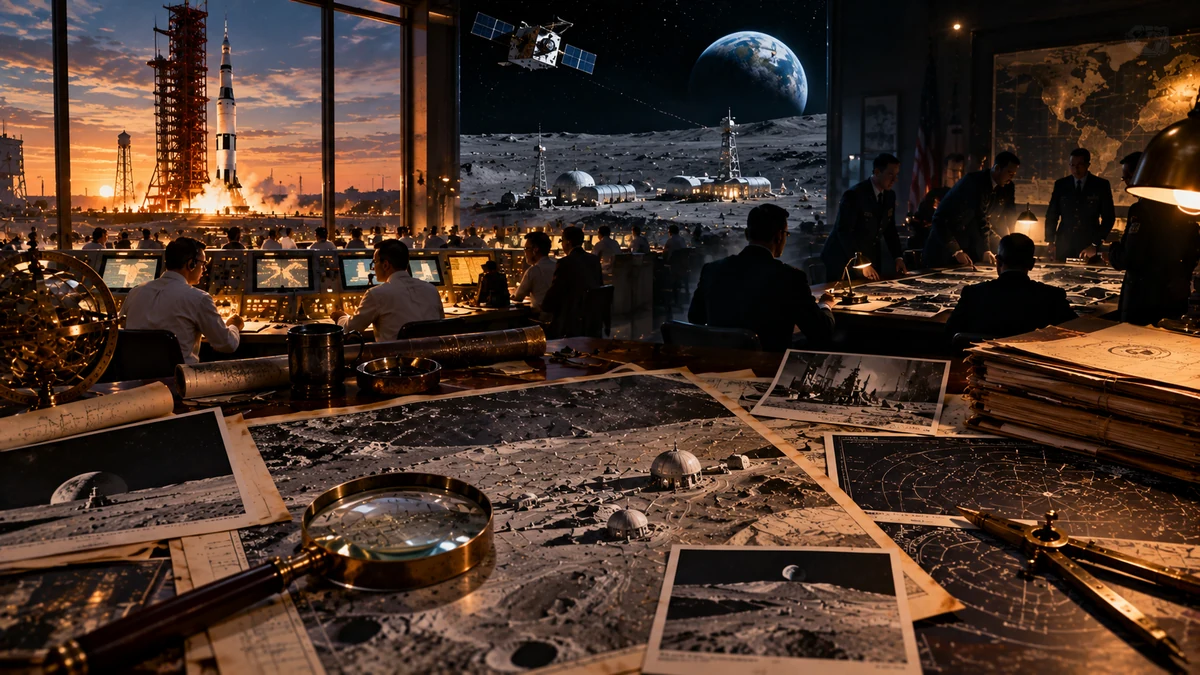
In Hidden Agenda: NASA and the Secret Space Program, Mike Bara expands a theme he had already explored in Dark Mission. Here the focus is less on interpretations of NASA’s lunar and Martian imagery and more on the possibility of a parallel, long-running secret space program said to extend from late-nineteenth-century airship lore and German rocket technology to U.S. military projects, alleged antigravity craft, whistleblower testimony, and claims of contact with non-human intelligences. [1]
A book of this kind makes one distinction especially important: documented secrecy is not the same thing as an interpretation of what the secrecy contained. The United States did operate extensive classified reconnaissance and space programs, some of which became public only decades later. Bara uses that historical fact as a starting point for a broader interpretation in which declassified programs are only the visible layer of a much deeper system. This article presents both levels without treating them as identical. [2][3][4]
A book about a parallel space program
Bara structures the book as a chronology of hidden development. Its contents move from early mystery-airship stories through German flying-saucer claims, MJ-12, the Cold War national-security state, a “parallel secret space program,” an alleged Alien Reproduction Vehicle, whistleblowers, Project Serpo, and later accounts of different non-human groups. The book treats this material as interconnected traces of a longer process. [1]
Within this framework Bara is not simply arguing that militaries conceal some capabilities—a historically ordinary fact—but that the publicly known rocket program ran alongside a technologically more advanced and far more restricted infrastructure. Each section of this article therefore marks what can be connected to the public archive and what depends mainly on testimony, later documents, or the author’s synthesis. [1][4]
Project Horizon: a real plan for a military lunar outpost
One of the most concrete episodes in the book is Project Horizon. In 1959 the Army Ballistic Missile Agency prepared a detailed study for a scientific-military outpost on the Moon. The Smithsonian archive and U.S. Army history confirm that the plan envisioned a 12-person outpost, extensive Saturn-launch logistics, communications, research, and possible military functions. [2][3]
This matters because the idea of a U.S. military lunar base did not originate only in later conspiracy literature. At the same time, the archival record describes Project Horizon as a feasibility study and plan that did not become an operational lunar base; Bara carries the question further by considering whether comparable efforts continued outside the publicly known program. [2][3]

What it means to say a secret space program really existed
The phrase “secret space program” also has a fully documented historical meaning. After decades of classification, the NRO released histories of CORONA, GAMBIT, HEXAGON, SAMOS, early signals-intelligence satellites, and other systems. CORONA, for example, was a covert CIA-Air Force photographic reconnaissance program whose first successful missions date to 1960. [4]
Such cases demonstrate that the public did not know in real time about all U.S. activity in orbit. Bara takes this historical pattern as support for the possibility of a still more advanced level that was never disclosed. The declassified public archive establishes the first proposition—long-term classification of important space capabilities—while the scope of any further unreleased level belongs to the book’s broader interpretation. [1][4]
That history also helps explain why the subject attracts alternative researchers. When programs kept officially secret for decades are later publicly acknowledged, it naturally raises the question of what else may remain undisclosed. The existence of past secrecy is therefore not trivial: it tells us something about the limits of public knowledge at a given moment, without determining in advance what any still-hidden material would contain. [4]

Paperclip: documented transfer of people, broader claims about technology
Bara links much of the hidden program’s genealogy to German technology before and during the Second World War. The documented part is Operation Paperclip: Wernher von Braun and his rocket team were brought to the United States after the war, first worked for the U.S. Army, and later became part of NASA’s institutional and technical foundation. [5]
The book adds accounts of much more advanced German craft, antigravity, and secret societies. The article presents those themes as part of Bara’s genealogy. The NASA history used here directly documents V-2 work, rocket programs, and the von Braun team; claims of additional antigravity technology form a separate layer of the book. [1][5]
MJ-12: a document that became central to a larger story
The book also discusses Majestic 12, or MJ-12, an alleged highly classified committee associated with the exploitation of extraterrestrial craft. The material became influential in UFO literature partly because it appeared in the form of a government briefing document and therefore seemed open to documentary verification. [1][8]
The FBI Vault now publishes its own file on the document and states that an Air Force investigation determined the memorandum to be a fake. Bara nevertheless places MJ-12 within a wider network of testimony and related claims. The article therefore records both facts: the document’s historical influence within the subject and the official archival assessment of its authenticity. [8]
Gary McKinnon: a documented intrusion and disputed content
The Gary McKinnon case is different because the underlying event is very well documented. The U.S. Department of Justice and a British court record confirm that in 2001–2002 he gained unauthorized access to numerous U.S. Army, Navy, Department of Defense, and NASA computers and copied files. [7]
McKinnon later publicly said that while searching for UFO evidence he encountered terms such as “non-terrestrial officers” and material he interpreted as pointing toward unusual space capabilities; Bara incorporates those statements into his narrative. The official indictment and court records reviewed here document the intrusion and its scope, but do not establish the content of those later interpretations. [1][7]
Operation Highjump and the power of a historically real event
Bara also uses Operation Highjump, the large U.S. Navy Antarctic expedition of 1946–1947, within the broader story. Official naval histories confirm the scale of the expedition and describe its purposes as testing equipment and personnel in extreme cold, training, exploration, and mapping. [6]
In alternative narratives Highjump is often linked to secret German bases or unusual craft. Bara considers such connections within his wider history. The archival sources used here document the expedition and its publicly recorded missions; the additional connections are therefore identified as an interpretive layer of the book. [1][6]
Whistleblowers, ARV, Serpo, and testimony-centered narratives
In the second half of the book, individual witnesses, the alleged Alien Reproduction Vehicle, Project Serpo, and accounts of human–non-human programs become more prominent. Bara reads them cumulatively: similarities among separate stories increase, in his interpretation, the possibility that they describe a shared concealed system. [1]
For readers, it is useful to recognize that this material has a different documentary status from Project Horizon or declassified NRO programs. The latter have institutional archives, dates, technical records, and formal declassification; in many later stories the central carrier of information is testimony, a circulated document, or an anonymous source. The article does not collapse these categories but presents them as different types of material that Bara connects into one interpretation. [1][2][4]
With narratives of this kind, tracing the origin of each element is often more useful than treating everything as a single bundle. Testimony may represent a genuine personal experience without making its wider interpretation independently verifiable from the same source; an anonymous document may contain checkable details while still having uncertain provenance. Bara builds his larger picture precisely from the accumulation of such traces. [1]
What Hidden Agenda shows regardless of the reader’s final conclusion
Hidden Agenda can be read as a map of many decades of stories about hidden technology and secret space activity. Some of its reference points rest on fully documented history: Project Horizon existed, Operation Paperclip moved German rocket specialists to the United States, the NRO concealed real satellite programs for decades, and McKinnon’s intrusions are documented in official legal records. [2][4][5][7]
Bara connects these elements to additional claims about antigravity, non-human technology, secret lunar installations, and concealed fleets. The article does not supply a single final verdict on those connections; it identifies their sources and documentary status. That lets the reader see where the book draws on the historical archive, where it relies on testimony, and where the author builds a wider hypothesis from multiple separate traces. [1]
This way of reading does not remove the book’s central question. Instead, it allows the question of hidden programs to remain open where the public archive provides no final answer, while avoiding the assumption that documented secrecy automatically validates every later narrative. The reader is left with a map of the material and can judge the weight of individual connections independently. [1][4]
Sources and further reading
- Bibliographic record, summary of the book’s central claims, and its chapter framework on Project Horizon, secret space programs, Gary McKinnon, Project Serpo, and related themes. Source 1 Source 2
- Archival description of four Project Horizon reports from 1958–1962 and their purpose: a study of a scientific-military lunar outpost. Source 1 Source 2
- Army historical overview of Project Horizon, the planned 12-person lunar outpost, logistics, and the project’s transfer into the civilian space framework. Source
- Official declassified history of actual classified U.S. space programs, including CORONA, GAMBIT, HEXAGON, SAMOS, SIGINT satellites, and Project UPWARD. Source 1 Source 2 Source 3
- NASA historical account of von Braun, Operation Paperclip, and the transfer of the German rocket team into U.S. military and later NASA work. Source 1 Source 2
- Official naval histories describing Operation Highjump as a large Antarctic expedition for equipment testing, training, exploration, and mapping. Source 1 Source 2
- Official indictment and court record documenting Gary McKinnon’s unauthorized access to U.S. military and NASA computers and files he copied; these records do not establish the content of his later “non-terrestrial officers” claims. Source 1 Source 2
- FBI archival record concerning the “Operation Majestic-12” document; the FBI states that an Air Force investigation determined the document to be a fake. Source