Ancient Aliens and Secret Societies — Mike Bara: ancient visitors, secret societies, and historical context
Mike Bara links ancient visitors, a catastrophe around 10,500 BCE, pyramids, secret societies, and NASA into a single model; the article presents those connections alongside documentary, archaeological, and institutional context.
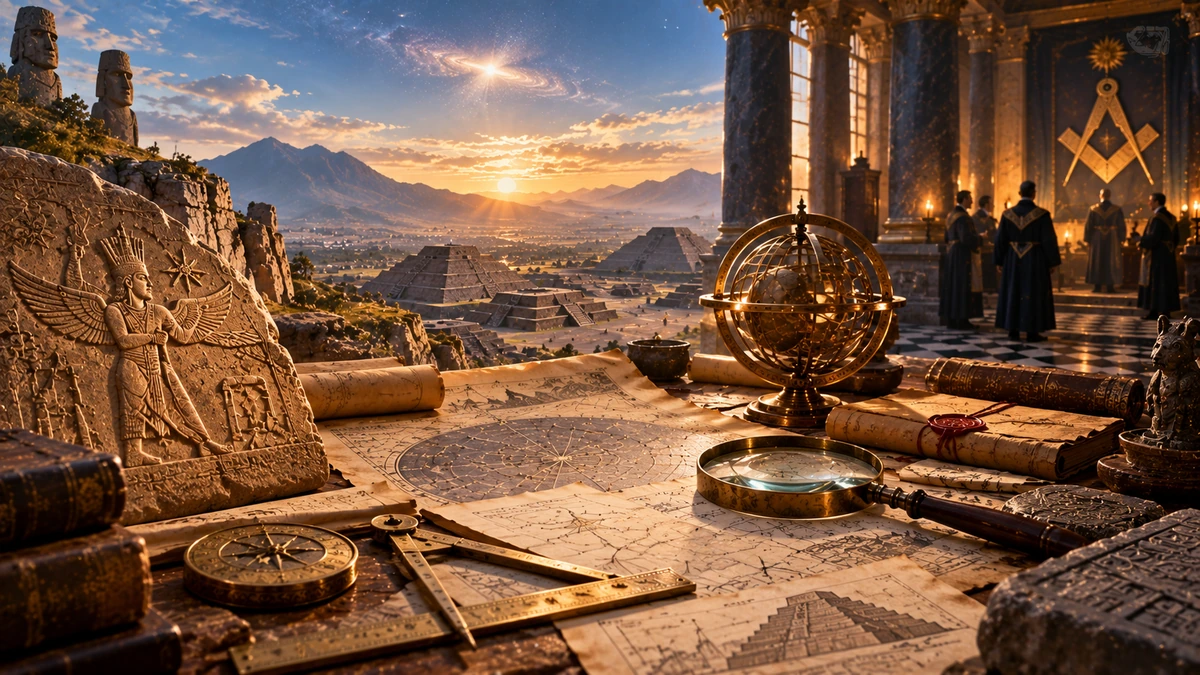
In Ancient Aliens and Secret Societies, Mike Bara links a late-Ice-Age catastrophe, monumental architecture, astronomical patterns, ancient gods, secret societies, and the modern space program into one long story of knowledge supposedly arriving from outside and later being controlled from within. [1][2]
This article first presents Bara’s model in its own terms and then places individual motifs alongside archaeological, historical, and institutional sources. Where something is independently documented, that is stated clearly; where a connection is Bara’s interpretation, it is identified as such.
A book that connects multiple historical and symbolic motifs
Mike Bara’s 2015 Ancient Aliens and Secret Societies does not primarily present ancient visitors as an open hypothesis. The publisher’s description states from the outset that Bara answers yes to questions about extraterrestrial intervention, lost knowledge, and its later control. The book is structured as an argument for that model rather than as a neutral archaeological monograph. [1][2]
Catastrophes, astronomical knowledge, monumental architecture, and secret organizations are real historical phenomena. Bara’s distinctive interpretation is that they can be connected into a continuous story of extraterrestrial intervention and later control of knowledge; the article therefore separates documented phenomena from that connecting interpretation. [1][3][6] The structure matters because conclusions stated at the beginning can make later coincidences appear more cumulative than they are.
10,500 BCE: catastrophe and Bara’s interpretation of a civilizational break
Bara gives major weight to a catastrophe around 10,500 BCE. The late Pleistocene and transition into the Holocene did include large environmental shifts, and debate about causes of particular events—including cosmic-impact hypotheses—is real. Independent sources document major environmental shifts; linking those events to an advanced predecessor civilization or extraterrestrial tutelage is an additional interpretive layer in Bara’s account. [1]
For clarity, the article separates three levels: the event, the explanation of the event, and the story of who then transferred knowledge to humanity. Bara often joins them into one chain. Archaeological sources are then presented alongside each of those levels so that documented material and interpretation remain distinguishable.
Giza and Orion: astronomical context and the “perfect map” theory
Ancient Egyptians observed the sky and incorporated it into religious architecture. Yet the best-known modern claim that the three main Giza pyramids literally map Orion’s Belt and point to 10,500 BCE remains disputed. Quantitative analysis does not yield a simple confirmation of a “perfect match,” while the archaeological context places the pyramids in the Fourth Dynasty of the third millennium BCE. [3][4]
The British Museum places the building of the great Giza pyramids around 2600 BCE; the Metropolitan Museum dates Khufu’s Great Pyramid to his reign, about 2551–2528 BCE. These data do not exclude astronomical orientation. They show that standard archaeological dating rests on a wider body of evidence, while the connection to 10,500 BCE remains a distinct interpretation of the geometric resemblance. [4] The distinction is methodological: astronomical symbolism can be historically important even when a proposed one-to-one ground map remains unproven.
Nazca: geoglyphs, aerial perspective, and interpretations of their origin
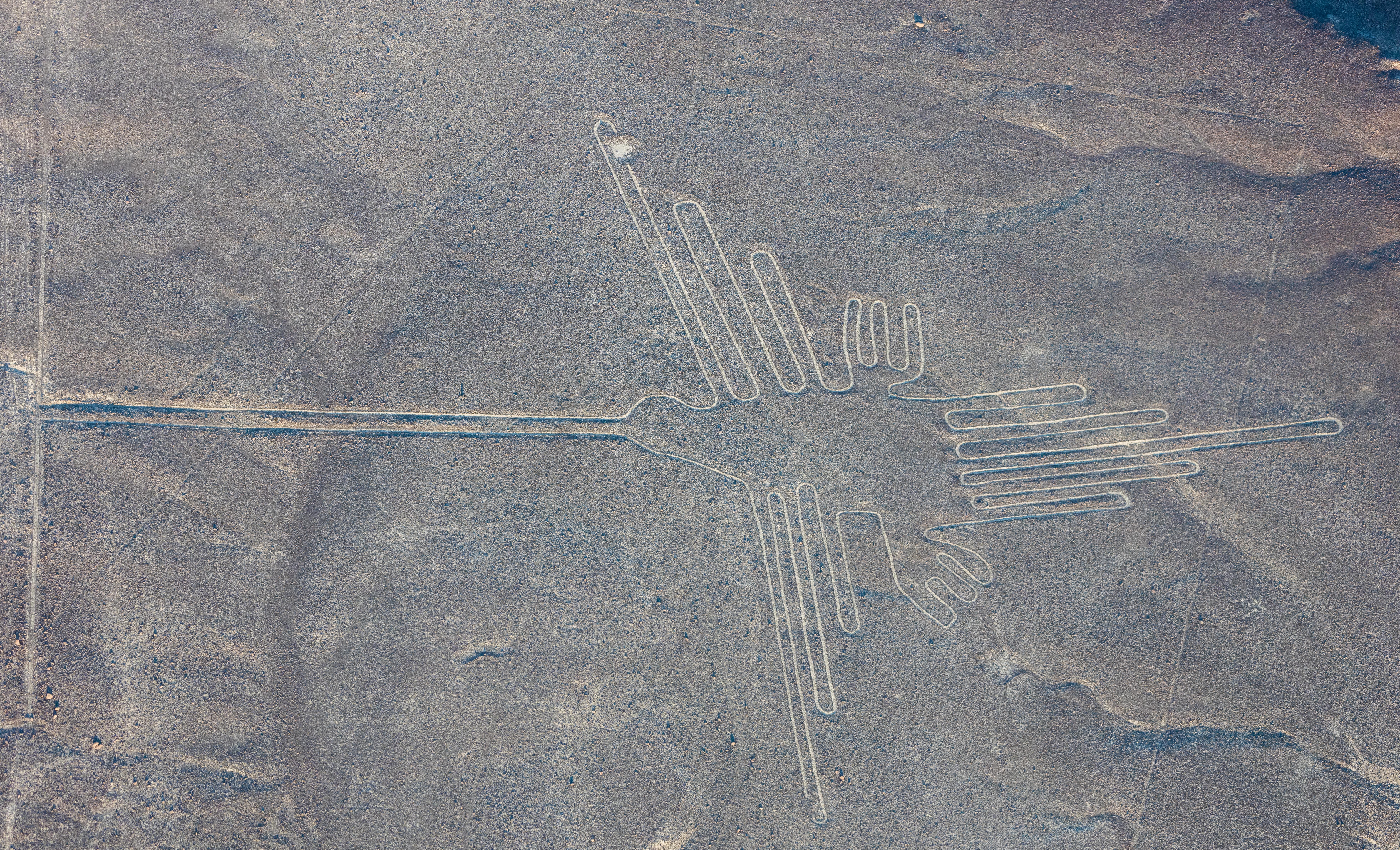
The Nazca Lines are a useful example of how something genuinely unusual can carry a much broader story. The geoglyphs are enormous, some forms are easiest to appreciate from above, and their complete meaning is not finally settled. NASA describes them as works of the Nazca people from roughly 200 BCE to CE 600; archaeological studies have also dated portions through associated material. [5][6]
Bara reads the scale and aerial visibility of the figures as relevant to an aerial or extraterrestrial context. The archaeological and NASA sources used here attribute the geoglyphs to the Nazca culture and do not report independent traces of aircraft or spacecraft technology, so the article presents those two levels separately. [5][6] Human construction is fully compatible with scale, long straight lines, and designs whose complete form is easier to appreciate from elevated viewpoints.

From the priesthood of Amun to Freemasons: Bara’s genealogy of secret knowledge
The second half of Bara’s model is a history of secret societies. The book draws a long line from ancient Egyptian priestly structures through the Templars to Freemasonry and modern institutions. Individual nodes in that chain are historically real: priesthoods, the Templar order, and Masonic organizations existed. Continuous transmission of the same secret doctrine across millennia is the book’s connecting thesis and is broader than the documented existence of the individual groups. [1][2]
For Freemasonry there is a much firmer documentary anchor: the United Grand Lodge of England connects modern organized Freemasonry with the formation of the first Grand Lodge in 1717. This does not rule out older symbolic influences; the documented institutional history of modern Freemasonry is a different kind of evidence from the claim of a direct line from pharaonic Egypt. [7] The gap between symbolic influence and institutional descent is exactly where a documentary chain becomes essential rather than optional.
Symbols and the question of historical continuity
Books in this genre often work through recurring motifs: pyramid, eye, star, sun, geometry, obelisk. These symbols have long histories and genuinely appear in different settings. Yet the same motif can arise independently in two cultures, change meaning, or be deliberately revived centuries later.
Symbolic resemblance can raise a question of influence or transmission. Historical genealogy is usually reconstructed with intermediate documents, people, organizations, texts, or material pathways as well. Iconographic similarity and institutional continuity are therefore different kinds of claim. [7] Reuse can even be evidence of later fascination with antiquity rather than survival of an unchanged ancient organization.
NASA: documented origins and Bara’s occult model
Bara extends his chain to NASA and argues that secret or occult networks influenced the core of the American space program. Here a large documentary record exists. NASA was created by statute in 1958 as a civilian agency, directly in the context of Sputnik and the Cold War space race, absorbing NACA and other existing research structures. [8]
Individuals in government, industry, or the space program may have belonged to associations or held esoteric interests. Bara’s broader claim concerns the purpose and direction of the agency itself. The institutional sources used in this article primarily document legislative, scientific, technological, defense, and Cold War drivers; Bara’s occult reading is presented as an additional interpretation of that background. [8] This makes personnel biography and organizational purpose two separate questions that should not be collapsed into one another.
How Bara connects individual motifs into a shared narrative
Bara’s story is compelling because it connects real things. Pyramids exist. Nazca exists. Secret societies exist. NASA exists. Elite networks exist. Astronomical symbolism exists. The documentation of individual nodes and the historical connections between them are separate questions.
Bara’s narrative often moves from “these can be connected” to “these were historically connected.” The article therefore lists sources not only for the objects at each end of a connection but also, where available, for the links between them, and marks cases in which the connection is primarily the author’s interpretation. [1][2][7][8]
What the comparison between the book and contextual sources shows
Whether or not one accepts Bara’s overall explanation, the book’s central subject remains significant: human societies have linked sky, authority, ritual, architecture, and secrecy for millennia. Knowledge can be monopolized, elites do organize in closed networks, institutions reuse old symbolism, and monumental sites can embody sophisticated mathematics and astronomical orientation.
Bara’s book offers extraterrestrial visitors as a common explanation for these phenomena. The independent sources used in this article document several of the individual historical and material phenomena, but not every connection between them. The reader therefore encounters Bara’s model and its documentary context as separate layers and can assess the relationship between them. [3][4][5][6][8]
Sources and further reading
- Mike Bara, Ancient Aliens and Secret Societies (2015); bibliographic record, contents, and summary of the author’s central theses. Source
- Publisher description; the book’s claims concerning visitors, secret societies, NASA, and an occult program. Source
- Quantitative astronomical analysis of the Orion Correlation Theory; used to distinguish visual resemblance from measured correspondence. Source
- Institutional archaeological context for dating the great Giza pyramids and Khufu’s complex. Source 1 Source 2
- NASA overview of the Nazca geoglyphs, their manufacture, approximate dating, and principal interpretations. Source
- Archaeological dating of portions of the Nazca lines through associated surface material and arrangements. Source
- UGLE historical framework: the first Grand Lodge in London in 1717 and the development of modern organized Freemasonry. Source
- Institutional history of NASA’s 1958 creation, civilian mandate, and links to Sputnik, NACA, and the Cold War. Source 1 Source 2