The Freemasons — Jasper Ridley: a history of Freemasonry between document and myth
Jasper Ridley follows Freemasonry from guild roots and the London Grand Lodge of 1717 through revolutions, anti-Masonic campaigns, and the twentieth century; this article tests where documented history ends and the myth of a unified hidden power begins.
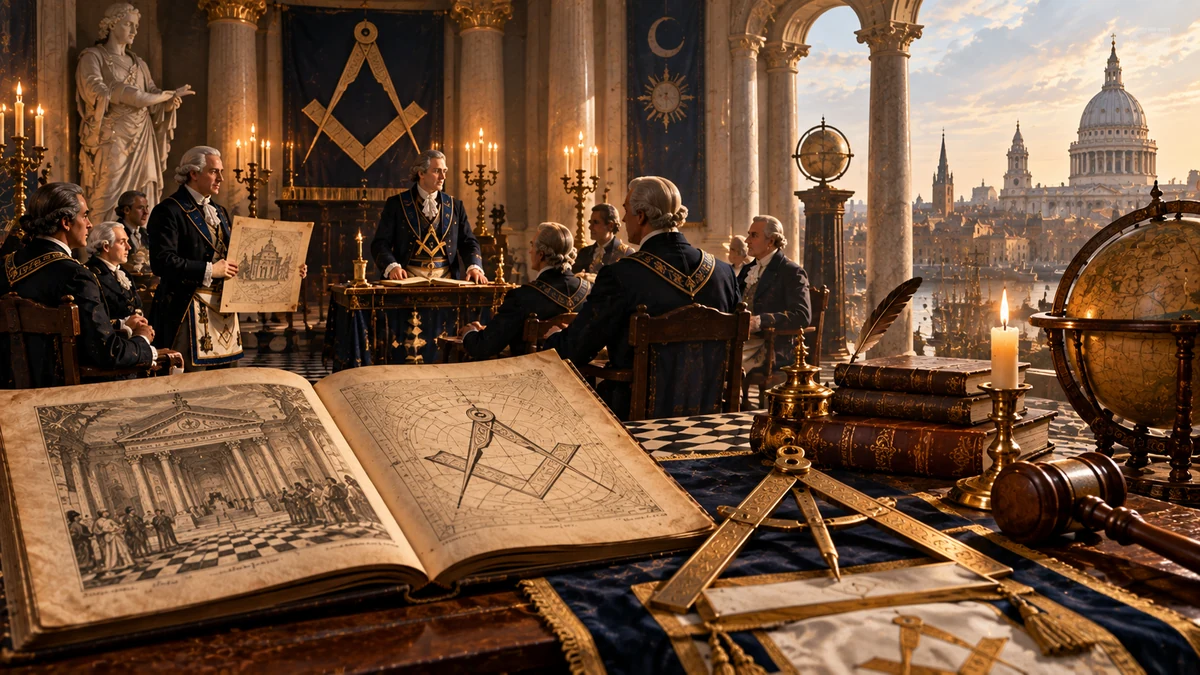
Freemasonry is a rare case in which two things are true at once: it has a documented history of ritual, oaths, internal degrees, and social networks, and for three centuries it has also been surrounded by myths attributing almost unlimited political power to it. In his 1999 book The Freemasons, Jasper Ridley places the history of lodges alongside later representations of their political influence. [1][2]
Ridley was not a lodge member. He was a British historian and biographer, formerly trained in law, who wrote mainly for a general readership. His purpose was not to uncover one “grand secret plan” but to tell a chronological history: from operative masons and early speculative members to Grand Lodge, church condemnations, revolutions, anti-Masonic movements, and the twentieth century. [1][7]
The method here is therefore double: Ridley’s narrative framework is taken seriously, while his larger historical conclusions are checked against institutional and specialist sources. This allows us to separate three levels that popular writing often fuses together: documented membership, documented influence by individual Freemasons, and the stronger claim of a unified central direction of world events. [2][3][4]
From guild to lodge: history does not have a single moment of origin
Ridley begins with early documented traces: modern Freemasonry is not simply a direct, uninterrupted copy of the medieval building guild. There are continuities in symbols, rules, and craft language, but the transition into a society admitting non-operative members was gradual and unclear. UGLE cites Elias Ashmole’s initiation in 1646 as an early verifiable milestone, followed by increasing evidence of “gentlemen masons” in the later seventeenth century. [1][3]
This matters because origin legends reach much further back — to Solomon’s Temple, the Templars, or ancient mysteries. Such stories belong to Masonic symbolic tradition, but they are not the same as a documented institutional genealogy. Ridley repeatedly maintains that distinction. [1][3]
This distinction also prevents later ceremonial mythology from being projected backward as if every element existed from the beginning. [1][3]
Grand Lodge and the Constitutions: the turning points of 1717 and 1723
In 1717 four London lodges joined to form the first Grand Lodge. Six years later Anderson’s Constitutions of the Free-Masons appeared, combining a legendary history, rules for the new organization, and moral “Charges.” These two dates matter more to documented history than later claims of millennia-long secret continuity. [3][4]
The Constitutions emerged from an Enlightenment setting shaped by religious conflict, dynastic tension, and new forms of associational life. UGLE now presents them as a document of religious tolerance, merit, education, and self-government. That is an institutional self-interpretation and should be read as such, but the 1723 document itself is real, dated, and historically influential. [4]
The key historical point is institutionalization: rules, offices, records, and recurring governance made the movement more traceable than before. [3][4]

Brotherhood, network, and political power are not the same thing
Masonic lodges created social ties among people who might not otherwise have met in the same formal setting. Aristocrats, merchants, officers, scholars, and later politicians belonged to different lodges. Such a network can create trust, access, and personal influence. [1][3]
But historical membership is not automatic evidence of a single political command. A Grand Lodge is not a world government, separate jurisdictions are not one hierarchy, and members could be political opponents. Ridley repeatedly uses this contrast: influence is a real historical category; total centralization requires a different level of evidence. [1][2][3]
The proper test is therefore documentary: trace a decision through correspondence, minutes, appointments, money, or coordinated action rather than through membership alone. [1][2]
The Catholic ban: the conflict is documented, the reasons historically specific
Clement XII condemned Masonic societies in 1738 in In eminenti; Leo XII explicitly reproduced and reaffirmed the ban in Quo Graviora in 1825. The concerns included religiously mixed membership, secret oaths, and suspicion that closed societies undermined ecclesiastical and political order. [5]
This is a real and long conflict, so there is no need to choose between two caricatures — that church opposition was invented, or that the prohibition by itself proves a global anti-Church conspiracy. The document establishes what the Church claimed and feared; an actual coordinated plan requires independent evidence. [1][5]
That distinction matters because official condemnation is evidence of conflict, not automatic evidence that every accusation within the condemnation was factually established. [5]
The French Revolution: Masonic participation is not the same as authorship of the Revolution
Eighteenth-century lodges formed part of the wider Enlightenment world of association, so it is unsurprising that some revolutionaries were Freemasons. Counter-revolutionary literature, especially Barruel, transformed this fact into a claim that lodges were the engine of a secret plan to destroy monarchy and Church. [1][6]
Specialist research on Bordeaux shows a more complicated picture: lodges were vibrant institutions and some of their practices were compatible with republican culture, but their response to revolutionary events was not fundamentally different from that of the wider public. It is more useful to study them as a laboratory of Enlightenment associational life than as a unified command center of revolution. [6]
The presence of shared Enlightenment language can demonstrate intellectual affinity without proving that a lodge designed or directed the revolutionary sequence. [6]
Secrecy also creates its own opponents
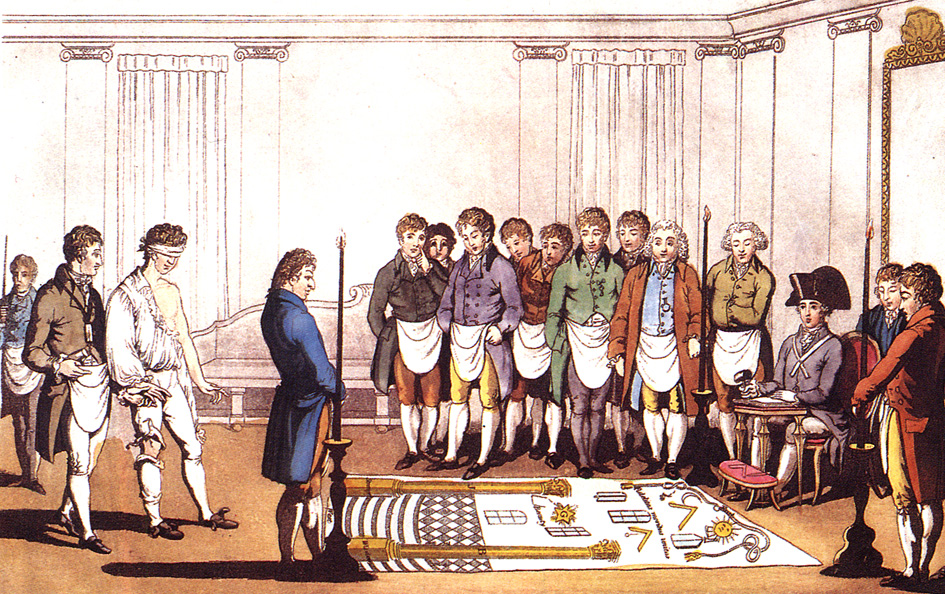
Freemasonry did have genuine elements of secrecy: particular words, signs, rituals, and internal procedures. Yet precisely this limited secrecy created an information gap that opponents could fill with larger explanations. Once part of a ritual is hidden, it becomes easy to infer that the political objective must also be hidden. [1][2]
Ridley is useful because he does not treat anti-Masonic movements simply as external madness. Secrecy, elite membership, and occasional real scandals supplied material for suspicion. The methodological problem begins when those facts are turned, without additional evidence, into one transnational master plan. [1][2]
The historian must therefore ask which information was actually restricted, who possessed it, and whether secrecy concealed ritual, patronage, crime, or policy. [1][2]
William Morgan and political anti-Masonry in the United States
The disappearance of William Morgan in 1826, after he planned to publish Masonic secrets, triggered a major anti-Masonic wave in the United States. The episode matters because it shows how a local conflict, real pressure, and an unexplained disappearance can generate a much wider political movement. [1]
Ridley uses the episode as a case where the issue is no longer symbolism alone. If individual Masons took part in intimidation or concealment, those are concrete actions by concrete people and should be investigated as such. Even that case, however, does not establish that every lodge acted under orders from one center. [1][2]
The episode also shows why specific allegations must be reconstructed locally before they are generalized into claims about an international fraternity. [1][2]
The twentieth century: from elite membership to persecution
The twentieth century further complicates the picture. In some countries Masons were present among political and social elites; elsewhere lodges were banned or persecuted. The Nazi regime associated Freemasonry with liberalism, internationalism, and the antisemitic myth of a “Jewish-Masonic” conspiracy. [8]
The USHMM documents lodge closures, confiscation of archives and property, and propaganda campaigns. This history is an important correction to the idea that Freemasonry always functioned as an untouchable power above states: under totalitarian regimes it could itself become a target of state power. [8]
Persecution also demonstrates that anti-Masonic conspiracy narratives could themselves become instruments of state propaganda and coercive political action. [8]
What Ridley explains well — and where he must be read cautiously
Ridley carries the reader across three centuries without requiring one universal theory. He presents real lodges, real rituals, influential members, church prohibitions, political fears, and persecution. Freemasonry therefore remains a historical object rather than a blank screen for unlimited speculation. [1][2]
The same breadth also limits the depth of individual chapters. Publishers Weekly warned that a study of such chronological and geographical scope sometimes oversimplifies periods and individuals. Ridley can be read as a broad synthesis and a map for further questions. The article therefore focuses on the question “do Freemasons secretly rule the world?” but: which individual, which lodge, which document, which decision, and what trace of influence can be demonstrated in the specific case? [1][2]
For THY-REALITY, that case-by-case standard is the useful endpoint: neither automatic dismissal nor automatic belief, but a traceable evidentiary chain. [1][2]
Sources and further reading
- Jasper Ridley, The Freemasons, Constable, 1999; bibliographic record, 340 pages, and scope of the book. Source
- Publishers Weekly, review of Ridley’s book; assessment of his skeptical approach and warning about simplification caused by the book’s broad scope. Source
- United Grand Lodge of England, historical overview; Elias Ashmole in 1646, Grand Lodge in 1717, the Antients/Moderns split, and union in 1813. Source
- UGLE, the 1723 Constitutions; rules of the new Grand Lodge and their Enlightenment context. Source 1 Source 2
- Vatican, Quo Graviora (1825), reproducing and reaffirming the condemnation of Freemasonry in In eminenti (1738). Source
- Kenneth Loiselle, study of Bordeaux Freemasonry during the French Revolution; argues for studying lodges as institutions adapting to revolution rather than treating them as the origin of a Masonic plot. Source
- Royal Society of Literature, biographical record for historian and biographer Jasper Ridley. Source
- United States Holocaust Memorial Museum, documented Nazi persecution of Masonic lodges, confiscation of archives, and propaganda about a Jewish-Masonic conspiracy. Source