Dark Mission — Hoagland & Bara: NASA, anomalies on the Moon and Mars, and claims of concealment
Hoagland and Bara connect Paperclip, the Brookings Report, Cydonia, lunar imagery, and NASA symbolism into a hidden-space-history thesis; the article presents these claims alongside publicly available historical and imaging sources.
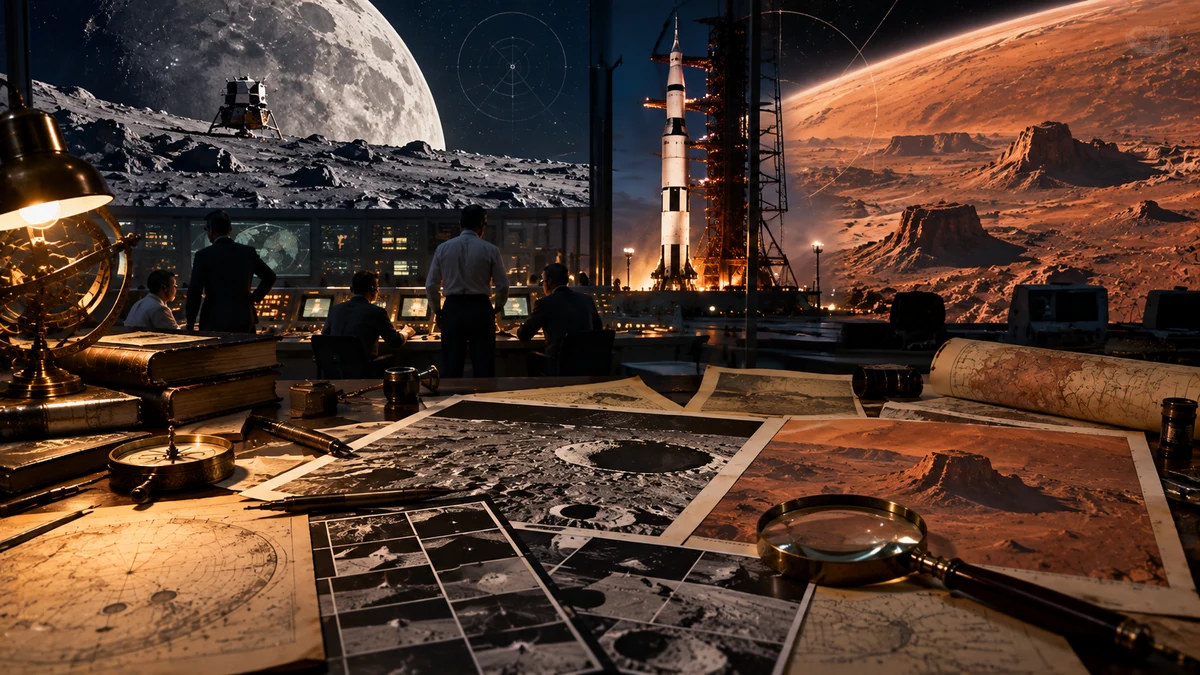
In Dark Mission, Richard C. Hoagland and Mike Bara portray NASA not primarily as a civilian scientific agency but as an institution with a second, hidden history. Their expanded 2009 edition links the agency’s origins, Operation Paperclip, symbolic and mission-timing patterns, lunar and Martian imagery, and alleged suppression of evidence for an earlier extraterrestrial civilization into a single interpretive framework. [1][2]
A book of this kind requires two levels of reading. Some building blocks are historically uncontested: NASA emerged in a Cold War setting, von Braun’s team came to the United States through Operation Paperclip, and the American space program had military and political roots. The next step is much stronger: do those facts demonstrate secret occult direction of the agency, artificial structures on the Moon and Mars, and systematic concealment? This article therefore tests the links one by one rather than accepting or rejecting the dramatic conclusion as a package. [3][4]
A book that reads NASA as a double institution
Hoagland and Bara construct the book as an alternative history of the space program. The expanded edition moves from “The Monuments of Mars” and “Hyperdimensional Physics” to “The Crystal Towers of the Moon,” conspiracy, Cydonia, and “The True Colors of NASA.” Their thesis is not merely that NASA has sometimes concealed information; it is that the public scientific program is only one layer of an institution supposedly pursuing an older symbolic and esoteric agenda. [1][2]
That distinction matters. Errors, secrecy, or political management inside a large state organization do not by themselves establish a single hidden purpose. A stronger thesis would need evidence connecting motives, decision-makers, mechanisms of control, and concrete outcomes—not merely the co-presence of secrecy, symbols, and anomalous photographs. For that reason the article treats institutional history, visual anomalies, and symbolic interpretation separately rather than combining them into a single evidentiary package.
The real shadow: Paperclip and the German rocket legacy
One key part of the historical background in Dark Mission is that the postwar American rocket program did not emerge in a moral vacuum. Wernher von Braun and more than a hundred German specialists were brought to the United States through Operation Paperclip. His team initially worked for the U.S. Army; in 1960 his development center moved into the new NASA, and von Braun became director of Marshall Space Flight Center and a central figure in the Saturn V program. [4]
But this does not automatically mean that NASA as a whole continued Nazi ideology or an esoteric program. The institutional genealogy is documented; the additional claim of secret ideological command requires a separate chain of evidence. This is one of the places where Dark Mission often moves from personnel history to an interpretation of symbols and intentions. Real moral and political questions surrounding Paperclip can also be examined without adding claims for which no documentary chain is supplied.
How NASA was actually created
The documentary history of NASA’s formation is comparatively straightforward. After Sputnik, the Eisenhower administration proposed a civilian space agency built around NACA; the National Aeronautics and Space Act was signed on July 29, 1958, and NASA began operations on October 1. The new organization absorbed NACA and later incorporated selected military and research units. [3]
That institutional history does not answer every question about classified programs, political pressure, or internal interests. It does show what the public record documents about the agency’s formation and military-industrial environment. Hoagland and Bara’s claim that NASA was “born in a lie” or directed through a unified occult program is presented here as a broader interpretation of that historical background. [3][4]
The Brookings Report: a real document whose meaning is often inflated
One of the most interesting documents in this literature is the 1960 Brookings Institution report prepared for NASA’s Committee on Long-Range Studies. It is real, publicly accessible, and surveys a wide range of possible social consequences of space activity. Among its hypothetical questions is how societies might respond to the discovery of extraterrestrial life or artifacts. [5]
But the existence of that discussion is not evidence that NASA made such a discovery and then concealed it because of the report. The document is a research agenda about possible future implications, not a record of a find. The distinction between anticipating a scenario and proving that the scenario occurred is decisive here. [5] It is a useful example of how a genuine primary document can acquire a much stronger role in a secondary narrative than it has in its actual text.
Cydonia: when low resolution makes a face
The “Face on Mars” is one of the clearest cases for testing how an anomaly behaves when better data arrive. Viking imagery from 1976 showed a landform that, under a particular illumination, resembled a human face. Mars Global Surveyor re-imaged it in 1998 and 2001 at far higher resolution; at roughly two meters per pixel it resolves as an irregular mesa with ridges and erosional structure rather than an architectural face. [6]
The original Viking image allowed an anthropomorphic reading because of its lighting and resolution. Later images make it possible to compare the same region under different conditions and at higher resolution; NASA/JPL interprets them geologically, while Hoagland places them within his broader reading of Cydonia. [6] The article presents both interpretations alongside the same imaging record.

The Moon: photographic anomalies and claims of structures
For the Moon, Dark Mission places substantial weight on unusual luminous forms, glass-like “towers,” geometry, and the processing history of NASA imagery. Space photography really is technically complex: exposure, optics, scanning, contrast, compression, dust, and harsh unfiltered sunlight can all generate visually suggestive edges and artifacts across generations of copies. [1][8]
A claim for gigantic artificial structures would be much stronger if independent measurements converged: repeat imaging from multiple angles, elevation data, thermal or radar signatures, and stable geometry. A single image in which enlargement produces a grid or bright boundary is a starting question, not the end of an evidentiary chain. With imagery, the original negative or digital capture, later reproduction, and interpretation produced only after enlargement must always be distinguished.
Apollo: historical event and photographic “anomalies”
Claims surrounding Apollo have long focused on absent stars, unusual shadows, the flag, photographic plate crosshairs, and other apparent irregularities. The Smithsonian review gives ordinary photographic or physical explanations for these examples; missing stars, for example, follow from short exposures needed for the brightly illuminated lunar surface. [8]
Later orbital data provide another layer. Decades after the missions, the Lunar Reconnaissance Orbiter imaged the landing sites; at Apollo 11 the descent stage and paths made by the astronauts are visible. This does not answer every claim made in Dark Mission, but it sharply constrains hypotheses in which the entire lunar surface history is a studio fabrication. [7] This matters because Apollo claims are often blended with the separate thesis of lunar ruins even though they are evidentially different questions.

Symbols, timing correlations, and how patterns are selected
Hoagland’s broader system often treats numbers, latitudes, dates, ritual motifs, and mythological names as traces of a hidden program. Such patterns can be culturally and interpretively interesting. Assessing them also depends on how dates, angles, and symbols were selected and whether the rule was defined before or after examining the data, since a large set of possibilities permits many different matches. [1]
A stronger test would define the rule in advance: which symbol should appear, when, where, and within what tolerance—and then test it against data not used to construct the pattern. Without that step, a correlation remains suggestive rather than independently predictive. The statistical surprise of a pattern can be judged only when the full set of available choices is known, not merely the matches that were selected.
What the comparison between the book and public sources shows
Dark Mission is most useful as a map of questions that became part of alternative space-program history. It points toward real historical subjects—Paperclip, Cold War entanglement between civilian and military interests, institutional secrecy, and the way the public interprets photographic anomalies. [3][4][5]
The public sources used in this article document Paperclip, NASA’s formation, the contents of the Brookings report, later Cydonia imagery, and LRO data from Apollo sites. Hoagland and Bara incorporate these materials into a broader interpretation of a hidden program and extraterrestrial architecture. The article therefore presents institutional history, imaging data, and authorial interpretation as separate layers, without deriving a final verdict for the reader. [5][6][7]
Sources and further reading
- Expanded edition; bibliographic data, contents, and summary of the central claims about NASA, the Moon, Mars, and alleged suppression. Source
- Original 2007 edition; publisher summary of claims concerning NASA’s alleged occult origins and suppressed lunar discoveries. Source
- Primary institutional account of NASA’s 1958 creation from NACA in the context of Sputnik. Source
- NASA historical account of von Braun, Operation Paperclip, and the transfer of the German rocket team into U.S. military and later NASA work. Source 1 Source 2
- The so-called Brookings Report in NASA’s Technical Reports Server; a public document on social implications of space activity, including hypothetical discovery of extraterrestrial life. Source 1 Source 2
- High-resolution Cydonia image and institutional description of the geological feature that resembled a face in Viking imagery. Source 1 Source 2
- LRO imagery of the Apollo 11 landing site showing the lunar module descent stage and astronaut tracks. Source 1 Source 2
- Review of frequently cited Apollo photographic “anomalies,” including absent stars, shadows, the flag, and reseau crosshairs. Source