George H. W. Bush — Panama and the Gulf War
In just over a year, George H. W. Bush authorized two major American military operations that the temptation of a simple narrative has often placed under a single heading: American power at the end of the Cold War. But…
Editorial illustration.
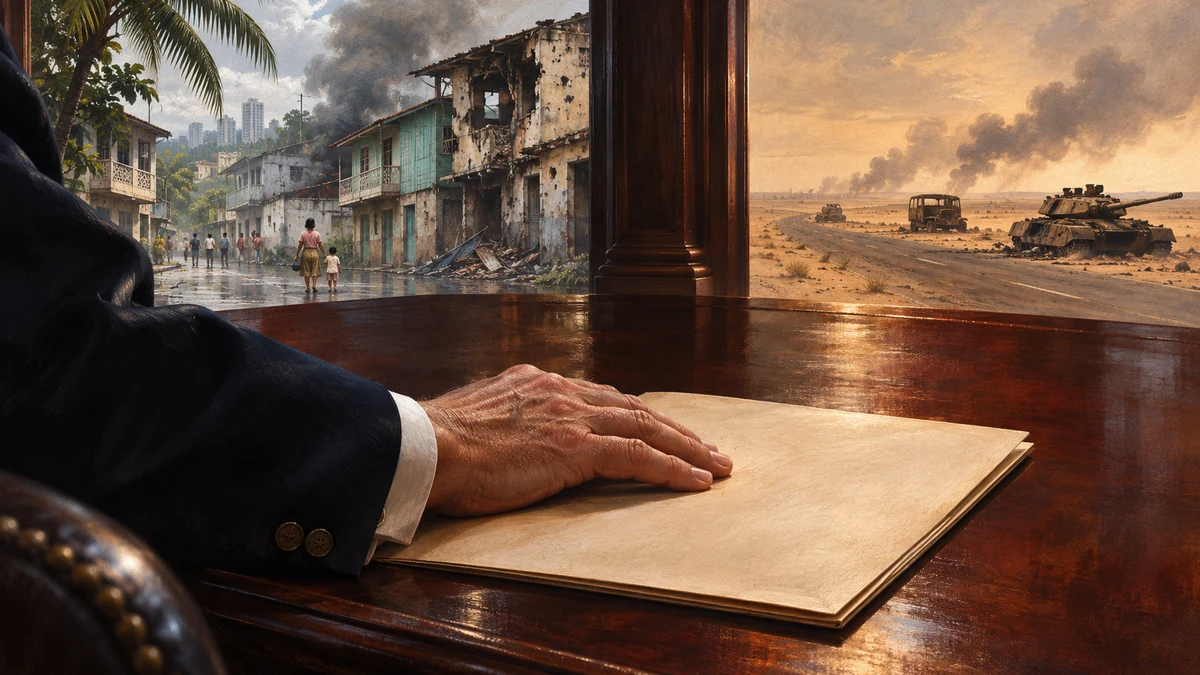
In just over a year, George H. W. Bush authorized two major American military operations that the temptation of a simple narrative has often placed under a single heading: American power at the end of the Cold War. But Panama in December 1989 and the 1991 war to liberate Kuwait did not have the same origins, the same basis in international law, or the same implications for civilians. They shared something else: a presidential decision set military force in motion, and the consequences of that decision cannot honestly be reduced to a single death toll.
In both cases, it is essential to distinguish the president's direct decision (P1), the broader conduct and framework of a military campaign (P2), and decisions about individual targets and their execution (P3). We must likewise distinguish deaths directly caused by U.S. forces from coalition-wide outcomes, indirect mortality, the later effects of unexploded weapons, and American military losses. Without those distinctions, a seemingly precise total would in fact be methodologically unsound.
Panama: a former partner becomes an enemy
When American troops entered Panama in December 1989, Manuel Noriega was not an unfamiliar leader with whom Washington had only just made contact. His longstanding ties to American intelligence agencies and his regional role formed part of the complicated history of U.S. policy in Central America. By the late 1980s, however, Noriega faced U.S. drug-trafficking charges, and Panama's internal political crisis was growing more severe.
According to the available results, opposition candidate Guillermo Endara won the election of May 7, 1989. Noriega's regime annulled the vote. Attacks on the opposition, international pressure, and disputes over who represented Panama's legitimate government followed. There was genuine political repression and a serious dispute over electoral legitimacy, and both facts must be acknowledged. But opposition to a dictatorship does not by itself settle whether another country may remove its government by force.
In mid-December, the crisis acquired an immediate military trigger. Panama's assembly declared a state of war with the United States; members of the Panamanian Defense Forces then fired on a vehicle carrying American officers, killing U.S. Marine Robert Paz. Bush pointed to these events as evidence of the danger to American citizens. American military plans to remove Noriega, however, predated the incident. It was a trigger in a months-long crisis, not the crisis's beginning.
The president's order and four publicly stated reasons
Bush approved the operation on December 17, 1989; the assault began during the night leading into December 20. In his address to the American people that day, he explicitly said he had ordered American forces into Panama the previous night. There is no need to speculate about this part of the chain of command: the launch of Operation Just Cause was a direct presidential decision, or P1. [1]
In the address, the administration set out four aims: to protect American lives, defend democracy in Panama, combat drug trafficking, and safeguard the Panama Canal treaties. Bush also spoke of bringing Noriega before American justice. These reasons document the president's public justification; they do not prove that he had a single concealed motive. Strategic and political interests can be investigated, but an inference about motive must not be mistaken for documentary evidence of a particular decision. [1]
According to American military and government audit sources, approximately 26,000 U.S. service members took part, many of whom had already been stationed in Panama before the attack. The Panamanian Defense Forces quickly lost the capacity for organized resistance. Noriega fled to the Vatican's diplomatic mission and surrendered on January 3, 1990. American forces achieved their immediate military objectives, and Endara's government took power. Yet the speed of military success tells us nothing about the cost borne by civilians. [2]
Civilian deaths: between the official figure and later records
American military losses are comparatively well documented: 23 U.S. service members died during the operation, and more than 300 were wounded. These are American personnel who died during a president-ordered operation, not deaths caused by U.S. fire, and they do not belong in a civilian death toll. [2]
Panamanian military deaths also show why early battlefield figures need to be reassessed. Initial U.S. reports cited 314 dead members of the Panamanian forces, but later investigations and revised records substantially lowered that figure. The research baseline therefore uses an approximate range of 50–70 Panamanian military deaths, explicitly noting that this is not a definitive, name-by-name register. [3]
The differences in civilian figures are even more consequential. An early official U.S. record listed 202 civilian deaths. Drawing on Panamanian forensic, hospital, and other records, Americas Watch concluded that the evidence pointed to at least approximately 280–305 civilian deaths, possibly more. The report's authors warned that the range was uncertain because of unexcavated mass graves, missing records, and incomplete lists of missing people. Conversely, the verified evidence available does not support political claims of several thousand dead with comparable evidentiary strength. [3] [4]
This does not mean there are 280–305 individually documented cases in which an American bullet or bomb was established as the direct cause of death. These are civilian deaths associated with the invasion, including circumstances involving fires, combat, and violence by different participants. Where direct American causation has been established, DIRECT-US is an appropriate label; the entire nationwide operational range cannot be assigned to that category without evidence.
The most tangible example of civilian destruction is El Chorrillo, a residential neighborhood adjoining the headquarters of the Panamanian Defense Forces. The military headquarters was a real military objective, but densely populated civilian buildings, many constructed of wood, stood alongside it. During the assaults and fighting, a major fire swept through the neighborhood, leaving extensive destruction. In Report No. 121/18 of 2018, the Inter-American Commission on Human Rights found that U.S. forces had failed to take the necessary precautions in planning and conducting the operation and had not adequately distinguished military from civilian property. The Commission specifically addressed El Chorrillo and found a violation of the affected residents' right to property. These are findings by the Commission in a particular proceeding, not a criminal judgment establishing the president's personal guilt. [4]

The precise number of people who died in that neighborhood remains unresolved. Figures for destroyed homes, displaced residents, or people needing assistance are important measures of human harm, but they are not death counts. For the same reason, deaths in El Chorrillo must not be added a second time to the nationwide Panamanian range.
Military success and a dispute over legality
Washington defended the invasion on legal and political grounds involving the protection of U.S. citizens, treaty rights concerning the Panama Canal, and the consent of Endara's government, which the United States recognized as legitimate. Critics argued, by contrast, that these claims could not justify a large-scale invasion and the forcible replacement of a government. The international response was sharply divided, but not neutral: on December 29, 1989, the UN General Assembly adopted Resolution 44/240, describing the intervention as a flagrant violation of international law, by 75 votes in favor, 20 against, and 40 abstentions. A General Assembly resolution is not a criminal judgment by an international court, but it is an important record of international opposition to the intervention. [5]
From a military perspective, the stated objectives had been achieved. From the perspectives of civilians, their property, and international law, different questions remained. Criticism of the operation does not erase Noriega's violence, any more than his violence erases civilian deaths and the obligations of attacking forces. That consistency is fundamental if political power is to be judged by conduct rather than by which side wields it.
Kuwait: a war with a different beginning
Only months later, a crisis began with a fundamentally different immediate cause. On August 2, 1990, Iraq invaded and occupied Kuwait. UN Security Council Resolution 660 demanded Iraq's withdrawal. The United States, therefore, did not initiate the original invasion of Kuwait. That distinction is essential to any historical and legal assessment of the 1991 war. [6]
On August 7, 1990, Bush ordered U.S. troops deployed to the Persian Gulf region; the U.S. Government Accountability Office confirms the date of the order. The first phase, known as Desert Shield, was presented to the public primarily as a defensive operation: protecting Saudi Arabia and preventing further Iraqi expansion. This was a direct presidential decision, P1, but it was not the same event as the start of the offensive air war the following January. [7]
Sanctions, diplomatic efforts, and the assembly of a multinational military coalition followed. The crucial distinction from Panama was the Security Council's decision. Adopted on November 29, 1990, Resolution 678 authorized states cooperating with Kuwait to use all necessary means to implement the relevant resolutions if Iraq failed to withdraw by the deadline. Separately, the U.S. Congress approved the use of force on January 12, 1991, and the president signed Public Law 102-1 on January 14. The votes in the Senate (52–47) and House of Representatives (250–183) showed that the decision was politically contentious, even though it passed. [8] [9]
The legal framework in 1991 was therefore not the same as in Panama. There was a Security Council mandate and domestic congressional authorization, while the operation's immediate objective was to expel Iraqi forces from Kuwait. None of this means that every coalition target was automatically selected lawfully or that the civilian consequences of those attacks were unimportant.
Desert Storm: the president's order and the image of a “precision war”
After the ultimatum expired, American and allied aircraft began Operation Desert Storm during the night of January 16–17, 1991. In a televised address, Bush explained the start of the offensive and the coalition framework within which it was being conducted. In the same speech, he also used the expression “new world order”—his vision of a post–Cold War international system in which the United Nations and international rules would restrain aggression between states. The phrase is historically significant, but by itself it is not evidence of a separate, covert plan. [10]
The decision to begin the air war was thus P1, the framework of the weeks-long campaign P2, and individual strikes and targeting decisions P3, unless there is specific evidence that the president ordered a particular strike. This makes it possible to describe presidential political responsibility clearly without attributing to him actions for which there is no direct evidentiary basis.
According to an American military retrospective, U.S. and allied aircraft flew more than 116,000 combat sorties over the campaign, and the coalition dropped approximately 88,500 tons of bombs. Both figures describe coalition-wide, not exclusively American, activity. Equally important is the distinction between the tonnage of ordnance dropped, the number of sorties, the number of targets, and the number of people killed: none of these measurements can legitimately stand in for another. [11]
The memory of the war was strongly shaped by images of laser-guided bombs and televised footage of precise impacts. Yet in its analysis of the air campaign, the GAO found that approximately 92 percent of the weight of ordnance dropped was unguided, versus 8 percent guided; among bombs directed at strategic targets, approximately 95 percent were unguided by number. Weight and number of bombs are different denominators. These findings do not mean that unguided bombs were deployed without planning. They mean that televised images of guided strikes did not represent the full mix of weapons used. [12]
Amiriyah: when hitting the target does not protect civilians
On February 13, 1991, two American F-117 aircraft attacked a fortified structure in Baghdad's Amiriyah neighborhood. U.S. planners regarded it as an Iraqi military command-and-communications facility. Washington publicly defended that interpretation of the target's use. Middle East Watch, however, raised evidentiary and legal concerns about assessing a building that also served as a civilian shelter. The American side later explained that it had not identified its nighttime use as a civilian refuge. [13]
After the attack, it became clear that civilians were inside the shelter. Based on varying Iraqi reports, Middle East Watch used a range of approximately 200–300 civilian deaths, not a definitive count identifying every victim. Unlike many coalition-wide figures, the direct strike here was American: DIRECT-US. But absent specific evidence that Bush personally selected the shelter as a target, the individual strike belongs to P3, not to a new and separate presidential decision at P1. [13]
A precision-guided bomb can hit its intended point and still cause a catastrophe if planners have misunderstood how the building is being used. That is the central lesson of Amiriyah: technical accuracy and a sound assessment of a target are two different questions.
How many Iraqi civilians died in the entire air campaign? No reliable and definitive nationwide, name-by-name list exists. Based on investigations at the time, Human Rights Watch concluded that direct civilian deaths from allied bombing probably did not exceed a few thousand and cited approximately 2,500–3,000 deaths as a possible upper bound. This is neither a verified minimum nor a precise midpoint estimate; moreover, it covers coalition strikes, not a U.S.-only total. Amiriyah falls within this broader consideration of civilian deaths and must not be added again. [14]
Harm that emerges after the attack ends
Coalition targets were not confined to tanks and missile positions. They also included electrical, communications, and other infrastructure which, according to military explanations, supported the operations of Iraqi armed forces. But the electrical grid was also essential for pumping and treating drinking water, running hospitals, and operating sewage systems. Attacking such a system can therefore have public-health consequences lasting well beyond the bombing itself. [14]
The research baseline correctly classifies these consequences as INDIRECT / MULTICAUSAL. They were shaped by damaged infrastructure, sanctions, disrupted supplies, the condition of the healthcare system, and decisions taken by different actors. None of this can be transformed into a substantiated personal figure for “deaths directly caused by Bush.” At the same time, it would be morally and analytically wrong to erase these consequences simply because they did not occur at the moment of an explosion.
The ground offensive, retreating columns, and the end of the operation
On February 23, 1991, Bush publicly announced that he had instructed commander Norman Schwarzkopf to use all available forces, including ground troops, to drive Iraq's army from Kuwait. This, too, was a direct P1 decision. The ground phase began on February 24 and lasted approximately 100 hours before Bush announced the suspension of offensive operations. Kuwait was liberated; the coalition did not advance to Baghdad in 1991 to overthrow the Iraqi regime. [15]
An official U.S. Army military-history study gives a figure of approximately 25,000–50,000 Iraqi soldiers killed, although other investigations offer different estimates and considerable uncertainty remains. These are estimates of Iraqi military deaths in a U.S.-led coalition war. They are not a civilian total, a record of deaths caused exclusively by American strikes, or a count of people the president personally selected as targets. [16]
An especially difficult case is the retreating Iraqi columns on the roads out of Kuwait, later known as the Highway of Death. Coalition aircraft attacked military columns that also contained civilian vehicles and people. The military character of part of a column does not justify assuming that everyone present was a combatant; the presence of civilian vehicles does not, conversely, establish that everyone attacked was a civilian. The evidence assembled does not permit a reliable, exact death toll for this episode. [16]

American losses likewise require careful categorization. A broader retrospective by the U.S. Department of Defense cites 299 U.S. service members who died in the Gulf War. That overall number encompasses different types of losses and depends on the scope of the record used. Deaths from Iraqi fire, accidents, and other noncombat causes do not fall into the category of civilians directly killed by U.S. force. [17]
Nor did the war end for every civilian when the fighting stopped. In 1994, Human Rights Watch estimated that more than 1,600 Iraqi and Kuwaiti civilians combined had died after the war from unexploded coalition cluster submunitions. This is a later estimate of harm categorized as LEGACY / US-LED-COALITION, not an additional count of civilians killed directly in the 1991 bombing campaign. [18]
What, then, lies behind Bush's orders?
In Panama, Bush directly ordered an invasion that rapidly achieved its political and military objectives but left documented civilian deaths, the destruction of El Chorrillo, and a major dispute over international law. In the Gulf, he ordered the deployment of troops and then the start of a war that followed Iraq's invasion of Kuwait and rested on a different international and domestic legal basis. The coalition liberated Kuwait, while its attacks also caused direct civilian deaths, wider harm that is difficult to quantify, and enduring dangers from unexploded weapons.
Responsibility for the decision can be demonstrated at several crucial stages; a single personal death toll cannot. If we combined civilian estimates with military deaths, coalition outcomes with American-only actions, direct strikes with postwar illness, and individual incidents with wider estimates, we would not arrive at historical truth. We would produce a number assembled from incomparable categories.
This is not a call to evade responsibility. On the contrary: responsibility becomes more demanding when we insist that the president's orders, commanders' decisions, actual targeting choices, legal obligations, and the lives of the people who bore the consequences all matter. Precision does not weaken the moral evaluation of war; it prevents that evaluation from becoming a slogan.
Sources and further reading
- George H. W. Bush, “Address to the Nation on Panama,” December 20, 1989, transcript at the Miller Center (citing the National Archives as its source). Source
- U.S. Government Accountability Office, Operation Just Cause (NSIAD-91-174FS), and U.S. Army Center of Military History, official historical overview of Panama. Source 1 Source 2
- Americas Watch, Human Rights in Post-Invasion Panama: Justice Delayed Is Justice Denied, April 7, 1991. Source
- Inter-American Commission on Human Rights, Report 121/18, Case 10.573, José Isabel Salas Galindo and Others v. United States, October 5, 2018. Source
- United Nations General Assembly, Resolution 44/240, December 29, 1989. Source
- United Nations Security Council, Resolution 660, August 2, 1990; U.S. Department of State, historical overview of the Gulf crisis. Source 1 Source 2
- U.S. Government Accountability Office, Desert Shield and Desert Storm Reports and Testimonies: 1991–93, NSIAD-94-134W, 1994. Source
- United Nations Security Council, Resolution 678, November 29, 1990. Source
- U.S. Congress, Public Law 102-1, Authorization for Use of Military Force Against Iraq Resolution, 1991; Senate and House votes. Source 1 Source 2 Source 3
- George H. W. Bush, “Address to the Nation Announcing Allied Military Action in the Persian Gulf,” January 16, 1991, American Presidency Project. Source
- U.S. Air University, “30 Years Later, Desert Storm Remains a Powerful Influence on Air, Space Forces,” military retrospective. Source
- U.S. Government Accountability Office, Operation Desert Storm: Evaluation of the Air Campaign, NSIAD-97-134. Source
- Middle East Watch / Human Rights Watch, Needless Deaths in the Gulf War, chapter “The Means and Methods of Attack,” 1991. Source
- Human Rights Watch, World Report 1992, “The Air War in Iraq”; Needless Deaths in the Gulf War, chapter on infrastructure. Source 1 Source 2
- George H. W. Bush, addresses announcing the ground offensive on February 23, 1991, and the suspension of the offensive on February 27, 1991, American Presidency Project. Source 1 Source 2
- U.S. Army Center of Military History, Between Desert Storm and Iraqi Freedom and the official history of the Gulf War, historical overviews. Source 1 Source 2
- U.S. Department of Defense, “Desert Storm: A Look Back,” historical overview. Source
- Human Rights Watch Arms Project, US Cluster Bombs for Turkey?, December 1, 1994, section concerning postwar civilian deaths in Iraq and Kuwait. Source