The electric car a century ago: a lost path or different economics of technology?
Around 1900 electric cars seriously competed with steam and gasoline. Their decline was not the story of one technical flaw or one conspiracy, but an interaction among batteries, price, mass production, roads, fuel, the electric grid and user expectations.
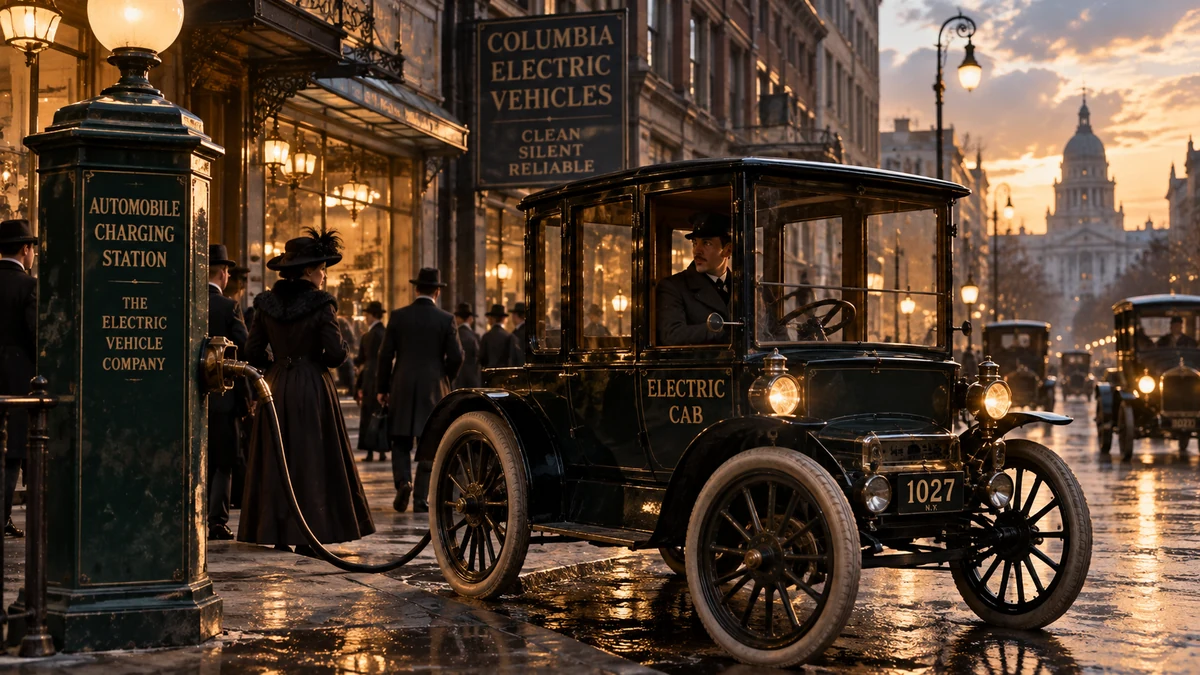
A little more than a century ago, the electric automobile was not a futuristic curiosity but one of three serious contenders for the future of road transport. Around 1900 steam, gasoline and electricity competed for the same emerging market. Electric cars were quiet, simple to operate, required no hand cranking and were especially useful in cities. New York had electric taxis, while manufacturers sold electrics to affluent urban buyers, often including women for whom the absence of a dangerous starting crank was a concrete practical advantage.
History, however, was not decided by a single technical attribute. The automobile became a system: vehicle, road, fuel or electric grid, service network, manufacturing, user habits and an idea of what a car was supposed to do. As roads improved and people wanted to travel beyond cities, the high energy density and portability of liquid fuel offered an advantage that the batteries of the period could not easily match.
At the same time, manufacturing economics changed. Ford's Model T drove down the price of gasoline cars through mass production, while the electric self-starter in 1912 removed one of the internal-combustion car's most unpleasant and dangerous weaknesses. The electric car did not disappear because it had no useful role; it mainly lost the contest to become the universal personal automobile, while electric delivery and other urban vehicles persisted in some niches for longer.
The useful question, then, is not whether the electric car was 'suppressed' or whether it was historically destined to win. The more interesting question is how a technology becomes dominant. Early electric cars show that technical quality alone does not select a winner: price, infrastructure, geography, manufacturing scale, available energy and user expectations matter too. It was a path that was not impossible, but it required a different economic and infrastructural ecosystem.
When the electric car was a competitor, not an alternative
In the 1890s the automobile industry had no obvious winner. Steam cars drew on familiar technology, gasoline engines were improving rapidly, and electric propulsion offered immediate torque, quiet operation and simple controls. The Library of Congress guide to early American electric cars notes that William Morrison developed a six-passenger electric vehicle in 1891 and that electric cabs were operating in New York by 1897.
Market-share estimates from this period are not precise enough to treat like modern registration statistics, but the broad picture is clear: electricity was a major option, not a marginal novelty. Electric cars were a significant presence at the major U.S. automobile exhibition of 1900, and firms such as Baker, Columbia and Detroit Electric built a real market in the following decade.
The early automobile also competed with more than other automobiles. It competed with horses, streetcars, railways and walking. A short, quiet trip in a dense city was a different transport problem from an hours-long journey on rural roads. From the beginning there was therefore no single definition of the 'best car'.
Why electricity was so attractive in the city
Early gasoline cars were noisy, vibrated, produced unpleasant exhaust and required considerable skill to shift. Their most awkward feature was the hand crank. Engine kickback could injure an arm or jaw, and starting required physical effort. By comparison, the electric car could feel almost like a domestic appliance on wheels: switch on, steer and drive without manually cranking an engine.
The Smithsonian describes early electrics as a kind of 'parlor on wheels' for affluent urban women. That does not mean electric cars were technically 'women's cars'; it means the market exploited the social constraints and needs of the time. Electric propulsion offered a concrete advantage to people who did not want or were unable to manage a crank, complex shifting and gasoline-engine maintenance.
Urban logistics were favorable too. Taxis, delivery vehicles and short-trip cars could return to the same garage and charge overnight. Newspapers were already discussing electric cabs and charging stations in the 1890s. In such uses limited range was not necessarily fatal; the vehicle performed a predictable service within a bounded area.

The battery: a real constraint, not merely an excuse
The central technical problem was stored energy. Lead-acid batteries were heavy, required maintenance and stored far less useful energy per unit mass than liquid fuel. For city travel that could be acceptable; for longer journeys it meant more weight, shorter range and much slower replenishment of energy.
Thomas Edison believed electric propulsion was promising and began developing a better storage battery around 1899. His nickel-iron system eventually became robust and long-lived, but the development path was slow: early versions had problems, the project required years of redesign, and a commercially mature battery arrived while gasoline automobiles were already improving quickly.
This distinction matters. Saying electrics vanished only because of 'oil interests' skips over genuine battery costs and performance limits. The opposite claim—that electric propulsion disappeared because it was technically nonsensical—is also too strong. Batteries constrained some uses while remaining practical enough for others, especially predictable urban routes, to sustain a genuine market.
The Model T changed the economics above all
Ford's Model T, introduced in 1908, did not win simply because it burned gasoline. Ford built a manufacturing system that reduced costs at a scale smaller electric-car makers could not match. The move to Highland Park and then the moving assembly line sharply reduced labor time per chassis and enabled enormous production volumes.
The result was a rapidly falling price. The U.S. Department of Energy gives a 1912 comparison of roughly $650 for a gasoline car and $1,750 for an electric roadster. Exact prices varied by model and year, but the direction is not in dispute: the mass-produced Model T was reaching a far broader market.
That changes what 'better' means. An electric car might be quieter and easier to drive, but a household able to buy one vehicle often preferred the cheaper machine that could serve city, countryside and longer travel. The gasoline car was becoming a more universal product precisely while its manufacturing cost was falling.
The electric starter removed one of gasoline's biggest disadvantages
Before 1912 the starting crank was a powerful argument for the electric car. Charles Kettering and Delco developed a practical electric self-starter, and Cadillac introduced it on a production automobile in 1912. The system did more than spin the engine: it formed part of an integrated electrical system for starting, ignition and lighting.
Competition changed immediately. The gasoline car retained longer range and rapid refueling while losing much of the inconvenience of starting. The Smithsonian emphasizes that the self-starter increased automobile accessibility for people for whom hand cranking was a barrier or danger.
There is an instructive paradox here: electrical technology helped the gasoline car defeat the electric car. The starter, generator, storage battery, electric lighting and later an ever-growing set of electrical subsystems made internal combustion easier to live with. The boundary between an 'electric' and a 'gasoline' automobile was therefore less pure even then than modern cultural debates often imply.
Roads, fuel and the electric grid shaped the geography of advantage
While roads were poor and most personal trips were short, an urban electric car's range could be sufficient. As intercity roads improved in the 1920s and the automobile became a tool for longer travel, gasoline offered something crucial: its energy could be transported cheaply and stored in a tank almost anywhere.
The electric grid expanded too, but unevenly. Urban households received electricity much earlier than rural ones. The Smithsonian notes that as late as 1932 only about ten percent of rural America was electrified, while cities and towns had obtained service much earlier. A car dependent on a charging connection therefore had a very different geography of usefulness from one supplied by portable liquid fuel.
This does not mean charging infrastructure did not exist. Historical evidence shows garages, chargers and organized charging stations. But infrastructure followed customer density and business models. Electric cars made the most sense where a grid already existed and vehicles returned to known bases; gasoline better supported expansion into spaces that had not yet been electrified.
Was the path lost—or suppressed?
The history of early electric cars does not require a story in which a single actor 'killed' a superior technology. There is no evidence for one unified conspiracy that by itself explains the outcome. There were, however, very real economic interests, network effects, investment choices and institutional paths that reinforced gasoline once it gained an early advantage.
David Kirsch frames this as a problem of historical path dependence: technological 'superiority' cannot be measured outside social context. A different system might have assigned more urban transport to electricity and long-distance travel to gasoline; instead, the automobile market moved toward a universal standard. Once manufacturing, service, roads, filling stations, mechanic skills and consumer expectations accumulated around gasoline vehicles, each later electric competitor faced a systemic disadvantage.
A useful counterweight to simple suppression narratives is that major technological actors did investigate electricity. Edison invested a decade in batteries, and Henry Ford discussed a low-cost electric car with him. That does not prove economic interests were irrelevant; it does show that the history is not a simple drama of one invention facing one enemy.
What early electric vehicles tell us about technology today
Today's electric car is not simply the return of the same technology. Lithium-ion batteries, power electronics, regenerative braking, fast charging, digital control and a vastly broader electric grid have changed the technical environment. Fuel prices, pollution costs, regulation and expectations about air quality and climate emissions have changed as well.
The historical lesson is therefore not that 1900 proved everyone should already have driven electric. Nor is it that the gasoline car 'naturally' won and every other path was mistaken. The lesson is that technologies exist inside infrastructures and economies that begin to feel inevitable only after one path becomes dominant.
Change the battery, grid, manufacturing process, energy prices and social goals, and the answer to which propulsion system makes sense can change too. The early electric car is most useful as a warning against technological determinism: the future is not simply a list of the best inventions. It is the result of relationships among invention, system, capital, geography and what society expects technology to do.
Sources and further reading
- U.S. Department of Energy — The History of the Electric Car: early competition among steam, gasoline and electric vehicles; urban advantages, Model T price comparison, electric starter, roads, oil and rural electrification.
- Library of Congress — Early Electric Cars in America (1891–1922): research guide and timeline for Morrison, New York electric cabs, market development and decline.
- Library of Congress — Search Strategies & Selected Articles: primary newspaper trail for early electric carriages, taxis, garages and 1910s electric-car reporting.
- National Museum of American History — Electric cars: 100 years ago and today: urban women, high cost, range, lead-acid maintenance and the mobility advantage of gasoline.
- National Park Service — Edison Biography: Edison's effort to develop a better storage battery for electric vehicles and the timing of gasoline-car improvement.
- Thomas A. Edison Papers, Rutgers — Storage Battery: Edison’s automotive battery program, lead-acid weight problem, nickel-iron development and commercial timing.
- Smithsonian Institution — Five Batteries That Gave the World a Jolt: Edison nickel-iron battery, redesign and use in Baker and Detroit Electric cars.
- General Motors Heritage Collection — 1912 Cadillac Model 30: production electric starter and lighting system, Dewar Trophy and historical context.
- National Museum of American History — Driving with Disabilities: Early Pioneers: Kettering self-starter, hand-crank hazards and accessibility effects.
- Ford Motor Company — The Model T: 1908 introduction, mass-production strategy and price range enabled by manufacturing scale.
- The Journal of Economic History / Cambridge — The Model T: modern economic analysis of Model T price, quality, production and competitive advantages.
- NBER — The Model T: quantitative history of production innovation, assembly-line labor-time reductions and Model T pricing.
- David A. Kirsch — The Electric Vehicle and the Burden of History, Rutgers University Press: path dependence, social context and the possibility of differentiated gasoline/electric transport systems.
- Policy and Society / Oxford Academic — Early modes of transport in the United States: infrastructure, electrification, utilities and policy in the competition among propulsion systems.
- IEEE Global Museum — The Rise and Fall of Early Electric Cars: Edison/Baker context, electric commercial vehicles and early propulsion competition.
- IEEE Industrial Electronics Magazine — When Cars Went Electric, Part 2: technical history of rechargeable batteries, motors and early electric vehicles.
- Library of Congress — Charging the battery of a Detroit electric automobile (c.1919): primary photographic evidence of practical charging infrastructure.
- Library of Congress — Detroit Electric auto on promotional tour to Mt. Rainier (1919): primary photograph showing electric-car long-distance promotion; no known restrictions on publication.
- Library of Congress — Edith Bolling Galt in an electric automobile (1904): primary photographic evidence for early urban electric-car use and marketing context; no known restrictions on publication.
- New York Journal, 6 December 1896 / Library of Congress — Motor Cabs in New York: contemporary discussion of electric cabs, charging stations, urban economics and geographic limits.
- Yale Energy History — Electricity Consumption: Culture, Gender and Power: urban-first household electrification and the expansion of domestic electricity from 1910 to 1930.
- National Museum of American History — Power from the people: Rural Electrification: urban-rural electric divide and roughly 10% rural electrification in 1932.
- Yale Economics — Historical Background on Rural Electrification: non-farm vs farm electrification rates and infrastructure economics, 1900–1930.
- Powerhouse Collection — Sectioned Edison electric car battery: museum documentation of an Edison nickel-iron vehicle cell, manufacture and design context.
- Project Gutenberg — Henry Ford, My Life and Work (1922): primary retrospective account of Ford’s product strategy, factory growth and Model T manufacturing philosophy.