Robots and Automation: Who Works, Who Decides and Who Benefits?
Automation changes more than job counts: it reallocates tasks, decision power and benefits. What does evidence actually show about robots, productivity, skills and power at work?
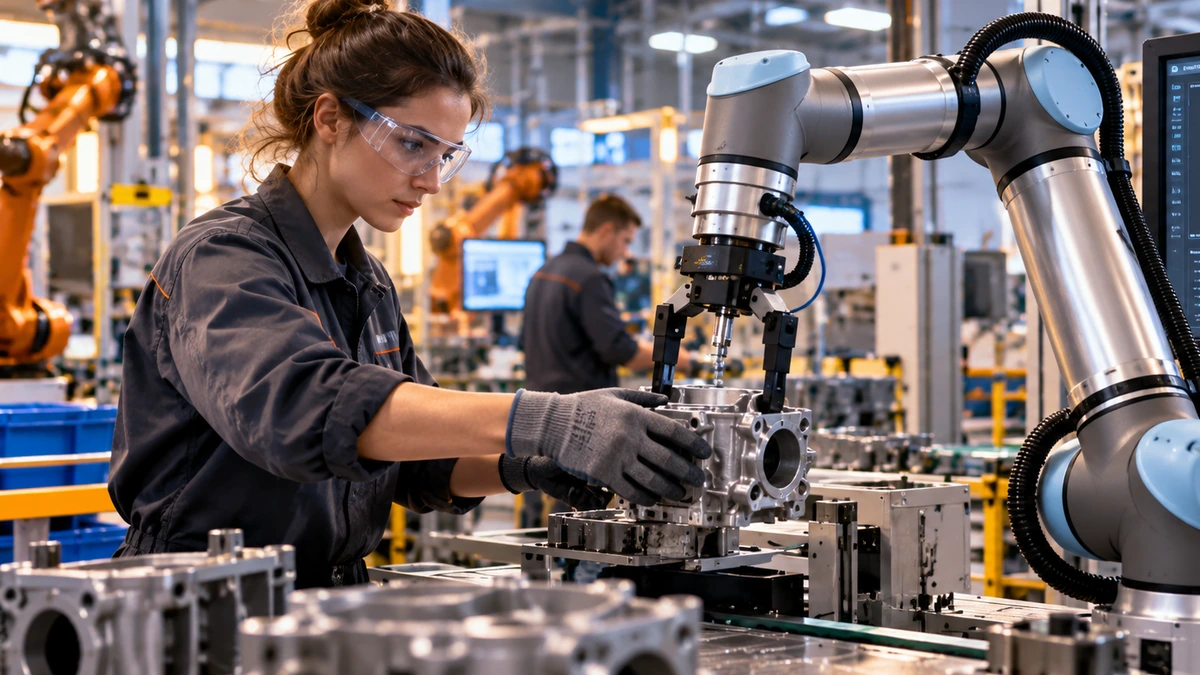
Robots are the most visible face of automation: mechanical arms weld car bodies, mobile systems move goods, software schedules deliveries, and algorithms decide which task comes next. But automation is broader than robotics. It means transferring particular tasks or decisions from people to machines, software, or combined systems. That is why the question of whether "robots will take jobs" often starts at the wrong level.
A job is not one indivisible task. It is made up of activities that can be automated at very different speeds: a repetitive physical motion may be technically easy to robotize, while unpredictable human communication remains difficult; routine data sorting can be automated, while judgment in an ambiguous context may remain human. Technology therefore often changes the content of work before it changes the number of jobs.
The economic effect also has no single direction. Automation can displace people from some tasks while lowering costs, expanding production, creating new activities, and changing skill requirements. Research can therefore find job losses in highly exposed local labor markets and employment growth in firms that become more competitive through robotics. This is not necessarily a contradiction; the gains of one firm can partly be the losses of another.
The central question is therefore not only what technology can do. It is also who decides which tasks will be automated, how the remaining work will be organized, and who receives the benefits of higher productivity. Higher output per worker can become higher wages, lower prices, greater profits, shorter working hours, new investment, or some combination. Technology creates possibilities; institutions, ownership, bargaining power, and work organization help determine how the outcome is distributed.
A robot is not the same thing as automation
An industrial robot has a relatively precise technical meaning: an automatically controlled, reprogrammable multipurpose manipulator. Automation is much broader. A conveyor can automate movement without a robot, software can automatically schedule shifts, an algorithm can evaluate worker performance, and a dedicated machine can take over one production operation.
This distinction matters because public debate easily narrows to humanoid machines while many of the largest changes arrive through less spectacular systems. The International Federation of Robotics recorded about 542,000 new industrial robots in 2024 and more than 4.6 million robots in operational use worldwide. Yet even that large number captures only one part of automation.
To understand consequences for work, counting robots is therefore not enough. We need to ask which activities were transferred to technology, which remained with people, which new tasks appeared, and how the change reorganized the whole production process.
A job is a bundle of tasks, not an indivisible unit
One of the most important shifts in the economics of automation has been the move from occupations to tasks. David Autor and, later, Daron Acemoglu and Pascual Restrepo emphasized that technology usually does not automate an occupation in one step. It takes over some activities, complements others, and can make still others more important.
The OECD likewise showed why estimates based on automating whole occupations can overstate risk. People with the same job title may perform very different tasks; some are routine and well structured, while others require adaptation, social interaction, fine dexterity, or judgment in unpredictable environments. Technical capability at one task therefore does not imply technical or economic capability to automate the entire job.
This perspective also changes the skills question. After automation a worker may lose some routine activities while taking on supervision, diagnosis, maintenance, communication, or exception handling. The reverse can also occur: a system can move difficult judgment into software and leave a person with a narrow execution task. Automation can therefore produce upskilling or deskilling; the outcome is not predetermined.
Displacement, productivity and new tasks operate at the same time
When a machine takes over a task previously performed by a person, it creates a direct displacement effect. For that activity the firm needs less human labor. In the Acemoglu-Restrepo framework, this pushes down labor demand and the labor share of income.
Automation can at the same time lower costs and raise productivity. If a firm then produces more, lowers prices, or wins new customers, demand for other, non-automated tasks can rise. New activities also appear: robot integration, programming, maintenance, quality control, process design, exception handling, and entirely new products or services.
That is why the technological fact that a machine can replace one task does not let us directly calculate the final number of jobs. The outcome reflects a balance among displacement, productivity, expansion of output, new tasks, prices, demand, and the adjustments made by other firms and workers.
Why two good studies can reach different results
Acemoglu and Restrepo found that greater exposure to industrial robots in US local labor markets was associated with lower employment and lower wages. Their estimate suggested that one additional robot per thousand workers reduced the employment-to-population ratio by about 0.2 percentage points and wages by roughly 0.42 percent in more exposed areas.
A newer plant-level analysis by Adrianto, Ben-Ner and Urtasun finds a different direct effect among robot adopters themselves: plants that introduce robots expand production and, on average, employment, while demand for technical skills rises. The authors also find negative effects among some non-adopters that lose competitiveness.
These findings need not conflict. A firm can grow and hire more after automating while a competitor loses orders and jobs; the local area can therefore experience a net loss or a redistribution of work. With automation we must always ask: at what level are we measuring — task, worker, plant, firm, industry, or the whole economy?
More skill is not the same as better work
When robots take over routine operations, demand can rise for programming, supervision, diagnosis, and maintenance. Some technologies therefore increase task complexity. Research on new manufacturing technologies provides examples where job content shifts toward less routine and more analytical work.
But greater technical complexity does not automatically mean greater autonomy or a better working day. A highly skilled worker may still have to follow a pace set by a system; someone may supervise complex machinery while software measures every deviation from a prescribed process. Job quality also includes control over pace, safety, predictability, learning opportunities, and social relations.
The more useful question is therefore how the job is redesigned. Does technology remove dangerous and monotonous work while leaving more judgment to the worker? Or does it remove judgment and turn the worker into an exception handler operating under pressure? The same device can produce very different work experiences in different organizations.
When management itself is automated
Automation does not take over only physical tasks. Algorithms can assign orders, choose routes, schedule shifts, monitor work speed, recommend performance ratings, and trigger warnings. The ILO uses the term algorithmic management for computer-programmed procedures that take over parts of coordination and managerial functions.
Such systems can reduce administrative burden, improve scheduling, and coordinate complex flows more quickly. They can also expand monitoring, reduce direct contact with supervisors, and blur the question of who actually made a decision. If a worker does not understand why an algorithm gave them fewer hours or labeled them inefficient, the possibility of appeal can be weaker than with a human decision-maker.
The question "who decides?" is therefore literal. An automated decision still has an objective function, data inputs, thresholds, and rules that somebody selected. Even when no person presses a button for each individual decision, responsibility for designing and deploying the system does not disappear.
Human-robot collaboration is a design problem
Collaborative robots, or cobots, are intended to work in shared spaces with people. Their promise is intuitive: a robot can contribute strength, repeatability, and precision, while a person contributes adaptability, contextual perception, and the ability to deal with unexpected situations.
Safe collaboration, however, is not a property of the robot alone. EU-OSHA stresses that the whole collaborative application must be assessed: movement speed and force, sensors, spatial layout, possible impacts or crushing hazards, and organizational and psychosocial factors. Some surveys and studies associate cobot use with higher work intensity, reduced autonomy, or greater surveillance when integration is poorly designed.
The best application is therefore not necessarily the one in which the robot performs the maximum possible number of tasks. It may be the one in which task allocation combines the strengths of both sides while preserving enough information, time, and authority for the human to intervene safely when the system encounters an exception.
Productivity does not tell us who receives the benefit
If the same amount of work produces more goods or services, productivity has increased. That is an important economic gain, but the number alone does not tell us who receives it. Added value can appear as higher profits, higher wages, lower prices, greater investment, more employment, shorter working hours, or a combination of these outcomes.
Distribution depends on competition among firms, workers' position in labor markets, ownership of capital, collective bargaining, tax systems, and other institutions. Acemoglu and Restrepo emphasize that automation can raise output while reducing labor's share of income when displacement is not offset by new tasks and other countervailing forces.
The claim that "automation is good because it raises productivity" is therefore incomplete, just as the claim that "automation is bad because it replaces labor" is incomplete. Productivity is about production efficiency. Questions of fairness and distribution require additional analysis of ownership, bargaining, and the rules by which the resulting surplus is shared.
Automation can respond to labor shortages — not only to a desire to cut jobs
In many sectors firms do not automate only to reduce headcount. Population ageing, shortages of specialized workers, hazardous tasks, and the need for continuous services can all increase demand for robots. The IFR identifies staff shortages as one important driver of growth in professional service robots.
Again, the effect differs by task. A robot that moves supplies through a hospital may remove a logistics task from clinical staff without replacing clinical judgment or the relationship with a patient. An automated warehouse system may reduce walking but increase work pace if the organization is designed solely for maximum throughput.
It is therefore not enough to know why the technology was purchased. What matters is how the released time and capacity are actually used: to fill shortages, expand service, improve working conditions, or simply intensify the tasks that remain.
The real question is not human or machine, but what kind of work system we build
The history of automation supports neither simple optimism nor simple catastrophe. Machines can eliminate jobs and reduce wages for some groups. They can also increase productivity, create new tasks, reduce physical hazards, and allow firms to expand. Meta-analyses suggest that average employment effects of robotization are less dramatic than the most alarmist forecasts, but differences across countries, sectors, and groups of workers remain substantial.
The direction of innovation therefore matters. If firms and research systems focus mainly on technologies that replace labor even where productivity gains are small, the outcome will differ from a path that creates technologies enabling people to perform new or more valuable tasks. Tax incentives, education, competition, and workplace rules can also shape which solutions become economically attractive.
The best answer to the title's questions is therefore not one number. Who works, who decides, and who benefits are three distinct dimensions of the same transition. A robot can change the first, algorithmic management the second, and ownership and institutions the third. Technology creates new possibilities and constraints; society still organizes the work built around them.
Sources and further reading
- THY-REALITY — Kibernetika: od povratne zanke do človeka v sistemu / Cybernetics: From Feedback Loops to the Human in the System (LOCKED): feedback, regulation and human participation in socio-technical systems.
- THY-REALITY — Umetna inteligenca: orodje, svetovalec ali nova avtoriteta? / Artificial Intelligence: Tool, Adviser or New Authority? (LOCKED): delegation of judgment and automated decision authority.
- THY-REALITY — Delo in lastništvo podjetja: kdo odloča, kdo tvega in kdo pobira presežek? / Work and Enterprise Ownership: Who Decides, Who Bears Risk and Who Receives the Surplus? (LOCKED): ownership and distribution boundary.
- International Federation of Robotics — World Robotics 2025: Industrial Robots. 542,076 installations in 2024 and 4.664 million units in operational stock worldwide.
- International Federation of Robotics — World Robotics 2025: Service Robots. Professional service robot sales and labor-shortage context.
- Autor, D. H. — Why Are There Still So Many Jobs? The History and Future of Workplace Automation. Journal of Economic Perspectives 29(3), 2015, 3–30.
- Arntz, M.; Gregory, T.; Zierahn, U. — The Risk of Automation for Jobs in OECD Countries: A Comparative Analysis. OECD Social, Employment and Migration Working Papers No. 189, 2016.
- Acemoglu, D.; Restrepo, P. — Automation and New Tasks: How Technology Displaces and Reinstates Labor. Journal of Economic Perspectives 33(2), 2019, 3–30.
- Acemoglu, D.; Restrepo, P. — Robots and Jobs: Evidence from US Labor Markets. Journal of Political Economy 128(6), 2020, 2188–2244.
- Acemoglu, D.; Restrepo, P. — Tasks, Automation, and the Rise in US Wage Inequality. NBER Working Paper 28920, 2021; later published in Econometrica.
- Restrepo, P. — Automation: Theory, Evidence, and Outlook. NBER Working Paper 31910, 2023.
- Adrianto, A.; Ben-Ner, A.; Urtasun, A. — Robots and Work. Working paper, 2024/2025: plant-level robot adoption, employment and skills.
- Acemoglu, D. et al. — Automation and the Workforce: A Firm-Level View from the 2019 Annual Business Survey. NBER Working Paper 30659, 2022.
- Baiocco, S.; Fernandez-Macías, E.; Rani, U.; Pesole, A. — The Algorithmic Management of Work and its Implications in Different Contexts. International Labour Organization, 2022.
- Rani, U.; Pesole, A.; Gonzalez Vazquez, I. — Algorithmic Management Practices in Regular Workplaces: Case Studies in Logistics and Healthcare. ILO/JRC, 2024.
- International Labour Organization — Algorithmic Management in the Workplace: definition, sectors and work-organization implications.
- European Agency for Safety and Health at Work — Collaborating Robots. Human-robot collaboration, physical and psychosocial risk assessment; updated 2025.
- European Agency for Safety and Health at Work — Strategies for Safety and Health in an Automated World, 2024.
- Ernst, E.; Merola, R.; Samaan, D. — The Economics of Artificial Intelligence: Implications for the Future of Work. International Labour Organization Research Paper 5, 2018.
- Guarascio, D.; Piccirillo, A.; Reljic, J. — Robots vs. Workers: Evidence From a Meta-Analysis. Journal of Economic Surveys 39(5), 2025, 2254–2271.