Cybernetics: From Feedback Loops to the Human in the System
Cybernetics linked feedback, regulation and communication across machines, organisms and organizations. What does it reveal about automation — and where do questions about humans and system goals begin?
Today, cybernetics is a word many people encounter mainly in compounds such as cybersecurity, cyborg or cyberspace. Its original meaning was broader and at the same time more precise. In the mid-twentieth century cybernetics emerged as an attempt to understand how systems — machines, organisms and later organizations — detect change, compare present conditions with a goal, and modify their behaviour through feedback.
Its basic idea is surprisingly ordinary. A thermostat does not need a complete model of a house; it needs a temperature measurement, a target range and the ability to switch heating on or off. Likewise, bodies regulate multiple variables, drivers continuously correct direction relative to the road, and organizations can adapt decisions to incoming information. In each case behaviour arises in a loop rather than a single linear chain of cause and effect.
This is also where misunderstandings begin. The word “control” in early cybernetics did not necessarily mean political coercion or total command. It often meant regulation: the capacity of a system to keep certain variables within acceptable limits despite disturbance, or to adapt when circumstances change. Once cybernetic ideas moved from engineering into management, social science and politics, however, questions about who sets the target, who measures deviation and who is permitted to intervene became unavoidably political.
Cybernetics therefore still matters. Algorithms, automation, platforms and AI operate in environments where behaviour is measured, responses are predicted and outputs are adjusted. Feedback thinking reveals something linear stories easily miss: a system does not simply act on a person; the person reacts to the system, that reaction becomes new data, and the system changes again.
From anti-aircraft control to a general science of regulation
The roots of modern cybernetics are closely connected to the Second World War. Norbert Wiener and collaborators worked on problems of prediction and control in which a device could not simply execute a pre-set path. It had to observe the consequences of its own action, take environmental change into account and correct the next command. This logic shifted attention from linear command to circular accounts of behaviour.
In 1943 Arturo Rosenblueth, Norbert Wiener and Julian Bigelow argued in “Behavior, Purpose and Teleology” that goal-directed behaviour could be analysed without invoking a mysterious inner force: a system could behave purposively when the consequences of action altered what happened next. Negative feedback reduces deviation from a target; positive feedback can amplify it.
In 1948 Wiener named the field cybernetics and famously framed it around control or regulation and communication in the animal and the machine. The important move was not to claim that organisms are merely machines, but to ask whether some patterns of regulation could be compared across very different physical systems.
Feedback changes the shape of causation
In a simple linear story A causes B and the event is over. In a feedback loop, B alters the future state of A. A driver turns the steering wheel, observes the new position of the car, and turns again. A body releases a hormone, detects the resulting change and adjusts the next response. The system does not necessarily need to “understand” what it is doing; it only needs consequences to affect future action.
Negative feedback is often used for stabilization. If temperature falls below a target range, a thermostat increases heating; once the deviation is corrected, it reduces it. Positive feedback behaves differently: change produces still more change in the same direction. This can be useful in rapid switching processes, but it can also create escalation.
Feedback is therefore not synonymous with healthy equilibrium. It describes a structural relation between output and future input. Whether a system stabilizes, oscillates, escalates or adapts depends on the sign of feedback, delays, measurements, response rules and the environment itself.
Homeostasis is a powerful metaphor, not a complete model of life
Cyberneticians drew heavily on physiology. The concept of homeostasis already described the capacity of organisms to keep some internal variables within limited ranges despite environmental change. Cybernetic language offered a way to express this in terms of measurement, comparison and correction.
But an organism is not a thermostat. Living systems have multiple goals, goals can change, regulatory loops interact, and learning changes response rules. Life also depends on transitions into new states, exploration and reorganization, not merely stability.
This is one of the central limits of the cybernetic analogy: it is useful when it reveals the structure of regulation, but misleading when similarity at the level of feedback is taken to mean that organisms and machines are identical in every important respect.
Ashby: a regulator needs sufficient variety
The British psychiatrist and cybernetician W. Ross Ashby developed one of the field's most influential ideas, the law of requisite variety. In simplified form it says that a regulator cannot successfully counter more kinds of disturbance than it can discriminate and respond to. If the environment presents many different states, a regulator with only one response cannot preserve the desired outcome under all conditions.
This does not mean a central controller must know every microscopic detail. Variety can also be managed through local autonomy, filters, hierarchy, standards, or by solving problems closer to where they arise. In this respect cybernetics often points away from naive centralization rather than toward it.
Ashby's formulation was mathematical, but its practical implication is broad: a regulator receiving too little information or possessing too few possible responses may appear confident yet fail systematically because the environment is more complex than its capacity to adapt.
Communication is not the same as meaning
Cybernetics developed in the same intellectual setting as Shannon's information theory, so terms such as communication, signal and information often overlap. Yet Shannon's formalism measures statistical properties of message transmission, not semantic meaning. Cyberneticians frequently extended these concepts to organisms and organizations, where meaning cannot be separated from context so easily.
A system may receive perfectly accurate data and still act badly if it measures the wrong variable or relies on a poor model of its environment. More data does not automatically produce better governance. What matters is which signal is treated as relevant, how rapidly it reaches a decision point, and what actions are actually available.
The same boundary matters in modern digital systems. A platform can measure clicks with extraordinary precision, but a click is not the same as satisfaction, truth or wellbeing. A cybernetic system is always regulating with respect to something; choosing that measured quantity is already part of the design.
Stafford Beer: organization as a regulatory system
Stafford Beer carried cybernetic ideas into management and organizational theory. His Viable System Model treated an organization as a system that must simultaneously preserve local operational autonomy, coordinate its parts, monitor internal conditions, scan the future environment, and maintain an overall identity or policy.
Ashby's requisite variety was central to this work. If every local irregularity must travel to the top of a hierarchy, the centre quickly becomes overloaded. Beer therefore stressed that some regulation must be distributed throughout the organization and that higher levels should focus particularly on exceptions that cannot be handled locally.
This is not a politically neutral technical truth about how every organization should be run. It is a model for asking questions about autonomy, coordination, information delay and adaptation. Its usefulness depends on how well its abstractions fit the organization being examined.
Cybersyn: the best-known political experiment in cybernetic management
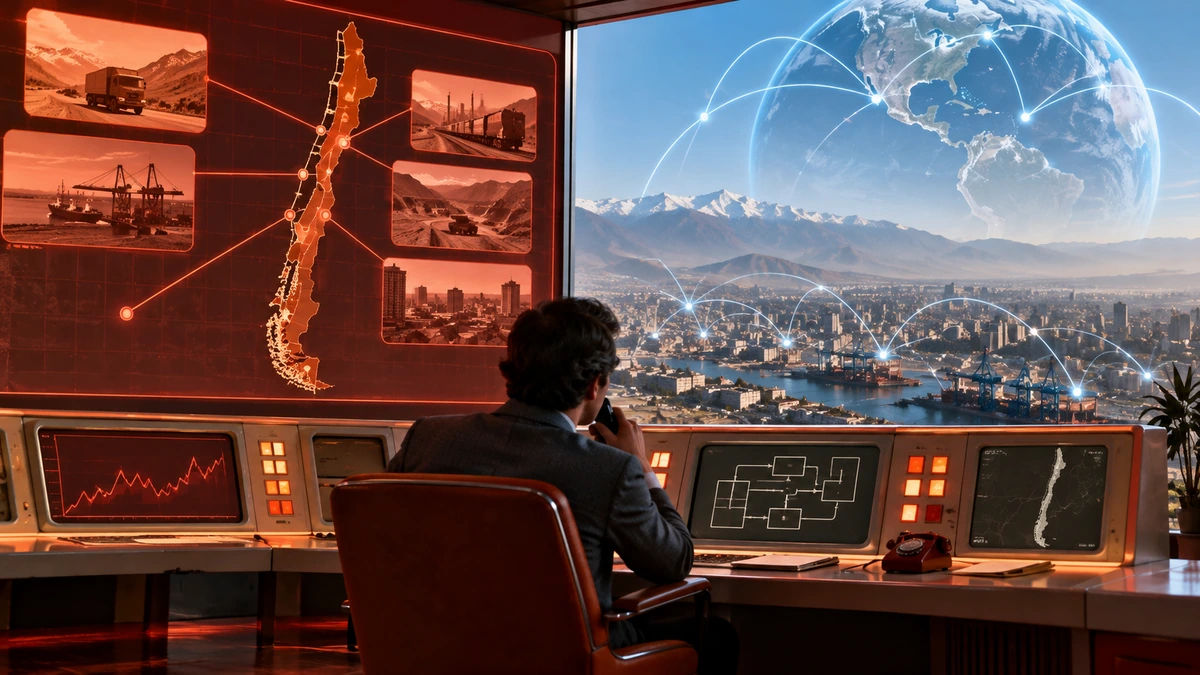
Between 1971 and 1973, under Salvador Allende's government in Chile, Project Cybersyn was developed with Stafford Beer and a Chilean interdisciplinary team. It combined a telex communications network, statistical software, an economic simulator and an experimental operations room. The aim was to monitor important indicators in the state industrial sector more rapidly and direct attention toward deviations requiring action.
Cybersyn is often portrayed either as a precursor of digital utopia or as a prototype of total surveillance. The historical record is more interesting. Eden Medina has shown that the project combined a desire for faster coordination with Beer's emphasis on local autonomy and the human being inside the feedback loop. The operations room was conceived as a relationship between people and artifacts rather than as an automated centre running the economy by itself.
During the 1972 truck owners' strike, the telex network was in fact used to coordinate information about roads, fuel, transportation and supplies. Yet project participants also confronted a basic limitation: an information system could not solve inflation, political conflict, lack of foreign credit, physical violence or other problems that were not simply failures of feedback.
When the observer becomes part of the system
First-order cybernetics often spoke as if a researcher could observe a regulator from outside: the system had inputs, outputs, a target and feedback. During the 1960s and 1970s Heinz von Foerster, Margaret Mead and others increasingly emphasized the difficulty of that position. If a person observes, describes or manages a social system, that person's categories and actions are already entering the loop.
So-called second-order cybernetics was therefore not just another control technique but an epistemological shift. The question became not only “how does the system work?” but also “how do our measurements, categories and interventions alter the system we are describing?” This directly connects to the questions raised in “Observer and Model: How Much Does Our Description Shape What We See?” about observer and model.
Caution is still required. The fact that an observer participates in a system does not imply that external reality disappears or that every description is equally good. Feedback effects of observation are a reason for stricter reflection about models, not a license for arbitrariness.
From automation to platforms: who chooses the reference value?
Modern algorithms often behave cybernetically even when nobody uses that label. A recommendation system observes a user's response, changes what it presents next, measures the response again and continues. Dynamic pricing, autonomous control and optimization systems can likewise operate through loops of measurement and correction.
At this point the most important question becomes less technical: what is the objective? A system optimizing time-on-platform will create a different feedback loop from one optimizing long-term satisfaction or safety. If a company measures only quantity, quality may become invisible. If public policy rewards one number, people may adapt their behaviour to that number and change the meaning of the metric itself.
Cybernetics therefore does not provide a politically neutral recipe. It reveals that every regulatory system contains choices about what is measured, what range is desired, which interventions are permitted and how decision-making authority is distributed. In social systems these are technical and normative questions at the same time.
The human in the system is neither just a sensor nor just a disturbance
Perhaps the most durable cybernetic lesson is not a dream of perfect control but the opposite: complex systems cannot be governed by top-down command alone. They require feedback, local capacity to respond, sufficient variety and willingness to revise the model when the environment changes.
Human beings, however, cannot be reduced to components in a diagram. People interpret, change goals, reject instructions, invent institutions and respond to the fact that they are being measured. When a system changes their behaviour, that change becomes a new part of the environment. Successful regulation can therefore create conditions in which the old model no longer applies.
Cybernetics is most powerful when used as a language for questions: where does information flow, what delays exist, who can act, what does the system measure, which consequences return as new input, and who sets the goal? It becomes dangerous when those useful questions are turned into a promise that society, organism or person can be completely translated into a single regulatory diagram.
Sources and further reading
- THY-REALITY — Opazovalec in model: koliko naš opis oblikuje to, kar vidimo? / Observer and Model: How Much Does Our Description Shape What We See? (LOCKED): models, measurement and observer effects.
- THY-REALITY — Vzročnost: kaj pomeni, da nekaj povzroči nekaj drugega? / Causality: What Does It Mean for One Thing to Cause Another? (LOCKED): causal structure, intervention and feedback boundary.
- THY-REALITY — Sintetična biologija: ko življenje postane inženirski material / Synthetic Biology: When Life Becomes an Engineering Material (LOCKED): engineering metaphors and limits of machine analogies in living systems.
- Rosenblueth, Arturo; Wiener, Norbert; Bigelow, Julian — Behavior, Purpose and Teleology. Philosophy of Science 10(1), 1943, 18–24.
- Wiener, Norbert — Cybernetics: Or Control and Communication in the Animal and the Machine. MIT Press, 1948/1961.
- Ashby, W. Ross — An Introduction to Cybernetics. Chapman & Hall, 1956. Primary source for variety, regulation and cybernetic systems.
- American Society for Cybernetics — Past Events / history of the Macy cybernetics conferences, beginning in 1946.
- American Society for Cybernetics — ASC History. Historical continuity from the Macy conferences and early cybernetics community.
- Kline, Ronald R. — The Cybernetics Moment: Or Why We Call Our Age the Information Age. Johns Hopkins University Press, 2015.
- Beer, Stafford — Brain of the Firm. Allen Lane / Wiley, 1972; later editions. Foundation of management cybernetics and the Viable System Model.
- Metaphorum — Viable System Model: overview of Beer's five-system model and Ashby's law of requisite variety.
- Schwaninger, Markus; Scheef, Christine — A Test of the Viable System Model: Theoretical Claim vs. Empirical Evidence. Cybernetics and Systems, and related management-cybernetics literature.
- Medina, Eden — Designing Freedom, Regulating a Nation: Socialist Cybernetics in Allende's Chile. Journal of Latin American Studies 38(3), 2006, 571–606.
- Medina, Eden — Project Cybersyn: Chile's Radical Experiment in Cybernetic Socialism. MIT Press Reader, adapted from Cybernetic Revolutionaries, 2023.
- Medina, Eden — Cybernetic Revolutionaries: Technology and Politics in Allende's Chile. MIT Press, 2011.
- von Foerster, Heinz — Observing Systems. Intersystems Publications, 1981; foundational essays in second-order cybernetics.
- Mead, Margaret — The Cybernetics of Cybernetics. In Purposive Systems, 1968. Early argument for reflexive/second-order cybernetics.
- Springer Nature — Replication Crisis in Psychology, Second-Order Cybernetics, and Transactional Causality (2024): overview of first- versus second-order cybernetics and inclusion of the observer.
- Cambridge Core — Spontaneity and Control: Friedrich Hayek, Stafford Beer, and the Principles of Self-Organization (2024): historical analysis of Beer, self-organization and cybernetic organization.