Synthetic Biology: When Life Becomes an Engineering Material
Synthetic biology does more than alter individual genes: it builds circuits, metabolic pathways and even genomes. What does it mean to “program” living systems — and why is life never merely a machine?
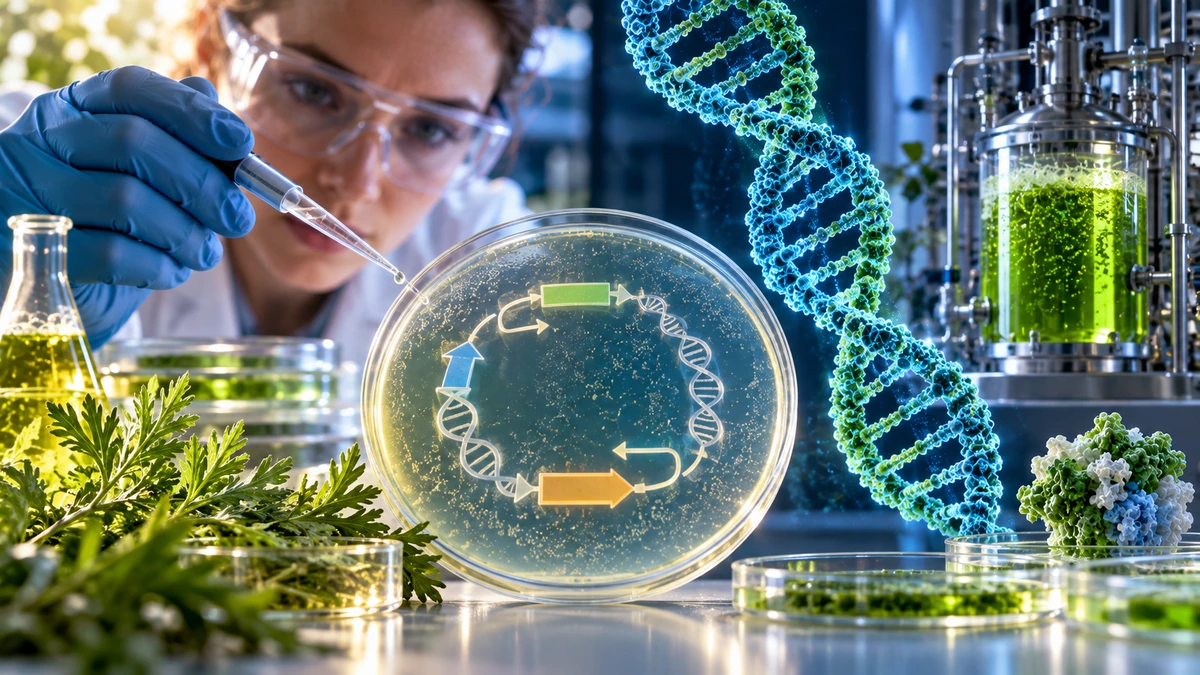
The word “synthetic” can make synthetic biology sound as if researchers are trying to create wholly artificial life from nothing. In practice the field is broader and less theatrical: synthetic or engineering biology applies principles of design, construction and testing to give living cells, components of living systems, or cell-free systems specified functions. Sometimes that means adding a single gene; in other cases it means assembling a regulatory circuit, rerouting metabolism or redesigning a substantial part of a genome.
The main novelty is not simply that DNA can be changed. Genetic engineering has done that for decades. Synthetic biology tries to move toward systematic design: define a desired function, choose or build biological parts, assemble them, measure what happens, and improve the system through repeated cycles of design, build, test and learn.
Life, however, is not passive material. Cells grow, compete for limited resources, change their surroundings, mutate and evolve. A genetic circuit that performs well in one bacterium may behave differently in another strain or environment. “Programming” biology therefore does not imply the same degree of predictability as programming software.
That tension is the heart of synthetic biology. The field has produced genetic switches, drug biomanufacturing, minimal genomes, biosensors and new approaches to cell therapy. Yet every success also reminds us that living systems are not modular machines that we already understand completely.
Synthetic biology is not simply another name for genetic modification
The boundaries between genetic engineering, metabolic engineering, genome engineering and synthetic biology are not sharp, and the fields overlap heavily in practice. A useful distinction lies in ambition: conventional genetic engineering often changes a particular gene or trait, whereas synthetic biology more deliberately connects biological components into systems whose behaviour can be designed, measured and iteratively improved.
NIST defines engineering or synthetic biology as the design, construction and/or assembly of components of living systems — from genetic circuits and enzymes to metabolic pathways — to achieve an intended function. In this sense CRISPR is one tool rather than the definition of the field. It can alter a specific sequence; a synthetic biologist may use that alteration as one component of a larger system that senses an input, performs a conditional decision and triggers an output.
The final product also need not be a new organism. Synthetic biology can use bacteria, yeast, plant cells or human cells, as well as cell-free extracts in which molecular machinery operates outside an intact living cell.
Genetic circuits: giving a cell a switch, memory or oscillator
Synthetic genetic circuits became one of the early symbols of the field. In 2000 two classic demonstrations appeared: a genetic toggle switch that could remain stably in either of two states, and the repressilator, a regulatory circuit that generated periodic oscillations in gene expression. They mattered not because they turned bacteria into computers, but because they showed that molecular regulators could be assembled to create new dynamics.
Later circuits became more sophisticated. Cells can be designed to respond to combinations of signals, store limited biological memory, communicate with other cells or trigger a therapeutic output only when several conditions are met. The analogy to logic gates is useful but limited: biological parts are noisier, slower, more context-dependent and less insulated from one another than electronic components.
Building a circuit is therefore not just arranging symbols on a diagram. A promoter, regulator or enzyme uses the same cellular resources as the host’s native processes. Large or strongly expressed synthetic systems can compete for ribosomes, energy and metabolic precursors, altering the behaviour of the very cell being used as the platform.
Design–Build–Test–Learn: the engineering ideal and biological reality
Modern engineering biology often organizes work around the Design–Build–Test–Learn cycle. A goal is defined, a genetic or cellular design is built, its performance is measured, and the resulting data guide the next version. Automation, high-throughput sequencing and machine learning can greatly accelerate this loop.
But “design” does not mean that outcomes can always be predicted in advance. Biological systems contain nonlinear interactions, stochastic gene expression, feedback loops and many unknown connections. A construct that works in an isolated test can change its behaviour in another cellular background, bioreactor or temperature.
This is not a minor technical inconvenience but one of the central boundaries of the field. Synthetic biology seeks to increase the predictability of living systems; it has not demonstrated that living systems have already become fully predictable.
Biomanufacturing: when a cell becomes a chemical factory
One of the clearest applications of synthetic biology is redirecting microbial metabolism so that organisms make molecules otherwise obtained from plants, petroleum or complicated chemical processes. By adding enzymes, changing regulation and redirecting metabolic flux, bacteria or yeast can devote more carbon to a desired product.
A classic example is artemisinin. Researchers engineered Saccharomyces cerevisiae to produce high levels of artemisinic acid, a precursor of an important antimalarial drug. By 2013 a combined biological and chemical process had reached industrially relevant production. Crucially, this was not a simple “insert a gene and obtain a drug” story: it required engineering several metabolic steps, balancing enzymes, optimizing fermentation and chemically converting the precursor.
The same broad strategy can be applied to fragrances, materials, enzymes, food ingredients and potentially more sustainable chemicals. Yet success in the laboratory does not guarantee an economical process. Yield, strain stability, feedstock cost, product purification and scale-up can determine whether a biological solution works outside the laboratory.
Synthetic and minimal genomes: how much of life can we design?
Synthetic biology also reaches the scale of whole genomes. In 2016 the JCVI team reported JCVI-syn3.0, a bacterial cell with a synthetically designed and minimized genome containing 473 genes. The goal was not to create life from non-living matter but to ask how many genetic functions were needed for autonomous cellular growth under specified laboratory conditions.
The result was both an engineering achievement and a lesson in ignorance. Of those 473 genes, 149 had no precisely known biological function when the work was published. An earlier, more aggressively minimized design was not viable until the researchers better identified so-called quasi-essential genes.
The minimal cell therefore does not show that life has been reduced to a simple list of instructions. On the contrary, constructing a very small genome revealed how many functions remain poorly understood and how strongly the meaning of “essential” depends on environment, growth rate and experimental conditions.
From biosensors to cell therapies
Synthetic systems can also act as sensors. A cell or cell-free system can recognize a molecule and convert that input into a measurable output. Such approaches support diagnostics, environmental monitoring and rapid prototyping of biological circuits without requiring the full system to operate in a living organism.
In medicine, synthetic biology moves toward cells that do more than carry a single change: they can be designed to perform conditional responses. Researchers are developing circuits that detect combinations of disease features before triggering a therapeutic function. Some of these concepts overlap with gene and cell therapy, so the disciplinary boundary is again imperfect.
The important test is not how futuristic the system sounds but whether its behaviour is reliable, measurable and safe enough for a specific use. In a living organism, delivery, immunity, evolutionary stability and interactions with surrounding cells are often harder problems than the circuit logic itself.
Why a living cell is not a computer running DNA code
The programming metaphor is attractive: DNA is code, genes are instructions and the cell is a machine. It is partly useful because DNA sequence does carry information and regulatory circuits can implement conditional responses. It becomes misleading when we forget that biology does not separate software from hardware as cleanly as a computer does.
A cell reads DNA using machinery that the cell itself produces; its state depends on growth history, nutrients, stress, spatial organization and environmental signals. A synthetic circuit therefore does not run on a neutral platform. It consumes limited cellular resources and can change growth, which in turn changes circuit performance. Modern research describes this as cellular burden and resource competition.
Living systems also reproduce. If a synthetic function lowers reproductive fitness, mutations that weaken or disable it can gain an evolutionary advantage. A program that can change during use through mutation and selection demands a different engineering mindset from conventional software.
Biosafety: preventing a designed organism from doing what we did not intend
Biosafety focuses primarily on unintended consequences: laboratory exposure, escape of an organism, unexpected gene transfer or ecological effects. The basic safeguard is therefore not one genetic trick but layered containment, laboratory practice, risk assessment and, where useful, biological restriction.
Synthetic biology has developed additional forms of biocontainment. An organism can be made dependent on a compound absent from nature, or a circuit can be built that stops growth under specified conditions. In 2015 researchers demonstrated bacteria whose essential proteins depended on a non-standard amino acid, creating a strong evolutionary barrier to survival outside controlled conditions.
No such mechanism should eliminate other safety layers. Life mutates, environments differ, and systems can fail in ways a laboratory test did not capture. NIH therefore specifies risk assessment, containment practices and institutional oversight for research involving recombinant or synthetic nucleic acid molecules according to the type of work being performed.
Biosecurity and dual use: the same capability can serve different goals
Biosecurity asks a different question: what if a biological capability is deliberately misused? Synthetic biology can improve diagnostics, medicines and manufacturing, while some of the same tools for synthesis, editing and optimization can be dual-use. The National Academies has therefore argued that risk should be assessed not only by naming a technology but by asking which new capabilities it actually enables.
That does not mean every synthetic biology project is dangerous or that any laboratory can simply create an arbitrary biological threat. Technical difficulty, access to materials, expertise, organism stability and realistic exposure pathways sharply constrain what is feasible. Exaggerating risk can be as unhelpful as denying it because it obscures the difference between plausible and speculative scenarios.
Responsible governance therefore involves research review, a culture of responsibility, secure synthesis and handling practices, monitoring of changing capabilities, and international cooperation. A 2026 National Academies report on synthetic cells similarly emphasized that biosafety, biosecurity and environmental considerations should be addressed together rather than only after technical success.
When life becomes an engineering material — but not an ordinary one
Synthetic biology really does alter the relationship between biology and engineering. An organism is no longer only something to observe; it can become a platform that researchers attempt to direct toward a specified function. That creates opportunities in medicine, manufacturing, sensing, materials and basic research.
But the phrase “engineering material” needs an important correction. Steel does not evolve, a software library does not compete with its user for ribosomes, and an electronic circuit does not have its own metabolism. Living systems have history, context, internal dynamics and the capacity to change. Successful biological engineering therefore often looks less like drawing a perfect machine and more like managing a system with rules of its own.
The mature promise of synthetic biology is not total control over life. It is the ability to build biological systems well enough that the act of building also reveals the limits of our understanding. Where life refuses to obey the engineering metaphor, we often learn the most about what living systems actually are.
Sources and further reading
- THY-REALITY — CRISPR in urejanje genoma: zdravljenje, dedovanje in meja posega / CRISPR and Genome Editing: Treatment, Heredity and the Boundary of Intervention (LOCKED): genome-editing tools, somatic/heritable distinction and governance boundary.
- THY-REALITY — Transhumanizem: od zdravljenja do preoblikovanja človeka / Transhumanism: From Healing to Transforming the Human Being (LOCKED): technology, therapy and human-modification context.
- THY-REALITY — Izboljševanje človeka: terapija, nadgradnja in nova neenakost / Human Enhancement: Therapy, Upgrade and New Inequality (LOCKED): therapy–enhancement and access context.
- NIST — Engineering Biology. Engineering biology / synthetic biology as predictive engineering of living systems and the Design–Build–Test–Learn framework.
- NIST Bioeconomy Lexicon — engineering biology / synthetic biology: design, construction and/or assembly of living-system components for intended function.
- Gardner, T. S.; Cantor, C. R.; Collins, J. J. — Construction of a genetic toggle switch in Escherichia coli. Nature 403 (2000): 339–342.
- Elowitz, M. B.; Leibler, S. — A synthetic oscillatory network of transcriptional regulators. Nature 403 (2000): 335–338.
- Slusarczyk, A. L.; Lin, A.; Weiss, R. — Foundations for the design and implementation of synthetic genetic circuits. Nature Reviews Genetics 13 (2012): 406–420.
- Khalil, A. S.; Collins, J. J. — Synthetic biology: applications come of age. Nature Reviews Genetics 11 (2010): 367–379.
- Paddon, C. J. et al. — High-level semi-synthetic production of the potent antimalarial artemisinin. Nature 496 (2013): 528–532.
- Hutchison, C. A. III et al. — Design and synthesis of a minimal bacterial genome. Science 351 (2016): aad6253. JCVI-syn3.0 contained 473 genes, 149 of then-unknown function.
- James, J. S. et al. — The design and engineering of synthetic genomes. Nature Reviews Genetics 26 (2025): 298–319.
- Xie, M.; Fussenegger, M. — Designing cell function: assembly of synthetic gene circuits for cell biology applications. Nature Reviews Molecular Cell Biology 19 (2018): 507–525.
- Di Blasi, R. et al. — Understanding resource competition to achieve predictable synthetic gene expression in eukaryotes. Nature Reviews Bioengineering 2 (2024): 721–732.
- Silverman, A. D. et al. — Cell-free gene expression. Nature Reviews Methods Primers 1 (2021): 1–25. Cell-free systems as synthetic-biology prototyping and production platforms.
- Mandell, D. J. et al. — Biocontainment of genetically modified organisms by synthetic protein design. Nature 518 (2015): 55–60.
- NIH Office of Science Policy — NIH Guidelines for Research Involving Recombinant or Synthetic Nucleic Acid Molecules, April 2024; biosafety and containment requirements.
- National Academies of Sciences, Engineering, and Medicine — Biodefense in the Age of Synthetic Biology (2018): capability-based assessment of dual-use and biosecurity concerns.
- National Academies of Sciences, Engineering, and Medicine — Supporting Responsible Innovation of Synthetic Cells: Biosafety, Biosecurity, and Environmental Considerations (2026).